Criticism

  • Desensitized Young Man

    As far as I know, 9/11 may very well be the first thing I ever saw on television. My father has told me on an occasion or two that I was sitting on his knee, an infant having only known consciousness for mere months, in front of the screen as the World Trade Center crashed into the streets below. I’ll never know if it went exactly like that, but it might as well have.

    As children, my brother and I weren’t permitted to watch TV, save on Fridays when we’d veg out after school on Nickelodeon or Cartoon Network. Luckily, when The Clone Wars aired, it was on a Friday night, where it quickly became a weekly tradition for the three of us. That same day President Bush bails out Wall Street for 700 billion dollars.

    When I was born my grandma made for me a time capsule from that year with artifacts: a red-white-and-blue Beanie Baby, a US Mint proof set, an issue of National Geographic. Every time I rediscovered it, the item that fascinated me more than any other was a videotape—along its spine: “September 11, 2001.”

    I graduated from college in December and went back to visit my father and stepmother. The top shelf of the closet in a bedroom that is no longer mine still had the cardstock box that grandma had curated for me. I fished out the tape for when I returned from my final winter break.

    It was while on a second date—where we first stopped to borrow a DVD from the library—that I saw the perfect opportunity to finally watch the tape on the only VCR around. Images I have lived the effects of that I had never actually sat down to take in in themselves. I inserted the tape into the slot at the bottom of the small box. No matter if wound forward or back, the display only remained blue. Somewhere in between two decades, it had been wiped. Things don’t exist in themselves.

    Pandora’s box had already been opened. The images unconsciously burned onto the hivemind of a nascent generation. A digital Ludovico technique early in the stages of psychosexual or prenatal development. And ever since, those same kids have been chasing the cultural contact high of the greatest cinematic event in human history. The Holocaust wasn’t so lucky as to have video cameras, live broadcast, or satellite TV, and is thus ineligible.

    The Holocaust was a hole in history, a blindspot. For Godard, the monumental failure of the moving image. The cinema did nothing to prevent the extermination of millions. However, this failure to represent and thus reckon with the greatest human atrocity was only one of cinema’s many trumpeted deaths. It would also later be killed at the hands of the television set.

    As it unfolded, the Holocaust did not have the inundating novel forms that would come to epitomize the era surrounding the birth of the new millenium, like massively multiplayer online gaming or reality TV. The big bang of the global century was characterized by the overabundance, the over(re)production, the replayability of the traumatic image and from every angle and at every time slot. In case you even thought about it, they made sure you never had the chance to forget.

    And so, while it took several decades for a new tragedy to come along and be added to the pantheon of those worthy enough to never be forgotten, it took exponentially less for the events of September 11 to be scrutinized, ridiculed: its plot full of holes, its shock value diminished. Like any other, it just became one more thing that just was. It was the butt of a constantly running joke, like on a date with a friend of a friend of a friend asked out over Instagram—blissfully unaware that we were really only ever in pursuit of that first hit.

    After a certain age, the taboo of TV wore off in my household. My parents were still playing by the rules of their own generation and that of their parents, failing to recognize that the box in the living room had lost its awe for us. The television hardly took center stage at sleepovers either, unless it was Project X or The Wolf of Wall Street or Zoey 101 reruns on Nick at Nite, but even so, we watched them so many times until they dissolved into quotable background noise.

    On nights spent with the kid across the street we’d look up pictures of naked girls on our 3DSs or his mom’s iPad 1, and be baffled at why it was so difficult to find any that were our age. Around that time he introduced my brother and I to his friend in the neighborhood across from us. That first time was my introduction to Omegle and Chatroulette: two preadolescents awake before anyone else, me and the boy across the street and a laptop, treading a sea of dicks to ask grown women if we could see their boobs, and somehow with moderate success. My first sexual experience.

    Back at my house, we finally bought our first laptops. On the nights spent over there, we ventured into Lemon Party, Meatspin, Blue Waffle, Tub Girl, 1 Man 1 Jar, 1 Man 1 Screwdriver, and gagging at the infamous 2 Girls 1 Cup, intermittently slamming the Lenovo clamshell shut before returning like it was nothing to song parodies and Jerry Springer clips on YouTube or inviting our Club Penguin girlfriends back to our iggys. Just more fodder for lunch table debriefs with my school friends.

    As we matured and honed our skills in the Hyperbolic Time Chamber of chatroom cyberspace, the game evolved. One could asl their way into titty pics from some teenage girl a few years older by moving from anonymous online chatting to Kik instant messaging. It felt like landing a fish, and in these cases we really were catfishing. And it often was required to have first swindled a grown man out of his dick pics to lend credibility to the aims of the primary sock account. All’s fair in love and war. It was a sport, played for the love of the game and the admiration of your fellow athlete.

    At any gathering of enough boys it’s only a matter of time before pornography makes an appearance. Typing random phrases (like “night vision” or “monkey costume”) into Google then adding “porn” before hitting enter, or flipping channels until stumbling upon the finale hot tub scene of a porn film underscored by a song, sounding like a bizarre parody of Kanye’s “Flashing Lights,” called “Bouncing Boobies.” You can imagine our reaction when we came across the same film channel surfing another night.

    In high school, now going steady with my school friends, ISIS beheadings watched in a Discord call on a $2,000 gaming PC were more la prise du jour. I’d had enough of T&A—that stuff was for kids—watching Muslims obliterate town squares or Asians eat bowls of live baby mice was now where it was at. We simply weren’t interested in girls like that anymore.

    In less than a decade and a half I’d seen more disturbing things than my father had in his almost four and a half, and with him none the wiser. I never felt any kinda way about it. I remember the big stink one morning when I casually admitted to having just watched Not Another Teen Movie on my laptop. What’s the big deal? I’ve already seen the world.

    Yet we pretend like all this did not happen. The latchkey generation don’t want to take the blame, but that just won’t do to satisfy the vindictive bloodlust of the digital natives. As if exhuming the crimes of those who came before will wipe our own slate clean. All the devils are here. In this generational cold war, neither can bring themselves to confess. And at this point, what would even be the point? You can’t unsee what has already been seen; you can’t unrape a childhood.

    The moral panic over media violence was always a wash. Neither side can hope to pin down the other. Media figures and industry reps could debate concerned parents and psychologists over onscreen violence all the live long day on TV, while back at home the computer had already usurped each of their social functions, silently replacing both flesh and plasma.

    We never stood a chance; there was never a choice. There is no more undiscovered country through which to transgress. The romantic hero of old remains a trace within his memetic variant, the sensitive young man of today, a man no less violently impressionable or romantically inclined or socially alien than a Hamlet or Young Werther, but now plagued by the banal anhedonia of a boy who’s already seen everything there is to see, and in all that expanse, glimpsed nothing sacred.

    , , ,
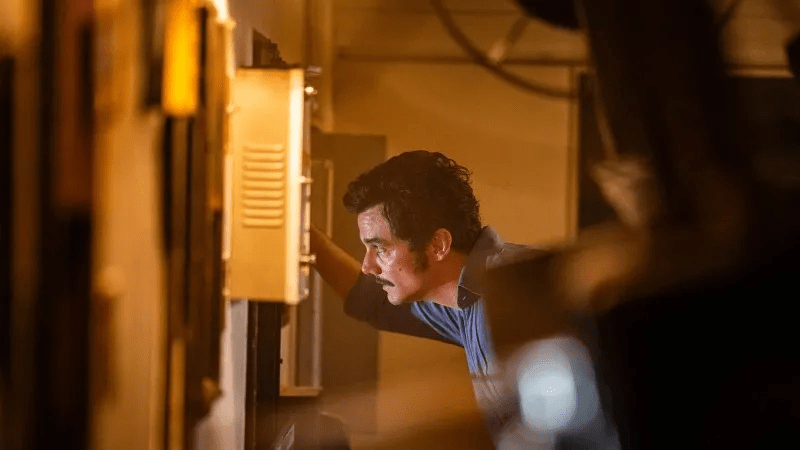
  • After all, it is a worthwhile question. The movie otherwise faithfully and palpably recreates the Brazil of the late ‘70s through its locations-based production, set design, music selection, color palette, and so on. The filmmaking on display here is also clearly indebted to those who were working contemporaneously to the events depicted onscreen. The audience can easily identify traces of New Hollywood aesthetics: e.g., the “documentary sensibility” of a Friedkin,1 for instance, the split diopters of a De Palma, the recurring allusions to Spielberg’s Jaws. Thus, The Secret Agent (2025, Kleber Mendonça Filho) employs devices and conventions that can be traced to a particular moment of film history (or of history on film), but nonetheless commits to a digital imaging system, a digital aesthetic. As a result, the film produces an almost uncanny effect, a disjointedness in the form itself—vintage Panavision B series anamorphic lenses mounted to the self-professed “gold standard of digital cinematography,” the ARRI Alexa 35.2 So, why—ultimately—the refusal of the analog medium? For anyone who may have asked themselves this question, the curious and the purists alike, the film provides an answer within its very structure.

    After the first cut to the present day—halting, accelerating beyond the flow of Recife 1977—the audience becomes aware that this story is being constructed in a sort of historical mind’s eye via cinematic language: that is, it is being told from the vantage of now from an objective, impersonal observer—almost half a century later. This is what the film itself is. The Secret Agent is a fictional story being metafictionally constructed, calling attention to its status as mass media object (one about narrative mass media as social-political-cultural memory), to its status as constructed images about the construction of images. And so, the first image of this interlude that breaks the established projection of a past spatiotemporality is none other than a smartphone, something so unmistakably belonging to the next—to our century.3 It is only after this image that the new timeline and its new protagonist Flavia (Laura Lufési) can be properly introduced. As a student of history, she researches and sorts through archival materials, listening to tapes and reading newspaper scans from online databases in order to experience and understand the tumultuous “period of great mischief,” finding herself drawn to the story of professor-turned-political-dissident Marcelo/Armando (Wagner Moura). His story, his life and times, are diegetically and industrially created from 2025 Brazil. This is a story of/by/from the present historical moment.

    THE SECRET AGENT, (aka O AGENTE SECRETO), Wagner Moura (right), 2025. © Neon /Courtesy Everett Collection

    However, like Flavia, eventually you have to return the tapes: for the audience and the filmmakers, the artifacts, the borrowed aesthetics of the past. If the first shot of 2025 itself did not clue the viewer in as to why cinematographer Evgenia Alexandrova opted to shoot entirely on digital (electing to merely “[treat] the colors differently on set and in post”),4 then the final sequence in the blood bank certainly brings it all home. Flavia has tracked down the last living relative of this man she has been obsessively researching, Armando’s only child, Fernando, the boy now grown into a middle-aged man, also played by Moura. Flavia gives Fernando, now older than his father ever was by about a decade,—“killed at 43” reads one digitized newspaper caption—a flash drive with audio recording related to his father and the network of political subversives who lived alongside him and tried to aid their flight from the country. Flavia offers the son a digital copy of the father he can no longer remember, despite once being that same boy, who with stars in his eyes, ran up and hugged him, upon his return to Recife. That boy who dreamed of finally getting to live together with his only living parent after the death of his mother—for things to go back to a normal that never was and can never be. The drive, an externalized memory, as it were—a digital re-collection of these moments we have lived through as an audience for the past 140 minutes. (In much the same way, the film is itself a digital re-collection of late ‘70s Brazil.)5 And so, Fernando remembers the first time he finally got to see Jaws, but not his own father, nonetheless the memory of him is still there inside him, emphasized by the dual performance of Moura. A mirror not of space but of time, the film’s political resonance with international audiences—its Oscar noms, the Palme d’Or—no doubt enunciates this fact. As Armando tells Fernando in the nighttime car ride after their reunion, when you think about someone it is like they are still there with you. This sentiment is formalized by the insistence—the intrusion—of digital technologies present in the film(making). And while the digital subsumes (and thus erases according to its exclusions) (recorded) history, this film nonetheless asserts the other side of the dialectic, that is, its capacity to unearth the potentialities of the past snuffed out by the curatorial malfeasance of authoritarian regimes, and then to preserve and disseminate these lost threads of history to the masses: to reiterate the ebbing rhizomatic spirit of the digital world.6 It is how Flavia finds Armando, how she finds Fernando, it is how the audience finds these characters, it is how critics find readers, it is how readers become viewers. Even though the cassettes were forcibly recalled from Flavia due to the reclassification of the sensitivity of their information, she nonetheless makes a copy as a gift, a totem.

    The Secret Agent, like any other movie, first and foremost, is about its own time, the period in which it was created refracted through its cinematography, sound, plot, mise en scene, and editing. The cold sterility of the present—taking place overwhelmingly within the confines of institutions (civic, academic, medical), i.e., monumental records of human society, centers of collective memory—is hyperbolized by the flat, translucent sheen of digital video. Even still, some might then wonder, why not just shoot the past on film and the present on digital? Yet, such a stylistic choice would ultimately undermine the construction of memory and its transformation in the post-digital world for the sake of nostalgic pedanticism and a more robust contrast ratio.7 History has been subsumed into the digital, film as well, the latter revealed only to be no more than a filter to select from a drop-down menu rather than the ontology it was once taken for, flattened into sheer surface and uploaded as freeplaying signifier, ones and zeros to be plugged and chugged at will in the wake of a digitized cinema.

    The digital is irremovably a part of our physiologies, our psychologies, our pathologies; it has supplanted our ability to remember. Thus, it is no mistake that the grown Fernando, now a doctor at a blood bank, agrees (even half-jokingly) to accept Flavia’s request for an interview if only she first donates blood. This is the price she must pay for further information, for that which she has already gathered: with information of her own. It is payment for convening with the dead, no matter if they are digital—to give back life. A testament to the vitality of her living, an offering of such to the fact of the deceased. Blood is like memory. Blood is memory, passed down from generation to generation. It is filial and bodily at the same time it is digitized, now able to be offloaded, backed up into the regime of the digital. So then, both fluid structures of forensic information hold within them all that has happened and all that is to come. Like Flavia’s blood, memory—cinema as such—can be readily drawn, donated, transfused, and passed down into new bodies. According to Armando’s own philosophy, he is now with(in) Flavia after all the time she has spent getting to “know” him. After handing the drive over to Fernando, he can now be with him too, now able to refigure a mental image of the father lost to him, murdered at the hands of the state. This young orphaned boy, now an older man, can fuse the limited recollections of his father with the recordings, the scans, the photographs contained on that little thumb drive.

    They don’t call it the digital for nothing.

    Sangue por sangue.


    1. https://www.indiewire.com/features/craft/the-secret-agent-cinematography-interview-making-of-1235161345. ↩︎
    2. https://www.arri.com/en/camera-systems/cameras/legacy-camera-systems/alexa-35. ↩︎
    3. The phone sits face up on the desk with its display powered on, prominently displaying the time, further signaling that the plot’s jump in time is mediated through digital technologies—the smartphone at once an increasingly sophisticated piece of imaging and networking capabilities, a signifier of seemingly limitless interconnectivity across time and space. Time is told through technology. ↩︎
    4. https://www.indiewire.com/features/craft/the-secret-agent-cinematography-interview-making-of-1235161345. ↩︎
    5. This movie is shot with digital camera sensors that convert image data via light into binary code. Most films about the medium itself tend to explore the indexicality of the filmic apparatus, but The Secret Agent does so with the digital, treating it with the same amount of gravitas and respect. Flavia giving Fernando the drive full of digital files copied from increasingly inaccessible locations microcosmically sums up the entire film. The images we have been watching, according to the diegetic world and the production of the film, were generated by an omniscient digital extremity turning abstract code into a legible document. The film is explicit in maintaining this is not the movie in the mind of Flavia, although she would certainly have her own imaginings that might align with what we see onscreen, but rather from the technologies she uses themselves. ↩︎
    6. The Hairy Leg scene also testifies to the subversive role of mass media under circumstances of state-sanctioned violence against the most vulnerable groups of society. For more on the history of this local legend, in which a Recife journalist deployed the recurring figure of the Hairy Leg as a means to bypass state censorship in order to report on the homophobic violence of the military police, read this article. ↩︎
    7. Hinting here at an entirely different conversation on the aesthetics of film versus video, and the limitations of a digital cinema that desperately and poorly imitates its filmic predecessor, Alex Bailey takes the words right out of my mouth with his stellar essay, “The Future of Film Is Texture.” ↩︎
    , ,
  • A ROMANCE for the Ages

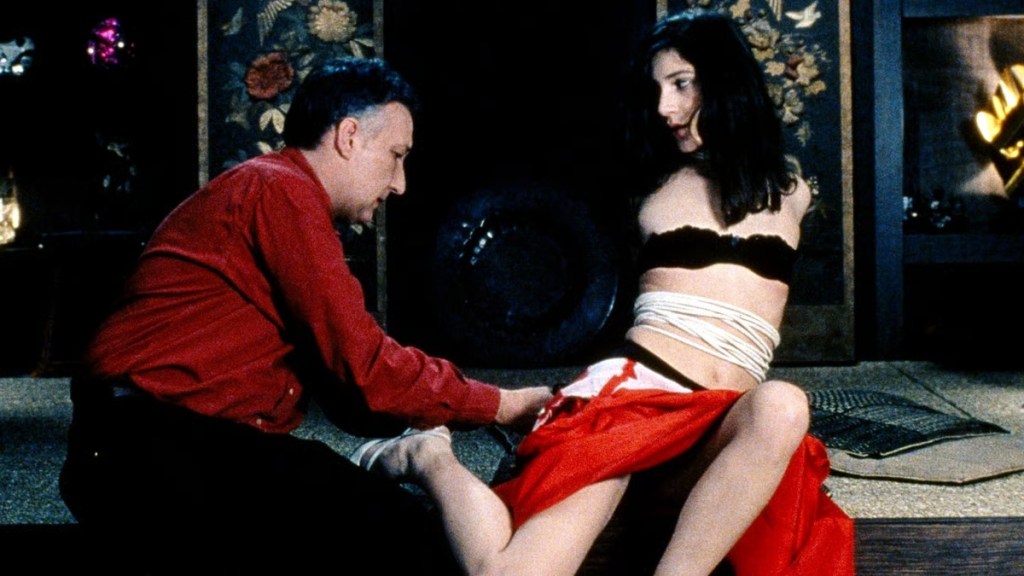
    She looks older than she really is; the thumbnail for Catherine Breillat’s Romance belies the age of its actress. One expects a more mature woman upon starting the film, only to be met with the glaringly naturalistic youth of its star, Caroline Ducey as Marie. At a distance and on first glance, one would not be remiss in assuming her to be a woman approaching her middle years. Perhaps, the mixup of this painterly frame begins with mise en scène. Marie, a sexually frustrated schoolteacher exploring the misogynistic violence at the core of (her) sexuality and the seeming biological impossibility of heterosexual love, looks down on an older man (François Berléand), grasping at the red dress pulled down around her waist. The graying of his temples, the trendy lavishness of the apartment, and his unremarkable, buttoned-up appearance contextualize the still, imparting authority by association onto the disrobed woman. Her brushed-out dark hair falls down her chest and shoulders, obscuring her profile and lending an air of mystique to her femininity. In time, when the film itself arrives at this moment, the viewer has already been confronted with and acquainted to the stark dialectic that comprises Marie’s character: at once, the ability to be the juvenile, naïve young adult continually wading into ever deeper and treacherous sexual waters as well as the most levelheaded, intelligent, and self-aware person onscreen at any given moment, making the sadomasochistic dynamic with that same man, her school’s headmaster, all the more complex and unsettling. It is like meeting someone for the first time, that first impression that quickly melts away and is not ever forgotten but is never felt again, never to color the object of a gaze henceforth. In that respect, it is no different than meeting any other person really.

    Ducey was in fact only 21 or 22 at the time of the film’s shooting, a film in which she takes a husband and bears a child. Did everyone’s parents convey that innocence, look that babyfaced, and act that impulsively when it was there time to bring children into this world? It has been assumed for some time now that it was the internet that, in its all-encompassing digital flattening of the historical and the social, bulldozed age along with everything else. The salaryman at his corporate email job, opening and closing a secret second window to some social media feed is the same as the student in the back of class scrolling on the hidden phone that nests between their legs. Online the two are allowed to rendezvous, an unspoken May-December affair. They meet together in secret and unbeknownst to each other—not even thinking to be known in the first place—to consummate the secret of the secret in itself, as it were. In the anonymizing embrace of the devouring Mother, all is accelerated or regressed back to an enforced and eternal pubessence. As a result of their shared language and expression, the salaryman and the student by default presume a mirror on the other side of lightning-fast connection that delivers their comments and communiqués before the gaze of the other through space and time. It is a portal between two screens that we mistake for a mirror. Maybe only unfortunate as opposed to incorrect. We have become one and the same, or as the misleading appearance of Miss Ducey suggests, loose strands of hair always fallen across her unblemished face even as she elegantly dons chic designer wear, perhaps this is the way things have always been. Children beget children.

    ,
  • In the apocalyptic world of Greenland: Migration, family is all about sacrifice. Family is everything and everything must be sacrificed to ensure its continuation. In Ric Roman Waugh’s sequel to 2020’s Greenland, family man John Garrity leads a band of survivors after the destruction of Greenland Station on an expedition to a scientifically anomalous paradise in a crater somewhere in the south of France, where the possibility of life reflourishing might still exist. As it turns out, this international trek across oceans and land masses ends up being little more than the single-minded effort of one father to secure the future of his family. Throughout the film, the entire cast of side characters that offer to help John, wife Allison, and son Nathan ironically all die in the wake of this family’s mission. Rather, everything in their wake gets destroyed, whether by soldiers, marauders, tsunamis, electromagnetic storms, or earthquakes, but always managing themselves to escape in the nick of time. Even institutions themselves—science, the democratic process, bureaucracy, the military, other families—are sacrificed on the altar of the American nuclear family.

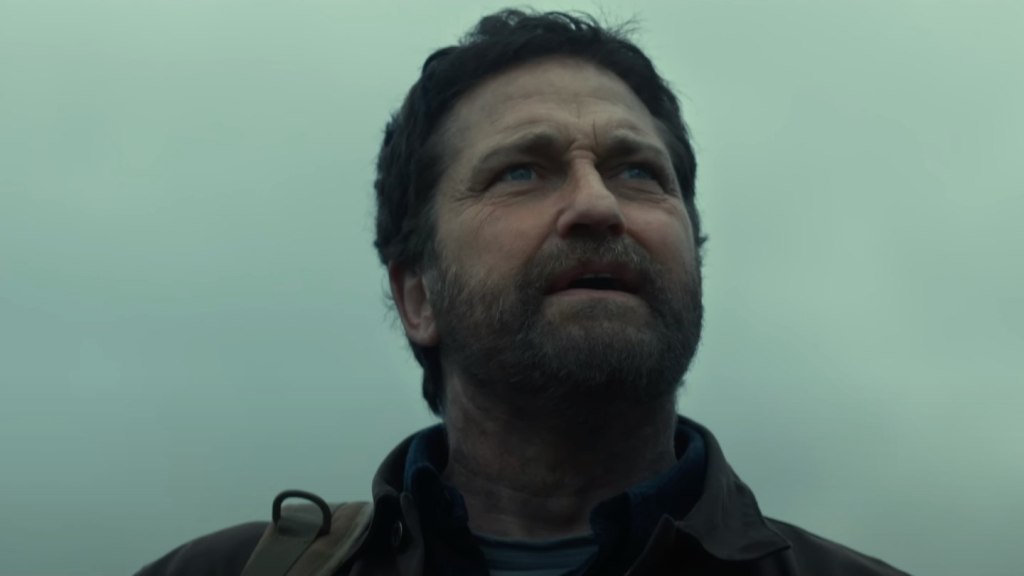
    John (played here with a convincing nuance by Gerard Butler), as established in the previous installment, is a successful structural engineer who is selected by the U.S. federal government to relocate with his family to an emergency shelter before the initial impact of fragments from the deadly comet, Clarke. Throughout the course of that film, the Garritys lose everything that John worked so hard to provide them. And so, with the loss of their suburban home and upper-middle class lifestyle, this John does whatever it takes to keep his family alive while the John of Greenland 2 does whatever it takes to reunite his family with all that they lost five years ago. Put simply, surviving versus thriving. Greenland 2 most obviously speaks to a generation of children who grew up socially isolated as a result of the coronavirus pandemic, but also to the fathers of these kids who see that what they were once able to build for themselves and their families is no longer obtainable for their kin. To add, the radiation sickness that John hides from Allison and Nathan adds dramatic weight to this fact: yet another emotional burden that the traditional family man must bear for those he promises to love and defend. It seems that only in the aftermath of a world-ending event like Clarke is it possible to imagine a young person living a life as materially secure and fulfilling as their parents’.

    There is however one notable exception to the rule dictating death behind the trail of the Garrity family. After reaching Calais, the Garritys are taken in by a Frenchman, Denis Laurent, and his family, Camille, a daughter Nathan’s age, and a mute, wheelchair-bound wife. Despite their kindness and generous accommodations, the dying John is determined still to travel to the crater, this new Fertile Crescent, just for a rumor’s chance at a new life for his wife and son. Thus, Denis begs John to take his daughter with them, to accept her into his American nuclear family—ostensibly the only surviving relic of the old world that can withstand the shocks of Armageddon. This plea is the chance Denis takes for the continuation of his family; therefore, he remains unharmed by the wave of catastrophe hot on the trail of the Garritys, as he offers them a sacrifice in the form of his daughter, who is likely to form a romantic pair with John’s teenage son.

    But for all this, the price must be paid. For all the sacrifices made for the future of his family, John must forfeit his life. The father must die. In the final minutes of Migration, John drifts into a peaceful sleep, having sustained a fatal gunshot wound protecting his loved ones but nevertheless delivering them to the summit of the crater’s paradise. Nathan, having earlier demonstrated skepticism toward heavenly salvation and religious ritual, kneels over the body of his father and wishes his soul safe passage in death. The overhead camera soars upward before fading to black, John rewarded with respite for a job well done. Yet, the work is not done. Over the final images of civilization reborn, John becomes a disembodied guiding voice(over) to the viewer speaking directly to them. God the Father and faith itself will continue to shepherd humanity in this next phase of its evolution. John the Father urges mankind that it is not too late to treat the planet and each other more justly, concluding the film on an optimistic note in an otherwise grounded look at the disappearance of the future, in this case, via environmental collapse. Therefore, Waugh settles his film, narratively and tonally, in opposition to other such works, for example, the speculative apocalyptic nightmare of Threads (1984, Mick Jackson). Does the family unit as we understand and abide by it have no place in the future? It seems to be but one element that will lead to our destruction while also being our salvation.

    ,
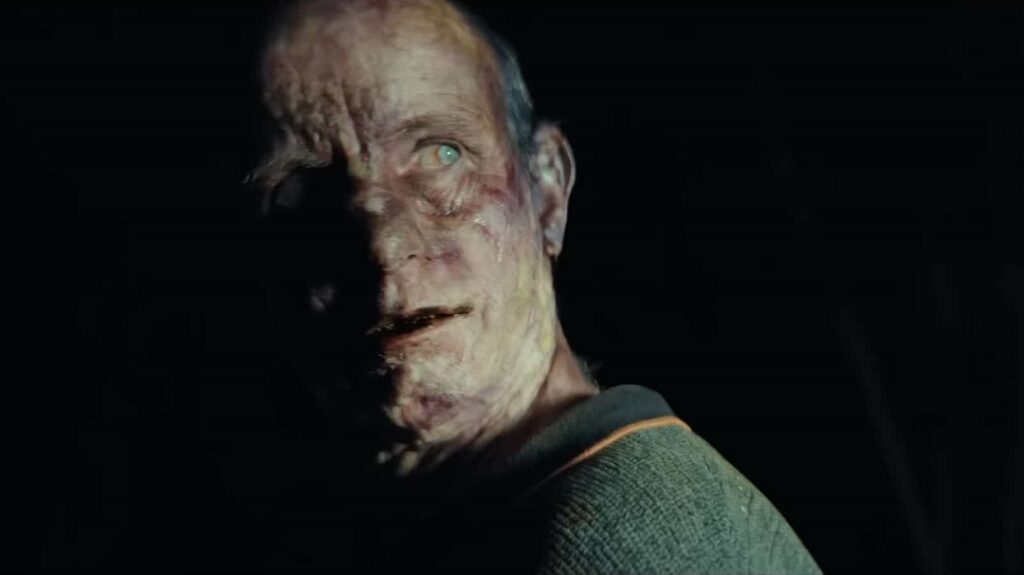
  • We Bury the Dead (dir. Zak Hilditch) happened to be the first in a long list of January genre releases (Mercy, Primate, 28 Years Later: The Bone Temple, Send Help, Shelter, Greenland 2: Migration) that I was looking forward to this new year. Easily the most memorable, touching scene of this unexpectedly quiet, tender zombie film occurs before American disaster relief volunteer Ava (Daisy Ridley) sets out on the final leg of her journey. The purpose of which—to travel to a seaside Tasmanian resort to locate and retrieve the possibly reanimated corpse of her late husband, his uncertain resurrection the result of an experimental American bio-weapon that halted the brain activity of every living thing within its fallout radius via electromagnetic signals. In her final night before her last day on the road headed south, Ava finds a Winnebago Leisure Seeker to hole up in for the night, carefully removing the brain-dead family of four and laying their bodies outside the camper door. In the middle of the night, she hears the reactivation of one of these corpses, and much to the vocal dismay of everyone in the theater, she goes out to investigate. On opposite sides of the residential vehicle, Ava prepares to dispatch the unwelcome visitor. She rounds the corner and the tension is cut. It is the father, wielding a shovel and digging a grave for the unanimated bodies of his family. He turns to Ava with a hauntingly blank, thousand-yard stare and then moves to continue his work.

    The singular-minded heroine finds herself at this intersection with the dead after having only narrowly escaped the predatorily nostalgic demands of the strungout, isolated armyman Riley. After dressing up as his late wife and agreeing to give him just one dance in exchange for safe passage to the Enso Resort, Ava discovers the decomposing body of Riley’s very pregnant wife. It is here that we are explicitly introduced to the principle of “unfinished business,” as until this point it is proposed that only a random selection of the dead are able to regain their basic motor skills. However, according to Riley, it is only the ones with unfinished business that are permitted once more to walk the earth, waiting for his wife to return to him with their unborn child.

    And so, it is the father that is chosen to perform a sort of last rites and lay his family to rest. But why is that? It seems as if his role as patriarch demands he is the one to return rather than the mother or one of the children, as if his social obligation within the family unit has informed his very biology ostenibly detached from any memory or emotion. The societal burden of your determined (and here, gendered) role stays with you in death. Is it perhaps pure affect, acting according to an unidentifiable pre-subjective social/ontological impulse? This inexplicable resurrection raises several complicating questions: why was the father the one to be resurrected? what did he do or fail to do in life that meant he had unfinished business in death? how aware is he of his actions in his undead state? why did he come back only after they were all removed from the RV? did the RV function as a sort of collective tomb that was then disturbed by Ava seeking refuge for the night? and what about all those that came before? Up to this point, the audience via Ava have only ever seen the reanimated quickly dispatched by the Australian army. The revelation of unfinished business and the resurrection of the father recontextualizes all the resurrections that We Bury the Dead handles with a careful, evasive hand. (It is the entire movie that is handled in this way, whether hiding its budget in several economical cuts to a wide, or a tightened frame restricting from view what is now only heard.)

    In fact, this is the first time that we see someone physically burying anyone. It is only earlier in the film during the first door-to-door body retrieval parties that we see bodies being buried, not by people though, but by machines: bulldozers in the far background dumping mountains of bodies into mass graves. At this point, Ava is still far removed [literally, in the foreground talking to fellow volunteer Clay (Brenton Thwaites)] from the disposal of the dead, and although she is getting closer to meeting it, it is still somewhat of an abstraction to her. Likewise, when the smoke signals are pulled to alert the military forces to the walking dead, the audience is never afforded a look at the killshot, only the ring of a gunshot and the flash of a muzzle from a distance. It is the undead burying the undead that teaches Ava how to make the closure she needs for herself for when the time soon comes to face her husband. We have forgotten how to bury our dead, necessitating the dead come back to life to teach us how again. The father fulfilling his final duty as man of the house—with the help of this stranger from the living, no less obligated to her beloved—kneels silently and bows his head, turned away, on the far side of his completed makeshift family plot. The camera tilts up to frame Ava behind him on the other side of the opened earth, taking the shovel and raising it slowly above her head. She strikes the resigned man over the head and he falls into the ground. It is not merely paterfamilias, but the Protestant work ethic that follows a man into the land of the dead, Hilditch asserting the uncomfortable matter of fact that “a man must break his back to earn his day of leisure.” The political becomes the social becomes the biological becomes the ontological.

    The conclusion of this film further affirms the above point in tandem with the principle of unfinished business. Driving back from the resort in Woodside, Ava (now reunited with Clay, presumed to have been dispatched earlier by the shady soldier) encounters once more the deceased expecting mother. Standing in the middle of the road, her baby bump gone, a bloody stain left in its place on her nightgown. A child can be heard crying not too far from the road. It was the mother’s unfinished business to not only give birth to this healthy, living child, but to find a home to care for it. In this case, it is to be “adopted” by a hetero-platonic pairing of a infertile widow who cheated on her now dead (and also unfaithful) husband and a man whose wife and child have removed themselves from his life, better off without him as it were. We Bury the Dead in its unexpectedly matter-of-fact affirmation of the social-biological-ontological continuum subverts then suggests a reconciliation (as renewal of/via friendship) of the family unit amidst the ruins of a cottage on the side of a deserted roadway, for the sake of this unnamed, ungendered life, for the sake of all things future and past.


    But, in this world, can things ever be past? The digital brings everyone and everything that ever was back to life, into your life. They must be buried or we will be overrun. The digital, defying death in its insatiable zombification of the world-historical into sequential bits of discrete data, is thus itself encoded with death and vice versa. In We Bury the Dead, the dead walking is vaguely but expressly tied to digital communications technologies. After all, it is electromagnetic signals that essentially fry everyone’s brains, but not only that, more importantly, this information is disseminated via the only instance of digital technology in the entire film—a seatback television screen on the flight to Tasmania. It is in this introductory scene that death, the digital, and the photographic converge explicitly and inform the rest of the film, as the woman next to Ava fingers a locket’s photograph of her own lost relation. She remarks that she hopes it is true what they say, that it was a peaceful and painless blink into sleep.

    Once in Tasmania, the volunteers, turning over their devices to the military before breaking into house after house in their mission to recover the dead (death itself?), are forced to reckon with overwhelming quiet but also intimate human contact—with the living and, more importantly here, the dead—without the mediating hand of the very forces that turn us into the braindead. It is the ever-modernizing world’s treatment of death (see Geoffrey Gorer’s “The Pornography of Death”) that characterizes the end of life as something simultaneously to consume for ecstatic pleasure and censor according to the puritanical mores of a repressed society; to dismiss and obsess over. And so, the camera that lingers on the artifacts of dead strangers, practically yearning to extract from these images some clue into their abruptly ended lives is not incompatible with that same society that would rally an international cooperative effort to quickly terminate and dispose of the (un)dead without hesitation or question. Yet, like the invasive gaze offered and encouraged us by social media and lives lived online, the audience through the eyes of Ava are permitted to enter these private domestic spaces of the deceased, the camera lingering on photographs of people who are just around the corner, waiting in the next room to be buried.

    ,
  • A Steam Room of Troubles

    There is no escape, there is simply the
    given, and there is nothing that we can do.
    —Harold Bloom, “Interview,” Diacritics

    Throw your soldiers into positions whence
    there is no escape, and they will prefer
    death to flight. If they will face death, there
    is nothing they may not achieve.
    —Sun Tzu, The Art of War

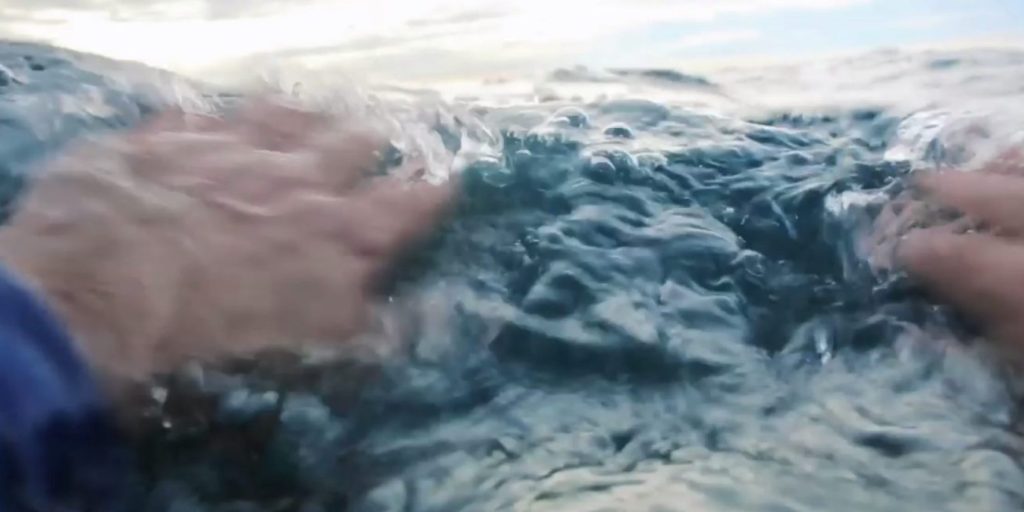
    I cannot break my months-long fixation with the metaphor of drowning. I notice it, more than ever now, everywhere. It started up once again this time with another fascination: monasticism, or rather the men themselves who were individually and obsessionally committed to it. (What is the place of/for the ascetic in the modern world, if there is any at all?) These two forces coalesced before me in Thomas Merton’s The Wisdom of the Desert, wherein the writer-monk posits that the Desert Fathers—the fourth century ascetics who turned their backs on the realm of the social and walked into the same deserts that propagated the earliest known human civilizations in order to live a life of solitude in the ruins of these empires—opted to “swim for [their lives] in an apparently irrational void.” And for this, Merton lauds them, gently urging his reader to follow in the footsteps (although not quite literally) of these humble Christian forefathers. It would seem that he proposes we willingly accept that going-under feeling (an existential impulse in search of an “‘anarchic’ desert ideal” not entirely divorced from Camus’s train of thought previously referenced) as he celebrates a “leap into the void,” the detachment of oneself from ego, although in surrender to and devotion toward God. Thus, according to The Wisdom of the Desert, this frustratingly slippery answer to the question of drowning cannot be an intellectual one but rather only and wholly a personal, spiritual one. Therefore, he proposes an individualistic solution to a collective social dilemma, which no matter how appealing or personally helpful (and I do find his reflections to have made a beneficial impact in my own thinking), I cannot find satisfactory. So, the fixation remains.

    But for all this talk of the desert, one’s entry into almost all Christian denominations is heralded by christening, baptism, that is, by some submersion of the mortal body in water; this ritual not only undergone for the purposes of initiation but even more so a necessary component of the salvation doctrine. Put plainly by Geoffrey Bromiley in the Theological Dictionary of the New Testament, “[t]he goal of baptism is eternal life.” To add, the act is itself a symbolic conquering of the primary primal(/mammal) fear. It is the very defiance of drowning that inducts one officially into the embrace of God’s undying love. It is no coincidence that the biblical Greek text employs the verb báptō, denoting several water-related actions, namely, “to dip,” “to immerse,” “to bathe,” and “to drown.” However, it is only baptism if you can manage to get out of the water.

    Suffocating in my own snot for the past two months, my body produces this mucus for its own defense against some unknown foreign contaminant. The sickness comes in waves, off and on again. The only recourse, especially when the inability to breathe renders sleep improbable, seems to be the image, to submerge my chills and body aches in hyper-consumptive normality, one shimmering spectacle immediately followed by another with no time to come up for air.

    To allow just one breath of their flows into your system causes your airway to seal itself as to prevent the entry of anything further into your lungs, your body essentially asphyxiating itself. The spasmed voice box eventually fatigues, releasing its dam and allowing fluid to flow freely into your airways post loss of consciousness. Laryngospasm and aspiration, as described, comprise the most common mechanism of drowning. Aspiration, “when something that’s supposed to be in your stomach . . . gets into your airways,” as Cleveland Clinic puts it; on the other hand, aspiration, as in the object of one’s dreams or desires, a goal or ideal to strive toward. The confusion of consumption with respiration in combination with the connotation of aiming toward a yet-unrealized future spells out the exhausting stalemate of the contemporary dilemma of drowning. Much has already been said of the collective inability to imagine a future that is not worse than that dictated by our current downard spiral trajectory. And so, consumption is the new respiration, having effectively replaced it to where it is no longer possible to imagine life without this ubiquitized, digitized, convenient version of it. (Note how false prophets who extol such solutions as the “dumb phone” or call for the resurgence of pre-streaming technologies all must look backward: this is precisely not imagination, this is nostalgia and self-help guruism.) We have nothing left to aspire to.

    When the sickness washes out with the tide (and like any tide, only temporarily), I have to reckon with the consequences of this gross submersion: not the endless coughing to remove the excess phlegm from my nasal and escophagal passages, but the new habit I have picked up over and over again, the one that nobody can seem to kick for good.

    “Modern life is a sea of images”: this is how Camille Paglia establishes her historical tracing of Western art in her 2012 book, Glittering Images, with the very first line. Paglia believes us, especially children, to be dangerously flooded with overstimulating digitized distractions, proposing “self-education in art” as the salve to ease our detiorating socio-politico-cultural landscape and turn back our declining attention spans, seductively worded with plenty of aqueous metaphors. Again, I do not even necessarily disagree, but find this answer ultimately unable to grapple with the phenomenology of drowning on the basis of its do-it-yourself, individualist stance, an iconoclastic one that is informed by Paglia’s personal brand of libertarian feminism. Is there nothing outside ourselves that can save us from this boundless, mesmerizing sea?

    It was not until I took my first visit to a bathhouse that I gained some insight, or at least anecdotal experience, regarding the implications of a contemporaneity figured in a constant state of drowning. Sitting in the warm caress of an 118-degree steam walk-in, I first noticed changes in my breathing within a few minutes. My ability to inhale oxygen felt dampened, my breathing shallow. Attention moves solely to breathing, as you force deep breaths in and out in spite of the oppressively humid atmosphere. You find it is not impossible, only requiring more effort and focus as you readjust to the new climate. As the hot water pours into the bucket on the floor and fills the tile chamber with water vapor, you retreat further into yourself, losing sight of the other bathers sitting only several feet in front of you. To not lose your cool, to resist the panicky feeling of drowning, it is almost as if you are actively required to continually and wholly center your own bodily experience. Then, in a moment, you begin to think about every single bead of water on your body, the sweat being pulled out of every pore, until you feel every little thing with exacting acuity. Behind a cloudy visual field, your body and the environment begin to merge in your mind. Is this particular drop of liquid rolling down my back from the room or from me, condensation or perspiration? The air begins to clear, the fog slowly dissipating but never disappearing; the hissing, boiling water from the faucet into an overflowing bucket runs slower but never gets cold. The collective comes back into frame in the breathing room, where one can once again see and hear the reassuring dissonance of others’ labored breathing. The site of arduous labor and pointed focus returns momentarily to a site of communal recovery and socialization. When all is said and done, for lack of a better word, it feels like microdosing drowning.

    “Hence baptism has no purely external efficacy and in itself is unimportant,” writes Bromiley. Much like the lack of a unified scientific consensus on the positive health benefits of heat immersion, the purpose of the steam bath is more appealing as an internal exercise, a test of will not wholly unlike the retreat of the ascetics into the desert. (It is no coinicidence that it is cultures outside of or adjacent to the Occident that tout the physiological/psychological benefits.) Nonetheless, not a discredit to its potential as therapeutic practice, forcing oneself to reckon with the sensation of drowning in a controlled environment. Yet, to further reiterate, drowning seems particularly unaccomodating to solutions of intellectual- or spiritualization, at least in terms of a large scale, collective response against its imposition on every human tendency toward life (if that is something even worth looking for).

    All that being said, as my avocational trip into the mist reminded me, there is no building a tolerance to drowning. At the end of the day, drowning is simply drowning. It is a metaphor that has haunted the greatest dramatic minds and works of the Western world. In Shakespeare’s magnum opus, the eponymous prince of Denmark for all his courtly brilliance, like the very playwright behind his words, could not remedy the drowning problem. In the most famous verse ever written in the English language, Hamlet asks, “Whether ’tis nobler in the mind to suffer // The slings and arrows of outrageous fortune, // Or to take arms against a sea of troubles, // And by opposing end them.” It always comes back to the same binary choice: kill yourself or suffer. Shakespeare explicitly ties the deathly option with water, worded as if double entendre, invoking warfare against “a sea of troubles” and the physical action of swimming, that is, “tak[ing] arms against” the determined direction of a most powerful current. “To take arms against a sea of troubles” is to “swim for one’s life in an apparently irrational void” is to tread water until exhausted strength drags under an unwilling body. And so, there really is no choice in the matter at all: it is always and simply, suffer and then die. Therefore, it would seem that the question of drowning is no question at all, but an indispensable fact of human existence: that is, that the human condition is the condition of drowning. Yet, we insist on creating for ourselves infinite petites morts—little drownings, figurative ones, ontologically pharmakonic—to avoid facing la grande noyade.

    In his science fiction novel, The Futurological Congress, Stanisław Lem differentiates between the two drownings. Throughout these passages taken from the memoirs of the fictional Ijon Tichy, Lem’s absurd man experiences hallucinatory breakdown after hallucinatory breakdown of an eccentric future world that itself already resembles a psychoactive drug-induced hallucination. As Tichy succumbs to the dissolution of his reality, he is transported into other illusory ones, sometimes even residing within them for extended periods of time, like the alternative lifetimes lived by those under the influence of a salvia trip. The world of this novel and the starting point reality of Tichy is one already heavily medi(c)ated by a laundry list of hallucinogenic drugs with any single expectant emotion existing in dosage form. Before his Dantesque descent into the bowels beneath his reality (literally as he takes refuge from a terrorist attack in the sewers), Tichy mistakenly drinks the tap water at the hotel hosting the conference. As a result, he accidentally acquaints himself firsthand with the psychotropic effects of benignimizers, a class of mind-altering substances that do exactly what it sounds like:

    Every analytical reflex was as if submerged in thick syrup, wrapped and smothered in a porridge of self-satisfaction, all dripping with the honey of idiotic optimism; my soul seemed to sink into the sweetest of oozes, like drowning in rosebuds and chocolate icing.

    It is here that the reader encounters the only instance of the word “drowning” in the entire novel, in a novel that bombards the reader with an overstimulating overabudance of absurd scenarios, characters, and visual images, in addition to its motif of water, especially submersion. It is worth highlighting that the only form of the verb “to drown” is conjugated in the present continuous tense here and, more importantly, presented as a simile. After Tichy’s persistent trips into alternate realities and consciousnesses, he awakens, as if from a dream, from these altered states when he rolls over into the waste water beneath the Costa Rica Hilton.

    In the non-place of the Hilton, after enduring the effects of the drug-laced water, he remembers he was not seen anyone drink any water. This is a future where just about everything except water is consumed. If someone is thirsty during the Futurological Congress, “they would have a coke, or a schweppes,” always something prepackaged and for sale. Perhaps in this avoidance of the nectar of life, the inhabitants of this funhouse mirror world have drowned out their fear of drowning, and as a result, their connection to its life-giving properties. It is precisely this interaction with that insurmountable animal impulse within all humanity that snaps Tichy back to “reality” one last time, finding himself once more fallen into the “stinking, blessed waters closing over [his] head . . . choking on the foul swill, but happy, happy!” Here, Lem expresses the necessity for contact with the threat of “real” drowning as opposed to the “false” drowning of addiction and self-medication but also, even more so, psychiatry and overmedicalization. Realizing that he has finally made it to the second day of the convention, Tichy laughs uncontrollably, startling one of his colleagues who drops the manuscript he is fussing over. The document falls into the dark water, “float[ing] away—off into the unknown future.” Here, Lem concludes his work on an uncertain yet contently fatalistic note, and working within a genre that conjures the present in its vision of imagined futurity, does not pretend to hold the answers.

    I do not feel so bad if even the greatest English dramatist in his finest poetic hour or the most widely read science fiction writer channeling Aldous Huxley could not write us beyond this fatalistic condition. I can accept that and it. I do not believe any one can pull us out, for life is sin. You pay for the mistakes of the past with your advancing age. Your bones creak from the abuses of adolescence. Your relationships all mirror those that came before you. That which was done unfortunately unto you, you will unfortunately do unto others. Everything that has been done has already been paid for, someone has already picked up the tab. We are fallen, and the water is rising. If history has proven anything it is that the world will keep ending for generations to come. Memento mori ad infinitum. There is no reversing it, despite the feeble protestations of those suggesting lofty, impossible radical (re)turns, to some manner of means by which we used to or ought to be conducting ourselves. I cannot go back. I have no memory. We can never afford to go back, to pay back. Everything that has ever happened is right here with/in/out us. Full steam ahead.

    , , ,
  • Drowning? Enter the Net

    I’m already drowning again. I still have no clue what to do about it. It’s such a beyond trite observation at this point, but it is too much for any one person to have access to the entire wealth of the world’s knowledge without so much as a second thought toward the matter. The Library of Alexandria beaming its binary-coded information into your skull, absorbed unblinkingly. Only this time the library can seemingly never burn, and perhaps, we are all the worse for it. The accumulation of knowledge for the sake of itself. There can be no love of wisdom if we can never experience the risk of losing it all for good. Now, one source may just get washed away in a boundless sea of others until it all becomes too much to tread. The Library of Alexandria, and a house of ill repute; it is as if the greatest monument to human thought also had the best bathrooms for cruising, with the most popular peep shows in town. That’s what the internet is. Ready-to-hand access to any and all information, the ability to have just about any person you could ever desire, naked and performing, for you. Choose Your Own Adventure and Build-a-Harem. Equal parts Demetrius of Phalerum and Hugh Hefner. The tree of knowledge and the forbidden fruit.

    Decades ago, one was forced to visit physical places to access either, forced to interact with other people to temporarily acquire that which they sought. You had to research, you had to peruse, you had to risk—trial and error. I’m not being nostalgic—and frankly, I wasn’t alive or old enough to enjoy the heyday of library archives or adult video arcades, restroom glory holes, or what have you—but, this purgatory we find ourselves in now just cannot be sustained, at least not by the human. It’s simply not tenable. I so desperately want to find a way, or rather a more interesting answer to the question, “what should we do?,” then simply walking away from it all, electing against every impulse to take no part in it. Aside from the fact this option is an impossible one, it is simply not helpful and, worst of all, hopelessly boring. Everyone already knows it. However, what is possibly the alternative? All things in moderation? There is no moderation. Our economy (although having undergone horrifying Gigerian transformations in the last century, let alone the last decade or two) has never run on such a principle, so we cannot either, especially not now. The powers that be need us more than ever to exist without temperance or taste. So, it seems it is a question of how do we navigate endless surplus and advertisement.

    What’s the only other option? Kill yourself? Get a lobotomy? Give up on everything until you are homeless and starving? While noble in a Bartlebian sense, it’s only a proposition appealing to the living, romanticizing the mere thought experiment or justifying the bitter end of some sad sap who was willing to do what it takes but thankfully was not us. All for some sort of intellectual edge? No! What can I do right now? Everything seared into my head by the digital bibliotheca/bordello is designed to make me feel inferior. I don’t think any modern innovation captures both of these binary oppositions into one form more than the dating app. The left/right swipe feature mimics the simulation of page-turning from print media, then coupled with the neverending stream of seductive images and promising prospects. It always comes back to the buying and selling of potential, alternative, better futures. A product, solely designed to extract as much money/time from you as possible before you kill yourself; for those who don’t spend, less success is owed them and likely all the more reason to end it.

    If it didn’t feel like drowning, it’d be significantly easier to let go, to sink and be forgotten; however, modern man has in him still that innate fear of drowning and the primal refusal of the horrible death it brings. A man’s gotta make a splash, as it were. It is in response to a life lived in a constant fluid state of alienated hyperarousal (fight-or-flight): a maelstrom of paranoia, self-loathing, distrust, obsession, brain fog, powerlessness. I want to do something that doesn’t just feel like staying afloat for a few more breaths before the inevitable. I want to be rescued. I don’t care if I’m the one who has to do it, I just need to know how. I don’t want to do just anything. I only want to do something great. And so, it is bombardment after bombardment of ideas that will go nowhere but notepads. The sinking weight of works unfinished. You know, I, like I am sure many others, make fun of those people who can only fall asleep or eat a meal accompanied by podcasts or let’s-plays or television or music—for fear of forming a single thought—but they’re right. They are right to feel that way. I do not claim to be above them nor do I enjoy ridiculing them. In many respects, I envy them; for I cannot just let go and embrace the new homeostasis.

    At this point, I’m helplessly and juveniley trepidatious when it comes to reading books or essays or watching movies, because like great works should, they inspire some mechanism within me to create something of my own, incorporating that first impulse of an idea—a phrase, a scene, a shot, a truth—into something that does not exist. Yet, they never go anywhere and float helplessly in the water with me, bobbing in the waves of the tide and my own thrashing. Surrounded by this debris, drowning without ever knowing exactly when or what caused the wreck that sent you to your inevitable watery grave. Trying to cling to anything to stay afloat as your biological fail safe kicks in, only serving to push it all farther away or causing it to crack and sink. Put less figuratively, more ideas equal more things not getting done. How can this feeling of inability be channeled into the completion of some project?

    In Albert Camus’s The Fall, the judge-penitent witnesses and does not intervene in the suicide of a woman leaping from a bridge. Yet, it was not necessarily the fall that killed her, but the water below that drowned her. In addition, it was the permission of one man to do nothing that condemned them both to the fall. Similarly, Hito Steyerl in her essay, “In Free Fall: A Thought Experiment on Vertical Perspective,” speaks to the contemporary philosophical dilemma of “groundlessness.” She remarks on the lack of stable ground or horizons on which to plant and align ourselves and our visions, likening this disoriented state to one of constant free fall. In each of their works, Camus and Steyerl assure us that falling, succumbing to its effects, can be liberating, that is, that liberation can be found within the act itself, as well as corruption and apocalypse. At the end of the novel, Camus’s absurd man shuts down, in the final lines, the hypothetical chance to go back and save the woman who jumps. He ridicules the hypothetical offer, smugly but not unjustly refusing to entertain the possibility of an alternative to events already happened: “Brr…! the water is so cold! But let’s reassure ourselves. It’s too late now, it will always be too late. Fortunately!” If the fall can carry with it a freedom, even a freedom to which one is condemned, then can drowning? Wherein lies the intellectual turn here?

    We have collapsed and been flattened into the horizon, it is no longer visible or measurable because we have fallen off the ship and into the water. In her essay, Steyerl proffers the example of J. M. W. Turner’s The Slave Ship (1840) as one artistic expression of the aesthetic/political move from linear perspective toward “one or several other visual paradigms.” The lack of an easily identifiable horizon line disorients the viewer, attention shifts to the drowning slaves, displacing the viewer’s desperate eye, frantic for a visual life raft. There is no vanishing point for your gaze to follow to some determined endpoint, no, only the wreckage of the present historical moment. No longer looking from a linear vantage point, one that implies linear temporality, as we no longer look out at potential futures teleologically promised to us. In his essay, “The Metaphysics of Crackle,” Mark Fisher argues that the repercussions of postmodernity on a broader (white European) culture reflects a similar and previous “temporal disjunction that has been constitutive of the Afrodiasporic experience since Africans were first abducted by slavers and projected from their own lifeworld into the abstract space-time of Capital.” More concisely, black people were the first postmodern people, several centuries before the rest of us were accelerated to this point. We are all drowning now, jagged little images of men surrounded by flesh-hungry sharks with nothing to swim toward and no visible horizon with which to orient ourselves. Herein lies the paradigm of drowning, less visual and more phenomenological.

    So, what is drowning, or more importantly, what does it feel like? Drowning induces panic, fatigue, hopelessness in its victims, with many reporting what most would describe as their life flashing before their eyes, especially regrets, dreams never lived. Then, there is calm as you embrace your fate in the waning moments of consciousness. Total surrender. And so, drowning compels the drowned in their panic to look backward: (1) spatially, to constantly turn about face, hoping against hope for any sign of rescue or refuge, (2) temporally, as your mind retreats into life review for your final moments, and (3) intrusively, for survivors, in the form of post-traumatic flashbacks. Survivors of drowning also report heightened states of euphoria immediately after first inhaling water: “I felt at peace,” “I was looking through a kaleidoscope of pretty colours,” “the most pleasant experience I’ve ever had.” Now, how do we achieve the euphoria of surrendering to death while alive?

    I am afraid there is no exciting, subversive answer to that question, at least not from any of the avenues that have come to inform my thinking. Embrace the absurd, pushing the boulder up the hill eternally? Become an object, living forever as an image? The more I think the more these notions seem like theoretical flights of fancy, no matter how rhetorically or aesthetically alluring to my romantic, critical sensibilities. But really, what on Earth would either of those maxims actually look like in practice? They are certainly seductive ideas, or rather images of ideas, but at this point, I have not the slightest clue how to realistically incorporate them into my life. (Am I not, by trying to live these images in material reality, forgoing the trap of representation (as outlined by Steyerl) in favor of the bountiful possibilities of direct participation in the image?) Alas, I am not an object, as it were, even if I wish so desperately I was (without even really comprehending what that means, rather vaguely, intellectually clinging to whatever that signifies for some sort of disaffected air of superiority). Rather, objects do not concern themselves with drowning. As an object, I would be free to float, or even sink or have already been sunk; it would not matter. An object drowned will simply sink and there it will remain. The object does not struggle in the current, it merely records its flows and violences onto its form, acting as an indexical record. Man is not indifferent to his body swallowed into the horizon, panicking and glimpsing his own struggling hands—hands only trained to consume—in the bobbing expanse of incomprehensible fluid infinity that immediately envelopes him. We cannot hold onto anything.

    Perhaps, the pleasurable kaleidoscope is not some transcendental state where we’ll glimpse our future again, but nothing more than the endless scroll of algorithimic feeding, the relentless swiping of a finger up that sinks you deeper and deeper down into yourself, temporarily forgetting the murky darkness that is always just outside of you. Rather, the object pulls you deeper and deeper into itself, into the image. In this near-death experience, this state of pre-death, one achieves ultimate bliss and capitulation, your brain slowly shutting down. “It was more of a numb feeling than anything. Kind of distant, like I was watching everything unfold from a different perspective, like it wasn’t really me that was experiencing everything. I think my mind was too dulled by panic and fear and exhaustion to really notice any pain at all.” In the struggle to remain afloat, one does not possess the faculties or demeanor to concern oneself with the drowning of others, although we certainly know they are there, just as ultimately helpless. The object has taken its revenge on the subject, revealing us to be, as Thierry de Duve (channeling and translated by Rosalind Krauss) puts it, “thing[s] of absolute narcissism.” Beings fastened unto objects, force fed and chasing escapist, self-destructive, hedonistic desires for some sensation of comfort. Every person screaming out into an inky void of noise, trying to quickly accumulate influence to keep their head above the deep, only and understandably fixated on their own position, unable to lend attention to the thoughts of others helplessly drowning just out of sight and reach. The NSA describes this narcissistic condition rather aptly: “We’re drowning (not waving) in a sea of data.”

    As if looking up at the sun from below the ripples of the ocean surface, I find myself struggling to breach the upper limit of not only my intelligence and will but my imagination. It should be at this point where a more levelheaded and proper theorist would build to the subversive but optimistically contrarian turn. However, I suspect the author never truly believes in their submission to faith in the unrealized radical potential futures of their dissected subject matter; more than anything, it feels like the standard generic convention of critical theory. When will we learn that everything theorized (by McLuhan, by Steyerl, by Haraway, by Hardt and Negri, by Deleuze and Guattari, and on and on) has come to pass in some way or the other but without the political liberation. The future arrived and it is terrifyingly bleak. Thus, I simply cannot extract myself or do not believe in any redemptive opportunity within the phenomenology of drowning. Exponentially rising sea levels, the overwhelming, ever-increasing sea of data, the endless stream of content—our future has been taken underwater. We will have to wait—and not long now—until the drowning become the drowned before we can be reunited with the sunken treasure of our once-future. The only thing left to do: to stop swimming and just get on with it.

    , ,
  • Is There No End for a DREAMER?

    In the closing minutes of Bresson’s second color film and third Dostoyevsky “adaptation,” the usually perambulatory Jacques silently hunches over two partially painted canvases laid across the floor. Earlier in Four Nights of a Dreamer, the viewer catches a glimpse at a couple such paintings that have been more or less finished: large faceless portraits of women defined by bold outlining brushstokes of black uniformly filled with vibrant hues of pure primary and secondary color. The young artist tries to find his ideal woman on the streets of Paris and on the canvases that he leans against the walls or lays across the floor of his studio. Rather, he translates their fleeting forms onto the canvas. As a former colleague from Beaux-Arts tells Jacques, art is about absence, the dual-sided disappearance of the artist and the object. Unable to approach the women who catch his eye and whose eyes he catches, Jacques speaks longingly, poetically of imagined scenarios into his portable tape recorder. In his poetic musings and De Stijl-meets-pop-art portraiture, he removes their features, perhaps unable or unwilling to remember them after his countless failed “attempts” at romantic connection, or perhaps in search of their essence, what they can all be reduced to most essentially, but more than likely this project leads one to his own faint-hearted idealism. This is the impression Jacques offers when Marthe asks for his story, he having just pulled her from the ledge of a suicide attempt over the Seine, having spent one year in wait for a lover who has finally returned from abroad only to ostensibly forget about her. It is as if Bresson took Louis Daguerre’s famous photograph from the Pont Neuf—its panoramic view of the river, the bridges, and the two figures in the foreground, resposing in the shade—as the starting point for his most lovely, sensuous film. Said to be the first photograph taken en plein air and with a visible human figure—and even more, there are two of them. Maybe they are in love, maybe they are not, who is to say.

    Let us step away from the impetus and back toward the end. In this scene before the last drowsy blink of the camera iris, Jacques paints an aural picture, a daydream reunion with Marthe: she will apologize profusely for her having abandoned him on their fourth and final night together in favor of her unnamed lover who passes them during the busy nighttime scene. He wants her to admit her mistake, to suffer “one thousand deaths” for him as a result of her decision, but more than anything else in that moment, he wants to be with her again. He ends his soliloquy, rewinds the tape, leaves the recorder at his bedside, and plays back the words he has just spoken. On the other side of the room, he kneels before his painter’s palette, surrounded by the reverse sides of several large paintings already completed with two primary works in progress situated on either side of him. His inability to focus on one or the other recalls the beginning of his story that first night on the bridge: Jacques spies an attractive woman through a shop window, they look at each other with interested glances, he follows her down the street but never approaches, and when he eventually loses her, another grabs his attention. His back turned to the camera, Jacques mixes yellow tube paint with water, trying to achieve a desired consistency, going back and forth between adding more paste and more water. He cannot seem to find the right balance—or maybe he is simply stalling, putting off the work he knows needs to be done—as with water-miscible oil paint, too much water will cause the paint to not adhere to the material support. He abandons this prolonged effort and turns away from the palette and the right hand’s canvas, twisting his focus toward the other open-faced canvas on the left, where an open red paint can sits between the bent artist and his work. Like the others, it is a portrait of a woman: he has finished most of the coloring on her dress green while the halted progress on her face divides her into two halves—one side, red brushstrokes; the other, blank. Without any need for water, he firmly presses and applies the red liquid onto the black-outlined area just above her expressionless, dichotomized face. The adjoining shapes become conflicting ones through their identical hue, marking a new direction for Jacques’s work, wherein previously no region of one highly saturated color is seen to border another of the same color. Further, in the first flashback at his studio, Jacques gets distracted by the conjurings of his own tape-recorded imagination while at work on a similar portrait; however, this red-skinned model’s hair is already in the stagnated process of becoming yellow. And so, the yellow paint Jacques was fussing over was intended to be the brown-blonde hair of Marthe. (He may have been watering down the paint, as when a water-soluble pigment—if that is what it in fact is—is greatly watered down, it will dry darker. Perhaps, Jacques was trying to recreate the subtleties of Marthe within the preestablished astringency of his minimalist style.) Instead he opts for red, the same unmistakable hue of the scarf he bought for her and lovingly wrapped around her head only moments before she left him alone on the street, for the man she believes herself to love more.

    This is what becomes of the dreamer. Subsisting himself on fantasies from fleeting memories and imagined fancies, he can only think to expel these feelings outward into some great project he is too embarrassed to share with anyone. He sees his dream as “flat and boring,” but he is a slave to it. Jacques will not be able to get Marthe out of his mind until he captures something of her in his art, so that her canvas, her image can be flipped around and leaned against the wall with all the others, but the ideal will still persist and there is only so much room. The floor is filling up and the walls are bare. A man is condemned to dream, to chase his ideal until he is able to impress it into the mind’s of all men.

    , , ,
  • “Hello, YOU”

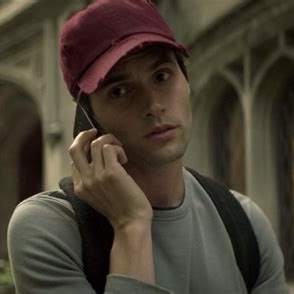
    I’ve found I quite enjoy a thing after everyone already else has. There’s no pressure to like or dislike it; I can take it as it is more or less. I’ve also found that my more snob-like tendencies are becoming a bit too pronounced for my taste, so it seemed about time to bring myself down to earth—away from the rep theaters, away from prestige miniseries, away from the film schoolers—which, as it turns out, delivered me to You. After an impulsive thought to watch a show that first streamed to massive popularity seven years ago, I watched the first four episodes of the first season last night. Maybe it was in part to my remembering the woman who lived in the dorm next to me freshman year of college, who told me I reminded her of Penn Badgley’s obsessive/delusional Joe Goldberg but in a good way. (Does that say more about how weird and offputting I was or her taste in men? Looking back, both claims are certainly valid.) The other half of this impetus likely lies where it always does for me: Steven Shaviro. In one blog post from 2003, he attacks the “high-minded backlash” of what he calls Anti-Harry Potter-ism: more broadly, in this case, the obnoxious, pretentious, classist tendency of academic/intellectual types to decry the actually existing consumptive habits of the average person outside the ivory tower. Anyway, I gotta say, the court of public taste was onto something with this Lifetime/Netflix original series. The premise alone and the complications/contradictions that arise because of it are entertaining and rife with interesting ideas to think over.

    I will have to keep watching the show to see how my thoughts toward it develop, but so far, You (as centered around the lead character, Joe) seems to adopt a bit of that snobbish tone discussed above. However, it takes this stance not toward pop culture media writ large (although it does take its fair share of shots), but toward digital communications technologies—namely, social media. Yet, its attitude is not a hard stanced, uncomplicated one. Joe, the manager of an independent bookstore disavows social media in favor of what he calls the “real thing.” For him, real life is epitomized by books. For example, when Beck asks to know the real Joe in episode four, he takes her into the climate-controlled box in the basement of Mooney’s Bookstore, home to the rare and collectible books (and former prison/murder site to Joe’s first victim in Beck’s ex-lover, Benji). Joe’s anti-technology tone is ironic and hypocritical in his navigation of this dialectic he has unrealistically established, certainly played for laughs all the while complicating his already unreliable narration (in the form of voiceover monologue). The object of his obsession is the unbelievably boring Guinevere Beck (but I feel this actor/character shortcoming only highlights and hyerbolizes Joe’s delusional fantasies). In addition to his usual stalking and breaking and entering, he pickpockets her phone after saving her from an oncoming train. Thanks to the convenience of the cloud and Beck’s poor password protection, Joe receives all her messages in real time, in addition to access to all her log-ins. And so, with the cognitive dissonance that defines his character, Joe nonetheless insists upon his avoidance of social media. The series cleverly depicts the impossibility of being a recluse from the digital, unable to free oneself from the demanding entanglements of network society. Thus, Joe still stays up late stalking potential lovers online, worries about the subtext of a text message, and of course, posts (even if through the Twitter account of the imprisoned/deceased Benji; it’s all the same.) Rather than being unimpeachable or uninvolved due to his reduced digital footprint, Joe is inescapably complicit, in fact, he epitomizes the very lifestyle he postures himself in opposition to. However, on the other hand, according to his status as a force of surveillance via social networking applications, I suppose he really thinks he is above it all.

    ,
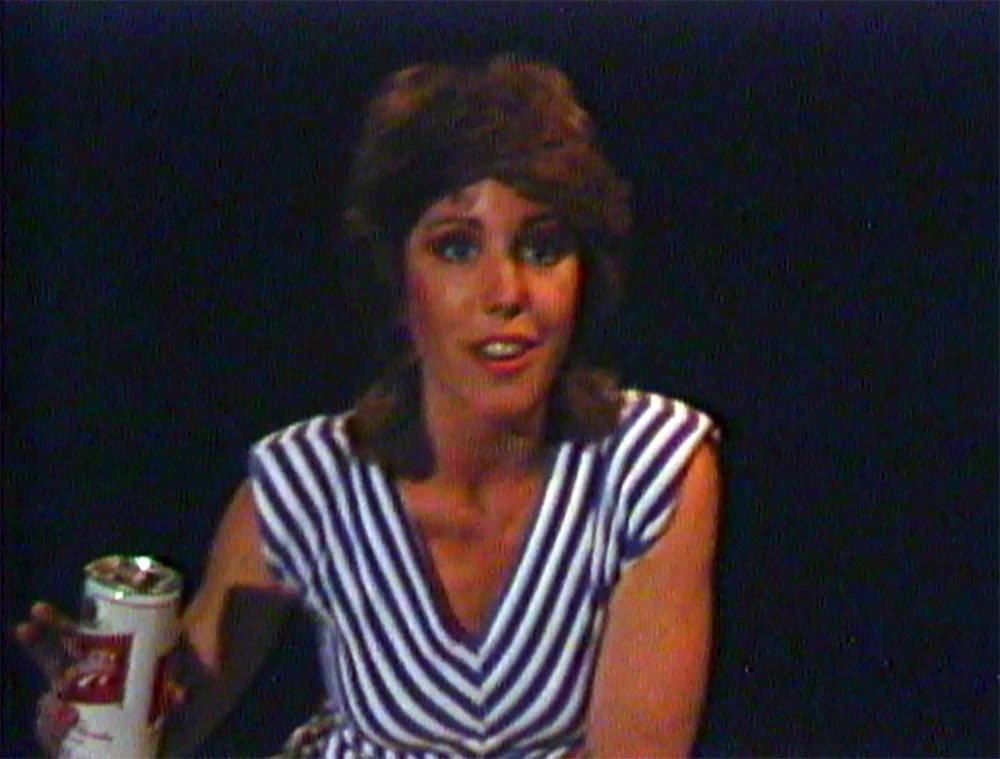
  • It struck me toward the end of Dale Herd and Barry Hall’s Dreamland Court that this experimental narrative videotape acts as a reversal of Michael Snow’s structuralist masterpiece. In Snow’s Wavelength (1967), an extended snail’s-pace zoom occurs for the entire duration of the film with characters passing through the space, the camera independent and indifferent to their presence. In Herd and Hall’s “performance tale” (based on the novel by Herd), the conceit is centered around a series of four characters shot alone and only in close-ups or medium shots, as they perform directly into the camera. Both works take place on the periphery, but with divergent approaches to narrative and mise-en-scene.

    While the direct minimalist approach of Wavelength eschews emotional investment in its actors/characters, it does not entirely forgo characterization, offering only glimpses of some sort of narrative with the static, zooming camera registering actors more as mere set dressing. Dreamland Court, inversely, foregrounds its characters through claustrophobic yet empathetic framing. As for mise-en-scene, there isn’t any, not really anyway. Herd and Hall offer impressions of an inhabited space, but the effect is produced somewhere in between the images: that is, a change in the color of lighting, a new or recurring wardrobe, soft music or chatter in the background, thus signalling whether someone is back in jail or sitting at a dive bar or laying in their bedroom. The four characters (Johnny, Jackie, Carson, and Joann) are presented for the viewer’s scrutiny against a minimal or non-existent backdrop, inviting one to piece together the translucent dynamics that inform these four entangled lives. All this to be intimated without ever having to be seen, without ever seeing them act together; the rest is to be imagined. (Even now, I cannot tell whether the mise-en-scene I am able to recall was in fact videotaped by the camera or intimated by me according to contextual cues.) This approach hinges entirely on its four characters and the unbelievably compelling performances given by these talented, underappreciated actors. And for much of the video’s runtime, it is apparent they are all in some perverse form of dialogue with one of the others at some point. Even while oftentimes acknowledging one of the others or addressing them by name, as if speaking to them face-to-face, it never feels like shot/reverse shot. The rhythm achieved between the montage and the actors feels more like a series of epistolic vignettes than a conventional cinematic construction of legible, contiguous space-time.

    From the first address of Johnny, a down-on-his-luck jailbird with a lucky streak, where he looks directly down the lens of the camera, Dreamland Court situates itself in contradistinction to Hollywood continuity editing. Each character is shot straightfoward as they talk to/about themselves, another character, or the audience—each inhabiting their own uniquely determined and identifiable spaces. Dialogue spoken exclusively as monologue adds a heightened degree of theatricality and hinders the possibility of the videotape’s editing as intercutting. To an outside observer, everything has already happened (in between the edit) before the next character reacts and gives their take on the events that were just described to us (i.e., a failed suicide-by-cop, a violent confrontation, or an accidental pregnancy). A constant game of catch-up for the viewer and these socioeconomic outcasts of 1980s LA. And so, the editing is not refusing narratively motivated cutting outright, but eyeline-matched shot/reverse shot as a foundational basis of spatiotemporal continuity is stretched beyond coherency. Dreamland Court as a text always feels gleefully disjointed as Johnny, Jackie (his unsatisfied wife), Carson (Johnny’s close friend and Jackie’s lover), and Joann (the teenager that Johnny presumably gets pregnant) are never pictured in the same place at the same time.

    Like Wavelength pushing the bounds of its own central experiment (e.g., by mixing multiple film stocks, stitching together multiple shots, applying color filters, intensifying a nondiegetic, high-pitched whine, etc.), as Dreamland Court goes on, characters start to walk out of frame as they monologue, the camera refusing to track them as they leave their mark, or they’ll have their face framed in three-quarters profile and positioned mostly offscreen to accentuate the negative space, or indiscriminate zooms in and out. Moreover, in one instance, a dialogue overlap of Johnny onto a shot of Jackie rings more discontinuous than the device’s usual cinematic deployment for the sake of smoothing over stitches between shots/scenes. (Can these monologues even be called scenes? Between the many appearances of all four characters, there are little identifying markers to distinguish one appearance from the other beside a tightly-framed change in wardrobe or lighting.) In addition, the final two shots—Johnny and his naive teenage girlfriend, both talking about her possible pregnancy—stand out from the previous vignettes and forgo the typical spatiotemporal ambiguity of the video. These two appear to communicate more directly and immediately than any other instance in Dreamland, looking out at each other across space and time to somehow envision a happy life together, if such a possibility can even exist.

    Where Wavelength drives toward its own death with unrelenting force, toward the photographic basis of cinema, Dreamland Court explores video as a medium in which to converse with oneself. Through the monologue and the video camera (with the actors likely witnessing their own image as live feedback via CRT monitor), Dreamland Court’s performance tale explores two intertwined threads of video since its inception: as narcissistic and/or therapeutic practice. At once, these self-aware/deluded inhabitants of the LA underworld are talking to/for themselves, “puking” (Johnny’s preferred term) their oftentimes embarrassing and turbulent emotions in a similar vein to therapy methods implemented six decades ago, involving patient self-confrontation via video. According to one such experiment conducted in 1963 at the University of Mississippi, the aim was that patients would see themselves objectively, as an object and as others see them, in order to motivate psychological growth (Collopy 109). To engage with and invest energy in the self-as-image was actually suggested as a cure to narcissism. Another experiment saw one subject conversing with himself as a means of self-conducted therapy and fostering a richer awareness of his ego (110). Famously and contradictorily, Rosalind Krauss formulated video as based upon a psychological medium rather than a material one, that of narcissism. She argues that the feedback loop causes artists, modulating and reacting to their images in real time, to invest energy inward, into selfhood, as opposed to an art object. And thus, Dreamland Court juggles these two oppositions of the video art dialectic expertly, mirroring the well-intentioned, forgotten, desperate, heated lives of a Los Angeles couple and their extramarital lovers. In their comitragic hoping against hope, Johnny, Jackie, Carson, and Joann find meaning and misery, heartbreak and a fresh start within their individual, collimate prisons—not to mention the emblematic jailhouse that habitually imprisons Johnny, testing the limits of all their relationships in turn.

    ,
  • Am I…washed up? These days, it is so hard for me to imagine myself writing something as focused as this piece. Maybe that’s just what happens when writing becomes a hobby you sometimes do in between working and hanging out rather than a full-time field of a study. I barely changed a thing about this paper from April 2022, only really fixing the numerous typos. I notoriously did not proofread my essays before I submitted them (often at the last possible minute), and this one for Film History II is no exception. Anyway, my professor loved it, calling it a “marvelous reading . . . that genuinely defamiliarizes and enlivens my sense of and appreciation for a film I’ve seen and taught dozens of times.” I don’t know if it’s that groundbreaking; perhaps I’m just in a mood, because I have to send someone a sample of my writing and feeling my more recent efforts inadequate and sloppy. Just the thought of spending this much time at the keyboard again—researching, outlining, writing—feels unbelievably daunting.

    The 400 Blows is not just one of the seminal works of the French New Wave, but a semi-autobiographical declaration of adolescence based on its film-critic-turned-director, François Truffaut. Truffaut opens his childhood up to the screen, presenting himself through Jean-Pierre Léaud’s performance as Antoine Doinel. In the film, Truffaut maintains a mimetic dialogue between himself as filmmaker and his represented childhood self, somewhere in between imitation and opposition. However, in the scholarship surrounding this film, the Antoine-Truffaut connection is passing contextualization and the New Wave is blanketly regarded as a radical departure from or rejection of classical aesthetics. In what “had to be best scene” of the film, Truffaut stages a three-minute conversation between the institutionalized Antoine and a psychologist. The psychological evaluation in The 400 Blows foregrounds the mimesis at the heart of the film and of the French New Wave. This scene deconstructs the division not only between Antoine as character and semi-autobiographical alter-ego but reflects the mimetic relationship between Hollywood and the emerging nouvelle vague.

    Before breaking down and exploring Truffaut’s own breakdown of mimetic distinctions of character and industrial-sociohistorical contexts, I need to examine how Truffaut mimetically employs and inevitably departs from the groundwork of Cahiers du Cinéma criticism and theory. This background is important for the mimesis of Truffaut and Antoine and between that of the French and American cinemas that follows. Firstly, the scene in the psychologist’s office disrupts the realism to which cinema should aspire, according to André Bazin, proto-auteur theorist and godfather of the New Wave. This scene is marked by several dissolves that deter any realistic sense of space-time, as the camera stays entirely trained on Antoine alone despite the classical cue to introduce the next scene. Thus, this formal experimentation subverts Hollywood assumptions of film grammar as well. Mimetically experimenting with Bazin’s film philosophy, the “wide-angle, deep focus long shots” that capture Antoine’s “moments of freedom” are abandoned—the distance between foreground and background no longer “exaggerated” (Fabe 128). The dissolves, which remain within the psychologist’s barren office, imply this scene is a long take that has been cut up in the editing room. This itself is mimesis: a long take that is edited but smoothed over with dissolves into a pseudo-long take—rejecting the confines of either filmic component. Unlike the long takes on the streets of Paris or of a running Antoine, there is no physical subject to track in this lengthy psychological examination. The mise en scéne is not shot in deep focus and rich with polyvalent props for the spectator to spot. There are no visual indicators to distinguish between fore-, mid-, and background; there is only Antoine, a dark wall, and a table. The interrogation room is a liminal space, its claustrophobia is imposed by the wall behind Antoine, which heightens the gravity of this moment for Antoine’s uncertain future. The quieted handheld immediacy invokes this narrative crossroad. In this scene, the audience is not afforded to “run by his side,” as Sam Solecki phrases it (58).

    Returning to the central argument(s), this scene foregrounds and (formally) disrupts the mimesis between Truffaut and Antoine. Most notably, the score and usual camera movement are not present here, which are responsible for the “aura” that lessens Antoine’s misdemeanors; therefore, Antoine is put on display without these intermediating factors (Solecki 54). He seems to be telling the truth: the character of Antoine, that is, but he is departing from the life and script of Truffaut. Antoine is finally able to speak for himself. For example, in the police booking scene, he is spoken for by the officers and his adoptive father. Now, Léaud gets to improvise his own characterization for Antoine, distancing himself from Truffaut. Once again, there’s no deep focus or nondiegetic score; it’s just him.

    The rattle of the camera mirrors the uneasy body language of Antoine and Truffaut behind the camera is likewise characterized as anxious under that restless and rebellious charm. Both young men are aware of their respective audiences. Truffaut is not only an iconoclast kickstarting a film movement with international repercussions but sharing his traumatic childhood. In this moment, the audience, like Antoine and the judicial system, are reckoning with his character and the decisions he has made up to now. Erin Hogan describes Truffaut’s camera as “highly sympathetic” to Antoine and his session with the psychologist is a rare moment where an “authority figure listens to him” (30, 36). However, Truffaut is much less sympathetic to adult characters—the psychologist is never even pictured, she is noncorporeal, she is unhuman. The absence of an actress on set during filming affirms that the adults in Antoine’s life are (literally) not there for him. Moreover, the woman’s voice added after the fact is therefore separated spatially (she is not on set) and temporally (by the dubbing in post-production and her age). In agreement with the documentary-like aesthetics fostered by cinematographer Henri Decaë, the added voiceover of Jeanne Moreau becomes a voice of God (which formally highlights the psychologist as an authority figure), as Léaud does not hear it. And during the shooting of this scene, Truffaut asks the questions to Léaud, establishing a mimetic effect through the semi-autobiographical narrative (“Jean-Pierre” 0:55–1:00). Furthermore, the scene was largely improvised, constructing a break between Truffaut as Antoine and Léaud as Antoine that still fits within the fluidity of mimesis. The actor strays from the director’s childhood as source material, rejecting stringent autobiographical imitation. Yet, Truffaut did not directly transcribe his early teenage years onto the screen, treating mimetically his own childhood in addition to a flexible approach to screenwriting and filmmaking.

    The interview elucidates Antoine’s motivations for his crimes, as up until this point, there was minimal explanation in his own words that speaks to the “degree of his unhappiness” (Solecki 56). Concerning Truffaut, the answers in the interview, which still draw from his childhood, reflect his motivation for becoming a filmmaker and bringing his own story before an audience. This scene not only solidifies our support for Antoine’s escape—even if it is brashly juvenile and his capture inevitable—but Truffaut’s first feature and inauguration as a filmmaker. Antoine, like Truffaut, feels trapped, and the film’s form reflects this truth. Wide, open shots that record the city are shaky and restless but not illegible, expressing an equally restless desire to break free from unsatisfying circumstances. The enduring movement of the frame constantly projects to the audience that the story of Antoine is that of Truffaut. So, the relative formal restraint of the interview is Truffaut telling the audience that he is still there, albeit less so. This is Antoine/Léaud’s moment, and the audience must examine why they support the delinquency of this boy. What are the implications of his actions? What are the causes? Truffaut urges his audience to be critical of their own spectatorship in addition to being cognizant of their passive status before a projected series of images. Put simply, this confrontation with Antoine is a confrontation of our own spectatorship. Why do we support Antoine? Why is this scene here, disrupting the flow? What should happen to him? The freeze frame that ends this scene arrests our uncertainty, suspending the conclusion of the examination. This photogram solidifies the spectator’s sympathy for Antoine and formally recalls and foretells the other instances of his imprisonment. The placement of this frozen medium close-up after the one in the police booking scene questions but ultimately affirms the spectator’s sympathy toward Antoine in the final suspended shot. Truffaut challenges passive consumption of narrative that has been shaped by the invisible editing of Hollywood, raising more questions than he answers in typical New Wave fashion. Truffaut criticized French films for their lack of formal risk and sincerity, so he inserts a scene between the lead actor and himself—albeit slightly disguised—that highlights the self-reflexive sincerity of Léaud and Truffaut. Both draw from their lives to form one character.

    On the other hand, this scene also highlights the mimesis between the French New Wave and Hollywood. The Cahiers critics were cinephiles enamored by several auteurs within the American film industry; however, these same foundational French critic/filmmakers diverted from American cinema and the socially unconscious American and French societies. The striking quietness of the examination—auditory and kinesthetic—contrasts the gestural, handheld 16mm aesthetic of the film before and after this scene. As a result, the stillness of the camera in this scene functions in opposition to its role in classical Hollywood; the anomalous stasis of the camera calls attention to itself when bookended by a film that rejects stasis almost entirely. Antoine’s slightly offscreen gaze heightens this effect, not quite acknowledging the camera, like he’s intimidated by it, refusing to register its overbearing presence. This scene contains seven dissolves that do not all operate in the same fashion: that is, in service to spatio-temporal continuity. These transition effects make legible the subtle differences in space and time. The first dissolve, discounting the one that opens the scene, is placed after the interviewer’s question but Antoine’s answer immediately follows as if the edit was not present, unaffected. In addition, the next two dissolves occur in quick succession as he listens to the psychologist relay claims from his parents that he is a liar. Truffaut manipulates the passage of time by keeping the psychologist’s voiceover consistent, but the image of the fidgeting Antoine is mirrored in the editing that acts equally uncomfortable and uncertain. This loosening of classical grammar invokes form following function by creating a similar residual effect in the viewer. Furthermore, the subdued state of the camera in this scene rattles and even pans slightly, never fully embodying stillness. The slight visual discontinuities between the dissolves betray the ostensible lack of movement. For example, the aforementioned dissolve brings the doorknob into the frame and its position on the otherwise blank wall illustrates the gestural nature of the original long take. Even at its most still, the caméra-stylo reveals Truffaut behind it. The audience is never aware of the time that passes for Antoine during the interview, as some dissolves shrink gaps in between questions and others seem superfluous in this respect.

    Truffaut negotiates with Hollywood filmmaking grammar in a less jarring and more mimetic manner than Jean-Luc Godard and his extensive use of jump cuts one year later in Breathless. (The contained camera in the psychologist’s office also recalls Breathless, but in a less radical way than the temp morts of the twenty-five-minute apartment scene.) The refusal to cut to a reverse shot of the disembodied voice is another example of Truffaut tackling Hollywood formal practices and twisting them, in addition to the not-quite stillness of the camera and the incongruous dissolves. Even the film’s most notable formal element, the freeze frame, is present but obscured in this scene. The dissolve that transitions from Antoine in the office interior to the visitors at the front gate exterior hides the frozen image of the interviewed youth. In conjunction with the muddled continuity of the dissolves, the frozen frame mimetically interacts with Hollywood by subduing its own formal experimentation. In other words, the preservation and maintenance of continuity associated with the dissolve subverts Hollywood aesthetics but is employed to hide the classically divergent freeze frame. Even within the suppressed rebellion of Truffaut’s usually kinetic camera, which he demonstrates undeterred in the dissolved shot before this scene, cinematic conventions are being broken. The stasis of this scene reflects Truffaut being contained by the pre-New Wave tradition de qualité that restricted French cinema through its stale, bourgeois form.

    Ultimately, this scene is a test for Antoine and Truffaut, as the boy next to Antoine warns in the previous scene. The scene with the psychologist is not a conversation, but an evaluation; there is an asymmetrical power dynamic between the interviewer and the interviewed. Like Antoine and the absence of an actress on set, Truffaut cannot see his audience. Thus, the dissolves reflect their desire to escape this interrogation, as if this transition technique is them trying to incite the next scene, foregrounding their discomfort. Antoine desires to escape this grueling trial and Truffaut desires to return to long take tracking shots; they both get their wish. When the awaited transition to the next scene finally ends the interview, the image is frozen, calling attention to the indexical makeup of film. Here, Truffaut is reversing the hierarchical organization of filmmaker over spectator and once more implicating the audience in the film, asking them to actively engage with it as spectator and socio-political actor. In short, he plays with audience expectations of film form to self-reflexively elicit an awareness of their spectatorship. As a newcomer director in a well-established national industry, Truffaut reverses the director-spectator relationship, invoking more active participation with the moving (and sometimes frozen) images from his audience and highlighting his own discomfort with cinematic and industrial stasis to induce their own discomfort. The freeze frame that ends this scene suggests that Antoine is not heard by the psychologist after all and the system she represents—this notion is left ambiguous, to say the least. The final freeze frame of the film channels this energy directly onto the audience, directly calling upon their newfound active involvement to expand beyond the diegesis.

    In conclusion, Truffaut does not imitate either approach to cinema—Cahiers or classical—instead opting to mimetically experiment with both modes. In addition, the similar appearances and childhoods of Truffaut and Léaud contributes to the mimetic characterization of Antoine. The mimesis between Antoine and Truffaut is itself mimetically entangled with that between Hollywood and the French New Wave. It is impossible to separate these mimetic dialogues, as they mutually inform each other, as evidenced in the scene between Antoine and the psychologist. I cannot even make clear separations between the two in the organization of this essay due to this overlap. Nonetheless, the onscreen mimesis between Antoine and Truffaut highlights a style of filmmaking that was more sincere, personal, risky, and socially conscious than le cinéma de papa (Truffaut lauded aspects of American cinema as bold and lambasted the French industry for its monotony). Truffaut’s opus offers a challenge to the form. Yet, the mimesis directed by Truffaut is not just found in relation to autobiography or classical Hollywood, but movements and genres from Italian Neorealism to film noir. The New Wave brazenly centers the abstraction that comprises the mimesis at the heart of the movement.

    Works Cited

    Fabe, Marilyn. “Auteur Theory and the French New Wave: François Truffaut’s The 400 Blows.” Closely Watched Films: An Introduction to the Art of Narrative Film Technique, U of California P, Berkeley, 2014, pp. 120–134.

    Hogan, Erin. “Boyhood, Abuse, and Adult Intervention in The 400 Blows (Truffaut 1959), Small Change (Truffaut 1976), and Pellet (Mañas 2000).” Red Feather Journal, vol. 4, no. 1, 2013, https://img1.wsimg.com/blobby/go/6a58c084-8445-4b4d-b5fb-2bc65b9a6026/downloads/Hogan%20RF%20V4i1%20SP2013.pdf?ver=1646403833519.

    “Jean-Pierre Léaud at the 1959 Cannes Film Festival for 400 Blows.” YouTube, uploaded by Criterion Collection, 4 Oct. 2012, https://www.youtube.com/watch?v=zvQp2xiHaDs.

    Solecki, Sam. “The 400 Blows: A Life on Film.” A Truffaut Notebook, 1st ed., vol. 3, McGill-Queen’s UP, 2015, pp. 53–61. ProQuest, https://ebookcentral-proquest-com.ezproxy.lib.usf.edu/lib/usf/reader.action?docID=4396126.

    , ,
  • “The disaster ruins everything, all the while leaving everything intact.”
    —Maurice Blanchot

    To have this movie be an adaptation of The War of the Worlds—a respected science fiction property that has been remixed by the likes of Orson Welles, Steven Spielberg, and Classical Hollywood—is hysterical and is so bold in its ridiculousness that it horseshoes itself back into being almost brilliant. Think of Ice Cube’s oft-repeated lines when on video call with his colleagues or children: “I’ll circle back.” Each of the aforementioned and adored adaptations, like another popular science fiction novel turned classic film(s), Invasion of the Body Snatchers, has been tackled by several filmmakers who all impart their own social critiques into the central figure of the alien invader. And it is here that I feel this movie and its screenlife style try to accomplish something interesting. A production impacted by the pandemic five years ago, War of the Worlds (brought to you by a music video director and a big tech giant with a $2 trillion market cap) adopts a stylistic approach that mirrors (1) the diegetic patriarchal surveillance of DHS dad Will Radford (Ice Cube), (2) the extradiegetic constraints imposed on people in lockdown, and (3) the formal and economic limitations of a film industry in the midst of a global pandemic. Like another release from this year, Ari Aster’s Eddington, this film (although less expressly) sorts through the wreckage of a world torn apart by Covid-19 as mediated by the increased presence of digital communications technologies in our lives.

    What struck me almost immediately about this film is its depiction of care onscreen, or rather how care as we experience it now can only be accurately depicted via screens. In particular, this protective but somewhat distant father (a result of his wife’s death) switches through dozens of windows and tabs and dialog boxes in order to watch over his pregnant daughter Faith: commandeering CCTV cameras and surveillance drones, checking her Apple Watch heart rate monitor, remotely breaking into her MacBook to read her text messages, etc. In one hilarious scene after an alien attack on her lab, Will guides his bleeding-out biologist daughter into a Tesla that he has hacked into, instructing and reassuring her over FaceTime, as a towering tripod alien lumbers toward her position. “Focus on me,” he tells her, as he clicks, scrolls, and zooms through his surveillance application software (aptly named Guardian), all the while simultaneously watching news coverage of the invasion and firing off messages to colleagues. In an affective sense, this is exactly how it feels to live in a post-pandemic world, how it feels to live in the aftermaths of the apocalypses that characterize twentieth-first century life. For example, many still work from home or at the very least are never not answering work texts and emails: the balance between work and life continuing to erode, the internet only having made everyone all the more productive. A consequence of neoliberal network society, the digitized privatization of everyday life. With the younger generations, this takeover looks a little different: Will begrudges his son Dave for staying home and streaming himself playing videogames, but this is a very real (albeit parasocial) response when one is faced with the inability to physically/emotionally connect with one’s peers in person after a year of staying home with only immediate family. Will goes as far as to remotely access his son’s PC and uninstall the new game as an act of tough love. The world feels so much different now, and so does care.

    Cinema feels so different now too. Likewise, most of the formal devices employed in War of the Worlds are thoroughly post-cinematic, this film taking place largely on a desktop; however, when director Rich Lee on the rare occasion opts for a standard cinematic device (e.g., a fade to black or a static shot from a nondiegetic camera toward the end of the film), it is these select moments that actually feel jarring and offputting: that is, the language of cinema that we have become accustomed to for over a century is no longer adequate to reflect that which is current. It is exactly that this movie does not take place, take up space1, that heightens its postmodern affectiveness. In other words, the limitations of physical life are dwarfed by the phenomenological demands and precarious neuroses of our internalized virtual environments.

    The cameras are off their tripods, so to speak, and like the curses escaped from Pandora’s box, they can never be put back. The camera is no longer even a camera. Moreover, after cybersecurity analyst father and leader-of-the-resistance hacker son team up and fail to infect the data-mining tripods with an “old school” computer virus, the spacecraft-esque heads detach from their robotic legs and fly toward the locations of each member of the Disruptor hacker team, having tracked their IP addresses. In this situation, the camera liberated from its support and itself, we have become not the imagemakers but the images themselves. Ice Cube is relegated to a little box on a Discord call as he watches on helplessly, his home ostensibly destroyed, believing to have just lost his son who he was finally beginning to connect with as well as any trace of his wife, having never cleared out her belongings. Will frantically commandeers a nearby surveillance drone to watch the rubble and cinders. Every man his own Twitch streamer, forced to react when constantly confronted and never not inundated with a feed of all the world’s horrors. Taking this point even further with wonderfully clunky irony, we learn from human characters, who are only ever interacting with each other via screen mediation (there is one marked exception, maybe more on that in a later post), that the occupying threat are hybrid organisms containing both biological and cybernetic components.2 This confusion of man and machine—watcher and watched, invader and invaded—invokes precisely that we ourselves have become the hosts for digital imaging and networking technologies and in turn have attached ourselves to other people primarily and irremovably through these pathways.

    And so, according to this digital regime, turning men into cyborgs, how might love, for example, between a father and his family, look and feel? At first, Will is obsessive: he sends his dead wife messages on Facebook everyday, he repeatedly listens to a mundane voice memo she left him, and he spies on his own children in order to feel close to them. So then, what does love feel like at the end of the movie, after this character changes throughout the course of this invasion? Love, as it turns out, is letting people into your system, like a virus. In the finale, as Will ventures out from the safety of his command center for the first time, he relinquishes remote control of his computer to Faith, who has to navigate his multi-screen displays, seeing how her father sees the world and interacts with others, as she guides him through the bowels of the Department of Homeland Security headquarters. In addition, she must also guide her brother as he hacks into military drones in order to destroy the oncoming alien attacks (that look straight out of Action Movie FX, which is in no way derogatory) that are targeting an Amazon delivery drone flying through DC, which is manned by her delivery driver boyfriend Mark, to get to Ice Cube in order to bring him a thumb drive for the “cannibal code,” newly converted from the DNA sequences of a cancer cure into computer code, that will deactivate the U.S. government’s top-secret data collection program, and thus deactivate the data-sucking space invaders. And so, rather than voyeuristically keeping tabs on his own family, the workaholic dad learns to let go and trust himself to trust his children.

    Despite its dull insistence on sentimentality and the redemptive power of the family unit, War of the Worlds nonetheless offers an amusing and thought-provoking illustration of the collision, the event horizon between the digital world, the world of data, and the real world, the world of people. As Ice Cube likes to tell Eva Longoria over at NASA whenever she asks him about the recent abnormal weather events that prelude the invasion, “I told you, I watch people.” Even that simple statement alone maintains this confused, collided perspective; after all, he does not actually watch people, he watches images. Yet perhaps that begets the question: what’s the difference?

    While I do not think this is an evil or unconscionable movie or even an unwatchable one, it is certainly a self-exculpating venture. When the aliens from another world first arrive, the on-the-ground news coverage style footage immediately invokes climate disaster: one shot especially conjuring the recent forest fires that ravaged California in the last year. Not to mention, when they first arrive, the tripods attack such sites as natural gas pipelines and electric grids, emphasizing the continuing and irreversible acceleration toward ecological destruction. One character remarks that this coordinated assault is not only attacking necessary human resources but also our ability to collectively respond to them. The tripods specifically target these stockpiles, but none are more important than the data centers. And so, this film poses a critique of our economy’s obsessive, full-steam-ahead attitude toward surplus and accumulation by having these parasitic invaders attack sites of abundance and wealth generation for tech oligarchs.3 However, this film premiered exclusively on Prime Video, a streaming platform that belongs to the largest information technology corporation in the world.4 So, of course, Amazon has countless data centers of its own, each comprised of tens of thousands of servers. (No wonder data is said to be the most valuable resource over and over.) In fact, these data centers are responsible for hosting Amazon Web Services (AWS), lending cloud storage services to some of the biggest companies in the world (e.g., Netflix, Twitch, LinkedIn); in fact, approximately one third of all internet traffic passes through AWS.5 Thus, it would not be an exaggeration to say that if Amazon data centers went down, a good chunk of the internet would also be affected. And so, the environmentalist and big tech anxieties become empty platitudes, as these data centers require enormous expenditures of energy in order to store our digital footprints, just for them to be sold as discrete packages of information to advertisers, credit and insurance companies, or even law enforcement. So, these vampiric, bionic reapers (that are invoking climate disaster in the film) are behaving themselves much like these corporations who are significantly causing and entangling these crises in the first place.

    Like many projects in this faux populist turn within Hollywood (or really just Hollywood writ large), this film reifies the status quo but now with a little added lip service, but perhaps that is giving too much credit to a movie that no one took seriously. Nonetheless, War of the Worlds would like you to believe that only the federal government with its bloated bureaucracies and bad actors is the one responsible for burning a hole in the ozone layer or for selling out your data to be kept behind glass in case of emergency.6 It is the same blame shifting, buck passing that Disney did with WALL-E; however, this time, it appears that no one is buying it. Frankly, one could easily trace this ethos all the way back to the very inception of the blockbuster form, to fellow H. G. Wells admirer, Steven Spielberg, fifty years ago.7 And so, when any movie tells you how bad things are and that all you need in spite of that is a little Faith, just remember, as this film’s trailer tells us outright, “it’s worse than you think.”

    Notes

    1. Diegetically, it consists mostly of screen recorded desktop footage of a man in his office. Formally, there is no physical medium onto which the images shot are imprinted and those images are further distanced by being frames within frames within frames. Metatextually, as this movie was swept under the rug and dumped onto Prime Video only yesterday with a trailer dropped only a week before that. ↩︎
    2. In Invasion of the Body Snatchers, as in War of the Worlds, we learn that maybe we are not so different than those who enslave us. Body Snatchers never just about the infiltrating communist threat—although it certainly reflects that Cold War anxiety—but also certainly the stark conformity already present in suburban 1950s America. This same polyvalency can be applied no doubt to Lee’s War as well. ↩︎
    3. As a result of the alien assault on data centers, Will looks on frantically as the Facebook messages with his wife, the last trace of her voice, her pictures—that is, her digital footprint—are scrubbed from an internet under attack: her digital death. By having the widower retreat into his work following her biological death, the obsession with the digital reflections of his wife, his constant tormenting of himself and inability to let her go, is intrinsically linked to capital’s obsession with constant accumulation for its own sake, way past the point of profit. The latter informs the former. ↩︎
    4. Not to mention, in terms of self-exculpation, War of the Worlds has for one of its heroes an Amazon delivery driver, saving the day by having someone place an order to activate his delivery drone. ↩︎
    5. This figure was reported in 2020. ↩︎
    6. This conversation between Joe Rogan and Edward Snowden goes into details on how and why consumer data is collected ad infinitum: https://youtu.be/VFns39RXPrU?si=w78TBnhvFtfH2qeU. ↩︎
    7. For more, an essay I wrote on Spielberg’s Jaws: https://householdrubbish.wordpress.com/2024/11/02/out-of-many-one-out-of-one-many-jaws-and-the-contradiction-of-the-new-hollywood-blockbuster. ↩︎
    , , ,
  • On WAVELENGTH

    “I really don’t know why it is that all of us are so committed to the sea, except I think it is because in addition to the fact that the sea changes and the light changes and ships change, it is because we all came from the sea. And it is an interesting biological fact that all of us have in our veins the exact same percentage of salt in our blood that exists in the ocean, and, therefore, we have salt in our blood, in our sweat, in our tears. We are tied to the ocean. And when we go back to the sea, whether it is to sail or to watch it, we are going back from whence we came.”

    John F. Kennedy, Jr., Remarks at the America’s Cup Dinner Given by the Australian Ambassador, September 14, 1962

    Michael Snow’s Wavelength (1967) opens with a team of people moving a shelf into a room. Throughout the course of the film’s structuralist experiment, the shelf remains mise en scene until the persistent and linking zoom segments slowly bury it in the illegibility of extradiegetic space. The frame: everything onscreen eventually becomes everything offscreen. That is the nature of the camera, exemplified here by the continuous, encroaching zoom at the center of the film. At the apex of the experiment lies a photograph, prefiguring the cinematic obsession with (its own) death. A moment that will never occur again arrested in time and space and flattened forever; the zoom must also come to an end, there is a limit even to the lengthiest and most penetrative gazes, otherwise, what you have is not cinema. Snow’s quasi-long take zoom gives motion to death. This is really no different than any other film, but the fundamental elements of Wavelength do not obscure this fact, in fact, quite wholly and only the opposite.

    The addition of the empty shelf in the opening of the film mirrors the room and the medium itself, each cell is space to be filled with matter. Yet, herein lies the central paradox of film: still images are only indexed onto these film cells via light, and only when projected in time do these “dead” images come to “life.” As Prospero reflects in The Tempest, “These our actors, / As I foretold you, were all spirits, and / Are melted into air, into thin air.” The photographic intervention transforming subject into object, something even less: an image—a flicker that delights across the screen. To shoot is to record, but to replay is to reanimate. The bookshelf remains empty, lined with only dust and light, like the strip of spectral images of the object itself.

    And so, the same applies with either of the windows on the back wall; however, they (and the room at large) do become populated with subjects/objects, yet the central paradox still holds true, further emphasized by their fleeting nature onscreen. None of these things last. At the outset, watching Wavelength feels like being a fly on the wall, observing life events unfold from a singular and determined vantage point, never receiving context for the glimpses of actualities beyond and within these four walls. Women chat, cars pass, men die. In other words, there is a narrative in Wavelength—somewhere in between its forty-five-minute runtime—but one the spectator is not privileged to, unable to escape the confines of this Canal Street loft. Despite its overwhelming lack of furnishings and relentless forward propulsion, the viewer is always acutely aware of the larger picture. Women chat, cars pass, men die, and film rolls. The ceaseless thrust toward the final image, toward the film’s death, toward our own, despite the aforementioned signs of life—the photographed waves a worthy figure of this death drive.

    That is, photography is the only means by which to capture it. Film absorbs the waves of the visible light spectrum and channels it here into fluid momentum. All that is Wavelength is the cresting of the wave that just begins to crash back down in its final formal gesture—the image of the water tacked to the back wall washes away in blur. Final frame: like a radio being tuned to catch different waves of transmission, the image finally revealed and held in all its detail starts to lose clarity until its ripples and waves are lapped into shallow focus, swept into the nothingness of the camera apparatus. Across several different film stocks and print processes, Snow pushes us toward the pull of the void. When one wave crashes, another is formed in its ripples, and so on ad infinitum. To the sea, to the photographic basis of cinema, to the mortality of men, or to the end of the film itself, Wavelength returns the viewer back whence they came.

    , ,
  • JAWS Essay Outtakes

    I couldn’t figure out how to weave the lines of argumentation that follow below into my essay from several months ago, so I just cut it from the more-or-less final draft. I certainly have a tendency to write bloated essays, finding it rather difficult to cut things out once the idea has already come to me, or finding the essay expanding out of control with it now requiring much more research than originally intended, so that I end up never finishing it. However, I’ve developed more restraint, I feel. So, that being said, I liked what these scraps of writing contributed enough to include them elsewhere.

    • Even in the perceived comfort of the burbs, Jaws and its cinematic progeny nonetheless allegorize the anxieties and desires of the (ironically) diminishing stability of middle-class American life.
    • Yet, in New Hollywood the biggest revolution was not stylistically or thematically, or even related to filmmaking. It was bigger than that–much bigger–a corporate revolution. Four years before the release of Jaws, the Powell Memo outlined the means by which corporations in the United States could fortify their position within American commerce and government, in corrosive antagonism to the already crumbling relic of the New Deal. More specifically and of utmost relevance here, Powell encourages corporations and their ownership of the media apparatus to be better spent influencing public opinion. This, of course, had obvious and unforeseen cultural consequences. Amongst business conservatives like Powell, the “inequitable taxation” of exceptional business leaders promoted the oncoming neoliberalization. But are these leaders individuals or corporations? This acutely obtuse application of language is key to Powell’s later court decisions as a Supreme Court justice, namely First National Bank of Boston v. Bellotti, in which corporations are granted the same rigorous legal protections under the First Amendment as an individual. The individual reigns supreme. And while Spielberg optimistically places his faith back in the individual after being bombarded with images of the failure of the American way of life, his faith in the everyman who can still do good as long as he remains unfettered, he (perhaps?) naively reifies the protection and re-reification of the subject as the center of political action, itself at the center of what Powell deemed an “Attack on [the] American Free Enterprise System.” Not to mention, turning himself into a pop auteur in the process, the very essence of late twentieth century cinema and beyond. The mythological individualization of cinema.
    • Heroes come together as does the audience in a theater (less of an occurrence nowadays, with individuals or their families opting to stream at home)
    • community amid postwar suburbanization undermined
    • In his confidential memorandum addressed to the Chamber of Commerce, Powell sows the seeds that would blossom into the neoliberal revolution.
    • When the memo was exposed by Jack Anderson of The Washington Post two years later, the blockbuster was well under way.
    • tight knit communities, immediate over extended family
    ,
  • It Can’t Be Done

    Electoral politics is designed to individualize.
    Everything about modern life is designed to individualize.
    I am individualized; therefore, I am liberalized.
    I am an individual; therefore, I am a liberal.

    Part I (of II)

    On the one hand, the onus should not be on the individual to vote if they do not wish to select either/any candidate for any reason. They are not to blame for the failure of another’s desired outcome. On the other, is it not also individualistic for the non-voter to abstain from their right, “to have their voice heard,” whether out of systematic disillusionment or outright refusal to vote for a candidate that does not reflect their values? To hold out entirely because of non-negotiable steadfastness to individual convictions. But then, there is the dilemma of your fellow man: don’t you owe it to them? Wouldn’t lesser-evilism, harm reduction, settling, voting blue no matter who, be the responsible thing to do? Nothing changes when you do; it’s all a fundraising racket that convinces the subject that they can make a difference, be a part of something larger than themselves. But then, the right to vote is only granted precisely because it is such an unsubstantial part of politicking; plus, anything that can be given can and will certainly be taken away. Not to mention, that it’s not even your vote that elects your officials, it goes to a college of electors, who so graciously take the burden off your shoulders. (However, even they have no opportunity for individual political expression, lest they be deemed “faithless” and replaced with someone who will tow the party line.) And yet, despite it all, when things don’t go the way they were supposed to, the burden always shifts to the shoulders below yours nonetheless. Rinse and repeat all of the above: this debate can ouroboros itself ad nauseam.

    I say this all as someone who did not vote just one week three months ago. I had to work. Yes, I could’ve made time: officially changed my residence and gotten a new state ID weeks or months prior, or looked into requesting an absentee ballot. But I had to work. It makes sense to me that the impetus for electoral engagement should default back to the party. You have to rally the masses out of their inertial comfort. (However, if a global pandemic couldn’t even do that, it’d be ridiculous to imagine electoralism as a stronger oppositional force, somehow succeeding in moving an immovable needle the other way. On the contrary, electoralism is part of the illness, this condition that arrests the movement of those who may not even realize they were never moving to begin with.) The people have to be sold. Everything is advertising and I wasn’t advertised to convincingly enough, at least not by anyone I would want in office. If you can’t even pull me away from my job that I hate, you can’t get me to do anything. There, again, it’s all about me, the individual always wants their way. “Why should I?” “What do I get?” “How does this help me?” I didn’t make things this way. Make it easier to vote and I will. Make me excited to vote and I will. Do that and I will play along. But what is it I’m voting for exactly? The economy? The president doesn’t even have the power to control the masters’ house, but we have to pretend he does. One person always has to be there to take credit or take blame. That’ll make me feel better, won’t it?

    Pages: 1 2 3

    , ,
  • Letters of Resignation (2/2)

    “I was young when I left home / And I’ve been out rambling ’round / And I never wrote a letter to my home”
    “I Was Young When I Left Home” (1961, Bob Dylan)
    If I didn’t have an elderly grandmother I swear to God I would’ve stuck to the plan. I would’ve left without saying anything, except when opportunistically and absolutely necessary. I do really think she is the thread that I’m hanging on by. I only told her I was leaving the afternoon before my bus was scheduled to depart. She had no idea that, when I came into her room and tried my best not to break down, my bags were already packed in the other room and the ticket had been purchased days before. I only told her I was leaving just hours before two friends came to pick me up, to spend the night with before they drove me to the station the next morning. Grandma promised not to tell my dad outright, but if he called and asked about me, she would not lie.

    As it turns out, he called me with impeccable timing, having just arrived at my destination. I had just gotten out of the shower. In an upstate New York suburban home only minutes from Lake Ontario, meeting for the first time my future first roommate, whom I had found through one of those roommate-finding apps that never seem to work for anyone. The phone is still ringing and he goes to voicemail before I can answer. I had a second phone and a brand new SIM card, I could’ve made the switch anytime over the past two days and thousand-plus miles. I could’ve continued to delay accountability, but that would be antithetical to the reason for moving away. I made a promise to myself and I was going to see it through. I said I wasn’t gonna look back, and that I was, in fact, prepared to do, but I did pick up the phone. The first crack in the myth I was trying to make for myself.

    Now, still transfixed on this sort of ridiculous nonsense that I feel most people never even think twice about, I cannot help but feel I should’ve committed one way or the other. I did both half-assed: instead of leaving it all behind and creating something new for myself like the dutiful mythologizing individualist I wish so desperately I wasn’t, I cut people out and feel obligated to get them back since I hear they’re upset I left without saying goodbye. Yet, even now, this is mythology I want to live by, but maybe that’s my whole problem, aside from these juvenile obsessions that I unrealistically want to uplift myself toward in the first place (all because they got a nice ring to them). It’s mythology, it’s a story that I’ve made up to be told around a campfire, to entertain, to make people feel some kind of way. I left the warmth of a perfectly good fire to whittle at kindling, in the hopes that I could build something even better, and then everyone would want to be around my bonfire, congratulating me on what a great flame I built all on my own. But, I’d only want them to want to be around it. It doesn’t matter since I have neither heat nor light. No one told me it was always gonna rain.


    Bob Dylan’s “I Was Young when I Left Home,” coming from early in his catalogue, is a nostalgic lament, in which its narrator ostensibly wants nothing more than to return home. Hearing news of all the familial tragedies that he missed since his departure, it is a song that sees the narrator grappling with his regret and his own (past) self-conviction.

    The original folk tune from a fresh-faced Dylan employs various forms of repetition within and between lines and across verses to establish a thoroughly nostalgic tone. More specifically, Dylan creates a closed circuit of nostalgic narcissism, as lines are often preceded by anaphora (e.g., “Not a shirt on my back / Not a penny to my name” or succeeded with epistrophe (e.g., “Gonna make me a home out in the wind / In the wind, Lord in the wind / Make me a home out in the wind).” In the anaphoric verse, the narrator only repeats himself twice, before further indulging himself with epizeuxis and a self-pitying outcry: “Well I can’t go home thisaway / Thisaway, Lord, Lord, Lord / And I can’t go home thisaway.” On the other hand, the epiphoric verse is the greatest example of uninterrupted repetition with three successive lines. Therefore, despite bemoaning the loss of his previous domestic life, whether already unconsciously convinced or currently trying to convince himself, the narrator has made his decision and will live with it, even if the reader can practically picture the lonesome traveler holding his head in his hands as he laments his self-imposed exile from home.

    Further, the song hinges on one of the most oft-repeated phrases, “thisaway,” a masterful double entendre in its own right. The polyvalent phrasing of the line (“But I can’t go home thisaway”) expresses both figurative and physical connotations of the narrator’s current state. Firstly, he is overwhelmed by feelings of inadequacy, considering himself unworthy to return home until he has made something of himself. And so, his reaction: to repeat—both formally and psychologically (that is, to fixate on the past); the young Dylan crafting here a formidable form-follows-function. And secondly, in the more literal sense, he cannot go back home by continuing to live away from home. However, also, in the same line, the same lyrics nonetheless convey steadfast reluctance in his reasons for leaving home: that is, he can’t just go-home away his problems. Thus, in the same breath, he recognizes that nostalgia will get him nowhere physically, but also especially in that aforementioned figurative sense.

    Even in the deepest drunken stupor of nostalgia, as you passively retreat into fantasy, it projected before you on the ceiling, pleading to relive the past, you’re still looking for any excuse to break free of its addiction, even if, in this very moment, you are unable to pull yourself away.


    With this vacation, I returned to the grounds of the fire that had warmed me, and there was no one left. All this talk (I guess, really thought) over the last few years—of the posthuman, the digital, the nostalgia of neoliberalism, anti-individualism, anonymity— is how I compensate for an unshakably selfish nature. Consider this my resignation.

    “I can’t go home thisaway”

    , ,
  • The current image has no alternative text. The file name is: l-intro-1694902797-252320892-859704371-e1735160480400.jpg

    This post is so ridiculously delayed. I don’t really feel like going back and trying to conjure up the initial thoughts and feelings I had to each of these works. So, for the most part, I am electing not to fill in the gaps that I never finished, leaving it as is. I just cannot be bothered anymore.

    Albums and Movies

    6/1: Real Steel (2011, Shawn Levy)*

    Does not hit as hard when you’re not a child.

    6/2: Immortals (2011, Tarsem Singh Dhandwar)

    Returning digital video back to painting in order to properly imbue ancient gods and heroes with the mythic significance and scale that they deserve. Stunning. I had never seen a Tarsem movie, so I cannot speak to his other works, however, in Immortals, the man is a dedicated tenebrist. It probably was mostly due to talking throughout, but shit is hard to follow, or maybe paying attention isn’t the point at all.

    6/4: Mad Max: Fury Road (2015, George Miller)*

    You know, hope is a mistake. If you can’t fix what’s broken, you’ll go insane.

    “There’s high ground just beyond that thing” MAD MAX: FURY ROAD REVIEW

    There is no paradise to which one can return; even if there was, there wouldn’t be room for just one: it’ll have to be all or none. It’s a simple premise. A group of diverse characters must band together and share in the only instinct afforded to them in the desert wasteland of George Miller’s creation, that is, to survive, as Max establishes in the film’s opening soliloquy. Surviving until surviving feels like something more. Unparalleled visual poetry on an impossible scale. Yet still with such a precise and graceful hand, this movie speaks universally to life in the West (all of the characters we follow can be diegetically traced back to some notion of west–sex slaves, soldiers, and blood bags alike). The West, where life is constantly accelerating ever faster toward no future at all. Thus, the only one way to progress beyond hierarchical systems is to constantly stay ahead of them. A process of deterritorialization that must outpace an opponent that is more machine than man. It’s funny, I almost felt bad for the lone tree getting uprooted, but the tree is dead. It’d been dead. Rip out its roots and pull yourself out of the sour mud. Rip out its roots and plant something new. Rip out its roots and destroy your past. It was never about hope (in the world of Mad Max, such a possibility bears no fruit), it’s about activating the utopian potentialities within the dystopian, unearthing them. The tree wasn’t just destroyed, it was leveraged, teleologically endowed with a purpose alternative to that assigned it in life. Even in death, a thing can save a life. Max’s vision of a girl he failed to protect causes him to flinch and shield his eyes, blocking an otherwise fatal crossbow bolt. In Fury Road, people are things, subjects collapsed into objects. You own the objects (water, gasoline, bullets), you own the people. Everything is a commodity. Miller offers two alternatives through Max and Furiosa. Furiosa ascends, bringing resources to the masses. Max vanishes into the crowd. The last look they share is recognition of the other’s role: Furiosa the strong leader and Max the guerrilla fighter. So, they are not mutually exclusive paths, but, in fact, two prongs of one attack to jumpstart the world out of its inertial stagnation. “An object at rest will stay at rest.” As said before, people are just objects. “Unless acted upon by an unbalanced force.” There is no velocity without first acceleration, without first an initial force. Furiosa imagines a better world for Immortan Joe’s breeders, motivated by nostalgia and escapism to return to the Green Place. Miller does not allow any such fantasy for his audience either, enduring criticisms that “they just go in a big circle.” On the contrary, they travel in a line. “I suggest we go back the way we came,” says Max. Every action has an equal and opposite reaction.

    6/4: Furiosa: A Mad Max Saga (2024, George Miller)

    Much better than the trailers made it seem. I wasn’t excited for this movie at all, until I rewatched Fury Road and remembered it’s one of the greatest movies within its respective genre and decade. In hindsight, this one is kinda just whatever.

    6/7: The 15:17 to Paris (2018, Clint Eastwood)

    No one loves the troops more than Clint Eastwood. I applaud what he’s trying to do, but overall, it’s understandable why this movie is regarded as such a dud. However, if you can’t look past nonprofessional actors and poor writing, grow up. That being said, I can understand why anyone would be turned off Eastwood’s antistyle. The complete lack of, or maybe even the negation of audiovisual and narrative flare, let alone spectacle. However, the scenes with the three leads as children struck me as a crystal clear mirror of what life is really like in a White American Christian household. Judy Greer is just a normal mother until she blurts out, “My God is bigger than your statistics,” to a teacher claiming her son could have ADD. Her middle-school-aged son has an armory of airsoft guns and a hunting rifle in his bedroom closet. He prays to God at night . He’s being raised in a single parent household. He gets in trouble at his restrictive Christian school. He wants to join the military because war looks fun. But for all 15:17’s stylelessness, I don’t think you can rightly say that Eastwood is just presenting things “as they are.” He’s still a conservative old guy who likes to make movies about American heroes. And I don’t know how to feel about his movies (formally, not politically). I was too focused on Alek Skarlatos looking like Chad Bo Burnham.

    6/?: Good Time (2017, Josh and Benny Safdie)

    6/9: Yeezus (2013, Kanye West); Weathering with You (2019, Makoto Shinkai)

    6/11: Peeping Tom (1960, Michael Powell)

    This should’ve been one of my favorite things ever and it wasn’t. Need to give another shot.

    6/12: Yesterday Girl (1966, Alexander Kluge), Om Shanti Om (2007, Farah Khan)

    6/19: Le joli mai (1963, Chris Marker and Pierre Lhomme); Borat (2006, Larry Charles); From a Distant Gaze (1964, Jean Ravel)

    6/22: Blue Collar (1978, Paul Schrader)

    6/25: Evil Does Not Exist (2023, Ryusuke Hamaguchi); I Saw the TV Glow (2024, Jane Schoenbrun); Enter the Void (2009, Gaspar Noé)

    I Saw the TV Glow did NOT make me feel good about working at a movie theater.

    Digital filmmaking to surveillance to death to transcendence, but forced back into the cycle, like a neverending bootloop. Like a moth, the camera is drawn to light, leading to free associative editing—a world where a fetus can become a model volcano. The best parts are with no characters or voiceover, not even any scenes, just wandering. Consciousness is montage. I also don’t know how I didn’t realize until I was sitting in the theater that every Noé film has a gimmick. But all of that aside, some of the finest child acting ever put to screen. The aftermath of the car crash is heartbreaking to watch.

    6/29: Submarine (2024, The Marias); Kinds of Kindness (2024, Yorgos Lanthimos); Velvet Goldmine (1995, Todd Haynes); Citizen Kane (1944, Orson Welles)

    Books and TV Shows

    6/1: “Steel” from Twilight Zone (1963, Rod Serling)

    6/9–6/11: Attack on Titan: The Final Season, Part One

    6/11–6/12: Attack on Titan: The Final Season, Part Two

    Nothing is a coincidence; it’s all planned out, but it doesn’t matter. It still fails—Eren and Isayama. Impossibly monumental work of fiction only made more interesting by the fact its ending doesn’t land for everyone.

    6/23-Ongoing: The Boys: Season Four

    , , ,
  • From the beginning, Jaws was always supposed to be the highest grossing film ever made. Widespread rollout into hundreds of theaters simultaneously during summer vacation, extensive television adverts, and a tie-in merchandise line all ensured its blockbusting capabilities before the film was ever screened before a paying audience. So began the industrial model of the blockbuster, an enterprise had it failed, would have meant (in a manner of speaking) the studio being “on welfare the whole winter,” as shark hunter Quint warns the Amity townsfolk. He could get the job done for three, but will accept nothing less than ten thousand. High risk, even higher reward. “This shark will swallow you whole,” that is, if you (the studios) fail to control this colossus never before seen. And so, this fear of being reduced back to working-class toil and all its insecurities and instabilities is the central anxiety at the bleeding heart of this film.

    In Jaws, the individual reigns supreme, the deliberative power of the masses are manifested as corrupt, overly bureaucratic, ineffectual, and callous. No doubt a consequence of Nixon’s Watergate blunder the year before. After all, chief of police Martin Brody moved from New York City to the quiet Massachusetts resort town in order to escape the urban tumult and social alienation, to start his middle-class life on his new suburban waterfront property. He was afforded the opportunity of upward class mobility, not entirely uncommon for the time, but one that was increasingly waning well before the outset of the next decade.

    Yet perhaps, the greatest element of fantasy in a film with a 25-foot killer shark is surmised by Brody’s insistence that “one man can make a difference.” However, in the world of Jaws, any attempt to come together is thwarted. Initially, Brody unilaterally closes the beach after the first attack, then relinquishes to their reopening at the behest of Mayor Vaughn. Furthermore, the civilian shark hunting parties are demonstrably disorganized and counterproductive, leading to the capture and killing of the wrong animal. Lastly, the final expedition of Brody, Hooper, and Quint goes horribly awry. Brody, with his fear of the ocean, clings to an onshore (stable) notion of collective support and accountability while at sea, attempting to radio for help in killing the great white; however, Quint, the self-made working man born and bred on a individualist diet of mistrust and self sufficiency, smashes the thing to bits. Right as the three men—a cop, a scholar, and the one man specialized for this kind of work—begin to get along, the shark attacks, leading to a damaged hull, a busted engine, and a dead captain.

    With Quint eaten alive and Hooper stranded underwater, Brody the surrogate of the state employs the former’s mode of safety and vantage with the latter’s tools to explode the relentless consuming machine. The ideal individual for the neoliberal age. Brody fully succumbs to the call of the individual after the death of the “working class hero” (Hooper’s jab at Quint). This middle-class savior now captaining the surviving duo of himself and the old money academic, kicking to shore in tandem, held afloat by flotation barrels. The state-regulated industrial patriarchy of Classical Hollywood gives way to the neoliberal network society. Every man for himself. Quint is not so fortunate. He succumbs to the gravity that the other two manage, as if a necessary sacrifice, sliding down the deck into the jaws that haunt him. The working man is consumed by the spectacle, pulled into the indiscriminate, all-devouring field of the shark.

    In the theaters, the similarly stratified audience has become enraptured by the Spielbergian cinema; in addition, a sort of stratification of the audience itself was underway on the basis of class due to the growing suburbanization of theaters. Not to say that the early cinema was utopian and did not succumb to divisions and exclusions, but in just 70 years, gone are the days of the nickelodeon; here are the days of the mall multiplex and the drive-in theater. And then now, streaming and the home theater further continue the social atomization of spectatorship, especially with rising ticket costs turning cinemagoing away from its roots as a shared working-class pastime. However, in its depiction of a fraught relationship between the collective and the individual, Jaws does not simply and entirely willingly accept the cult of the individual. Likewise, outside the text, the pop auteur forges a formal language unique to himself, while appealing to the largest possible audience. Spielberg wishes to have it both ways, and like any good hyper-Newtonian blockbuster, things end up in the air.

    , ,
  • You know, hope is a mistake. If you can’t fix what’s broken, you’ll go insane.

    I. MAX CAN’T STOP MOVING.

    There is no paradise to which one can return; even if there was, there certainly wouldn’t be room for just one: it’ll have to be all or none. It’s a simple premise. A diverse group of characters must band together and share in the only instinct afforded to them in the desert wasteland of George Miller’s creation, that is, to survive, as Max establishes in the film’s opening soliloquy. Surviving until it feels like something more than just survival. Unparalleled visual poetry on an impossible scale. Yet still with such a precise and graceful hand, this movie speaks universally to life in the West (fittingly enough, all the characters we follow can be traced back diegetically to some notion of west—sex slaves, soldiers, and blood bags alike). The West, where life is constantly accelerating ever faster toward no future at all. Thus, the only one way to progress beyond hierarchical systems is to constantly stay ahead of them, to push out from within them. A process of deterritorialization that must outpace an opponent that is more machine than man. In this world, accelerating ahead of the machine requires deforestation, a perverse form of terraformation in the desert hellscape of Mad Max. It’s funny, I almost felt bad for the lone tree getting uprooted, but the tree is dead. It’d been dead. Rip out its roots and pull yourself out of the sour earth. Rip out its roots and plant something new. Rip out its roots and destroy your past. It was never about hope (in the world of Mad Max, such a possibility bears no fruit), it’s about activating the utopian potentialities within the dystopian, unearthing them. The tree wasn’t just destroyed, it was leveraged, teleologically endowed with a purpose alternative to that assigned it in life. Even in death, a thing can save a life. Max’s vision of a girl he failed to protect causes him to flinch and shield his eyes, blocking an otherwise fatal crossbow bolt. In Fury Road, people are things, subjects collapsed into objects. You own the objects (water, guzzolene, bullets), you own the people. Everything is a commodity. Miller offers two alternatives through Max and Furiosa. Furiosa ascends, bringing resources to the masses in the process. Max vanishes into the crowd. The last look they share is recognition of the other’s role: Furiosa the leader and Max the guerrilla. So, they are not mutually exclusive paths, but, in fact, two prongs of one attack to jumpstart the world out of its inertial stagnation. “An object at rest will stay at rest.” People are objects. “Unless acted upon by an unbalanced force.” There is no velocity without first acceleration, without first an initial force. Furiosa imagines a better world for Immortan Joe’s breeders, motivated by nostalgic escapism to return to the Green Place, a place that no longer exists. Miller does not allow any such fantasy to last for his audience either, enduring criticisms that “they just go in a big circle.” On the contrary, they travel in a line. “I suggest we go back the way we came,” says Max. Every action has an equal and opposite reaction.

    II. WHAT MAKES MAX SO MAD?

    Therefore, the structure of the narrative is not, in fact, deterritorializing or schizophrenic; rather contradictly, it’s expressly linear. And so, it is actually the character of Max who possesses these characteristics. He is haunted by hallucinations and has maintained his flat and withdrawn affect for an extended period of time, on their own enough to constitute a schizophrenic diagnosis. Mad Max receives a hallucination in the midst of a fight to the death, his mind invaded by a dead girl, reflexively jerking his hand upward to miraculously block a shot to the head. For a man who is merely surviving, Max is effortlessly and unconsciously crossing through the zones that comprise our picture of the world with this one gesture. His mind, recalling happenings from the social realm of his past, prompts his body to act automatically, which later allows him to bring the War Rig, with the corpse of Immortan Joe in tow, back to the Citadel, effectively altering the material reality of its inhabitants. To move history forward according to some notion of historical progress (even in a post-apocalyptic wasteland), a schizophrenic voice is needed, and as Fury Road demonstrates, it needn’t speak very often. For the other passengers of the War Rig, as well as the truck itself, are more markedly linear in their motivations and movements. Max breaks the mold. Everyone believes in hope ostensbily, except Max, who is the better off for it. He does not cling to linear notions of personal growth or historical progress. In the very first shot of Max, he tells us, “It was hard to know who was more crazy, me or everyone else.” He is the ultimate nomad, moving from place to place in a time and space where there is no sense of place. It’s not until he’s about to get branded (by a hot iron in the shape of Immortan Joe’s insignia) that he takes his line of flight, escaping from his captors. It is here that he goes from potential prison laborer to blood bag. To be branded is to be labeled, to become a subject, a demographic. The branded Imperator needs the nomad, the agent and object of deterritorialization. As the tagline reads, “The Future Belongs to the Mad,” and maybe that’s because they’re the only ones who can bring it about.

    III. INSPIRATIONS AND INTERESTS

    https://www.youtube.com/watch?v=2TE7HFBzf-w

    https://journals.sagepub.com/doi/full/10.1177/1474474018787308

    https://floridabhcenter.org/wp-content/uploads/2021/03/Pages-2019-Psychotherapeutic-Medication-Guidelines-for-Adults_Schizophrenia_06-04-20.pdf

    https://ssrn.com/abstract=1912551

    https://quadrantcrossing.org

    ,
  • Albums and Movies

    5/1: Problemista (2023, Julio Torres)

    First time at Williamsburg Cinemas. I don’t know anything about Julio Torres, but thinking back on this debut, he seems pretty annoying. When I was watching it, I could mostly stomach his and Tilda Swinton’s quirky and grating humor, but I cannot see myself ever wanting to rewatch Problemista. Something that I would’ve liked to see more of is the figure of the maze—in the form of a staircase of cubicles. It felt more like an afterthought rather than a fleshed out detail of much importance, only appearing twice. On the other hand, I did like how the movie showcased what it’s like to live in Bushwick and turning to Craigslist, personified as some queer deity, during desperate times. When all is said and done, this movie did get me to ride the Roosevelt Island tram, which was cool.

    5/2: Places and Spaces (1975, Donald Byrd)

    Recommended by a friend. Yeah, jazz-funk fucking rips. Everyone say, “thank you, black people.”

    5/3: El Topo (1970, Alejandro Jodorowsky); The Darktown Revue (1931, Oscar Micheaux); Body and Soul (1925, Oscar Micheaux)

    El Topo is an insane film. The lone gunslinger wandering the desert is reborn and accepts his role as a monastic guide for the disenfranchised. Surrealist cinema at its best.

    Darktown Revue played before Body and Soul as an accompanying short during Film Forum’s Micheaux retrospective, which sadly was not held over for an extra week, I assume because no one came to watch any of them. His first sound film, Darktown Revue was surprisingly funny, especially given its invocation of minstrelsy, in which a black preacher in blackface delivers a sermon comprised of mostly nonsense. Micheaux always seems to have been a provocateur, criticizing aspects of black culture for breeding complacency amidst poverty, speaking from his perspective as a black homesteader and promoting the upliftment of the individual through hard work and commitment to a craft. While I don’t necessarily agree fully, Micheaux was all about offering alternatives when not many were available.

    I could not follow the plot of Body and Soul and even after its “cop-out” ending was still left puzzled. It is revealed that the whole thing was a dream, Paul Robeson’s diabolical reverend character didn’t really kill the dreaming mother’s only daughter, Isabelle. I don’t know if it was established earlier in the film or it’s just one of those Micheaux sudden endings that wraps up everything too neatly right at the very end, but Robeson was playing twin brothers the entire time and Isabelle marries the long-lost sibling, Sylvester. I think? It doesn’t really matter, because I was more invested in Julia Theresa Russell’s performance as Isabelle. She’s beautiful in a demure, waif sort of way. Her eyes seemingly always about to overflow with tears, like a woman burdened by too many secrets, always appearing as if she has just seen a ghost. Every time her face is onscreen, I can’t take my eyes off this woman I’ve never seen before. Herself, a ghost: not much is known about her and she never appeared in another film. There’s something deathly and tragic about her mousy appearance. This must’ve been how Bazin felt about Bogart.

    ~5/4: Pussy Whipped (1993, Bikini Kill)

    Kathleen Hanna’s voice is so attractive.

    5/6: Dune: Part Two (2024, Denis Villeneuve); good kid, m.A.A.d city (2012, Kendrick Lamar)

    After watching Dune 2, I thought the movie was cool, but it didn’t really make me feel much. Yet, leaving the theater I felt oddly invigorated and confident. So, I’ve come to the conclusion that this movie is crack for average white guys who haven’t achieved anything. I ended up watching it for free at work, after dragging my feet for two months and never going to AMC Lincoln Square to watch it in IMAX 70mm. I just needed to get it over with. I’m tired of seeing Timothée Chalamet and Zendaya everywhere, they just don’t have the sauce that Hollywood is still trying to convince us they have.

    I’ve been in a pretty rock heavy phase of music listening for the past year and a half, but this album really brought hip hop back into the fold for me.

    5/7: Swing! (1938, Oscar Micheaux); Underworld (1937, Oscar Micheaux); To Pimp a Butterfly (2015, Kendrick Lamar)

    Every time a couple of characters would kiss or intimately embrace, Micheaux fades to black before cutting to the next scene. I still don’t know what exactly this could mean in relation to Swing!, but it’s a noteworthy device. No one quite intercuts like Micheaux either, often asking the audience to draw parallels between extensive cabaret numbers and emotionally vulnerable conversations between two characters. Truly the first Black auteur. Really enjoyed this film.

    Out of all the Micheaux films I saw at Film Forum during the festival’s week-long run, I would say Underworld might be the most entertaining. Sol Johnson plays the naive pushover who wants to do the right thing expertly, Bee Freeman as the manipulative and conspiring villain steals the show, and ever since I first saw her in Birthright years ago, Ethel Moses has always reminded me of Setsuko Hara. Throw in a gangster plot on top of that with the classic Micheaux last-minute reveal that saves the hero and you got yourself a really fun race film.

    I get it now. Kendrick Lamar is a Bob Dylan level talent. His beef with Drake seemed like as good a time as any to finally get around to listening through his albums. “Wesley’s Theory” is the strongest album opener I’ve heard since “Serve the Servants“.

    5/8: untitled unmastered. (2016, Kendrick Lamar); DAMN. (2017, Kendrick Lamar); Ten Minutes to Live (1932, Oscar Micheaux)

    I liked untitled unmastered. but by the very nature of it, I haven’t gone back to listen to specific tracks, like I have with DAMN. “LUST” is the song I listen to most off the album.

    Ten Minutes to Live is definitely a film I need to go back and rewatch, as I feel I would have a lot more thoughts. There’s just so much good stuff going on and my memory is failing me right now.

    5/13: The Last of the Mohicans (1992, Michael Mann); The Amazing Spider-Man 2 (2014, Marc Webb)*

    First time at Roxy, really liked how moody it was and that it’s only one theater. Saw Last of the Mohicans on 35 with a friend, which was the first time I’ve actually seen a film on film in New York. It was like watching a Romantic painting come to life. We watched the theatrical cut, so this ending did not have Chingachgook’s final monologue, proclaiming that one day there will be no more frontier left and new peoples will come along. While I haven’t seen this scene in full context of the Director’s Definitive Cut, I think it might say too much. I love the tragedy of the last Mohican declaring himself thusly and leaving it at that. In my mind, the rest is unspoken. The breathtaking soundtrack and photography do the rest. My parents were in town visiting me and my dad insisted that I had to accept the invite to go watch The Last of the Mohicans.

    Amazing Spider-Man 2 might be my favorite moviegoing experience to date. We flipped a coin, which dictated that we rush to Prospect Park Nitehawk (another first) to miss only the first bit of this movie. Also projected on 35mm (and only finding out after the fact that it was actually shot on that format as well), this film looks incredible. It’s a disaster, but it’s great. I hadn’t seen it since high school probably when I watched it on a laptop or something, back when I knew even less than I did now and watched slop pop-criticism like ScreenJunkies and New Rockstars. The character design of Electro is actually super inventive and his final fight with Spider-Man is insanely creative. And then, on the other hand, Dane DeHaan’s Green Goblin looks repulsive and uninspired and is such a huge miss in a film with such tremendous high points in terms of costume design. I suppose I can applaud trying to do something new across the board. Of course, the scenes with Gwen and Peter have off-the-charts chemistry and you can’t help but smile, as Andrew Garfield and Emma Stone somehow elevate what is mostly trash dialogue. To add, Sally Fields is great as Aunt May and her scenes with Garfield are just as emotional and heartfelt. All around this movie is phenomenonally acted for absolutely no reason. And when you’re not invested in the onscreen tension between love interests, you can laugh alongside everyone else in the theater as a sad Peter Parker puts in earbuds and listens to Philip Philips’s “Gone, Gone, Gone.” This movie is the most comic book movie in every sense, for better and for worse.

    5/14: Mr. Morale & the Big Steppers (2022, Kendrick Lamar); Challengers (2024, Luca Guadagnino)

    I am not a big Luca Guadagnino fan, but Challengers is the film of his that I’ve enjoyed the most (so far and based on the few I’ve seen). For me, it’s not movie of the year or as awesome as I was promised it to be, but I like it more than I dislike it. However, while not getting me to go out and find a racket and someone to play with, it did inspire me to get a gym membership since every character is insanely in-shape and hot. It actually got me to change something in my life, which is more than I can say for most movies. The acting for the most part was just fine, I’m still not a Zendaya fan and something about Mike Faist’s performance seems off somehow (which maybe I kinda like?), but Josh O’Connor as Patrick was really the highlight of it all.

    5/15: Rise of the Planet of the Apes (2011, Rupert Wyatt)*; Dawn of the Planet of the Apes (2014, Matt Reeves)*; War for the Planet of the Apes (2017, Matt Reeves)*

    Like the state giving itself the authority to execute who it pleases, Caesar, fittingly named after the one man statesman, unilaterally decides that the only way to unify the fractured ape community, split over the Human Question, is to kill his rival Koba. In doing so, he breaks one of his commandments (“ape shall not kill ape”) by conveniently declaring that Koba is not an ape, for he killed an ape first. By its conclusion, Dawn undoes all the diplomatic undertakings instigated by the Jason Clarke character toward Caesar and the apes. Caesar has the opportunity to try the diplomatic approach ape-to-ape, but it’s never even considered. Caesar doesn’t seem to learn anything and I wish this hypocrisy would’ve been explored more in War, or Kingdom for that matter. I do really enjoy the tortured king who has to do what he must (and Serkis kills it), but this ending severely undercuts what could’ve been a much more bold and groundbreaking characterization in my eyes. It’s nothing new to say that post-apocalyptic stories in their imagining of a world beyond the human end up recreating the same conditions that led to catastrophe, building back the same society with the same inequities in a world where it’s already been proven that all rules are off and new modes of living could now be explored, ones more sustainable and decent for everyone. Yet, it seems that even genetically enhanced apes still have too much human nature in them. Interestingly, Dawn posits digital technologies as perhaps the one tool above all which defines the modern human. When Malcolm’s group gets the dam up and running and power is returned back at the settlement, Dreyfus’s iPad turns on and he finds family photos. This technology serves as an extension of his memory, unlocking that which he has repressed. The same applies to Caesar. Returning to his childhood home from Rise, he returns to his former attic sanctuary, where he finds a video camera that had documented a touching moment between human father and ape son. (Side note: Reeves seems pretty preoccupied with having characters and the audience watch events through the mechanism of video: Batman looking through Catwoman’s eyes via contact lenses, the entire structure of Cloverfield, plus Dreyfus and Caesar here.) So, it would seem that Caesar accepts his humanity, as it were, yet still decides to kill Koba. He urges the apes to forgive Malcolm’s group’s transgressions and calls him a good man worthy of his trust. So, why doesn’t he take that same attitude and try to negotiate with the human-hating Koba, his friend and officer?

    War might be my favorite of the trilogy. It’s really fun how this series became these neat genre pieces once Reeves took over: Dawn, a war movie, and War, a prison escape movie. I think that speaks to how strong and open-ended a template Rise is—a reputable first entry that would allow one to take the series in any number of directions. Woody Harrelson is better than I initially remembered and gave him credit for. Steve Zahn puts his heart and soul into playing Bad Ape. I wish actors scrambled to play mocap suit monkeys the way they pledge allegiance to the slowly deteriorating Marvel empire.

    5/17: Kingdom of the Planet of the Apes (2024, Wes Ball)

    I didn’t want to have to say it, but this one is a dud. Wes Ball just does not have it. The opening sequence is trying to hard to be Avatar 2 (of which I am not a fan), fully immersing you in this sublime computer imagery, but it’s just boring and goes on for way too long. Kingdom has plenty of interesting ideas that it never expands on: it squanders its already lengthy runtime. Proximus trying to break into the fallout bunker, William H. Macy as a (criminally underused) academic or historian that educates Proximus about humanity’s heyday, and the different interpretations of Caesar’s teachings and actions are all good ideas that never go anywhere, and then, the movie ends. That being said, I am interested to see more from this next trilogy and the wonderful Kevin Durand.

    5/19: Blood on the Tracks (1975, Bob Dylan)

    I’d heard over and over that this is classic Dylan (on top of his game, return to form, etc., etc.) and as the album progressed that assessment became increasingly apparent. “Lily, Rosemary and the Jack of Hearts” still runs through my head.

    5/24: The Amazing Spider-Man (2012, Marc Webb)*; Pass the Distance (1971, Simon Finn); Spider-Man (2002, Sam Raimi)*

    With his Amazing Spider-Man series, Webb turns a hero that could be anyone into a hero that can only be one. In doing so, the hero’s journey is transformed into one big conspiracy. Peter’s father introduced his blood into the super spiders, making his son the only viably possible candidate for Spider-Man. I don’t know if I like or dislike this change. I’d probably like it more if it was executed better, that is, the idea that Peter never really had as big a choice as Tobey Maguire Spider-Man. His decision to become Spider-Man is less meritorious maybe, but it also further deifies him even more than the myth of the exceptional individual at the basis of all superhero movies. I don’t know it that makes sense. This movie is just kinda bland anyway. Like comic book movies new and old, anyone who tries to expose the corruption and contradictions of civilized society must be a homicidal maniac. Doc Ock, the Lizard, Reeves’s Riddler, Nolan’s Joker, etc. Connors wants to imagine a world where everyone is equal, which gets twisted into he wants everyone to be a lizard. Like Doc Ock in Spider-Man 2, curing ills becomes about achieving perfection, some perverted form of it. (Perhaps, perfection is always perverted?) Either way, it’s a straw man of any vaguely egalitarian perspective.

    First introduced to “Jerusalem” years ago, thanks to the Spotify algorithm, I finally took the time to give the entire album a listen. Already having listened to its high point, the rest still has the same frantic and mescaline sound that “Jerusalem” takes to the extreme. Pass the Distance sounds like a nervous breakdown, you can practically hear Finn writhing on the floor as he wails and groans in anguish, passing through every stage of grief before your ears.

    5/27: 24 Hour Party People (2002, Michael Winterbottom)

    I love that 24 Hour Party People affirms how digital video allows one to insert oneself into history and control its flows, rendering history an open spacetime of play and possibility. Steve Coogan is undeniable as Tony Wilson, and so is Andy Serkis as Martin Hannett. A two-hour experiment in mythmaking that feels even longer, but you don’t want it to end.

    5/30: Spider-Man 2.1 (2004, Sam Raimi)*; Spider-Man 3 (2007, Sam Raimi)*

    Not sure if 2.1 is the version I’ve seen during any of my several watches, but I’ll still mark it as a rewatch. The last time I watched the Raimi Spider-Mans in high school, the first ended up being my favorite, but the second easily sweeps it this time around. It rises above the rest of its comic book ilk, despite having all the same not-so-unconscious political prescriptions and blockbuster format. Allegorizing the ideological workings of the blockbuster, ever wary of abstraction, Doc Ock tells Peter, “Nothing is as bad as uncertainty.” Additionally, the nuclear mad scientist only wanted to provide clean, cheap electricity for the entire planet, before he goes crazy. (Norman Osborne, on the other hand, was creating expressly military technology before his powers got the best of his psyche.) But even, then he doesn’t simply go from a noble cause to a homicidal one: under the influence of the AI metal arms, he wants to try again, this time on a larger scale. It becomes two exceptional individuals taking it into their own hands whether to pull the plug on a world-changing event. An event, mind you, that could cause the earth to collapse into itself. Spider-Man thwarts Doc Ock’s all-consuming force of nature by revealing his identity and appealing to his humanity; however, the blockbuster’s exploitation of gravity is not so easily dispatched. Doc Ock isn’t lying when he says he can’t stop it. And so, he sinks his miniature sun by dragging it to the bottom of the ocean, gravity succumbs to gravity. Is this a way out or merely fantasy? Working within the blockbuster framework, Raimi delivers a film that questions its very phenomenological foundation, all the while delivering an impeccable story and touching character moments. Yeah, the fixation on personal choice and responsibility is incredibly par for the course in the New Hollywood blockbuster, but it’s a great movie nonetheless. I love the moments between Peter and Aunt May. It’s genuinely heartbreaking when she gives him money for his birthday even after Peter finds out she is behind on her mortgage payments, or when she thanks him for finally telling the truth about not stopping Uncle Ben’s murderer. Not only is his aunt (or very much reminds me of my own grandmother) is support system, but the city itself—literally and socially—as perfectly exemplified in the runaway train sequence.

    Unfortunately, I just cannot get behind Spider-Man 3. In a little over ten minutes, we’re introduced to three villains and Peter is so annoying. I was already turned off well before they happened, but none of the big emotional moments (e.g., the Sandman stuff, Peter hitting Mary Jane, Harry dying in his friends’ arms) impacted me. Still, it was cool to see the theater I work at onscreen, Peter standing out from under the marquee as he looks up at the very recognizable apartment building across the street, spying Mary Jane through one of the top windows. However, I do like that it ends like all the others plus a little something extra to tie them all together. The first ends with a shot of Peter alone, the second of Mary Jane, the third, the two of them in an embrace.

    Books and TV Shows

    Don Quixote (1605, Miguel de Cervantes, trans. J. M. Cohen)—Currently Reading

    If I don’t finish this book by the end of June, I’m killing myself.

    The Temptation of Saint Anthony (1874, Gustave Flaubert, trans. Lafcadio Hearn)—Paused

    Note: * indicates a rewatch, relisten, or reread

    , ,
  • I’m getting really tired of having to keep up with these monthly updates. It is keeping me writing, sure, but I’m not channeling the limited free time I have into the essays that could actually be good. Yet, I am getting new ideas. I need to write my thoughts here immediately rather than leaving them strewn about on Post-it notes that take up space or sitting in my mind. Everything takes up space. I’ll get better about staying on top of things. Let’s get this over with.

    Albums and Movies

    4/2: Bad Lieutenant (1992, Abel Ferrara)

    4/4: MAGDALENE (2019, FKA twigs)

    My favorite FKA twigs project so far. “fallen alien” is the standout song and the “cellophane” music video is nothing short of stunning.

    4/6: Section.80 (2011, Kendrick Lamar)

    4/9: Catch Me If You Can (2002, Steven Spielberg)

    I do not like Tom Hanks and I cannot explain why.

    4/10: Le Samouraï (1967, Jean-Pierre Melville)

    The coolest movie of all time is not what I expected. Having seen plenty of those works that it inspired, this film is a lot more formally restrained and meditative than I had imagined.

    4/14: Jaws (1975, Steven Spielberg)*; The Circus (1928, Charlie Chaplin)

    I hadn’t seen Jaws since being a child who was only half paying attention, and while not, in my mind, one of the best films ever made, it is nonetheless incredibly well-crafted and enjoyable. I have many, many more thoughts that I have already started organizing into an essay. As a piece of film history and a cultural text that reflects the changing socioeconomic makeup of American (and global) society in the precarious transition from New Dealing to Reaganomics, it’s fascinating and rife for interpretation and discussion.

    The Circus has one of the most powerful endings ever put to film. The final silent adventure of one of the greatest movie characters, emphasized by a monumental ending score that reverberates with notes of career triumph and bittersweet acceptance. And so, the Tramp willingly steps aside and looks on as the circus caravan leaves him in its dust. In its wake, the circumference of the big top tent remains indexed at his feet. He stands, turning his back to us, walking out of the circle traced in dirt. Heading toward the highway, the iris of the camera tightens around Chaplin’s Tramp, the viewer’s gaze begging the Tramp to stay, ironically closing the world around him until there’s no room for him either. We’re not ready for him to disappear, but he takes his leave anyway. He doesn’t look back. The circus, the cinema goes on without the Tramp, without Chaplin. But this is hardly the last time we’ll be hearing from the greatest clown who ever lived. In fact, the next time will be the first.

    4/16: Tommaso (2019, Abel Ferrara); Classe tous risques (1960, Claude Sautet)

    I’m so glad there’s someone like Abel Ferrara out there who’s making movies like Tommaso. It’s weird, it’s autobiographical, it’s meandering, he and Willem Dafoe are an unstoppable force that I’ve become enamored by ever since watching New Rose Hotel in Film Noir and the Western. I don’t have particularly strong or rehearsed feelings about Tommaso, but I like that it exists. I like that I don’t know exactly how to feel about it.

    I did not expect Classe tous risques to be as big of a drag as it was. I went in for Jean-Paul Belmondo and came away with him as the sole highlight. Toward the beginning of the film, Lino Ventura’s character watches his wife get gunned down by the police in front of him and not once do you believe that was something he, in fact, witnessed. Once Belmondo is introduced, his magnetic charm and lovable boyishness redeem an otherwise middle-of-the-road genre film.

    4/17: Nostalghia (1983, Andrei Tarkovsky)

    I can only describe watching Nostalghia on a big screen as a religious experience. It’s the type of two-hour film that feels like four and is all the better for it. Tarkovsky envisions nostalgia as an otherworld that entraps all desires, at once a landscape literal and wholly internal. Anytime there will be a Tarkovsky playing in theaters, I will be there.

    4/22: Elevator to the Gallows (1958, Louis Malle)

    This was a film I was so excited to be able to watch for the first time in a theater—my first time at Metrograph. However, after all the years of waiting to watch it, it was just fine. Nonetheless, the ending scene with Jeanne Moreau in the dark room really saved an otherwise mediocre addition to the canon of film noir. The score by Miles Davis—created by him essentially just riffing over the final cut of the film—is powerful in its tendency toward letting silence be silent. Like Classe tous risques, I can appreciate its impact on cinema and on the specific films it would help usher in that I enjoy watching and discussing much more. Feelings aside, there needs to exist a supercut of scenes in which Jeanne Moreau is wandering and pouting her way through modern European cities. She’s the best to ever do it. I love her. It’s about time I rewatch La Notte.

    4/23: Cloverfield (2008, Matt Reeves)

    Cloverfield rules. The concept of having the entire movie exist as on a single videotape is my kind of thing. Having the monster attack be recorded on top of previously shot footage of a romantic Coney Island day between two friends-to-lovers is an incredibly inventive way to establish character and introduce “flashbacks” as these accidental, unannounced formal intrusions, plus it’s just a beautiful, succinct way to bookend this movie.

    4/27: The Visit (2015, M. Night Shyamalan)

    I liked The Visit, but it suffers from the same problems I have with his other movies that I’ve watched over the past couple months. He cannot help himself but to overexplain his symbolism and metaphors. For example, in the climax between the two siblings and the escaped-asylum-inmates-turned-grandparent-imposters, brother and sister and husband and wife are separated. The germaphobe, OCD boy gets a shitty diaper slapped in his face, which is hilarious and shocking and disgusting, but I immediately knew that it would obviously cut back to his sister being terrorized upstairs and have her face her fear of the mirror. It feels clumsy and heavyhanded, but I don’t necessarily not like it, but it did take me out (not that that’s always a bad thing). And I don’t know what it is but the way Shyamalan directs children is extraordinary and light-years beyond any of his contemporaries. They’re funny without being annoying and feel so natural.

    4/28: Monkey Man (2024, Dev Patel)

    I went into Monkey Man hearing it wasn’t that great and was a bit of an unfocused, bloated mess, but came out blown away by the world it was able to create. The action was awesome, there were several shots that made me think “wow, I’ve never seen this before,” and Dev Patel’s performance is a strong anchor in his directorial debut. I appreciated the transgender representation brought in through Alpha and the hijra warriors—who are very much a part of Indian culture whether ultranationalists want to acknowledge it or not—which never felt belittling or pandering. They’re there and that’s that. They were interesting, they kicked ass, and that whole section in their temple demonstrates that those left behind or cast aside or forgotten by society at large are those who are best equipped to demonstrate a mode of living outside of or subversive to the accepted order, a new way of life organized around collective care for the (in)visible.

    Books and TV Shows

    Don Quixote (1605, Miguel de Cervantes, trans. J. M. Cohen)—Currently Reading

    The Temptation of Saint Anthony (1874, Gustave Flaubert, trans. Lafcadio Hearn)—Paused

    4/10: Klara (2010, Klara Lidén)

    This was just some book I saw on one of the bargain shelves outside of the Strand that looked interesting because of its all black front cover (except for the title in white typewritten font in the bottom right corner) and the repetition of weird photographs when I flipped through it. It’s an interesting look into a contemporary Swedish artist that I had never heard of. A good chunk of the book feels a bit like nonsense, but it’s an interesting conceptual framework for a book, at least I haven’t encountered anything like it previously.

    4/23: Command Z (2023, Steven Soderbergh)

    Note: * indicates a rewatch, relisten, or reread

    , , ,
  • Albums and Movies

    3/1: Dan Soder: On the Road (2024, Mike Lavin)

    3/3: Planet Waves (1974, Bob Dylan); M3GAN (2022, Gerard Johnstone)

    I want there to be a Meg and M3GAN crossover, so they can call it The M3G. Other than that, this movie’s critique of AI is weak as hell. Around the time I watched this movie, I read “Will AI Remember the Days of Slavery?” in the latest issue of e-flux Journal, which raises the much more interesting question of what happens to machines of labor . Popular science fiction almost never highlights this class of artifical intelligence, instead opting to project its technological anxieties onto those that have more domestic uses. The productive robots, the ones that make the robots that will wipe your ass in some la-la land Star Trek future, have already been displacing human labor for decades offscreen. M3GAN ends with what is supposed to be a sinister and cautionary handheld long take of its diegetic version of Alexa, but ends up being ridiculous and obvious. We are not told anything new about the further encroachment of AI into human life. To go off of Mudede’s convincingly argued point in his article, supply-side machines turning against mankind in some sort of sci-fi, Y2K singularity event would be leaps and bounds more terrifying and have much more dire consequences far beyond the more commonplace what-if-Roomba-was-evil.

    3/4: Heat (1995, Michael Mann)*; The Dark Knight (2008, Christopher Nolan)*; The Batman (2022, Matt Reeves)*

    I really spent nine hours watching movies and every single one was a rewatch. Heat is one of the best movies ever. The Dark Knight is too long and is boring and when you’ve outgrown liking Batman, it’s just a movie that’s way too long with insane politics. Not saying anything new there. The Batman just fucking sucks. This is the first time I’ve seen it since its theatrical release: I was lukewarm toward it then, but it’s downright horrible to me now. Firstly, the characters are almost unanimously miscast across the board, aside from maybe Penguin and Catwoman. Robert Pattinson is okay, Andy Serkis is a horrible Alfred, Paul Dano is poorly directed, Jon Turturro is flat and not credible, Jeffery Wright only ever says, “What are you saying?” or “What does that mean?” over and over, and the needle has swung toward “hard pass” on the question of Barry Keoghan Joker. Stylistically, the overuse of shallow/rack focus in this movie and any other still irritates me, but whatever I get it, no one knows what’s going on in the movie, so I guess I’m not allowed to see what the fuck is going on either. Just a really obnoxious bokeh effect going on. Seems like a waste of the Gothic architecture (shooting on location in London was kinda genius). The Batman feels like it crafted a world where you can believe superheroes and supervillains exist, but the characters do not fill the shoes. The ending is still laughably corny and I still firmly believe that Bruce giving up the mantle of Batman to be with Catwoman would have saved the movie for me. That seems like the best thing that could’ve happened after he finds out that he and the Riddler are the same, motivated by vengeance. I don’t care, it’s a stupid movie, it’s not for me, I don’t like cape shit anymore.

    3/5: Dune (2021, Denis Villeneuve)*; The Beekeeper (2024, David Ayer)

    I want to like Kurt Wimmer, but Equilibrium and The Beekeeper are just bad scripts. Before its release, this movie struck me as a weird QAnon, one-man-army fantasy, but it had Jason Statham, so I had to see it. Nothing much of mention here aside from Josh Hutcherson giving a fun and memorable performance as a slimy loser failson.

    3/8: Kung Fu Panda 4 (2024, Mike Mitchell)

    It seems extremely fitting, bordering on almost self-aware, that the villain of the unnecessary sequel to the Kung Fu Panda trilogy, which resurrects all the series’ past villains, is a chameleon. My problems with this one are the same as with the second: underdeveloped villain played by a legendary actor. But, Ian McShane as Tai Lung still hits so hard.

    3/10: This Is Me… Now (2024, Dave Meyers); Hail to the Thief (2003, Radiohead); Crank (2006, Mark Neveldine and Brian Taylor)

    Radiohead is still on fool’s notice ever since I listened to Hail to the Thief. Did not enjoy a single song and then was surprised when I heard one I sounded promising to me, but turns out that was the last song right before the album ended. Made me really reflect on how I feel about the band. Kind of annoy me, but Amnesiac is still great. At some point in the near future, I’ll keep the chronological discography deep dive going.

    How have I never seen Crank until this point? It has everything I like: Jason Statham, shitty digital video(tape) cinematography, a playful post-end-of-cinema nihilism, and liberal use of slurs. A man who cannot stop or he’ll die surmises the affect of living in the aftermath of the Digital/Neoliberal Revolution. One of the greatest movies in my mind. Will be writing more on it in the future: the ending fall from the helicopter as Hito Steyerl’s vertical perspective.

    3/12: Crank: High Voltage (2009, Mark Neveldine and Brian Taylor); Hancock (2008, Peter Berg); Inside Man (2006, Spike Lee)

    Inside Man was a fun watch—Clive Owen captivates your attention in every scene and the heist unfolds masterfully—but something about it feels off. The film wraps up almost too neatly. It’s too clever. Can’t put my finger on it. I watched this based on recommendation from Todd McGowan’s discussion with Anna Kornbluh on her new Immediacy book that I need to read still, in which they believe this film to be the point after which Spike Lee’s artistic output began to take a nosedive.

    3/18: Ring (1998, Hideo Nakata)

    I do not care how beloved or influential it is, this movie is bad. I like it, but it’s just not good. We only find out at the very final scene that if you just double it and give it to the next person, you can save yourself from the videotape’s curse. It’s randomly revealed that the husband is apparently psychic just like the girl from the tape. With an admittedly small sample size to pull from, J-horror films are a mess oftentimes, and sometimes it works and sometimes it doesn’t. They present images and scenarios quite unlike anything you’ve ever seen before but in such a clunky way. An approach to horror that confounds and depresses rather than frightens. There’s something to be said about the videotape freezing its victims within the frame of the film (a thoroughly filmic convention), this movie being shot on film yet meditating heavily on video, and how that relates to film and its relationship to video. I’ll think about it and maybe come back to write down my thoughts. People who engage with video are punished filmically? Yeah, no, I don’t know.

    3/20: The Zone of Interest (2023, Jonathan Glazer)

    An incredibly powerful ending that wonderfully concludes this one-hundred-minute long conceptual experiment. Höss pauses at the threshold of darkness; workers preserving the artifacts from the greatest human atrocity; he starts down the stairs again, his descent into Hell. I loved the abstract color fields and overtures dispersed throughout. Zone of Interest is just a precisely, masterfully constructed work of art all around. It employs its digital dullness to underscore the already uneasy, nauseating effect that Glazer and sound designer Johnnie Burn worked to create. Really, really great. I’m Jonathan’s glazer.

    3/21: Cure (1997, Kiyoshi Kurosawa); Civil War (2024, Alex Garland)

    A film I had been dying to see for years—ever since watching Pulse, one of my favorites—but could not find a copy online, was playing at Film Forum. I was so excited to be able to watch it in a theater setting, but I was fighting a losing battle with sleep. And now, I don’t go out to watch movies at night anymore. Can’t really say much about it because I was drifting in and out during the middle section. Goddammit.

    Civil War is a laughably terrible movie that makes me question whether Ex Machina is actually that great of a movie. The actors are asleep as they deliver some of the most heinous dialogue in recent memory. And so, unsurprisingly, this movie is incredibly boring and has nothing to say about the ethics of war photography or what it means to make movies in the political climate of 2020s America. Then, Civil War shifts from a plodding, boring piece of shit into a sludgy, washed out video game as the Western Forces somehow overpower the National Guard and storm the White House and successfully kill President Nick Offerman, but not before Kirsten Dunst’s character dies in one of the lamest and funniest ways imaginable. I was able to see this trash before it was officially released in the US because of an early screening held by the owner of the theater I work at, which turned out to be the best way to watch it, crying from laughter alongside my coworkers as Stephen McKinley Henderson dramatically bleeds out in the backseat of a car amidst a swarm of embers or when Wagner Moura silently screams for the camera once his colleague kicks the bucket after arriving at the military encampment. How did people like this? Jesse Plemons is the only shred of anything redeemable or worth salvaging, as his one scene is legitimately unnerving and suspenseful. At least, we can rest easy knowing that Alex Garland won’t be putting his grubby British fingers on a camera anytime soon, or so he says.

    3/22: Mike Recine: I’m Normal (2024, Jason Katz)

    3/25: Everything Sucks (1996, Descendents); Pure Mania (1977, The Vibrators); Taxi Driver (1976, Martin Scorsese)*

    Descendents make punk rock for nice guys, and I love it. In terms of early British punk, the Vibrators do not have the same penchant for memorable hits as the Sex Pistols or the Buzzcocks. “Into the Future…” stays on the rotation though, such a catchy song. Other than that, most of the rest of the album was just alright.

    3/26: Training Day (2001, Antoine Fuqua)

    3/27: LP1 (2014, FKA twigs); EP1 (2012, FKA twigs); EP2 (2013, FKA twigs)

    I have never heard anything quite like FKA twigs. It’s erotic, it’s arrhythmic, it’s melancholic, it’s ambient, it’s dance. The music video for “Papi Pacify” is stunning. (Steven Shaviro of all people finally got me to give her music a listen.) “Two Weeks” is my favorite track from these three projects, I think.

    3/28: Welcome to New York (2014, Abel Ferrara)

    3/29: M3LL155X (2015, FKA twigs)

    3/30: Snatch (2000, Guy Ritchie)

    Creating a two shot by framing the second character in closeup on a CCTV monitor placed behind the first character is absolutely genius. The hyperbolized, stylistic, and kinetic editing juxtaposes the relatively slow pacing of the story—moving fast but going nowhere, perhaps? A lot happens but the film doesn’t feel like it goes anywhere, like running in place. It didn’t seem like the film really commented on the “end of cinema” trend going on at the turn of the century. Ritchie jumps between film and video aesthetics without any judgment. Ritchie has the frame doing somersaults and barrel rolls, allowing the viewer to see the frame as nothing but surface, even if it is filmic with a material basis. It can’t stay that way. The film entitles itself with such a gesture. Video is just one more toy to play with in the sandbox of the moving image; however, Ritchie is clearly aware of the implications of the former toward surveillance and how this top-down digitization of the gaze does not affect everyone equally. For example, the heist in the beginning sees the crew pretend to be Hassids, where they shed off these identities as quickly as they adopted them. Ironically, they steal the diamond MacGuffin from real Jews. They are successful in the robbery because to them everything is just an appearance to be shed off. Any criticisms of this film as “style over substance” completely misunderstand or fail to take into account the larger era of cinema and its fraught relationship with video, and what video signaled socially, culturally, cinematically. Ritchie depicts it masterfully. And so, to prove this, Ritchie sees the two Black criminals pulled over and caught with a dead body in their trunk. Surveillance doesn’t so much have blind spots as it has its specific targets. Video brings everything to the surface. That is, until it doesn’t. After managing to get their revenge and getting paid handsomely for it in the final boxing match, the pikeys go into hiding and disappear: to set up camp somewhere else. Ritchie illustrates that there are still avenues by which to subvert the surveillance state. The film, through Turkish, introduces all the players and their motivations and backstories at the outset; the audience is situated like the surveillance apparatus, yet even then, we (like the English characters in the film) do not foresee the scheme laid out by the pikey Irish Travellers until it’s already been pulled off. In the near future, I’m super excited to go back and watch Lock, Stock and Two Smoking Barrels and rewatch Snatch. I think I’m onto something here.

    3/31: Animal (Expanded Edition) (2010, Kesha)

    It felt so gay to walk down the street at night listening to “Boots and Boys,” but in the best way possible. This album is so good. Maybe the 2010s weren’t all bad.

    Books and TV Shows

    Don Quixote (1605, Miguel de Cervantes, trans. J. M. Cohen)—Currently Reading

    3/23–25: Death of a Salesman (1949, Arthur Miller)

    3/26: The Temptation of Saint Anthony (1874, Gustave Flaubert, trans. Lafcadio Hearn)—Started

    I’m back on my monk shit.

    3/26: The Sayings of the Desert Fathers: The Alphabetical Collection (1975, trans. Benedicta Ward)—”Foreword,” “Translator’s Preface,” “Prologue,” “Anthony the Great”

    I repeat: the St. Anthony phase is not over. I don’t know exactly what yet, but I’m researching for something.

    Note: * indicates a rewatch, relisten, or reread

    , ,
  • Albums and Movies

    The current image has no alternative text. The file name is: img_7274.jpg

    2/1: Poor Things (2023, Yorgos Lanthimos)

    This is the first film I saw for free since I started working at a movie theater. Honestly, I feel next to nothing about this movie. I liked the black-and-white, fish-eye tracking shots in the first third more than anything that came after. I don’t know what I was supposed to get out of this movie and felt its critique of class stratification was weak. My main motivation for watching the movie besides being a fan of Lanthimos’s previous films (having seen everything from Dogtooth to present) was so I could read the piece about it published in e-flux Notes. I liked that essay more than the film itself. The movie beats you over the head with its lame critique of capitalism, I don’t know what I’m supposed to get out it. It does make me question how much I used to like Lanthimos; I still feel like Sacred Deer probably still holds up well though.

    2/6: The Meg (2018, Jon Turteltaub)

    I enjoyed this movie so much I went back to the library the next day to also borrow the sequel. I have been converted hence to the action-star sublimity of Jason Statham, combining the domineering presence of Arnold or Stallone in their prime with the grim and gruff emotional economy of Clint Eastwood. The will-they-won’t-they between Jonas and Suyin is not only convincing against all odds but is just so fun to watch, with Statham being the father who stepped up adding another nice touch. And somehow, Meg 2 tops the first in almost every department, adding Chinese action hero Wu Jing (who I’m familiar with from Wolf Warrior 2 and The Wandering Earth); however, the lack of Suyin was a bit disappointing, as she dies between Meg 1 and 2 to explain Li Bingbing leaving production for undisclosed reasons. Yet, the jetski battle between Statham and a giant shark, concluding with him impaling it with a helicopter blade probably makes up for it. Now, these movies do have that same ugly digital sheen of gray that coats most recent CGI-heavy releases, but for both of these movies it somehow works for me. I was studying the characters’ faces during closeups and seeing the ways in which the digital camera was adding this swirly, painterly quality to their skin. Then, I started to spot it in every scene, but maybe it was just my TV. When The Meg came out, I was in high school and would continually joke about how amazing the stupid shark movie was despite never having seen it, but now, having finally seen it, I was right all along: these movies rock.

    2/8: All Things Must Pass (1970, George Harrison); Amnesiac (2001, Radiohead); Meg 2: The Trench (2023, Ben Wheatley)

    All Things Must Pass did not wow me like I expected it to when I first listened. I definitely heard the Dylan influence, but felt like I would rather just listen to New Morning. However, revisiting sections of the album since then, I enjoy it a lot more and the songs I wasn’t feeling have grown on me. “Isn’t It a Pity” is one of the most beautiful songs I’ve ever heard, it reminds me of my grandma.

    I’ve enjoyed the previous three Radiohead albums, I think they’re good, but none of them have gripped me in the way that Amnesiac has. I wouldn’t really call myself a Radiohead fan, I like their music and listen to it sometimes, although many people my age have found themselves fanatically drawn to the band in a way that kind of eludes me. (When did this happen? I was out of the loop on music until a year and a few months ago.) I do think Mark Fisher has a point when he says in one blog post, “there was something too easy, too tasteful, about Radiohead’s move from stadium angst into a sound that often felt like Experimental.” There is a pretension about their music and the following that they have amassed that itches at the back of my mind, unconsciously bothering me. No matter! An album that begins, “After years of waiting / Nothing came”—I mean, there was no way I wasn’t gonna be into it after that. The lament for the death of the future ironically coupled with the dawn of the new millenium is delivered as vividly as any of the best films from this era on the same subject. An album speaking to lost futures and fighting the impulse to retreat into the past concludes with “Life in a Glasshouse,” a track that ends with a bittersweet jazz trumpet, wherein Yorke sings, “We are hungry for lynching.” This line sung over elements of jazz stuck out to me for its obvious racial connotations. Radiohead links the end of history of White postmodernity to the Black artistic tradition of jazz, implying this genre informed and shaped and adhered to the project of modernity, and thus, its “spiritual successor” as well. What Yorke and company do expertly well is identify that White postmodernity has only just now begun to catch up to the centuries-old reality of Black diaspora, that is, Black people are the first post/modern people. (Aside: The full-length version of this song that includes the trumpet solo is even better and I wonder why that section was removed for the album.) As Mark Fisher asks in his “Metaphysics of Crackle” essay, “Who were the first victims of future shock if not the African slaves?” (50). He goes on: “time being out of joint is the defining feature of the Black Atlantic experience.” As I listened for the first time, Amnesiac struck me as almost hauntological (I’m not sure if it could actually be labeled as such sonically, but it seems to me to certainly touch upon the same anxieties and sentiments lyrically. “I might be wrong, I might be wrong / I could have sworn I saw a light coming on / I used to think, I used to think / There was no future left at all / I used to think.” “Think about the good times and never look back.” “I want you to know / He’s not coming back.”

    2/9: Hackers (1995, Iain Softley)

    Young Angelina Jolie with a boy haircut. That’s the number one reason to watch this movie. Overall, it’s a lot of fun, everyone in it is super hot, and I really enjoyed the visualization of cyberspace as an actual space, where skyscraper-like structures and streets divide and organize the data of these global corporations. Interestingly enough, Softley opted to forgo CGI for these sequences, believing digital processes would not lend themselves as well to a three-dimensional imaging of cyberspace. In this sense, the simulation is just as real or concrete as the life that goes on offscreen (in the film and our own lives). “There is no right and wrong. There’s only fun and boring.” I think that perfectly sums up the Computer Age, and the only attitude that can survive within it, inundated with hyperreal simulations to forget the desert of the real. Everything that came before simply does not matter: it isn’t matter.

    2/12: Dazed and Confused (1993, Richard Linklater)

    2/13: The Golem: How He Came into the World (1920, Paul Wegener and Carl Boese)

    In one scene, Rabbi Löw walks upscreen to the stationary tableau camera to demonstrate his placing the life-giving word into the amulet, rather than the obvious cutting to closeup that most films would have opted for—a stylistic choice I really appreciated, especially in combination with the washed-out lighting, overexposed frame, and aggressive green tint, turning his eyes cat-like and softening his features. That right there is Expressionism at its finest, if you ask me. Also, we need more directors acting as the lead in their own films, doesn’t seem to be as common anymore. Just off the top of my head, Chaplin, Eastwood, Wegener have all delivered captivating performances in remarkable films; we’ll see what Dev Patel does with Monkey Man.

    2/14: I Might Be Wrong (2001, Radiohead)

    2/17: Sully (2016, Clint Eastwood); Unforgiven (1992, Clint Eastwood); Promising Young Woman (2020, Emerald Fennell)

    I have nothing really to say about Unforgiven besides that it’s an amazing film and Clint Eastwood looks so much like my grandpa in it. His performance is so wooden and reserved and could certainly be called “bad” acting by his detractors, but man, he’s so good in this movie. Still not sure how I feel about him as a director—the jury is still out.

    2/18: Coney Island Baby (1975, Lou Reed)

    2/19: Singles Going Steady (1979, Buzzcocks); Spiral Scratch (1977, Buzzcocks); Saltburn (2023, Emerald Fennell)

    Everyone seems up in arms over Saltburn, at least they were for like the two weeks after it hit streaming. I don’t care enough about it. I had a good time watching it when I wasn’t thinking about it, I kinda gave up on trying to make the movie make sense. I was trying to fit it into the capitalism-bad movies that have grown in popularity in the past five years. Then, you learn that doesn’t work because Emerald Fennell is an old money rich lady, which also might explain the unsatisfying ending to Promising Young Woman where the police save the day. Needless to say, the best part of this movie is the ending long take with Barry Keoghan dancing naked through the estate he has just inherited. More of that.

    2/20: Lush (2012, Mitski); Schindler’s List (1993, Steven Spielberg); The Texas Chain Saw Massacre (1974, Tobe Hooper); Old (2021, M. Night Shyamalan)

    I only just now learned that there is a dedicated fanbase and critical reappraisal around Shyamalan after shitting on him was the cool thing to do for the past decade-and-a-half. After watching Old, and then Knock at the Cabin, I feel like his penchant desire to overexplain his twists removes a good deal of abstraction and ambiguity that was built, in the first two acts of Old in particular. These two COVID movies essentially posit that we should just embrace family values in order to overcome social isolation and come together, which is really fucking stupid. To say that, now, is insane to me. I find it interesting that Old has as its villain a pharmaceutical company who uses the geographic anomaly of this beach that accelerates the aging process to test new miracle drugs. Don’t really know what to make of that.
    Is his problem that he thinks his scripts are so smart that he has to make sure we don’t miss anything or does he not have enough faith in them to let the contradictions continue to marinate in our minds after the credits? I feel like when a movie has a good twist, you wanna talk it out and interpret and reinterpret it over and over, creating readings that cancel each other out or could exist simultaneously, but I don’t feel that way about his films. I think, “oh, that was fun,” and that’s about it. He doesn’t let you feel frustrated, at least, not in the way that I like. But, come on, it is awesome in Old to finally see the camera that’s been recording these characters from afar and Shyamalan is the one behind it.

    2/21: First Blood (1982, Ted Kotcheff); Retired from Sad, New Career in Business (2013, Mitski); Bury Me at Makeout Creek (2014, Mitski); Puberty 2 (2016, Mitski); Be the Cowboy (2018, Mitski); Knock at the Cabin (2023, M. Night Shyamalan); Trainspotting (1997, Danny Boyle)*

    First Blood is a very bad movie. I do not understand what was going through the minds of people who produced it and watched it. Probably nothing.

    The Mitski marathon continues. I feel like I understand the Gen Z female mind so much more after having listened to Mitski, or at least, I have been elucidated on, granted access into the minds of my female peers. As I was not there or even really aware of it at that time, I do not know, but I do wonder if Mitski is in large part responsible for this online female culture or if she was merely one of its biggest exports. Either way, the entire aesthetic package of Bury Me at Makeout Creek was the final piece of the puzzle that explains so many of my interactions with female friends and past romantic interests. By this type of culture, I am referring to the romanticization of your own suffering and/or mental illnesses (more often than not, attributed to the hands of a male lover), the seemingly incessant desire to wallow in your own sadness and status as scorned lover, the Instagram poetry (also probably written to a past lover who will never read it), wanting to stay a girl forever, etc. In a sense, it annoys me, (1) because it is annoying and (2) because I’ve kinda done the same shit, but I respect the vulnerability. There are songs that would make me want to brace myself like I was about to get punched they were that affecting, like I shouldn’t even be listening to this—it’s too personal. My two favorite albums are Lush and Puberty 2, Lush for its songwriting, and Puberty 2, for its more experimental sound. When I first listened to Lush to begin my chronological deep dive in order to prepare for the Mitski concert that I was invited to attend on the 24th, I was floored by it. The next couple albums didn’t hit that hard for me or evoke that same intense reaction, although I generally still enjoyed them. Of course, I like the big songs off those albums, and on the later albums as well, post-Puberty 2, I enjoyed the albums as a cohesive project even less than the 2013 and 2014 albums. The 80s, synth-heavy sounds of Laurel Hell is not great, which started in Be the Cowboy. The latest album is alright, I like it more than the last two, but I could take or leave about half the songs on there. One thing that sorta bugs me is that many of her songs feel like half a song, a good idea that didn’t have enough time to mature into something stronger and more robust, but then again, sometimes it really works, like on “My Love Mine All Mine.” Plus, her album cover game is pretty weak. However, at the concert, I did enjoy that all her older material now had a bit of that same Americana feel that she was exploring on The Land Is Inhospitable, no doubt thanks to the enormous band that accompanied her. That being said, at the concert, I did end up enjoying the songs I was less partial too, but her biggest songs are her biggest songs for a reason. All in all, I need to listen to more female artists.

    Because of Trainspotting, I have been developing an ongoing and very specific list of movies that could be considered “perfect” although they are not necessarily my personal favorite movies, a sort of everyone should watch these style of list. Here’s what I got so far:
    1. Trainspotting
    2. Heat
    3. Fight Club
    4. The Raid 2
    5. Crank
    6. The Gold Rush
    7. Raiders of the Lost Ark

    2/22: Laurel Hell (2022, Mitski); The Land Is Inhospitable and So Are We (2023, Mitski)

    Books and TV Shows

    ~2/15: It’s Always Sunny in Philadelphia (2005–present, Rob McElhenney)—Finished
    This show got so ugly and so much less consistently funny into the later seasons. Shooting it in HD and 16:9 makes the actors, who are already aging, look like shit. It became hard to watch because the resolution was so crisp and everything seemed so bright and blinding. How is making everything sterile and clean good for comedy? I’ve never had an affinity for television in the same way I do for cinema, in fact, I much prefer the latter, and I think I’ve finally figured out why. Watching TV turns entertainment into a chore, especially because of streaming. Sixteen seasons all in one place makes it hard to say no. You get sucked into an unproductive vacuum, which feels even worse when the show has ceased to be entertaining (The Sopranos had a similar effect where I was getting irritated by it and called it quits after the third season). With a series you have to power through or just throw in the towel; however, with a movie, if you don’t like it, you can see exactly when it’s gonna end if you’d like, you can know exactly how much time you’re gonna spend before you even hit play. I like the confinement. More than anything, I just feel relieved that I got through It’s Always Sunny, so I can go back to not watching TV. Although, “The Nightman Cometh,” “Mac Finds His Pride,” seasons one and six, and Charlie Day still stand as highlights regardless.

    Don Quixote (1605, Miguel de Cervantes, trans. J. M. Cohen)—Currently Reading
    I’m about halfway through—just started Part Two, although I’ve had to stop bringing the book on the commute to work because the cover is almost ripped off—and I have so many ideas about the character that I will work out more thoroughly as I finish the second half.

    Note: * indicates a rewatch, relisten, or reread

    , , ,
  • I have been terribly lazy and bad about keeping up with any sort of writing, this past month in particular. I’m taking this idea from Steven Soderbergh’s blog, as in my own personal diaries where I have been documenting the movies and music I have been watching and listening to since the start of last year. I have plenty of thoughts on several of the things I watch and listen to, but oftentimes, these go nowhere and just kinda sit around in my mind. Perhaps, this space will give me some space to expand upon them or just to record some basic reflections on what I’ve seen (even if only to help me better remember what I’ve seen/read/listened to) or to just let bad ideas be bad ideas without any sort of expectation.

    Albums and Movies

    1/2: Boarding Gate (2007, Olivier Assayas)
    Assayas is a weird director for me. In theory, I should love his films and how he handles and thematizes post-classical aesthetics. Yet, I just cannot help but feel that there’s just something missing (for me) whenever I finished Irma Vep, Demonlover, and now, Boarding Gate. I love thinking through his films and find that a more enjoyable experience than watching the films themselves. Perhaps, this lack is carefully crafted, not that it matters, but it is always there. Never quite revealing itself, keeping right below the surface of feeling or sensation. Engaging with criticism about the film, namely Steven Shaviro’s Post-Cinematic Affect (my main motivation for watching this film), helps me intellectualize my own response and make sense of my own inability to grapple with Assayas-as-auteur. His films are unsatisfying because their very form embodies the untethered, mobile, and unstable nature of life in the late 20th/early 21st century, maybe?

    1/4: Frailty (2023, Jane Remover)

    1/5: The Human Centipede (First Sequence) (2009, Tom Six)
    This movie is so nauseating to look at, its sterile cinematography and poor color grading probably contributing more to my headache while watching it than any of the body horror depicted onscreen. That being said, I think the film’s ugliness as a result of its low budget works in its favor, producing a nauseating and uneasy e/affect. I cannot stand it when people write off any sort of production or project on the basis of its economic limitations. This-movie-looks-terrible-therefore-it-is-terrible sort of logic is uncritical and lazy and excludes you from engaging with the work as a cultural text. Please, just take one second to think how this one aspect that does not please your senses might still serve the greater whole. This problem persists from the more casual “movie nerd” with their pop culture palette and desire for escapism to the most hardcore analog film bro who still clings to the idea of cinematic truth via film as this contained medium with transcendental potential. As Sergio Leone once said, “When I was young, I believed in three things: Marxism, the redemptive power of cinema, and dynamite. Now I just believe in dynamite.” Anyway, I haven’t yet decided to visit the subsequent entries in this series, and I’m not in any hurry to do so, although I’m sure I will eventually at some point. But above all else, Human Centipede’s greatest accomplishment is the creation of two of the most annoying female characters of all time.

    1/6: El Mariachi (1992, Robert Rodriquez)
    This movie is great, plain and simple. Charming in its performances, cinematography, editing, music, action setpieces, ADR, love story, etc. The more you learn about its production, the more you enjoy it. I’d love to rewatch it with director’s commentary. I don’t think there’s any person alive who could watch this film and not want to go out and make a movie of their own. This is Rodriquez’s greatest gift.

    1/7: Desperado (1995, Robert Rodriquez)
    So disappointing. What the fuck happened? I was so excited to watch the followup to El Mariachi, but the casting change from Carlos Gallardo to Antonio Banderas is such a miss. The gentle masculinity and boyish charisma of the neo-Western hero has been “upgraded” to a hypersexually aggressive parody of himself. The character feels completely different. I thoroughly enjoyed the Steve Buscemi cold open, who is great but criminally underused in this film. The sex scene between Banderas and Hayek is laughably horrible: electric guitar solo, liberal use of dissolves, dozens of candles, uncomfortable closeups, gratuitous female nudity. To be fair, this whole movie is gratuitous and ridiculous in comparison to the relative restraint of the first, of which I am stylistically much more fond of and impressed by. But now that I have experienced and can expect the tonal whiplash, I have to go ahead and watch Once upon a Time in Mexico, don’t I?

    1/8: New Morning (1970, Bob Dylan)*; Pat Garrett & Billy the Kid (1973, Bob Dylan); Dylan (1973, Bob Dylan); I Love You (2023, Teen Jesus and the Jean Teasers); The Bends (1995, Radiohead)*; Jackass Number Two (2006, Jeff Tremaine)*; Jackass 3D (2010, Jeff Tremaine)
    Jackass Number Two easily deserves its newly earned spot as one of my favorite movies. It had been years since I had (re)watched it, but there’s something timeless and universal about the comedy of Jackass, and this entry into the series is easily the best, pound-for-pound, in terms of laughs. A man getting hit in the dick will never not be funny. These guys deserve to be enshrined among the all-time comedy greats right up there next to Charlie Chaplin and the lot. The most elaborate of Number Two’s pranks, like the finale staged kidnapping of a fake terrorist with a beard made out of pubes and ass hair, elicits just as big a laugh from me as a short insert of Bam Margera skateboarding down a ramp into a sheet of plexiglass directly in front of the camera. This movie improved upon the lightning-in-a-bottle of the first that I feel the next two sequels could not hope to top.

    1/9: Jackass Forever (2022, Jeff Tremaine)

    1/10: mid90s (2018, Jonah Hill); Kids (1995, Larry Clark)
    The standout scene of mid90s for me was the scenes between Stevie and Estee during the house party. I was immediately pulled in when I heard Nirvana’s “Where Did You Sleep Last Night?” play softly underneath their conversation in the kitchen, as this older teenage girl flirts with and seduces this 13-year old kid. She knows he’s bullshitting and turns it against him. “I don’t kiss and tell. I’m a gentleman.” “That’s good to know.” She knows she won’t be considered a predator, not even to the child victim who most certainly will spin the tail to impress his cool older friends. The whole scene is heartbreaking and hard to watch. The wailing of the cello off this cut from the Unplugged album as she leads him to the bedroom lends the scene its mundanely sinister and melancholic, haunting air. Cobain belts the first verse for the final time from the other side of the closed door after Estee asks Stevie to undress her, as if desperately trying to warn this misguided little boy that he doesn’t have to go through with anything. “It’s okay, don’t be nervous,” she assures him. “My girl, my girl, don’t lie to me,” Cobain protests over Stevie’s silence. The song fades, Stevie admits he’s not sure about this, but she goes in to kiss him again anyway. Shutting him up under the guise of passion, charity. “He’s gonna worship you for the rest of his fucking life.” It’s a masterfully executed, terrifying scene that I was completely emotionally unprepared for, making my stomach sink into the floor with how acutely it captures the dread of being in what feels like a helpless encounter, one in which you think maybe your only way out is through.
    The 90s adolescence double feature concluded with Kids, which I had been meaning to watch for a long time due to its controversial status in the film world. I thought it was great. I appreciated how detached it was; it did not moralize the abhorrent abuses committed by its two lead characters and their friends. Protagonists Telly and Jasper are disgusting and reprehensible teenagers and I felt no sympathy toward them, but all you can do is look in on their lives over the course of one New York City day, in which they smoke, steal, and rape. Of course, the idea of the fly-on-the-wall, D. A. Pennebaker style of documentary that this film is indebted to is ultimately a fiction. We know there is no such thing as a wholly detached observer or a mere window into another world when it comes to cinema. We know that montage shapes how the audience interprets events and characters onscreen. I learned that bell hooks takes issue with this film and dismisses it as reactionary garbage. She states that a Black man getting beaten close to death in the film is emblematic of its problematic racial politics; however, I think I might disagree. Where hooks thinks the film is unaware of its race problem, I found that to be exactly its point when I watched it. These kids are diabolical, racist, misogynistic, and get away with every crime they commit. The filmmakers don’t punish them because the world doesn’t. It is neither endorsement nor condemnation. It’s the horrifying reality. The kids are not alright. I would like to rewatch it with her arguments in mind and see if I lean more toward her view, paying particular attention to montage, but I definitely want to check out Larry Clark’s other work.

    1/16: Wonka (2023, Paul King); Willy Wonka & the Chocolate Factory (1971, Mel Stuart)*; Charlie and the Chocolate Factory (2005, Tim Burton)*
    I watched all three of these movies after feeling compelled to watch Wonka to see if a hunch I had about it, based on its end credits, was correct. I’ve already compiled most of my thoughts on that movie in my last post. So, I went back and watched the other two Willy Wonka movies afterward, more as a why-not than anything else. I like the Gene Wilder movie, mostly for his performance and the music. For some reason whenever my brother and I would spend time with my grandpa in his room, we would surf channels in search of Willy Wonka & the Chocolate Factory. I don’t know why my grandpa insisted on looking for this movie in particular. Maybe we had stumbled upon it the first time by accident and enjoyed it so much that we wanted to see if we could find it playing again by sheer dumb luck every other time. I remember one time we found Charlie and the Chocolate Factory instead. Rewatching that film, I couldn’t stand it; however, I find myself respecting the film all the more for it. But, my god, was this film grating to sit through. I saw Depp’s Wonka as Burton’s avatar. “Candy has no point. That’s why it’s candy,” sums up the point of this movie for me. In the years right before the industrial shift from film to digital, Wonka/Burton says there’s no point, so he can feel free to insert his retarded ideas into a beloved cult property and combine it with established film history and pop culture imagery as he pleases within his approach to the blockbuster form. Mike Teavee is shrunken down and inserted into a television playing the prehistoric opening of 2001: A Space Odyssey. There’s probably something to unpack there about Burton’s blockbuster and what he’s saying about this dominant form and the effects of mass media on his characters/audience with his choice to include 2001, a sort of proto-blockbuster, a necessary precursor for its existence. Burton is his Wonka. If the ’71 Wonka is God, Burton’s is the Devil.

    1/19: Penalty of Leadership (2024, Nicholas Craven and Boldy James)

    Books and Series

    ??/??–~1/6: The Orphanage (2021, Serhiy Zhadan)—Finished

    ~12/22–~1/6: Post-Cinematic Affect (2010, Steven Shaviro)
    Brilliant. Shaviro blends vulgar autuerism and academic rigor in one of the finest pieces of moving image criticism that I have ever read without ever falling into either’s trap of coming across as annoying or pretentious. I cannot praise the imagination of these essays enough.

    1/11–~30: Silas Marner (1861, George Eliot)

    1/21–22: Fleabag (2016–2019, Phoebe Waller-Bridge)
    The mental image of the police banging on the front door in the middle of night because my dad put out a missing persons report to the NYPD because no one’s texts were getting through to my broken phone while I’m just in my room watching Fleabag with headphones on is so fucking funny.

    ~1/27: It’s Always Sunny in Philadelphia (2005-present, Rob McElhenney)—Started

    ~1/30: Don Quixote (1605, Miguel de Cervantes, trans. J. M. Cohen)—Started

    Note: * indicates a rewatch, relisten, or reread

    , , ,
  • My new job at a quaint Brooklyn movie theater has got me thinking. Now in the fifth week since its U.S. release, Wonka is still going strong, oftentimes filling our larger theaters close to capacity on the weekend, with families curious to see the third film adaptation of the Roald Dahl chocolatier, popularized more than 50 years ago by Gene Wilder’s iconic performance in Willy Wonka & the Chocolate Factory (1971, Mel Stuart). Cleaning the theaters before the next screening means I repeatedly (and only) catch the tail end of the credits, accompanied every time by an undeniably catchy original song for the film, “A World of Your Own,” performed by Wonka star Timothée Chalamet. It begins:

    Close your eyes and count to ten
    Make a wish, now open them
    Here’s a store that’s like no other
    If it was, I wouldn’t bother

    Chocolate bushes, chocolate trees
    Chocolate flowers and chocolate bees
    Chocolate memories that a boy once saved
    Before they melted away

    A world of your own
    A place to escape to
    A world of your own
    Where you can be free
    Wherever you go
    Wherever life takes you
    This is your home
    A world of your own

    The song is dripping with nostalgia, dreaming of a time when things were better and inviting the viewer to do the same. It proffers Wonka’s chocolate store as one way in which to experience that feeling once more, the feeling of being a child—even after your dreams have long since “melted away.” Here, the verse succeeding the chorus:

    Here is the child that you left behind
    Here is the kid with the curious smile
    Here is the wonder we used to feel
    Back when the magic was real

    The repetition of “here” in the beginning of each line positions the viewer in both space and time, seated before the conjured image of the film they are watching. What you left behind is right here; here is the kid you used to be. To be back in the theater in that very moment is to return to the “wonder” and “curiosity” of childhood. Wonka claims it can revive the magic lost to the years gone by. Certainly no small feat. Nostalgia is the antidote of (the) age, Wonka affirms. And then, reprising the refrain:

    A world of your own
    A place to go when you’re
    Feeling alone
    Feeling unsure
    Embrace the unknown
    Enjoy the adventure

    Wonka founds itself on the assumption that there once existed a world capable of magic: a world of sorcerers and believers alike. Practitioners and adherents turned to disillusioned skeptics and heretics after the mirages, myths, and mirror tricks of the last few centuries were unmasked in the philosophical power vacuum following the atrocities of the Second World War. “To write poetry after Auschwitz is barbaric,” philosopher Theodor Adorno famously declared. The world as it remains is no longer conducive to magic, only simulacra. It likely never was. Wonka tells its audience to “[e]njoy the adventure” by retreating into fantasy, by believing that everything is going to be fine in spite of all indications to the contrary, hoping against all hope. Speaking directly to the viewer, this retreat into fantasy essentially relies on an adherence to individualism: “A world of your own / A place to go when you’re / Feeling alone” (emphasis added). As if widespread loneliness and isolation is best treated on a case-by-case basis, that is, with more isolation. While the film ostensibly offers the triumph of a diverse collective over the monopolistic Chocolate Cartel, the individualistic shortcomings of liberalism, that presuppose the individual rational subject as the basis for its politics, are reinforced. The film’s faux progressive slant is as vapid as its oft-repeated phrase: “The greedy beat the needy.” After a bridge, the song ends with another variation of its chorus, Chalamet now backed by the ensemble cast:

    A world of our own (A world of our own)
    A place to escape to (A place to escape to)
    The world of our own (A world of our own)
    Where we can be free (Where we can be free)
    Wherever you go (Wherever you go)
    Wherever life takes you (Wherever life takes you)
    This is our home (Ooh)
    A world of our own

    After being subjected to these lyrics over and over, I am eventually reminded of Dr. Ferguson’s lectures on the New Hollywood blockbuster, in which he notes that this form of media like any other reflexively allegorizes its own operations. His primary example is in regards to Spielberg’s Close Encounters of the Third Kind (1977)—the year that formally codified the blockbuster in conjunction with Star Wars (1977, George Lucas). Specifically, Ferguson draws attention to the film’s tagline: “We are not alone.” He goes on to contextualize: in a world still reeling from the post-Nixon military-industrial complex and the consumerist alienation of (primarily White) midcentury suburban life, directors like Spielberg and Lucas reinvented the cinema, imbuing into it a new sense of community. Not only this, but also introducing a “new aesthetic value”: “material contiguity” in the form of hyper-Newtonian aesthetics (“Self-Exculpating Environmentalism”). We are not alone, indeed. This new brand of aesthetics—made possible by a shifted emphasis from image to sound (Dolby, then later, surround sound, foreground bass as a physical force), post-Classical Hollywood aesthetics (shaky cam, fast-paced editing, loosened and fragmented notion of continuity), increased z-axis movement, and the increased value on gravity and physics in order to provide an immersive thrill ride—envelopes the viewer in a purely sublime “thisness,” an enclosed bubble of sensation “grounded” in the here and now (“Self-Exculpating Environmentalism”). Therefore, this thisness (or haecceity), rejecting “causal dependencies between spatially separated beings,” represses and expresses distrust toward the forces of abstraction, themselves predicated on certain degrees of pure imagination, ironically enough (“Introduction”). There is no better future; that is, to say, it does not get better than this. The blockbuster, from Close Encounters to Wonka, tends to exculpate its own contributions to what Steven Shaviro calls the “neoliberal network society,” itself also a project decades in the making that prioritizes and privileges “immediate connection in an age of self-perceived disaggregation” (“New Hollywood Blockbuster”).

    In “A World of Your Own” (playing once as its own musical number and then again in the end credits), a parallel is drawn between Wonka the movie and Wonka the chocolate store in the diegesis. Either way, we are “buying in” to that which is “Wonka.” Director Paul King imagines his musical fantasy as a reprieve from the poisonous banality of contemporary life. However, the film falls short of this mark by a long stretch. As indicated by character interactions between Wonka and his sidekick Noodle as well as the lyrics across the entire soundtrack, this movie is expressly intended to make you feel like a little kid again, relying on the physical embrace of blockbuster aesthetics more than anything else to enrapture the audience’s imagination. However, this film could not function as a standalone effort, purposefully reminding the viewer of the “magic” of the original 1971 film, in addition to all its own spectacular bells and whistles. Thus, King immediately underscores the opening of the film with the instrumental composition of “Pure Imagination” from the original film, as if the cinemagoer eager for their dose of nostalgia was not already drooling. Yet, this longing for the past goes even further. Embodying the nostalgia mode (Frederic Jameson’s conception of present-day media’s insistence on the formal reproduction of older forms over the establishment of newer ones), the opening audio track of Wonka directly parallels that of Willy Wonka. In the 1971 film, the opening credits “Main Title” is subtitled “Golden Ticket/Pure Imagination,” with the codetta of the first running into the beginning of the second. In Wonka, the closing notes of “Pure Imagination” transform in a similarly contiguous manner, into the opening whistles of “A Hatful of Dreams.” A polyvalent song that supposes paradise is merely a matter of perception is replaced by an ode to rugged individualism, requiring anyone who dares dream of a better life to pull themselves up by their “one good bootlace.” Wonka admits that the Protestant logic of pulling yourself up by your bootstraps proves even more difficult today, yet for all its professed imagination and magic, offers no substantial or consistent critique, let alone, any alternative. The film is acutely aware of its sappy wistfulness, going as far as to embrace it and wish to be celebrated for it; after all, the director does brand his film “A Paul King Confection.” So, what is the film’s proposed solution to the thousand natural shocks that neoliberal flesh is heir to? To feed oneself on the “chocolate memories” that only the blockbuster can revive and sell back to you, wherein the postmodern condition is repackaged and remarketed as utopia. But, it will never be enough; the appetite only grows. Such films that fall victim to this nostalgic impulse today can be categorized into what Bill Nichols identifies as postmodern films of reaction (as opposed to those of resistance). These films “sanction the status quo” by failing to imagine or present any indication of an alternative to the present order (Nichols 207). In Wonka, the invisible machinations of capital are downplayed as merely the individual greed of the three heads of the Chocolate Cartel, assuring that the socioeconomic order being critiqued is able to be directly confronted and swiftly defeated, simultaneously ensuring its reification offscreen.

    However, what is to be made of the chorus of voices behind the last refrain in “A World of Your Own, wherein the lyrics change to “[a] world of our own” (emphasis added)? It would seem, after all, that the film wishes to conclude with some sort of future founded upon collective cooperation; however, its vision of a new world is as inclusive as it is atomizing, unintentionally reflecting the algorithmic logic of life entangled in the network society. Not to mention, the complete lack of credibility that these characters, in any sense, genuinely care for each other, especially since Wonka’s lead is so obviously disinterested. Furthermore, the possessive determiner your becomes our, involving the audience in the ensemble rather than their simply being addressed, conjoining the diegetic and the extradiegetic realms at film’s end. And while the cinemagoing experience can certainly be regarded as a communal act, the phenomenology of the Spielberg-Lucas blockbuster cannot adequately address the socioeconomic framework that it simultaneously meditates upon and props up. Moreover, it was designed (1) as a way for these pop auteurs to pay homage to the B-movie serials that they and the rest of the TV Generation grew up on, and thus, “return” to an idealized world of easily demarcated lines between good and evil, and (2) to cradle the viewer in a comforting caress of hyperbolized gravitational physics, offering what Dr. Ferguson refers to as a reassuring “there, there,” alluding both to hyper-Newtonianism’s consoling phenomenology as well as its preoccupation with physical proximity, wherein gravity is a more secure, distanced form of mediation (“New Hollywood Blockbuster”). In turn, the blockbuster approach to cinema paralleled the rise of Thatcherite/Reaganist economics; on the one hand, imaging neoliberal “desires and possibilities” while, on the other, decrying its “instabilities and anxieties” (“New Hollywood Blockbuster”). And so, the cinema itself becomes a sandbox and a mirror, “[a] world of our own” and “[t]he world of our own,” as the final chorus dually invokes, embodying the central conceit of the Information Age: we are more connected than ever, yet we are more alone than ever.

    Employing chocolate as a figure, Wonka then reflexively allegorizes the aforementioned underpinnings of the blockbuster—its nostalgic impetus and gravitational tropes. After landing in the city after seven years at sea, the first instance of Wonka’s magical edibles is the Hoverchoc—a chocolate that causes those who ingest it to defy gravity and lift off the ground, mirroring the effects of the Fizzy Lifting Drink in Willy Wonka & the Chocolate Factory. Then, the “World of Your Own” musical number in the middle of the film connects past memories to chocolate, reducing the elusive/illusive and abstract nature of their construction into simplistic and sugarcoated confectioneries. Coming full circle, Wonka and his crew of formerly indentured servants vanquish the evil corporate tyrants by tricking them into consuming the Hoverchocs in the resolution of the film. This move—either naively or disingenuously—asserts that the blockbuster and its gravitational fetishism as a means of critique is effective in challenging and eventually dismantling existing power structures and returning previously monopolized resources back to the public. To consume (and agree with) the vaguely anticapitalist notion of Wonka is to take part in its nominally performative act of “protest.” Yet, no formation of media that represses abstraction in favor of reducing “nearly all cinematic experience to hyperbolic material physics” can itself truly envision a better world beyond the structural limitations of our own—within or without the cinema (“New Hollywood Blockbuster”).

    Nonetheless, the film sees itself aligned with the title character and against the corruption of the Chocolate Cartel; however, a reading that situates the film itself in the role of the three chocolate tycoons is much more in line with our reality. Slugworth, Prodnose, and Fickelgruber control the institutions of power—namely, the police and the church, and therefore, the masses—through chocolate (often being described with language typically reserved for and producing effects commonly associated with recreational drug use), not at all unlike the tranquilizing effects of the blockbuster on the aesthetic (and therefore, the audience). “The greedy beat the needy, every time.” That may very well be the case, however, the film is not speaking for the needy, as it claims, but rather for that other, privileged term of the binary opposition. What exemplifies greed more than a halfhearted, uninspiringly safe, nostalgic cash cow, designed to “uplift” the spirits of those in need? The neoliberal blockbuster instructs us to take comfort in the constant flux of cameras and characters falling and flying through space, mirroring the precarity of life in network society, a world where nothing feels grounded, from institutions of finance to institutions of culture (“Declarations”). It is all-encompassing, all-consuming, and presently seems inescapable. Even the stage play for all its abstraction and imagination and comparatively “primitive” suspension of disbelief is subsumed by the same order. “It’s Time to Believe in Magic Again,” announce the billboards for Harry Potter and the Cursed Child seen all over Broadway and Times Square. The film nominally speaks out against socioeconomic disparities (well, as much as one can in a movie “made for children”), cashing in on the wave of progressive politics that have continued to surge into the mainstream since Occupy, but even then does a rather poor job, offering only an inconsistent and contradictory critique of the capitalism boogeyman.

    But, any assessment of a Willy Wonka movie is not complete without a look at the man himself. Regarding the 1971 film, it was elevated to cult status largely on the strength of Gene Wilder’s performance. And although the first film is in no way a sacred text in my movie-watching life, Chalamet, on the other hand, for all his promise fails to live up to either of his predecessors. His performance is above all boring and uncaptivating, failing to capture the mysterious and sadistic charm of the Wilder version or the cranked-up-to-11, grating ridiculousness of the Johnny Depp version in Tim Burton’s reimagining of the source material [Charlie and the Chocolate Factory (2005)]. If the Willy Wonka of the first film was an obvious stand-in for God, then God is most certainly dead in this film. Wonka winds up just another bland star vehicle that will coast its way to a respectable box office return something shy of a billion dollars solely on the good graces of its hot, young actor and famous licensed property. It is genuinely baffling how such a dull and uninspiring movie received positive reviews from the likes of anyone fancying themselves a professional “critic.”

    Wonka expects you to sit back and enjoy the film for what it is, or at least, what it tries to be: a lighthearted romp, all in good fun; and anyone you mention your distaste to will likely tell you to do the same thing. Yet, the film is particularly lacking in imagination of any sort. You cannot expect to jump-start magic in a world no longer agreeable to it. There is reason, and good reason at that, why even the most humble of moviegoers bemoan the constant remakes, reboots, and sequels. This transparently dubious attempt at producing a guaranteed moneymaker—amidst the hundreds of other produced every year—just so happened to be the one that arrested my attention. Wonka is only one tiny piece of a globalized industrial and aesthetic trend that has spiraled beyond its considerably humble beginnings in the 1970s. More than fifty years ago, Charlie could pass the tests of Old Testament Wonka, uplifting his family out of poverty through his persistent faith, goodhearted nature, and an unwavering attachment to his loved ones. Willy Wonka & the Chocolate Factory demonstrates that, while almost certainly unlikely, one can be lifted out of these conditions if one plays by the rules. However, the possible rewards for adhering to these rules were already diminishing in the same decade, so how about now, more than a half-century later? “You lose,” whether you return the Everlasting Gobstopper to the candyman or not. “You get nothing!” All that being said, it is no wonder Wonka fails to conjure any magic of its own.

    Works Cited

    Adorno, Theodor W. “Cultural Criticism and Society.” Prisms, translated by Samuel and Shierry Weber, MIT Press, 1983, pp. 17–34. Archive, https://archive.org/details/prisms0000ador/mode/2up.

    Ferguson, Scott. “Introduction: Critique after Modern Monetary Theory.” Declarations of Dependence: Money, Aesthetics, and the Politics of Care, U of Nebraska P, 2018, pp. 12–36. PDF file.

    Ferguson, Scott. “The New Hollywood Blockbuster: Close Encounters of the Third Kind.” Canvas, University of South Florida, 23 Feb. 2022, usflearn.instructure.com. Video recording.

    Ferguson, Scott. “Self-Exculpating Environmentalism in the Digital Blockbuster.” Moving Image Aesthetics: Introduction to Film and New Media Studies, 11 Sep. 2019, University of South Florida, Tampa. Lecture.

    Nichols, Bill. “Three Fundamental Styles: Realism, Modernism, Postmodernism.” Engaging Cinema, W. W. Norton & Company, 2010, pp. 175–208. Archive, https://archive.org/details/engagingcinemain0000nich/mode/2up.

    ,
  • Godzilla Minus One is a film that delivers exactly what is promised by the kaiju genre in spite of a “shoestring” budget within the industrial economy of the blockbuster. According to the film’s director, the film cost even less than the $15 million amount that had been reported as its official budget. Nonetheless, the film delivers compelling action set pieces, a charming love story, and a cast of stock side characters that are memorable and likable. But better yet, the film makes a promise that is unforeseen—in my limited memory—within the blockbuster form, and it keeps it. In the third act, as the retired Japanese Navy men prepare their plan to defeat the monster, engineer Kenji declares that this final mission will have zero human casualties. And the film executes exactly that—not even a single redshirt-esque, “unimportant” death; however, as the viewer, I did not feel like this was a cop-out or a concession made on the grounds of less-than-ideal funds or irritating plot armor, despite some glaring examples of deus ex machina and bait-and-switch deaths. Rather, writer-director Yamazaki Takashi, by returning to the immediate postwar period of Japan, envisions a future founded upon collective care, one that not only masterfully reckons with a decades-old national guilt but introduces a level of care not present in the contemporary (American) blockbuster.

    As film scholar Scott Ferguson puts it, the blockbuster “allegorizes its own operations,” and the thirty-third installation in the Toho Godzilla franchise, despite its low budget and care-ful approach, is no expection (145). Such examples illustrated in the blockbuster typically see characters employing the assistance of targeting computers or holographic displays or any such futuristic/fantastic technology to register and align abstract phenomenological data, which according to Ferguson, represses the the “boundless co-presence” and “mysterious mediations” of abstraction (147). The blockbuster envelops its viewer in an ecstatic audiovisual spectacle both comforting and suffocating. An “insufficient [form] of care” for the neoliberal age (147). By returning to midcentury Japan, merging the blockbuster with the historical epic, there is no such diegetic technology present (although this does not entirely diminish its hyper-Newtonian aesthetic, rather sidelining it for a surprising amount of the runtime). In the place of the aforementioned hi-tech gadgets are printed charts and maps, handdrawn diagrams, and most importantly, the film photograph.

    If the film recenters interpersonal networks of human connection in the midst of Godzilla’s leveling of Tokyo (as well as the flattened landscape of contemporary cinema), Yamazaki registers this attempted realignment most demonstrably through the figure of the photograph. It is through the photograph that the film’s mission is allegorized. In the film, one can practically see the human element behind the film in part to its low budget. The viewer sees the man behind the film through its endearingly economical effects. And as a mangaka offers a more intimate, even amateurish approach to comic artmaking than major American comic book publishers, more often than not collapsing the role of illustrator and writer into one singular artist, Yamazaki is both writer and director and VFX supervisor. This (relatively) scrappy, DIY approach is almost entirely unheard of in blockbuster filmmaking—certainly in the last decade—which has made increasingly Fordist and atomized the production process: uninvolved (boards of) directors relegating creative labor to outside VFX houses and/or highly specialized teams with whom they are unfamiliar whether due to time constraints, the juggling of other multimillion dollar commitments, or the breakneck pace demanded by a cross-media, instantly streamable multiverse—the nature of the business. “That’s just how things are done here.” No. Both of these highly-grossing franchises have recently released their thirty-third entry, so what’s the excuse? Godzilla Minus One offers a rendition on the most pervasive cinematic form that treats its subject matter, craft, and audience with a more involved hand, one guided by care.

    So, Godzilla allegorizes its mission through the recurrence of photography throughout the film. In many ways, it can be said that photography motivates the main characters and drives the plot. (Of course, the act of photographing actors to make a motion picture also performs both these functions in an extradiegetic sense; so, by reflexively acknowledging the photographic basis at the heart of cinema, Yamazaki likewise recognizes interpersonal care as the center of any culture.) To take a photograph, to hold onto a photograph is a sign of care, as the film routinely demonstrates. Yet, according to theorist Roland Barthes, the figuration of the photographic image supposes a paradoxical and simultaneous preservation of life and production of death: “This will be and this has been” (96, 92). The earliest and longest lasting instance of photography in the film—the photos of the dead Odo Island mechanics given to Koichi, after his failure to attack Godzilla, by their sole survivor Tachibana—comes to thoroughly encompass both of these poles of photography. The guilt-ridden kamikaze pilot carries these photos, refusing to let go of the shame he carries after depriving the Japanese empire of one more honorable suicide and his subsequent failure to fire on an invincible sea monster.

    In Camera Lucida, Barthes reflects on the death of his mother and her postmortem existence by photographic means, commenting on her absence/presence. He sees a photo from her youth and remarks, “she is going to die” (96). In her photograph, he sees his own impending death. Through this exercise, Barthes has “no hope of ‘finding’ her” (63). Koichi has no hope of finding these men either. He has nightmares of his own death. The bundle of photographs given to Koichi once aboard the rescue vessel depict scenes from the fallen men’s lives, with most appearing to be posed family portraits. These photographs are documented proof of the lives these men once lived, a collective testament to the fact that they once cared and were cared for. It is not until he begins to care for himself—by being forgiven by Tachibana, by admitting his feelings for Noriko after her death, by finally wanting to live, by forcing himself to bear the weight of these photographed lives, by allowing himself to care and be cared for—that there exists the possibility of such a future for all. Kenji declares that no one will die on G-Day, maintaining that their future cannot—it will not—be built upon anymore neglect and death.

    The second major instance of photography takes as its subject Noriko, whom Koichi accepts into his dilapidated Tokyo home along with the child in her care, Akiko, following his return from war. After taking employment as a Pacific minesweeper, Koichi creates a bond with the crew and they are invited for dinner at the “family” home of Koichi, Noriko, and Akiko. A photograph is taken of Noriko at the dinner table, visibly uncomfortable at the insistence her likeness be recorded. To capture her life force with an image signals her death later in the film during the Godzilla attack on Ginza. “She is going to die.” After her death, her picture reemerges and finds itself in the cockpit of Koichi’s fighter. After this point, the status of the photograph is uncertain. Afterward, Koichi is informed that Noriko is in fact alive, having regained consciousness in a hospital; however, I find myself preoccupied still with the status of the photograph. When Koichi flew the plane into Godzilla’s mouth, did he eject with it? Did it burn in the explosion? For all intents and purposes, the photograph is destroyed. It is never seen again in the remaining final scenes. For the sake of the viewer, the photo is gone, as Noriko gets to live again (minus one eye and a mysterious indexed mark on her neck; a burn from Godzilla’s atomic breath? a scar? radiation poisoning?). He ejects from the plane and destroys the somber, deathly image of her visage, choosing to live in honor of his memory of her and for the life of his young, “adopted” child. It is only then that she can return to the picture, as it were. It is only then that their future can begin.

    However, the final instance I would like to discuss is not even a photograph at all. It is a child’s drawing. Akiko draws a family portrait: her, Noriko, Koichi. Significantly more abstract than the photographic image, the drawing is also more iconic than indexical, according to C. S. Peirce’s semiotic formulation. But the truth claim of the photographic arts is not only founded upon indexicality. According to film historian Tom Gunning, it is in combination with iconicity that such a claim can be proposed (42). The iconic is necessary and cannot be overlooked. With Akiko’s drawing, there exists no indexical connection between the subjects and the light that allows her to see them, unlike the photochemical reaction of film photography. The “compelling sense of directness” implored by photography in its reproduction of the world is made increasingly abstract through the iconic nature of drawing media (Sadowski 332). And so, it is here I also believe to be some nugget of care extractable toward some collective future that remains unexplored. Although bearing little resemblance to any of the three, the picture nonetheless imagines a future where they are finally together as a family. It is not realistically figured—the three subjects are next to indistinguishable from each other, their expressions are blank and openended, there is no indication of setting or mise-en-scène—and returns an air of abstraction to the family unit, to the representational arts, and the blockbuster. In the final moments of the film, Akiko gets her wish.

    But at the end of the day, Godzilla Minus One is a blockbuster, and like Godzilla at the end of this film, it is still the dominant form that is not going away anytime soon, no matter how many times it is sunk. Although, in recent years, the blockbuster has become increasingly stale not just to a critical audience but for the mainstream to which it widely appeals: the visual effects so lackluster as to reverse the once seemingly dialectical progression of digital imaging capabilities (as in the recent outputs of the MCU since the start of its “Multiverse Saga”), or on the other hand, so sublime and immersive, that is to say, too believable and realistic (as is the case in Avatar: The Way of Water), as to arise no sense of transcendental wonder within the viewer at all. As film critic Leonard Goi remarks, “[The Way of Water’s] visual charms can often trigger the opposite [of their intended] effect, yanking you out of Pandora rather than drawing you in.” Spielbergian form without the requisite and resultant Spielberg Face. The average consumer, so conditioned by the digital information society, understandably demands more from their media, having come to depend on a never-not-unavailable stream of personally marketed content flows algorithmically curated to their interests. Or, as Steven Shaviro puts it, the consumer has become adapted to flexibility, no longer content with “Fordist standardization and uniformity” that lacks input for customization and personal preference (14). However, flexibility goes beyond the consumer, even ordering the consumed.

    Shaviro’s conception of flexibility, drawing from Deleuze and David Harvey, can be employed to trace the entangled relationship between the blockbuster and neoliberalism, not so coincidentally birthed as formalized regimes around the same time. First and foremost, flexibility is the prerequisite for the Information Age: “an ability to take on any shape as needed, a capacity to adapt quickly and smoothly to the demands of any form, or any procedure, whatsoever” (14). Shaviro delineates two reasons why flexibility is cultivated in the contemporary moment: the first being as a means to reduce costs through what he calls “just-in-time production.” The second reason is of particular interest to the discussion at hand:

    flexibility is the attribute that “new economy” corporations
    look for in their employees: workers must be “adaptible [sic] and
    flexible, able to switch from one situation to a very different one,
    and adjust to it; and versatile, capable of changing activity or
    tools, depending on the nature of the relationship entered into
    with others or with objects” (Boltanski and Chiapello 2007, 112).

    And so, we can think of the blockbuster as under the employ of the neoliberal. The blockbuster—as economic model, as aesthetic form, as pop culture entertainment—comprises, in part, the culture industry of capital, performing the indispensable function of pacifying the masses via consumption. The culture industry, as a machination of capital instills new desires in its subjects; desires only achievable through products only it can provide (for a price, of course). “Advertising has us chasing cars and clothes, working jobs we hate, so we can buy shit we don’t need,” as Tyler Durden put its in Fight Club. All art has become advertisement. Only now, it’s not selling products necessarily but rather experiences, “escape.” We are purchasing affect. Consumption as affective labor. And while there is a whole industry of toys and collectibles and comic book tie-ins and box sets that has spawned out of the Lucas-Spielberg model, that is in no way the main product of the neoliberal culture industry. We buy in to the fantastical, spectacular worlds of the blockbuster and its larger-than-life characters. And so, outside the envelope of the theater seat with built-in haptic effects, the curved widescreen, and Dolby surround sound, we look for heroes to catch and save us from our free fall. But all our heroes died decades ago.

    However, the blockbuster machine, despite its exclusion of “abstraction’s endless co-presence,” which “furnish[es] nervous sensoria with disastrously insufficient forms of collective care,” is nonetheless an impressive marvel, owed to its technological advancements to the (post)cinematic arts, thanks to all the capital pumped into it (Ferguson 147). The omnipresence of the blockbuster mimics the spread of neoliberal network society into all corners of the Earth—physical, virtual, affective, psychological, etc.—to become the undisputed global order. So, like any good employee, the blockbuster must be flexible, its aesthetic preoccupations merging with the documentary, the art film, the historical drama, television, video games. I am not moralizing about the state of cinema, and declaring its death as has been done hundreds of times over. I am not condemning the blockbuster. As Godzilla Minus One highlights, there is still plenty to admire. In fact, I don’t believe the first step toward a new kind of approach to cinema can be constructed within the cinema. Things will happen as they will. Instead, it is the work of the critic, a really good critic, the professional contrarian, to exalt the seemingly mediocre and the overlooked, to point out what you and I cannot yet see, what we feel is unworthy of being seen. What started as a half-baked review idea transmogrified into an ode to Steven Shaviro and his style of criticism, especially his Post-Cinematic Affect. But, in the meantime, if this is all we’re gonna get, shouldn’t we at least have an iteration that is not only more enjoyable but also more audacious?

    Merry Christmas. War is over, if you want it.


    Works Cited

    Too lazy to do this right now…

    Ferguson, Scott. Declarations of Dependence: Money, Aesthetics, and the Politics of Care.

    Gunning, Tom. “What’s the Point of an Index? or, Faking Photographs.”

    Barthes, Roland. Camera Lucida: Reflections on Photography.

    Sadowski, Piotr. “Between Index and Icon: Towards the Semiotics of the Cast Shadow.”

    https://rbc-cataloging-manual.beinecke.library.yale.edu/comic-books-and-graphic-novels

    https://www.traileraddict.com/star-wars-4/targeting-computer

    Shaviro, Steven. Post-Cinematic Affect. https://www.xenopraxis.net/readings/shaviro_postcinematicaffect.pdf

    https://mubi.com/en/notebook/posts/the-current-debate-the-cornball-sincerity-of-avatar-the-way-of-water

    https://w1.chainsawman-online.com/manga/chainsaw-man-chapter-148/

    https://twitter.com/Trey_Explainer/status/1578421650961203200

    https://pbs.twimg.com/media/Fejxdg5XEAIep28?format=jpg&name=large

    , ,
  • Political art is dead. And while it is incredibly hacky to declare an entire insitution that no longer holds the cultural gravity that you wish it did as dead—poetry, cinema, music, cultural criticism—nonetheless, my visit this afternoon to the Cristin Tierney Gallery served to strengthen this sort of claim, even if it is a lazy one. Political art today is dog shit. So, let me rephrase: good political art is dead. I am not against political art, but I am becoming even more of an anti-moralist. Donald Trump and his consequences have been a disaster for the art world. (Adam Kotsko’s essay in the Atlantic on the adoption of evangelicism by the mainstream Left summarizes and critiques this problem excellently.) Gone are the days of Eisenstein and the “Dialectic Approach to Film Form”; say hello to the milquetoast headline-driven slop of rampant radical liberalism! At this point, I would take another film as thematically reprehensible and vile as The Birth of a Nation if it meant we got something that managed to be both formally groundbreaking and overwhelmingly popular.

    My visit was initially prompted by my research for the Three Transitions essay (that I just finally pushed into the good-enough-to-post stage yesterday), where I learned that this space would begin screening this video by the time that I would be in the city. The chance to see a Peter Campus in person was too good to pass up. The Cristin Tierney Gallery is a sleek space, its up- and downstairs walls entirely white with lots of open space due to the limited works on display. I knew Campus awaited me upstairs, but I walked through the lower level first: mostly paintings, some sculptures, a photograph or two, and a single-channel video—all a part of the ongoing Masculinity in Contemporary Art exhibition. None of it really did anything for me, but I do wish I would have stayed to watch the entire runtime of the video, as its cover image was the most striking and interesting on the gallery website.

    The work that most annoyed me was a series of sculptures (?) by Jennifer Dalton, Mistakes Were Made, in which she just writes out slogans that are vaguely apologetic and clearly orbit around #MeToo. It was only after the fact when I read the exhibition information packet that I learned they were all apologies from famous men. So, sure, you could read these works as reflexively acknowledging the phony, placatory tone of these celebrities through the felt boards and chalkboards and cinema light boxes, but lazy moralizing and pandering became smug condescension when I read their titles (absent from the wall). Really, Matt Damon saying he should take a backseat on women’s issues and Joe Rogan admitting he’s said racist stuff is comparable to Kevin Spacey raping young boys? I know, patriarchy and White supremacy encompass all of these instances and they all contribute to their cultural proliferation, but what does this series hope to accomplish? “Please, clap.”

    Kevin Spacey says “Honestly” So It’s Probably OK (2020, Jennifer Dalton)

    Thinking more and more about it, I could see this piece critiquing that White liberal, virtue signaling, empty slogans in wacky fonts accompanied by flat illustrations, purely aesthetic style of politics (identified by Brad Troemel in his The Left Can’t Meme Report, also coinciding with the phenomenon he identifies as “literalism,” similar to Kotsko’s diagnosis that “we are all evangelicals now”); however, the rest of the gallery does not lead me to offer that charitable a reading. God forbid a work of art run the risk of “misinterpretation,” better tell everyone exactly what I think about a given issue, so I can’t be criticized for having the wrong opinion! The choice of media strikes me as not befitting of the subject matter either, as this bland appropriation of kitsch/camp aesthetics is practically inseperable from overly earnest liberal White women who don’t understand irony and love to drop words like “anti-racist” or “trauma” into every conversation. This style of post-Trump contemporary art practically broadcasts everything about it before you even get the chance to look it over a second time. Needless to say, I did not need to spend much time in this part of the gallery. What screams gentrification more than mediocre art in the middle of the Bowery? Maybe I’m just an asshole.

    I walked out, went to the next door over and was buzzed in to go up to the main attraction. This space was even more open: only a flatscreen television playing Three Transitions on loop was on the wall as you walked into the large room. Opposite the large screen, a slick looking cathode ray-tube TV with a white chassis sat atop a white pedestal around chest height. And that was it. I did appreciate the choice to have the video playing in two forms, but I did prefer the smaller, low-definition screen for sure. Interestingly, the two videos were not synced—about half a full runtime’s length difference between them, if I had to guess—so, you could hear the rip of the paper barrier over your shoulder as you watched Campus paint his face in front of you. Not a complaint, just an observation.

    I probably watched the whole thing a total of four times or so. The man who first greeted me at the top of the stairs came around the corner and approached me again. Based on the staff listing online, I assume he is William Petroni, Managing Director of Cristin Tierney. He asked me what I thought of the video. I told him I’m a fan of Campus’s work and was already well acquainted with this one in particular. I told him I felt the video strikes me as posthuman. “What do you mean by that?” I did my best to explain my reading on the spot as concisely as possible. I mentioned the deconstructionist tendency seen in video art of that period and the importance of the classical art object to Campus’s critique of self-portraiture by way of video. He said that was interesting, spoke to the confused sense of interiority and exteriority while highlighting the intensely psychological underpinnings, and then I left. On my way down the stairs, walking up is a pretty woman, and she makes eye contact with me. She could possibly be the model in these photographs, but I can’t tell.

    I think I’d like to visit more museums and galleries and see which ones I like the best. I was performing that experiment with coffee shops, but I think I’ve found my usual spot already—free wi-fi and plenty of outlets, not too crowded either, good Colombian empanadas. I don’t know how these places normally work, but I liked that this gallery was free, plus it was completely empty; a complaint I had about my visit to the Museum of Modern Art last Monday was how crowded it was (and $15 definitely isn’t free), but to be expected. The free postcards with a screengrab from the third transition was a great addition as well and will definitiely be going on my wall at some point. Although I had already read the press release online over a month ago probably, I took a physical copy, and I do like that the artspeak is pretty toned down from some of the more pretentious and egregious examples that are all too common.

    So, I did enjoy my time there as a whole. Seeing such a monumental work in person in a similar capacity to how it would’ve been viewed fifty years ago was certainly a worthwhile experience. I’m glad I brought my back pocket notebook because I took some notes on details I hadn’t noticed that I want to add to my essay. It’s still the fiftieth anniversary, so I wanna see if I can get this thing published by someone for that reason alone, or at least get some eyes on it. I’m saying it here so I have to do it, but Peter Campus has his email on his website, so I wanna send it there and see if I get a response. Maybe he’s like Chomsky and replies to all the emails he recieves. I still keep saying I’m gonna email that old gnome before he croaks, but I don’t have anything I really want to ask. Tomorrow, I’ll go to the library for the third time to make my edits to the essay. Nothing crazy, but the details I noted today seem so obvious in hindsight and will work themselves well into the established mold, plus I think they’ll really help make it a stronger commentary.

    ,
  • This essay is the second piece I wanted to elaborate on, as I think the readings I teased out have not been previously discussed, to my knowledge, by any of the previous scholarship surrounding this videotape by Peter Campus. This was originally “Response Paper 5” for my History of Video Art class in my final semester, a low stakes weekly assignment, meant only to be 250 words, to ensure we were engaging with class materials. However, in my preparatory rewatches of Three Transitions for the assignment, I was propelled to keep riffing and digging further and see where it took me—much past 250 words. When I thought I had said everything I had to say, there was another idea that jumped out ahead of me, necessitating that I push forward. Once more, this text ended up being more ambitious than I had originally imagined: that is, I found myself having much more to say all over again—new angles, new complications—a year and 3,000 words later. So, here is a little something to mark the fiftieth anniversary of one of the most important contributions to the history of video art.

    In relation to fine art, Peter Campus’s Three Transitions did not immediately remind me of the standard self-portrait. Campus’s addition struck me as something else, operating by an entirely new set of principles, diverging from the usual artist posing in medium close-up. In my mind, if we were to compare this video to any self-portraits, what seems a more suitable comparison are those paintings that foreground the process of the artmaking within the self-portrait itself, pushing or playing with the genre’s conventions rather than focusing on a realistic re-presentation of artist likeness. Diego Velázquez or Adélaïde Labille-Guiard with their self-portraits in a group, for example: Las Meninas (1656) and Self-Portrait with Two Pupils (1785), respectively. In addition, Pieter Claesz with the combination of self-portrait and allegorical still life in Vanitas with Violin and Glass Ball (1628), or Johannes Gumpp’s two self-portraits (ca. 1646) and Norman Rockwell’s Triple Self-Portrait (1960) that see the artists each represent themselves three times in one painting. In all these examples, the artist is seen at work, creating, within that very work that is now displayed for the viewer. And while the latter three reveal the material supports of their self-portraits upon the canvas itself, Campus, despite working with a different medium with its own set of formal apparatuses, also opts to highlight these same fixtures of two-dimensional art in his work, namely, paper and paint. But to create his own version of a triple self-portrait, Campus superimposes two video feeds, adjusting the alpha channels of the layers to double his likeness for each of the three transitions. (So, is that two-self portraits total; one for each layer? Three; for each vignette? Or six; for the total number of Peter Campuses onscreen over the video’s duration?) Despite the multiplications of himself, Campus’s gesture is not one wholly in line with self-portraiture. Unlike those artists, Campus is picturing his body in order to “destroy” it. Two layers of visual information are glaringly (and repeatedly) fused to form an anti-self-portrait triptych. In Three Transitions, Campus plays on the art tradition of the self-portrait, challenging its celebration of artist identity and individual subjecthood by employing video abstraction, alongside two-dimensional art media, as tools of deconstruction.

    In what I see as aligned with typical early video art fashion, Campus is concerned primarily with deconstruction without necessarily planning any sort of reconstruction. In the first scene, after appearing to cut and then step through his own superimposed back, Campus shoddily tapes the ripped paper barrier back together. In the second, he applies paint atop his face, and due to differences in his movement and position before the camera in each layer of footage, reveals a second face that appears to have been waiting underneath the “real” thing. And the third sees Campus burn a piece of paper that holds his own moving image through the same principle of chromatic substitution explored in the second. Across all three of his transitions, Campus is taking fine art media and repurposing them to dis-figure his own image and question assumptions upheld by the self-portrait tradition, a tradition previously only made possible by similar supports. In the scholarship surrounding this video too much attention is paid to Campus himself and the changes undergone by his body-image and what that means he means about subjectivity in the age of instantaneous feedback, etc., etc. I am more interested in the objects at hand. Too much focus on the self and not the portrait, the support, the media that organizes the form.1 The “self-ish” approach seems antithetical to the project of a video centered on breaking down boundaries. Rather, what is the video saying about self-portraiture? about artistic tradition? about itself and its medium within said tradition?

    For instance, one could note several similarities between Campus and Gumpp’s acts of tripled self-portraying (and by extension to Rockwell’s appropriation of the latter as well); however, Gumpp’s goal is one of “defiance . . . by means of art,” an act of preservation from a mysterious, overlooked artist acutely aware of his “impending absence” after the work’s completion (Blasone 3). As scholar Pino Blasone astutely notes, art critic Jean-Luc Nancy and artist Norman Rockwell in their own responses to Gumpp’s portrait omit the symbolic additions of the cat and dog on either side of the artist. As I see it, scholarship surrounding Three Transitions fails to accommodate the significance of Campus’s symbolically reflexive mise-en-scène as well.

    The relationship between painting and moving images goes further back than Campus and his critique of the subject and the limitations of self-portraying. Long before video, film took from painting its core language, but film was about real time—images in motion. When consumer-grade video equipment was made available to the public, artists who adopted the new medium (in the mid-60s and into the early 70s) made themselves the objects of their art, many often performing alone in their studios. These video pioneers added the elements of time, motion, and sound to the act of self-portraying as artistic expression. They took advantage of the instantaneous feedback allowed by the advent of video—to see oneself in real time, to interact with one’s own image, and thus, act according to it. Not to mention, analog video also contributed to the destabilization of art as tangible object. At the time, video was stored on a physical tape, but the images were not viewable through this mechanism alone, as on a reel of film. You could not handpaint on magnetic videotape or physically cut it like film. Unlike film, unlike painting, video processes were all electronic. And so, by employing two-dimensional art media, Campus reflexively acknowledges the historical basis of this new form of moving image media in order to produce something aesthetically radical.

    By foregrounding paint media, Campus returns to the linguistic basis of filmic cinema in order to forge a new mode of looking, one more adapted and adaptable to the world of screens and simulations.2 After all, video (Latin for “I see”) is an action, while film is a technology. In her “Aesthetics of Narcissism” essay, Rosalind Krauss identified this looking as one directed back on the artists’ self when she prescribed onto video a psychological model of medium: narcissism. She argues that the mainstay motif of nascent video art, that is, the monitor, creates a closed loop of space-time with the camera, and it is within this loop of space-time that the artist operates, manipulating their own image by engaging with their own image (Krauss 50). Put simply, an “investment of energy in selfhood” characterized the video art medium more so than any common material basis (Jurgess). Whenever I engage with Krauss’s assessment, I always find myself agreeing and disagreeing (no doubt a testament to its rhetorical brilliance and academic longevity). For example, while Campus does observe his own image offscreen to direct the movement of his body, by the finale of the video, he begins the move to remove him-self from the image, absorbed into the frame. He allows the viewer a peek into the pregnant nothingness beyond the human. All one needs to participate in the camera-man cyborg is hands—the only parts of his body left. And so, Three Transitions, although largely spotlighting the artist’s corporeality, searches for a new mode of looking that attempts to peer beyond the subject. In the liberal Western world, social institutions—including, and especially, those involving art and artmaking—are centered around the concept of the individual, the subject. Perhaps, we can never escape this narcissism or self-possession, I don’t even think Campus completely does (or can), but he suggests the possibility and necessity for other “models of posthuman distributed subjectivity” not centered around the human (Jurgess). After all, Campus titles this work Three Transitions, not Three Self-Portraits, foregrounding the progression and destruction of his body-as-art-object through time, emphasizing transformation, evolution, moving beyond. But toward what?

    According to Steven Shaviro, “An artist is somebody who wants to turn the whole world into images; but he usually ends up making more objects instead.” However, Campus with the ending to his most famous video—a video that has overshadowed the rest of his oeuvre, essentially rendering him into an image, in a manner of speaking—typifies this desire to turn the world into images. Video only conjures images, not objects. For Shaviro, an image is nothing like a solid object. By placing his image over paper, by painting his face, and only by videotaping these acts, Campus registers the unique ability of video to flatten the world into images, especially the art world and its traditions of self-representation à la object construction. Why go to a museum to view the works of the Old Masters when the entire canon of Western painting exists free of charge as images online? He burns the old media until its just a camera recording darkness. “Images are premised upon a visibility so extreme that it relegates the world to a state of almost transparency” (Shaviro). Campus accelerates this process toward its logical conclusion, removing art media and artist from the picture—no, from the screen.

    In an increasingly visual culture increasingly concerned with surfaces and interfaces, Campus becomes these very things himself. For example, in the final transition, Campus is the only visible thing, placed in the foreground as well to highlight his role as surface, as image (as he also holds his own image in his hands). Of specific importance here as well, the background gets noticeably darker from the first to the second to the third transition, paradoxically adding and subtracting a sense of depth within the frame. Both self-portraiture and Three Transitions convert three-dimensional models to two-dimensional image to create the illusion of depth; now, the camera does most of that work for you, allowing the artist to focus on different, newer questions alongside the age-old quandaries. And so, it is all a flattening into surface: the transfer from 3D to 2D, from life to analog (and once more now to digital). Video is concerned with nothing but surface, that is, with what we can see.

    The void is absent, the void is revealed, the void is darkened, and it is here, at its darkest, its most impending and impregnable state, that Campus stages the crux of his critique.

    In the first two sections of Three Transitions, things return to how they were, albeit changed: the paper barrier is more or less intact, Campus still has a face (or two?). But in the last episode, the protruding brow of Campus shrinks back out of frame as the paper—as stand-in for classical painting media—withers away. The first two vignettes could be read as a dual-sided repetition of destruction-creation but the last is a destructive gesture toward subject and two-dimensional fine art tradition, especially the self-portrait. Yet destruction seems too harsh a label for this misleadingly simple video short. It is more a change of matter into new forms, as its title implies. The video triptych follows Campus’s phase transitions through the three states of matter. In other words, the first section is solid (paper), the second is liquid (paint), and the third, gas (fire). It should be noted that fire is a chemical reaction: through video, art and the human body are ultimately undergoing a sort of molecular transformation. The reappearance of paper in the finale is not a return to the groundedness of the initial solid phase, as it is not solids or liquids that combust but the gaseous vapors produced once heated.3 After reaching its flashpoint, this chroma-keyed sheet of paper, once ignited, cannot be repaired like the first, destroying the possibility of any ultimate reconstruction.

    However, there is a fourth, more elusive state of matter, and I do not believe Three Transitions leaves it out. Without definite shape or volume, plasma as a medium is quasi-neutral, infinitely conductive, and dominated by electrical and magnetic fields. Videotape could be described in much the same way, interacting with both these fields, encoding audiovisual information by magnetically recording electronic signals. Like its first appearance, the paper in this final section once more acts as a barrier, separating the “real” Campus from the black void before him, the camera from the void, viewer from void. As it burns, an indefinite space of possibility is revealed; it makes itself known, finally apparent to the viewer so trained to focus on the artist and art objects. That buck stops here for Campus, with video. No longer is the author the final word on the creation of meaning. For the final four seconds before the credits, the disembodied hands of the artist appear as if those of the camera—the camera now functioning like POV. Campus-as-camera. This final action captures the ready-to-hand synthesis of man and video. Film may have developed the language, but video handed out the paper and pen (or rather, paper and paint) to everyone.

    Then, Campus cuts the video short. The paper is never fully allowed to burn. He will eventually have to let it go; an action that we will never see. The edit does not allow the viewer to witness the artist dropping the old media/tradition nor does it allow any legitimate destruction to the artist’s body. As I work through the problem of this video over and over, the self-portrait reasserts itself more than originally considered. Yet, there is a cut. That is the brilliance of Three Transitions: it is both humorously deadpan and disorienting, it is self-portrait and not all at once. Shaviro affirms this paradox more broadly: “images have a weightlessness that is both mysterious and soothing.” Campus’s career aside, as a standalone text, the video and the state of the artist end ambiguously (i.e., what becomes of the artist and his hands, previously tasked to rip, tape, and paint?). Nothing. The paper is always still there, even if it is burning, but the face is always erased by the end, however, the perpetual loop of the gallery will always be sure to bring it back; the gallery monitor and canvas work in tandem after all, preserving the order of things. Like postmodernism to medium specificity, video interrupts, but it does not undo. Yet no video since has captured the potentially deconstructive, emancipatory power of video as succinctly as Peter Campus’s Three Transitions. Video is the next state; the void, its reflection. Video was the next state, but it is not the final state.4 Nonetheless, video still has the power to move art and subjecthood effortlessly between each phase of matter until there is nothing left but two sets of pinched fingers clenching ashen paper in a void, perhaps where something new can spring forth.

    Notes

    1. It would seem that the current direction of Campus’s career (i.e., opting to work in the vain of what he refers to as “videographs”—static long shots of natural landscapes recorded with a digital video camera—which followed his period as a nature photographer from the late 70s to mid-90s) and the choice to now stylize his name and works without capitalization spells a move that aims to de-privilege the subject. ↩︎
    2. According to André Bazin in “The Ontology of the Photographic Image,” the essence of photography is centered on its realism, taking over the realistic function of painting maintained up until the late nineteenth century. As a result, cinema took over as the primary arbiter of realism, producing the richest imitation of reality: “André Malraux has described the cinema as the furthermost evolution to date of plastic realism, the beginnings of which were first manifest at the Renaissance” (Bazin 10). Campus makes uncanny the realism once proclaimed to be embodied in the photographic arts. To paint one’s face to reveal the same face via chroma key technique figures the fledgling video medium as markedly and consciously departing from realism, or, at the very least, concerning itself much less with such notions while reflexively operating within this filial thread of the (moving) image. (And so, it can be said that video has the baggage of two other art forms to carry.) However, and/or for example, the locked, static framing in Three Transitions recalls the “simplicity” of silent cinema tableaux, in turn derived from the landscapes and genre painting of nineteenth-century French Realism. Even the videographs mentioned in the previous note also invoke this historicity. So, maybe Campus is not all that far off? ↩︎
    3. Additionally, paper serves a different function between the first and third transition, appearing in the latter to behave almost like a monitor or even a mirror. Ironically, the next and now current stage of video in its digital iteration has been regarded by scholars like Lev Manovich as more akin to painting than traditional cinema or videotape (3). Not to say that Campus predicted digital video, but he certainly foresaw and/or ushered in the conditions that allowed the (post-)medium to literally supplant itself over physical media, overtaking those cultural spaces once dominated by print and paint before the Information Age. ↩︎
    4. But what will supersede video and the digital? This article suggests the quantum, which oddly enough returns in some sense to the analog model. The difference between digital status and quantum state is also perhaps relevantsomething to think about and develop later. I don’t know anything about science, but it all sounds very exciting. Even further reading: https://www.inc.com/thomas-koulopoulos/the-end-of-digital-revolution-is-coming-heres-whats-next.html. ↩︎

    Works Cited

    Postface

    What is left in a world in which we have burned our images?

    Perhaps, in fact, we have reached the void that Campus foresaw, having walked face first, full of excitement for all its promises only to find there was no global village, there was no more counterculture, and there was nothing beyond our selves. We only got more images. The digital revolution changed everything and nothing. We are unhappy not because we have become images or because images have been exposed as always having been the “real” thing, but because we mistake the images as anything other than what they are. An image is an image is an image.

    , , ,
  • Denouement

    Three tapes, 60 minutes each. That’s all we had going into this trip. I’m sure you can see, as time passes onscreen, how we interacted with and staged time differently as illustrated in the changing relationships between the images from tape to tape. In my mind, I was always going to go back and cut out “bad” takes or repetitive imagery to create a better rhythm—something that would feel more intentional, more elevated or artistic to whoever happened to watch. When I got back home and I ran back all three tapes and converted them from analog to digital, I did not want to cut anything out. (Although not a clear-cut conversion outright, since Digital8 is already itself an odd hybrid of analog 8mm recording mechanisms plus a digital encoding codec in order to write the image-sound signals to guarantee clearer results for both, and therefore, allowing “digital images to be recorded on . . . tape.”) I realized something so obvious when I was marveling at the flow of images and each of our competing and complimenting approaches to moving image form on my first playback through these events I had just lived. Everything we did was intentional. If that red button was pressed, even by accident, it nonetheless created an impression (rather than an index) of our living and goings-on in Tampa, on the train, in Philadelphia, in New York, and then back again.

    Surely, I could have crafted a tighter narrative, centered on any number of things, and certainly that was my goal at first: the best candidate for a singular protagonist being Matthew with the most definable arc, or more explicitly paralleling or reframing juxtapositions between all three cities, or adding the guiding voice of god through narration or subtitles, or whatever. From there, I could have whittled down what we had shot, but the in-camera feel would have been lost. Although I was often shooting, and reshooting, with the after-the-fact edit in mind, in which I would pick which of the two shots of the same thing were better, I instead opted to keep in both. It is important that each tape can hold around 60 minutes because that is what we knew from the beginning we had to work with. Digital8 processes only give you, as we found out, a little over an hour of allotted time to record on a 120-minute 8mm videotape. So, although I was thinking of the edit (both cutting out “bad” takes on my computer and the in-camera question of how the previously recorded shot would line up with the one I was looking at through the viewfinder), it was still all up to the camera. I am wholly subservient to it. I surrender to the image cult in my rejection of further endless digital manipulation at the hands of my hands relying on Premiere Pro. The result was only to be revealed to me once I was back home alone.

    With her idea of the “possessive spectator,” Laura Mulvey in Death 24x a Second, essentially argues (and I agree, albeit less inclined toward the psychoanalytic), digital cinema and its associated systems of perpetually evolving sign exchange and spectatorship enhance, make more convenient the desire for “cinematic repetition compulsion.” With nonlinear video editing software and chapters on DVD/Blu-ray menus and the easily accessible array of other electronic aids, the digital viewer—often alone, or at least in the shared isolation of their homes—can manipulate the sequencing, speed, or any number of adjustable settings and sliders of varying technical complexities if they only learn how. Now, I do not think this kind of digital spectatorship is a bad thing, I cannot stand (most of) that old-timey scholarly fearmongering over digital cinema with no credit given to its innovation and unique aesthetic capabilities. I stand in stark opposition to that line of thinking. However, her model for a more thoughtful, “pensive” form of spectatorship—one more acutely aware of time and what is past and the stillness of the image that digital technologies now reveal as always beneath the rush of images with the press of a button—would be welcome simply for the fact that it is different and new and it is about time we had something different and new. Or maybe, I actually don’t agree. The possessive is no less new, and better yet, it is already here. Why are we trying to legitimate the digital by means of the index? If digital video is more akin to a “sub-genre of painting,” why are we still clinging to the old rules of legitimation? Be possessive, be fetishistic, join the winning side of objects over subjects, that is, images.

    On the one hand, yes, I am lazy and wanted to get this project done and over with minimal effort, so I could focus on others that will require a greater deal of my time and energy, but also the idea of having a project that relied on in-camera editing was recently planted in my head by my old professor; this set of tapes was the perfect candidate. Plus, I think it’s funny to completely eschew the ethos of meticulous planning that often comes with working in-camera, generally a film camera. Ironically, cameras with digital capabilities presented a less costly and mentally exhausting alternative industrial model to filmmakers who were burning money whenever film was rolling, making the once necessitated economics of the in-camera model largely obsolete for penny pinching purposes. We just did it anyway, playing with an outmoded form on an outmoded camera that contributed to outmoding the very style I adopted for our tapes.

    Yet, I feel editing in this sense seems too active a verb, which also highlights my concern with the term moviemaker or the more refined, academic alternative, imagemaker. We don’t make images or bring them about, we have no control over them. We can manipulate them to our will, but we live in a world comprised almost entirely of images, and they do not care about us. We did not create the image of the image in our image, but our image in the image of the image. And so, I have felt for some time it is more accurate to describe such a profession or passion as imagefinding, its devotees, imagefinders—like the camera: viewfinder. I have no control over the camera, so I relinquish the imagined power I hold over it in the final cut. Let it be. The digital hailed as democratizing is too much about control. I do not handle a camcorder because of “nostalgic vibes,” but for this reason. It may seem sloppy or amateurish, but I think it is much more beneficial to the viewer to see it as is—to see the readjustment mid-shot after clearly whoever was behind the camera had a lightbulb moment they wanted to test out, or they try a couple times to get a shot, but it doesn’t quite turn out, the camera button might have gotten stuck and the shot lasted too long, the composition that looked good with the naked eye just didn’t translate well, etc.

    Instead of curating the frames (by conjuring up an overarching story or removing filler or editing according to any thematic), I made it about the lack, the refusal to trim the excess, precisely because none of it is. We all contributed to its organization and submitted ourselves to the object-apparatus, so why would I get to choose what passes the final say after the fact? When you edit in-camera on the street, whether shooting on Super8 film or 8mm videotape, you know you have this much space to fill over this much time. And that’s it. We filled that space with little room for much else. For seven days, we were only thinking in minutes and seconds.

    , ,
  • I have been thinking it would be fun to go back and look at some of my old essays I submitted for school. The purpose is to fix up some of these texts and/or to expand some into more lengthy, thoughtful projects with better direction and scope, now that I have graduated and can do whatever I want really. Plus, I need to start building some kind of public “portfolio” to prove to some imaginary prospective future employer that I actually do, in fact, write with a relative amount of competency. Also, I felt that this essay could serve as a bit of a companion piece to the video I just finished, and while they don’t necessarily go together, I am picking up on many of the same threads that were on my mind at the time I was writing (December 10, 2022).

    The following essay was the last piece of writing I ever submitted in my three-and-a-half years at my undergraduate program within the Film and New Media Studies department. This essay was my final contribution to my time in college and the cherry on top of a one-on-one directed study with a professor of mine who came to be a trusted cinephile-mentor over the years, an advocate for my writing, and a good friend. The semester prior I had completed my “final” project for my Humanities Seminar, a paper almost twice as long as the one I am about to reproduce and horrifyingly bland and academic when I went back to reread it. I can only describe this piece as my reaction against that style of writing.

    Although much of the layout/form of the writing/images that I messed around with on the original Word document will be changed due to the alien nature of the blog format, I think the message should not be too harmed; however, I would recommend whoever happens to find themselves reading this here now, that you take the time to at least watch Pulse (2001, Kiyoshi Kurosawa), Ichi the Killer (2001, Takashi Miike), and Demonlover (2002, Olivier Assayas), as they will all be discussed, or perhaps don’t, that in and of itself could offer a fun, alternate reading. So, here is maybe the best thing I have ever written, over a feverish few days.

    When cinema “ended” it had already been the end of history. It just had not caught up yet until the digital exposed what was already apparent: film, as the everlasting, pure cinematic medium, was a fantasy no longer tenable. Years after the fact, I have caught up too. It is the end of my last semester. What comes next? As I see it, the end of history and the digital merged aesthetically onto a cinematic formulation that mirrors what Hito Steyerl calls the “groundlessness” of the present (13). The simulations of the postmodern were imbedded into the cinema. Capital, as much as gravity, pulls us back to Earth again. Inertia is a historical process.
    Falling,

    Falling, ever faster. If there is no end,

    can it be disaster?

    In her thought experiment, Steyerl characterizes the inability to rally behind progressive metanarratives or offer foundational truth claims as free fall—the feeling of disorienting weightlessness that comes with falling (13). Only there is no ground. One falls ostensibly forever, having forgotten the time before when they were not. As a result of the shattered horizon—shattered in its linear form and shattered, as in, realized to be a manmade fiction—of the present and the digital revolution, aerial perspective has been the dominant way of looking (14).

    Postmodern simulation dominated mainstream cinema around the dawn of the new millennium, when the digital revolution, already in progress for decades, was going global. This fin-de-siècle cinema thematized the growing digital neoliberalization of the planet, equally paranoid as enthusiastic. The exciting, untapped relations to new media technologies and processes found its way not only into the diegetic realm but into the films’ form as well. The previously privileged analog truth of film was increasingly overwritten with computer-generated effects, digital nonlinear editing systems, digitized negatives, and of course, the digital video camera (Rodowick 6-8).

    In the decade or so surrounding the new millenium era (let us say, 1996-2004), several moving image texts were tapped into the precarity of the digital revolution: that is, what would become of the cinema? The image is changing, digital video patrols the skies unseen. The relation between viewer and viewer as well, that which constructs the view and those who view it. The digital underscored the groundlessness of film as a medium, challenging notions of indexicality and reality in their anxiety about evolving new media technologies.

    Linear perspective is spatial relation that makes the image navigable; however, there is also the notion of linear time that it introduces, as its spatial construction allows the “calculation of future risk” (Steyerl 18). Predictable linear time is modernist in its ideation of linear historical progress: “The future might be a ways away, but it is inevitable.” In order for these calculations and narrative constructions to exist, the horizon must be imagined as stable. The index, the human, the medium. Cinema takes its core language from painting, so it would not be a stretch to map linear perspective onto film, as also evidenced by the film strip’s material (linear) composition, in opposition to digital video’s free fall perspective. Linear perspective is built around one eye looking in space, the cyclopic lens of film maintains this linearity. With the digital, a lens may not even need be present.

    Vertical perspective, similar to linear perspective’s construction of grounded spectator and stable horizon, creates floating spectator and stable ground. This aerial view reflects the distancing effect of “surveillance technology and screen-based distractions” (Steyerl 24). To be above is no longer to escape. God is not in His heaven—the cinema is—and all is not right with the world. I have spent time wondering what draws me to this period, only ever able to come up with the lackluster post hoc excuse of time travel: to return to birth, where it all began in 2001 with a pulse.

    And so, I am just as much concerned with beginnings as I am with endings. In Kiyoshi Kurosawa’s Pulse, vertical perspective spells the end. After two hours of digital ghosts moving between digitality and reality, the gaze itself becomes equally disembodied and haunting, perhaps even more so. The final shot is an aerial shot, no different than one found on Google Earth really, or a video feed from a drone—that is, until we are shut out. Kurosawa turns the TV off, defeated. The last image before the screen goes black is a sad little ship in a deep blue sea. Realizing cinema, which extended the “detached observant gaze” from photography, was, of course, going to become only more elaborate in this respect (Steyerl 24). Even when the world has ended, verticality ensures that it will be rebuilt in exactly the same dysfunctional image. The digital captures “the world as a picture,” as Steyerl points out in How Not to Be Seen. Maybe the apocalypse was the digital, but the digital is the only thing that can survive to witness it. Nuclear winter.

    The final shot freezes in time before the camera zooms out (or the image sinks into void), only then does Kurosawa switch it off. The freeze frame is the dying breath of the filmic trying to reassert itself at the dawn of the digital century, but the screen zooms, the freeze frame itself a frame within a frame of the digital before the image is turned off remotely. But as I watch this scene over and over, this photographic gesture is never actually a still image: “its ontological structure is of a constantly shifting or self-refreshing display”—subverted once more, this time by the digitality of my computer monitor (Rodowick 138). The closing song over the credits, “~lay down my arms~,” signals Kurosawa’s admitted defeat before his name fades to black. “Now, alone with my last friend in the world, I have found happiness.” Michi, the woman from the frame narrative, tells us this revelation as Kawashima dissolves into digital particles. Her last friend is no longer there, but she still acknowledges his spectral outline on the wall. A ghost: half-present, half-absent. A new kind of indexicality? This might as well be Kurosawa talking through the screen. Having come to terms with the false fantasy of cinema as a distinct medium with its own essence, Kurosawa embraces the uncertainty, although quite reluctantly and only at the signs of inevitability, admitting that it’s “not coming back,” “there’s nothing left now.” The ghost of Kawashima, the digital particles resist gravitational pull, and in the next shot, he becomes vertical perspective himself.

    “Pilots have even reported that free fall can trigger a feeling of confusion between the self and the aircraft” (Steyerl 13). The cybernetic conjunction of man and machine was exacerbated even further by the automatic qualities of video compared to film: instantaneous playback, on-site improvisational synthetization, its grab-and-go consumer appeal. Pulse highlights confusion of person and digital image machines, where the machinic component of the cybernesis has subsumed the human element. The end occurring on a boat is of importance here as well. Boats once relied on the horizon for navigation. Now maritime navigation is subservient to aerial. The camera floats above the imagined stability of the observer on a boat’s deck. This aerial perspective gives no information, makes nothing visible that was already otherwise so. The move upward of the camera extends the walls of the frame, the ship forever trapped in the middle of the sea during the apocalypse, the ship to be seen constantly from above, trapped within the confines of the frame in space and time. It has nowhere to dock. The epitome of linear perspective travel/navigation has been outmoded. It can never dock. Film likewise threatened by video. The linearity of film, its images miniaturized and sequenced in rows, has been compounded by the chameleonic single frame of the digital numerical. Aerial perspective, its tie to video, transports us away from reality, Kurosawa notes. It creates a distancing god’s eye in place of indexical immediacy.

    Once more: 2001, Japan: Takashi Miike’s Ichi the Killer diagrams a similar confusion of self and machine. Antagonist Jijii (played by Shinya Tsukamoto) removes his loose-fitting garments to reveal the physique of a bodybuilder. The grotesque bodily transformations of the famous body horror auteur go digital: the filmmaker’s face uncannily superimposed onto an ill-fitting muscular form. Tsukamoto snaps bodyguard Takayama’s neck in bone-crunching POV. The walls of the frame are doubly claustrophobic; free fall channeled by the socioeconomics of the apartment building. The snapped neck looking up implies thwarted desire to fly out of free fall to accelerate upward to break the illusion of relational weightlessness. The snapped neck indexes the highly stratified society of new millennium Japan, “intensified class war from above” as seen from below (Steyerl 26). Rather than looking up to the sun, the nationalist pride of Japan, we are met with a washed-out sky. So then, even if we did climb the floors, what is waiting at the top?

    To fall back down again. In slo-mo, Kakihara balances on the railing of the rooftop staircase, having been kicked by Ichi. The moment right before one is condemned to free fall feels as if it would never end. “What do you mean history has ended?” He is expected to catch himself, but he loses control and enjoys the fall. After Tsukamoto discovers the body, Kakihara is pictured in a liminal space washed in blue light, recognizable as the place where Karen, and presumably Boss Anjo, once tortured Kakihara for his own masochistic pleasure. Although he fell to ground to escape the unfulfillment of his digital desires (digital media creates impossible desires: Kakihara deals in pornographic videotapes), he cannot escape the limbo of groundlessness. Even death offers no reprieve. With history killed, where do the dead go? They haunt the present. Like a video image allows one to see one’s image instantaneously, to see oneself outside of oneself, to haunt oneself—Peter Campus’s dilemma, the “displacement of image.

    Let us return to Tsukamoto’s Jijii: even the cyberpunk director cannot escape becoming a cyborg, modified by the digital, incorporated into it, nay, constituted by it! If we follow this logic, the other major characters can be ascribed with a cinematic positionality. Ichi is easily video with his slick black costume, hikikomori relation to TV and videogames, and false, programmed memories inserted by Tsukamoto are coated in digital noise. Tsukamoto’s orchestrative relationship to Ichi as well as his digital chimera body marks him as film with digital modifications, a partly video aesthetic merged to film. He is Miike. Kakihara is the most difficult to characterize, until I read Tom Mes’s assessment of the film, wherein he resolves the trinity quite nicely. Kakihara, in such a libidinally unsatisfying film with despicable and pathetic characters, is the only “identification figure” left for the audience, both him and the viewer participating in violence with a laissez-faire attitude (Mes 235). He is like you and me.

    In the end, mastermind Tsukamoto—no motives ever explained—kills himself, like Kakihara. Ichi, although never seen again after the rooftop, survives alongside the child Takeshi who kicks him as revenge for his father’s murder. Kakihara’s blue purgatory is prompted by Tsukamoto looking up the apartment shaft, and before that, when he looks up, montage implies that he intuits Ichi’s helpless state as well. Tsukamoto (film as a medium in its own limbo) realizes his mortality in the pathetic fates of the unstable yet precise ones and zeroes of digital video and the audience. After the masochistic spectatorship is lost to free fall, our new identificatory figure is Takeshi; he registers the camera at the end after a computer-generated crow flies by his head—a new relation between a new audience and a new form of cinema is forged after the digital continues to infiltrate postmodern society (no longer merely onscreen violence but a part of nature itself). Digital cinema requires a new mode of viewing, of interacting with the world. It starts by recognizing the gaze, only then can we deploy digital cinema to examine critically our contemporary institutions. 

    Like Kakihara’s delight in free fall, the audience loves the fleeting hyper-Newtonian thrills enhanced by digital technologies which leads to the birth of the acritical audience, a viewership that desires spectacle enabled by digital special effects. The death of cinema begets the death of the audience. Although now, it would seem the causality is reversed. However, it was all an illusion. Kakihara was not kicked off the roof; the digital did not thrill the audience. The index of Ichi’s knife boot on Kakihara’s forehead, as a sign that is marked by direct causality, is a hallucination. Video has no index, no relation to the real from the perspective of the filmic semiotic paradigm. Puppet master Tsukamoto’s filmic persona as the one to reveal Kakihara’s unmarked forehead confirms this illusion. It does not matter. It is Tsukamoto’s actions that still lead to the death of Kakihara and the humiliating dissolution of Anjo gang. Ichi—a voyeuristic, isolated, amorphous avatar for Tsukamoto—did not cause Kakihara’s death as Tsukamoto had planned. Tsukamoto looks up at the sight of the aerial perspective framed by the apartment building. He recognizes his own fate—suspended in air, around the neck, from a tree. Takeshi ignores him for the camera, and after humiliating the two biggest sadists in the film, demonstrates a sort of mastery over Ichi the Digital and Tsukamoto the Analog Hybrid.

    After free fall, the audience is left feeling like Kakihara, trapped in the blues of our empty sadomasochistic chamber, completely unfulfilled in either impulse. The hanging chains in the foreground key us into the shackles of verticality. The camera cuts to close-up: Kakihara looks up at the high-angle lens, his digital extendo mouth falls open, his eyes expressionless. Cornered by the camera on all axes. The horizontal tessellation of the non-place walls overpowered by the free-falling chains. The intermixed horizontal and vertical credits reconfigure this visual contrast metacinematically. The last chain of text is vertical and ends with the year: 2001.

    The stability once afforded by linear perspective and its privileging of the horizon has been superseded by “multiple perspectives, overlapping windows, distorted flight lines, and divergent vanishing points” (Steyerl 13). 

    “Digital practices call for transformation, dissemination, recontextualization, and even transmutation into other kinds of perceptual outputs. Their identity is inherently multiple and open to viruslike mutations into ever-renewable series” (Rodowick 133). 

    The following year, Olivier Assayas’s Demonlover carries the torch. The ending sees Franky interfacing with an automatically scrolling selection of snuff livestreams spotlighting female torture. Aligned in a row in the center of the frame, the Hellfireclub thumbnails roll from left to right consecutively, resembling a perversely digital film strip. Gravity is inevitable, and thus, so is free fall. As Franky contemplates over a model of DNA, the tortured Diane looks back at the surveillance camera beaming her image to viewers and voyeurs alike, like us and Franky. Here, Assayas claims that this turn of events, the end of cinema, the end of history was always to pass. A digital determinism. Hardwired. Diane’s face strikes the same visual chords as Kakihara’s—both in limbo, both watched and aware of it; his desires shaped by digital mediation, desires of others pasted onto her through the digital. “These hands could’ve moved mountains.” The lyrics of the closing credits indict the filmmakers but also mourn the potentialities of the digital that continues and makes more efficient the exploitation of women under capital and moving image culture. Franky embodies Steyerl’s floating spectator, safely inputting his fantasies from a high-angled distance thanks to daddy’s credit card. Aerial perspective is male, White, and wealthy: it is not afforded to everyone. After the film’s form effectively kills itself and then returns to continuity stasis, after its defeatist conclusion, Demonlover takes the motif of visual entanglement (“tangled in shit”) from Ichi’s purgatory and makes it auditory in the credits. Two simultaneous voices, singing different lyrics, are heard. 2002 (palindrome): the digital and analog, two ongoing threads in not-quite-yet-certain relation. The fear is not the future but that the future will bring nothing new, in fact, only arriving with the same old failures. No new solutions. All films picture some purgatory—whether trapped inside a monitor, a retired space of sexual fantasy, or, as in Demonlover, some present combination of the two.

    These films by Kiyoshi Kurosawa, Takashi Miike, and Olivier Assayas react to digital disorientation of cinema, the invasion of multi-screen displays and aerial perspectives onto linear filmmaking. In addition, they react to the decentering of the individual subject as a result of this new perspective paradigm. Ichi the Killer seems most willing to embrace the digital with its laughably over-the-top, grotesque computer effects. It is also the most confident in its embrace of the digital absurd, the figure of Takeshi offering some generative possibility under the digital regime. In the years before and those that followed, the digital absorbed cinema and did cinema better. Pulse knows this truth, Ichi and Demonlover too. Cinema’s own genetic makeup and language created its death, as its formal conventions were programmed into the digital. If we are to consider Rodowick’s assumption that the digital image does not “occupy space,” then the digital is spectral—a ghost from the future that haunted cinema even before its new millennium revolution, a harbinger of the death of cinema (134). And so, the linear perspective once coded into digital machines and software has taken on a new gaze that Rodowick fails to address (132). “Photorealism was displacing abstraction as the driving goal of research in digital image simulation” (Rodowick 132). Now, the entire world is digital simulation with surveillance situated atop it, maintaining it. 

    “Falling is corruption as well as liberation, a condition that turns people into things and vice versa”: Pulse’s phantasmagoric computer virus turns people into images (Steyerl 28). But Kurosawa images this transformation as much epochal as it is apocalyptic. Twenty-one years later, self-objectification might be our only chance to render ourselves invisible, or at least organized under some new solidarity. If the boat were removed from the final shot, the film would end on a much less dour note. The endless sea would be a place of play with its open possibilities: sink or swim.

    History has been halted. My future as well. Suspended in air. However, if history ended half a century ago, then it was certainly confirmed last week. Recent advances in artificial intelligence processes [Midjourney and, more recently, OpenAI] spell, once again, the end of the human, and I do not mean this in any alarmist, “end-of-cinema” sense. OpenAI GBT-3.5, for example, an application programming interface in open beta, can write an essay about Hito Steyerl’s concept of the poor image, for example, or answer ethical and philosophical dilemmas faced by the postmodern subject, with oftentimes surprising mindfulness—that is, humanlike, student-like. This software exposes the inhuman manner of writing upheld by humanities scholarship. Academic publishing institutionalizes and protects stale form, never rewarding anyone for challenging it. In few years’ time, AI will surpass academia in this form of writing that it blindly teaches. Of course, it will; it can do it better! “Did you internalize the content?” “Can you swallow information and spit it back out?” In the near future, an undergraduate could receive a degree largely by submitting assignments (partially or mostly) written by AI—undetectable to Turnitin and editors. OpenAI even allows one to edit text according to customizable instructions, allowing overworked and underpaid professors and teaching assistants to grade and add comments faster, if desired. AI will grade AI, simulations of simulations. The sort of education that regurgitates formula should be over. The infinite conversation must come to an end. AI art will continue to produce and then consume itself to produce more AI art, until humans are pathetically pushed out of the loop. The same will happen with online discourse, etc., etc. We are made external to the infinite conversation after believing ourselves to be enlightened for centuries, and the end of that process is to digitally recreate ourselves via feedback loop that no longer needs us. The end of (the end of) history. Thus, I do not think there is no future. While technology and media will devolve into the mindless never-ending discourse we finds ourselves engulfed in today, we will have the ability to walk away and start again, to refuse to watch the forty-seventh installment in the Marvel Cinematic Universe produced entirely by AI, to escape free fall. The freedom to choose, but the choice is always yours.

    The digital is one means by which we can turn writing into a living document.

    With this, I have relinquished the linearity of my academic track and the style of scholarship it produces for the uncertainty of free fall outside of its bubble. Here, I have taken up the impossible challenge of concluding an entire semester’s worth of theory across all my classes, plus the last three-and-a-half school years of undergraduate knowledge, all while attempting to discover (over just a few days) some alternative form that will satisfy me, that will convert narcissistically (in)coherent thought process to poetic, nonlinear magnum opus. And I have failed, but it is all there somewhere in between.

    Works Cited

    Mes, Tom. “Ichi the Killer.” Agitator: The Cinema of Takashi Miike, revised edition, FAB Press, 2006, pp. 226–243.

    Rodowick, David. The Virtual Life of Film. Harvard U Press, 2007.

    Steyerl, Hito. “In Free Fall: A Thought Experiment on Vertical Perspective.” The Wretched of the Screen, e-flux, 2012, pp. 12–30.  

    , , , ,
  • me and who?!!

    How to Blow Up a Pipeline is the best fucking movie I’ve seen in a minute. Imagine Elephant (2003) meets Night Moves (2013) meets an 80s thriller. Holy shit, I’m almost tempted to watch it again following a rewatch of Van Sant and Reichardt’s respective films—what a boxset trilogy that would be! Jesus Christ. Wow. And why the fuck have I heard nothing about this movie!? It came out a year ago, but it is only now getting a US release. It feels like the same unfortunately overlooked treatment that another exceptional recent thriller, American Animals (2018), received. What a crime, man. Plus, it’s not some hippy dippy ending that weird online “metamodernists” love to harp about, talking about hope and shit. But, my God, what a fucking rollercoaster. I was about to get pissed as hell that they were setting up the two sexy ass anarchists to rat out the entire operation to the feds. I was thinking, “man, Marxists are gonna have a field day with this shit and say, ‘they fucking George-Orwell’d another leftist cause.’” (Funnily enough, the author of the 2021 book of the same name, Andreas Malm, is supposedly a Marxist). And yes, a word (or two) from the other Marxist scholar alluded to in the title in just a moment (or two).

    But enough about the illusion of form—I could go on and on about how the film does an incredible job of balancing the polyvalency of all the character’s attitudes toward their ecoterrorism and giving them all credit where it’s due (I’m thinking of reformist Alisha’s line about Xochitl being a college girl who read one book and now thinks she can change the world LOL) or how it feels like the best onscreen depiction of how Gen Z really speaks and acts, like in the night-before hangout scene in the abandoned desert house. No, it’s time to talk about form itself. This film appropriates the wonderfully postmodern formal structuring device of Van Sant’s fragmented reflection on the Columbine massacre: focusing on individual characters through labeled, personalized flashbacks to recontextualize, refine, complicate the accepted notion of audience’s (and critics’) expectation for [cinematic (linear)] Truth. Further to this point, just incredible that a film can end with a goddamn TikTok and not make me wince or take it any less seriously. Wait, that’s actually so fucking genius. Ending with a TikTok call-to-action AND THEN CUTTING TO THE DESTROYED PIPELINE UP IN SMOKE—THAT IS BRILLIANT, THE FILM IS LITERALLY SAYING THAT TIKTOK IS NOT JUST A PLATFORM FOR ACTIVISM TO SPREAD AMONG THE YOUTH BUT A GENERATION-DEFINING CATALYST THAT IS DISMANTLING THE VERY FORM OF CINEMA AND MOVING IMAGE CULTURE AS WE KNOW IT AND HOW THAT IS NOT A BAD THING! We absolutely should question, organize against, and dismantle existing ways of doing things.

    So, that brings me to the topic of the nostalgia mode (Frederic Jameson’s oft-quoted symptom of postmodern culture, a culture, which, he asserts, has lost the ability to historicize, and thus, everything is flattened into an inescapable, hellish present. Anyway, the nostalgia mode is a formal fixation on what Mark Fisher describes as the “antiquated models” of form, despite a work’s best appearances toward the contrary in terms of c*ntent (Capitalist Realism 58). So, while Coppola and Lucas and Spielberg lamented and resurrected the 50s from their position in the 70s and 80s (and today), we have been doing much the same with the 80s since the turn of the century and even still into the 2020s. (However, I cannot help but feeling a sense of shift, the slow death of the 80s nostalgia wave, which I strikingly realized when I saw Ben Affleck’s Air in the theater two weekends ago, an experience from which I have developed an essay that I’m dragging my feet to finish. In other words, the 90s are already here as the current occupying Ghost of Aesthetic Past.) The synth-heavy score of How to Blow Up a Pipeline recalls those common in any 80s thriller, but I would argue is not simply nostalgia, or to produce an equally menacing, ambient tone to the desert visuals, or just ’cause it sounds cool. No, Gavin Brivik’s original soundtrack appropriates the familiar sounds of synthesizers to transport the viewer back into the social climate of that particular decade. Think about it; a film this smart and socially/politically forward-thinking would not just slap on an 80s-esque sound just to catch the top-end of this cultural wave’s trough. Put simply, when I think 80s, I think Reagan. The successful neoliberal takeover—the privatization of everyday life, rampant deregulation, tax cuts for the ultra-wealthy, the empowerment of multinational corporations, increased crackdowns on organized labor: the New Deal has long been old news. And so, it’s not just the tense situations onscreen that create suspense but the droning electronic sounds that get your leg shaking. Spectatorial anxiety as economic anxiety. The very suspense stems in large part from the audio track (and its particular wicked 80s feel), a rather blockbuster-esque formal innovation with its reliance on Dolby (then later, surround) sound. To trace and diagnose the state of the present condition through nostalgic (hauntological?) sounds, in my mind, diverges from the lush operatic fantasy (John Williams) or comfortingly engulfing drone-and-braaam (Hans Zimmer) that dominates the soundscape of the Hollywood blockbuster.

    It was just recently too that I was expressing to a friend how everything that’s coming out looks like utter dogshit, but if I have to sit through a laughably bad Ezra Miller Flash preview as a trade-off for a We’re All Going to the World’s Fair (2021) or a How to Blow Up a Pipeline, I’ll definitely still complain about it for sure, but at least I know anti-content is still out there, even if it is priced out of deserved theatrical slots. I had never even heard of director Daniel Goldhaber, but I will absolutely go back and watch his debut Cam (2018), a horror film about a camgirl, which sounds sick as fuck. I love films that make you wanna get out there and fuck shit up, as what you do right after you finish watching is what really matters. Anything that makes you move to create/destroy something. In terms of sheer affect, I’ve not wanted to go out and blow shit up this much since I rewatched Fight Club a couple months ago. So, if anyone reads this semi-hastily composed musing, here is my humble contribution. Now, I am free to learn how to build a bomb, it seems.

    ,
  • It got to the point where I was so hungry and fatigued that my eyes would not even look straight. Staring at the ceiling, and my body was too tired for even that. I wouldn’t move my head but my vision would drag itself from the patched popcorn ceiling to the dingy gray wall all on its own. So, I would reset my eyes and they would fall again to the same spot between the window and the corner next to the empty side of the bed, like clockwork. When I would focus on one spot—so my pupils couldn’t roll away—everything just spun. Me, we, they, you, none of it’s going anywhere, but everything is constantly moving about an indifferent axis, out of our control. If you lose your marbles in a world obsessed with hyperbolized gravitational physics, witnessed in the very spatiotemporal fabric of our popcorn entertainment—the only comfort/distraction from the everyday—they’ll eventually sink right back into place.1 It’s just gravity. That’s what holds (consumer) society together. In the age following the revolutionized nostalgia of Neo(liberal)-Hollywood aesthetics, there are now three certainties in life: death, taxes, and gravity.

    Death cannot be cheated per se, but geneticists continue to pursue the discovery of (and extension toward) some sort of innate biological expiry, pushing it further off, but taxes certainly can be cheated: unless, that is, you’re stupid enough to be poor, then sorry (60% of Americans living paycheck to paycheck), you’re likely outta luck.2 So, where does that leave Big G? It has become a play-thing, another game to be played (and therefore, cheated), just another variable to be modulated at will. Plug and chug. Force to be consumed. On the screen, we believe a man—a good ol’ American farm boy—can fly. But on the ground, outside the theater, is a different story, yet we still believe ourselves to be exceptional individuals of worthwhile merit. Steinbeck’s temporarily embarrassed capitalists. We have forgotten that the only place to spit in a rich man’s house is his face.

    As it stands, gravity is the medium to be controlled—to control—rather than money, no, in service of top-down monetary control—austerity. “Who needs the nanny state!? I have my Funko Pops and baby movies and ‘hot takes,’ thank you very much.” We want to believe so badly that a man can fly, break through the barrier of the inertial present and its people, to rise above all the austerity, whether that condition be understood as free fall (Steyerl), flattening (Jameson), capitalist realism (Fisher), the end of history (Fukuyama), etc.3 Yet, not even Superman, a demigod proclaimed to be made of the same material that supports the towering financial district, can fly forever. No (super)man can control capital: it is a machine, after all. Only the machinic itself could stand a chance to dismantle it, physically or symbolically. One who defies gravity defies all the potentialities of money in service of those on the ground, in favor of quarter after quarter of record-breaking corporate profits. The machine is propped up for one more year until it can be handed off to the next guy who also doesn’t know what the fuck to do.4 The fear of collapse is always child’s play when daddy is always in the other room to clean up your mess when the tower of blocks starts to wobble. One who defies gravity is surely waiting for the blow–back down to Earth.

    “Faster than a speeding bullet, more powerful than a locomotive, able to leap tall buildings in a single bound [emphasis added].”5

    Even in the opening narration to his earliest animated iteration in 1941, the Man of Steel’s superhuman feats are measured against the monuments of capital and its progress. His first appearance in Action Comics #1 sees him leap a “twenty-story building,” for example.6 In both versions, what goes up must come down.

    The phenomenological soothing/suffocating caress of gravity, it’s there even when I sleep. I don’t like how soft my bed is, I sink; I’m not even heavy; and it’s hot, so I sweat. It really is a bed too big for one person. Has anyone ever gotten so hungry they couldn’t see straight? Of course they have.

    That was two days ago, I think. (It was.) Yesterday morning I woke up after half-sleeping in humid heat. I dread going to work more than usual. My first waking thought is automatic—in Thom Yorke’s droning singsong, “a job that slowly kills you”—and it makes me smile. (Not actually.) Getting ready, the sun fails to peak behind the clouds and through the blinds at its usual time. I was right to feel dread. I walk to the bus in the gray, start reading Venus in Furs, and walk to work in the same climate. It’s supposed to rain as I get there. (It doesn’t.) On ugly days, the restaurant never gets busy, doesn’t matter that it’s Friday morning. (I was right.) I’ll be fortunate if my tip share is even $20 after a 6-hour opening shift. (It was not.) I’m not even making $8/hour base pay, and not even $11.50 with my tip cut. (Did I really give up the one thing I’m good at, the one area where I was encouraged, for this? What am I trying to prove by shunning grad school for hustling and minimum wage employment?) Not to mention, this past week my scheduled hours were much less than average. I thought to take that free time to finally start to get my shit together, move on, away—do something. (I did not.) I might get caught in the rain when I leave. (I don’t.) I’m still thinking of that window, its light dimmed from the other side, like a cold eye in a dead face.

    Roll over. Sink in, sweat out. Invite a friend. Leave a stain. Whatever that means to you. (What is it that you’re thinking as you lay there?)

    If you can’t sleep, move to the other side. After that, all you can do is wash the sheets.

    Notes

    1. Dr. Scott Ferguson describes, what he calls, the “hyper-Newtonian phenomenology” of the New Hollywood blockbuster as possessing an “immersive, contiguous physics of locomotion [emphasis added].” Much of the critique of the New Hollywood blockbuster hinted herein comes from Dr. Ferguson’s lectures and texts, so I am very indebted to and inspired by his ideas. For more on blockbuster aesthetics and the history of animation, check out this fantastic podcast episode (skip to ~1:13:51 for second quotation above). Beaman, Will and Scott Ferguson, hosts. “Can the Little Mermaid Speak?” Money on the Left, Spotify app, 14 Jan. 2023. https://open.spotify.com/episode/2uZm0JxwQiYPMcycp4co0l?si=1e44656e8e564001.
    2. Pino, Ivana. “More than Half of All Americans Are Living Paycheck to Paycheck, According to a New Report.” Fortune Recommends, Fortune, 28 Apr. 2023, https://fortune.com/recommends/banking/more-than-half-of-americans-living-paycheck-to-paycheck.
    3. In Nick Mullen’s reading of the dipshit crypto bros who lost all their money to ape jpegs, there are parallels to my figuration of the Superman character—that is, we made fun of their loss because we secretly wanted them to succeed, to hope that it really could be that easy to become rich, to defy gravity. It’s a really well-written essay of COVID self-loathing and alienation that is worth the short read. Mullen, Nick. “Haircut Day.” Nick Mullen, 15 May 2022, https://www.mull.dog/haircut-day.
    4. PlasticPills, host. “Bernard Stiegler and Posthumanist Post-Marxism (ft. Diego Ruzzarin).” Pill Pod, episode 119, PlasticPills – Philosophy and Critical Theory Podcast, Spotify app, 14 Apr. 2023. https://open.spotify.com/episode/3N6Nykisq6w5M2QXxFXUkN?si=c071dd14e10d488a.
    5. “Superman (1941) – Quotes.” IMDb, https://www.imdb.com/title/tt0034247/quotes/?ref_=tt_trv_qu.
    6. Siegel, Jerome and Joe Shuster. Superman. Action Comics, no. 1, DC Comics, June 1938. WordPress, https://whynotcomicbooks.files.wordpress.com/2018/06/action-comics-1.pdf.

    Images

    1. Peak, Bob. Poster. Circa 1978. WordPress, https://cordaro9418.files.wordpress.com/2013/09/superman.jpg.
    2. Johnstone. Spacetime Curvature. 2 Mar. 2004. Wikimedia Commons, https://commons.wikimedia.org/wiki/File:Spacetime_curvature.png.
    , , ,