
“The disaster ruins everything, all the while leaving everything intact.”
—Maurice Blanchot
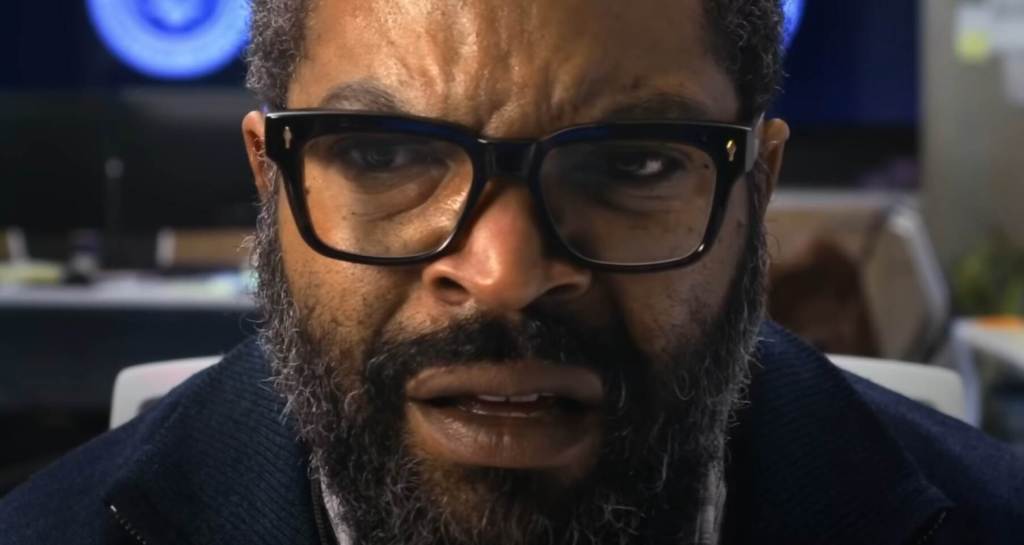
To have this movie be an adaptation of The War of the Worlds—a respected science fiction property that has been remixed by the likes of Orson Welles, Steven Spielberg, and Classical Hollywood—is hysterical and is so bold in its ridiculousness that it horseshoes itself back into being almost brilliant. Think of Ice Cube’s oft-repeated lines when on video call with his colleagues or children: “I’ll circle back.” Each of the aforementioned and adored adaptations, like another popular science fiction novel turned classic film(s), Invasion of the Body Snatchers, has been tackled by several filmmakers who all impart their own social critiques into the central figure of the alien invader. And it is here that I feel this movie and its screenlife style try to accomplish something interesting. A production impacted by the pandemic five years ago, War of the Worlds (brought to you by a music video director and a big tech giant with a $2 trillion market cap) adopts a stylistic approach that mirrors (1) the diegetic patriarchal surveillance of DHS dad Will Radford (Ice Cube), (2) the extradiegetic constraints imposed on people in lockdown, and (3) the formal and economic limitations of a film industry in the midst of a global pandemic. Like another release from this year, Ari Aster’s Eddington, this film (although less expressly) sorts through the wreckage of a world torn apart by Covid-19 as mediated by the increased presence of digital communications technologies in our lives.
What struck me almost immediately about this film is its depiction of care onscreen, or rather how care as we experience it now can only be accurately depicted via screens. In particular, this protective but somewhat distant father (a result of his wife’s death) switches through dozens of windows and tabs and dialog boxes in order to watch over his pregnant daughter Faith: commandeering CCTV cameras and surveillance drones, checking her Apple Watch heart rate monitor, remotely breaking into her MacBook to read her text messages, etc. In one hilarious scene after an alien attack on her lab, Will guides his bleeding-out biologist daughter into a Tesla that he has hacked into, instructing and reassuring her over FaceTime, as a towering tripod alien lumbers toward her position. “Focus on me,” he tells her, as he clicks, scrolls, and zooms through his surveillance application software (aptly named Guardian), all the while simultaneously watching news coverage of the invasion and firing off messages to colleagues. In an affective sense, this is exactly how it feels to live in a post-pandemic world, how it feels to live in the aftermaths of the apocalypses that characterize twentieth-first century life. For example, many still work from home or at the very least are never not answering work texts and emails: the balance between work and life continuing to erode, the internet only having made everyone all the more productive. A consequence of neoliberal network society, the digitized privatization of everyday life. With the younger generations, this takeover looks a little different: Will begrudges his son Dave for staying home and streaming himself playing videogames, but this is a very real (albeit parasocial) response when one is faced with the inability to physically/emotionally connect with one’s peers in person after a year of staying home with only immediate family. Will goes as far as to remotely access his son’s PC and uninstall the new game as an act of tough love. The world feels so much different now, and so does care.
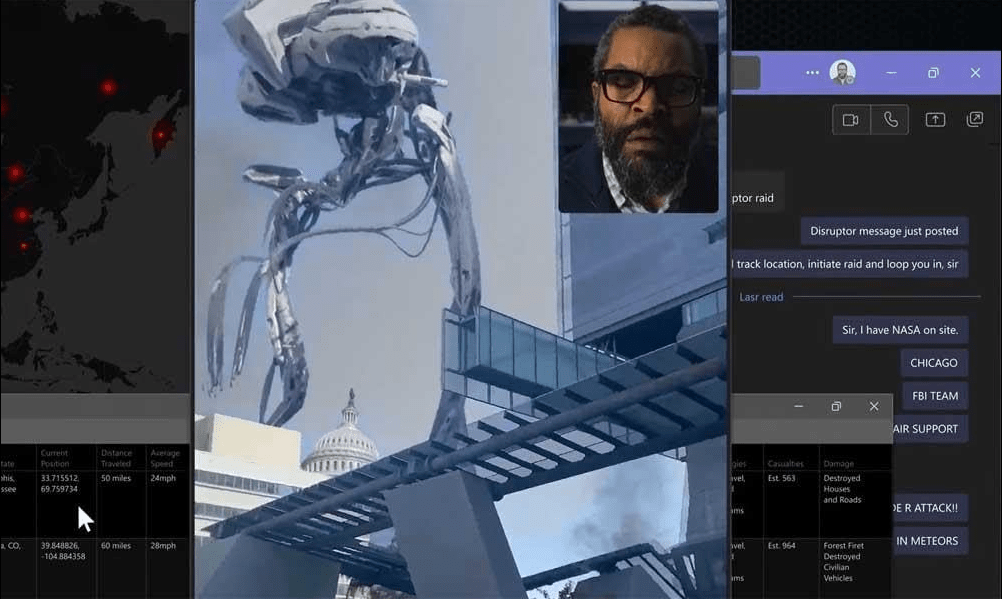
Cinema feels so different now too. Likewise, most of the formal devices employed in War of the Worlds are thoroughly post-cinematic, this film taking place largely on a desktop; however, when director Rich Lee on the rare occasion opts for a standard cinematic device (e.g., a fade to black or a static shot from a nondiegetic camera toward the end of the film), it is these select moments that actually feel jarring and offputting: that is, the language of cinema that we have become accustomed to for over a century is no longer adequate to reflect that which is current. It is exactly that this movie does not take place, take up space1, that heightens its postmodern affectiveness. In other words, the limitations of physical life are dwarfed by the phenomenological demands and precarious neuroses of our internalized virtual environments.
The cameras are off their tripods, so to speak, and like the curses escaped from Pandora’s box, they can never be put back. The camera is no longer even a camera. Moreover, after cybersecurity analyst father and leader-of-the-resistance hacker son team up and fail to infect the data-mining tripods with an “old school” computer virus, the spacecraft-esque heads detach from their robotic legs and fly toward the locations of each member of the Disruptor hacker team, having tracked their IP addresses. In this situation, the camera liberated from its support and itself, we have become not the imagemakers but the images themselves. Ice Cube is relegated to a little box on a Discord call as he watches on helplessly, his home ostensibly destroyed, believing to have just lost his son who he was finally beginning to connect with as well as any trace of his wife, having never cleared out her belongings. Will frantically commandeers a nearby surveillance drone to watch the rubble and cinders. Every man his own Twitch streamer, forced to react when constantly confronted and never not inundated with a feed of all the world’s horrors. Taking this point even further with wonderfully clunky irony, we learn from human characters, who are only ever interacting with each other via screen mediation (there is one marked exception, maybe more on that in a later post), that the occupying threat are hybrid organisms containing both biological and cybernetic components.2 This confusion of man and machine—watcher and watched, invader and invaded—invokes precisely that we ourselves have become the hosts for digital imaging and networking technologies and in turn have attached ourselves to other people primarily and irremovably through these pathways.
And so, according to this digital regime, turning men into cyborgs, how might love, for example, between a father and his family, look and feel? At first, Will is obsessive: he sends his dead wife messages on Facebook everyday, he repeatedly listens to a mundane voice memo she left him, and he spies on his own children in order to feel close to them. So then, what does love feel like at the end of the movie, after this character changes throughout the course of this invasion? Love, as it turns out, is letting people into your system, like a virus. In the finale, as Will ventures out from the safety of his command center for the first time, he relinquishes remote control of his computer to Faith, who has to navigate his multi-screen displays, seeing how her father sees the world and interacts with others, as she guides him through the bowels of the Department of Homeland Security headquarters. In addition, she must also guide her brother as he hacks into military drones in order to destroy the oncoming alien attacks (that look straight out of Action Movie FX, which is in no way derogatory) that are targeting an Amazon delivery drone flying through DC, which is manned by her delivery driver boyfriend Mark, to get to Ice Cube in order to bring him a thumb drive for the “cannibal code,” newly converted from the DNA sequences of a cancer cure into computer code, that will deactivate the U.S. government’s top-secret data collection program, and thus deactivate the data-sucking space invaders. And so, rather than voyeuristically keeping tabs on his own family, the workaholic dad learns to let go and trust himself to trust his children.
Despite its dull insistence on sentimentality and the redemptive power of the family unit, War of the Worlds nonetheless offers an amusing and thought-provoking illustration of the collision, the event horizon between the digital world, the world of data, and the real world, the world of people. As Ice Cube likes to tell Eva Longoria over at NASA whenever she asks him about the recent abnormal weather events that prelude the invasion, “I told you, I watch people.” Even that simple statement alone maintains this confused, collided perspective; after all, he does not actually watch people, he watches images. Yet perhaps that begets the question: what’s the difference?
While I do not think this is an evil or unconscionable movie or even an unwatchable one, it is certainly a self-exculpating venture. When the aliens from another world first arrive, the on-the-ground news coverage style footage immediately invokes climate disaster: one shot especially conjuring the recent forest fires that ravaged California in the last year. Not to mention, when they first arrive, the tripods attack such sites as natural gas pipelines and electric grids, emphasizing the continuing and irreversible acceleration toward ecological destruction. One character remarks that this coordinated assault is not only attacking necessary human resources but also our ability to collectively respond to them. The tripods specifically target these stockpiles, but none are more important than the data centers. And so, this film poses a critique of our economy’s obsessive, full-steam-ahead attitude toward surplus and accumulation by having these parasitic invaders attack sites of abundance and wealth generation for tech oligarchs.3 However, this film premiered exclusively on Prime Video, a streaming platform that belongs to the largest information technology corporation in the world.4 So, of course, Amazon has countless data centers of its own, each comprised of tens of thousands of servers. (No wonder data is said to be the most valuable resource over and over.) In fact, these data centers are responsible for hosting Amazon Web Services (AWS), lending cloud storage services to some of the biggest companies in the world (e.g., Netflix, Twitch, LinkedIn); in fact, approximately one third of all internet traffic passes through AWS.5 Thus, it would not be an exaggeration to say that if Amazon data centers went down, a good chunk of the internet would also be affected. And so, the environmentalist and big tech anxieties become empty platitudes, as these data centers require enormous expenditures of energy in order to store our digital footprints, just for them to be sold as discrete packages of information to advertisers, credit and insurance companies, or even law enforcement. So, these vampiric, bionic reapers (that are invoking climate disaster in the film) are behaving themselves much like these corporations who are significantly causing and entangling these crises in the first place.
Like many projects in this faux populist turn within Hollywood (or really just Hollywood writ large), this film reifies the status quo but now with a little added lip service, but perhaps that is giving too much credit to a movie that no one took seriously. Nonetheless, War of the Worlds would like you to believe that only the federal government with its bloated bureaucracies and bad actors is the one responsible for burning a hole in the ozone layer or for selling out your data to be kept behind glass in case of emergency.6 It is the same blame shifting, buck passing that Disney did with WALL-E; however, this time, it appears that no one is buying it. Frankly, one could easily trace this ethos all the way back to the very inception of the blockbuster form, to fellow H. G. Wells admirer, Steven Spielberg, fifty years ago.7 And so, when any movie tells you how bad things are and that all you need in spite of that is a little Faith, just remember, as this film’s trailer tells us outright, “it’s worse than you think.”
Notes
- Diegetically, it consists mostly of screen recorded desktop footage of a man in his office. Formally, there is no physical medium onto which the images shot are imprinted and those images are further distanced by being frames within frames within frames. Metatextually, as this movie was swept under the rug and dumped onto Prime Video only yesterday with a trailer dropped only a week before that. ↩︎
- In Invasion of the Body Snatchers, as in War of the Worlds, we learn that maybe we are not so different than those who enslave us. Body Snatchers never just about the infiltrating communist threat—although it certainly reflects that Cold War anxiety—but also certainly the stark conformity already present in suburban 1950s America. This same polyvalency can be applied no doubt to Lee’s War as well. ↩︎
- As a result of the alien assault on data centers, Will looks on frantically as the Facebook messages with his wife, the last trace of her voice, her pictures—that is, her digital footprint—are scrubbed from an internet under attack: her digital death. By having the widower retreat into his work following her biological death, the obsession with the digital reflections of his wife, his constant tormenting of himself and inability to let her go, is intrinsically linked to capital’s obsession with constant accumulation for its own sake, way past the point of profit. The latter informs the former. ↩︎
- Not to mention, in terms of self-exculpation, War of the Worlds has for one of its heroes an Amazon delivery driver, saving the day by having someone place an order to activate his delivery drone. ↩︎
- This figure was reported in 2020. ↩︎
- This conversation between Joe Rogan and Edward Snowden goes into details on how and why consumer data is collected ad infinitum: https://youtu.be/VFns39RXPrU?si=w78TBnhvFtfH2qeU. ↩︎
- For more, an essay I wrote on Spielberg’s Jaws: https://householdrubbish.wordpress.com/2024/11/02/out-of-many-one-out-of-one-many-jaws-and-the-contradiction-of-the-new-hollywood-blockbuster. ↩︎


Leave a Reply