Literature

  • A Steam Room of Troubles

    There is no escape, there is simply the
    given, and there is nothing that we can do.
    —Harold Bloom, “Interview,” Diacritics

    Throw your soldiers into positions whence
    there is no escape, and they will prefer
    death to flight. If they will face death, there
    is nothing they may not achieve.
    —Sun Tzu, The Art of War

    I cannot break my months-long fixation with the metaphor of drowning. I notice it, more than ever now, everywhere. It started up once again this time with another fascination: monasticism, or rather the men themselves who were individually and obsessionally committed to it. (What is the place of/for the ascetic in the modern world, if there is any at all?) These two forces coalesced before me in Thomas Merton’s The Wisdom of the Desert, wherein the writer-monk posits that the Desert Fathers—the fourth century ascetics who turned their backs on the realm of the social and walked into the same deserts that propagated the earliest known human civilizations in order to live a life of solitude in the ruins of these empires—opted to “swim for [their lives] in an apparently irrational void.” And for this, Merton lauds them, gently urging his reader to follow in the footsteps (although not quite literally) of these humble Christian forefathers. It would seem that he proposes we willingly accept that going-under feeling (an existential impulse in search of an “‘anarchic’ desert ideal” not entirely divorced from Camus’s train of thought previously referenced) as he celebrates a “leap into the void,” the detachment of oneself from ego, although in surrender to and devotion toward God. Thus, according to The Wisdom of the Desert, this frustratingly slippery answer to the question of drowning cannot be an intellectual one but rather only and wholly a personal, spiritual one. Therefore, he proposes an individualistic solution to a collective social dilemma, which no matter how appealing or personally helpful (and I do find his reflections to have made a beneficial impact in my own thinking), I cannot find satisfactory. So, the fixation remains.

    But for all this talk of the desert, one’s entry into almost all Christian denominations is heralded by christening, baptism, that is, by some submersion of the mortal body in water; this ritual not only undergone for the purposes of initiation but even more so a necessary component of the salvation doctrine. Put plainly by Geoffrey Bromiley in the Theological Dictionary of the New Testament, “[t]he goal of baptism is eternal life.” To add, the act is itself a symbolic conquering of the primary primal(/mammal) fear. It is the very defiance of drowning that inducts one officially into the embrace of God’s undying love. It is no coincidence that the biblical Greek text employs the verb báptō, denoting several water-related actions, namely, “to dip,” “to immerse,” “to bathe,” and “to drown.” However, it is only baptism if you can manage to get out of the water.

    Suffocating in my own snot for the past two months, my body produces this mucus for its own defense against some unknown foreign contaminant. The sickness comes in waves, off and on again. The only recourse, especially when the inability to breathe renders sleep improbable, seems to be the image, to submerge my chills and body aches in hyper-consumptive normality, one shimmering spectacle immediately followed by another with no time to come up for air.

    To allow just one breath of their flows into your system causes your airway to seal itself as to prevent the entry of anything further into your lungs, your body essentially asphyxiating itself. The spasmed voice box eventually fatigues, releasing its dam and allowing fluid to flow freely into your airways post loss of consciousness. Laryngospasm and aspiration, as described, comprise the most common mechanism of drowning. Aspiration, “when something that’s supposed to be in your stomach . . . gets into your airways,” as Cleveland Clinic puts it; on the other hand, aspiration, as in the object of one’s dreams or desires, a goal or ideal to strive toward. The confusion of consumption with respiration in combination with the connotation of aiming toward a yet-unrealized future spells out the exhausting stalemate of the contemporary dilemma of drowning. Much has already been said of the collective inability to imagine a future that is not worse than that dictated by our current downard spiral trajectory. And so, consumption is the new respiration, having effectively replaced it to where it is no longer possible to imagine life without this ubiquitized, digitized, convenient version of it. (Note how false prophets who extol such solutions as the “dumb phone” or call for the resurgence of pre-streaming technologies all must look backward: this is precisely not imagination, this is nostalgia and self-help guruism.) We have nothing left to aspire to.

    When the sickness washes out with the tide (and like any tide, only temporarily), I have to reckon with the consequences of this gross submersion: not the endless coughing to remove the excess phlegm from my nasal and escophagal passages, but the new habit I have picked up over and over again, the one that nobody can seem to kick for good.

    “Modern life is a sea of images”: this is how Camille Paglia establishes her historical tracing of Western art in her 2012 book, Glittering Images, with the very first line. Paglia believes us, especially children, to be dangerously flooded with overstimulating digitized distractions, proposing “self-education in art” as the salve to ease our detiorating socio-politico-cultural landscape and turn back our declining attention spans, seductively worded with plenty of aqueous metaphors. Again, I do not even necessarily disagree, but find this answer ultimately unable to grapple with the phenomenology of drowning on the basis of its do-it-yourself, individualist stance, an iconoclastic one that is informed by Paglia’s personal brand of libertarian feminism. Is there nothing outside ourselves that can save us from this boundless, mesmerizing sea?

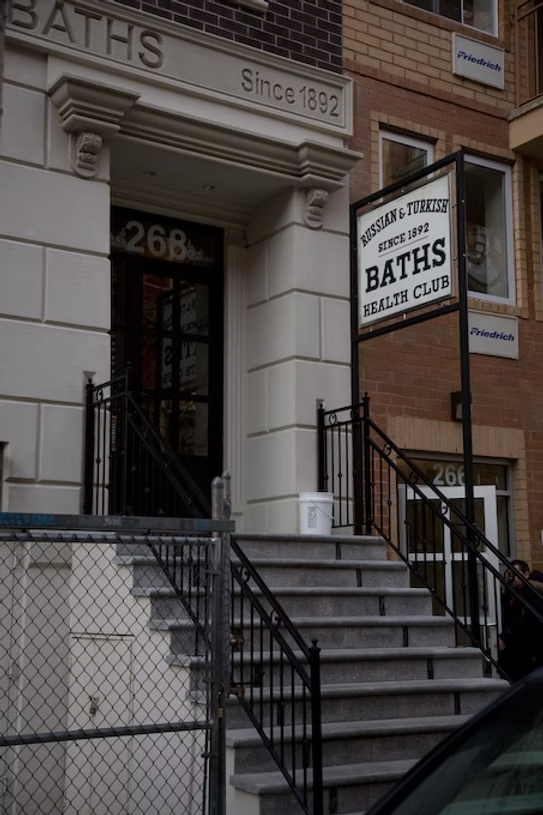
    It was not until I took my first visit to a bathhouse that I gained some insight, or at least anecdotal experience, regarding the implications of a contemporaneity figured in a constant state of drowning. Sitting in the warm caress of an 118-degree steam walk-in, I first noticed changes in my breathing within a few minutes. My ability to inhale oxygen felt dampened, my breathing shallow. Attention moves solely to breathing, as you force deep breaths in and out in spite of the oppressively humid atmosphere. You find it is not impossible, only requiring more effort and focus as you readjust to the new climate. As the hot water pours into the bucket on the floor and fills the tile chamber with water vapor, you retreat further into yourself, losing sight of the other bathers sitting only several feet in front of you. To not lose your cool, to resist the panicky feeling of drowning, it is almost as if you are actively required to continually and wholly center your own bodily experience. Then, in a moment, you begin to think about every single bead of water on your body, the sweat being pulled out of every pore, until you feel every little thing with exacting acuity. Behind a cloudy visual field, your body and the environment begin to merge in your mind. Is this particular drop of liquid rolling down my back from the room or from me, condensation or perspiration? The air begins to clear, the fog slowly dissipating but never disappearing; the hissing, boiling water from the faucet into an overflowing bucket runs slower but never gets cold. The collective comes back into frame in the breathing room, where one can once again see and hear the reassuring dissonance of others’ labored breathing. The site of arduous labor and pointed focus returns momentarily to a site of communal recovery and socialization. When all is said and done, for lack of a better word, it feels like microdosing drowning.

    “Hence baptism has no purely external efficacy and in itself is unimportant,” writes Bromiley. Much like the lack of a unified scientific consensus on the positive health benefits of heat immersion, the purpose of the steam bath is more appealing as an internal exercise, a test of will not wholly unlike the retreat of the ascetics into the desert. (It is no coinicidence that it is cultures outside of or adjacent to the Occident that tout the physiological/psychological benefits.) Nonetheless, not a discredit to its potential as therapeutic practice, forcing oneself to reckon with the sensation of drowning in a controlled environment. Yet, to further reiterate, drowning seems particularly unaccomodating to solutions of intellectual- or spiritualization, at least in terms of a large scale, collective response against its imposition on every human tendency toward life (if that is something even worth looking for).

    All that being said, as my avocational trip into the mist reminded me, there is no building a tolerance to drowning. At the end of the day, drowning is simply drowning. It is a metaphor that has haunted the greatest dramatic minds and works of the Western world. In Shakespeare’s magnum opus, the eponymous prince of Denmark for all his courtly brilliance, like the very playwright behind his words, could not remedy the drowning problem. In the most famous verse ever written in the English language, Hamlet asks, “Whether ’tis nobler in the mind to suffer // The slings and arrows of outrageous fortune, // Or to take arms against a sea of troubles, // And by opposing end them.” It always comes back to the same binary choice: kill yourself or suffer. Shakespeare explicitly ties the deathly option with water, worded as if double entendre, invoking warfare against “a sea of troubles” and the physical action of swimming, that is, “tak[ing] arms against” the determined direction of a most powerful current. “To take arms against a sea of troubles” is to “swim for one’s life in an apparently irrational void” is to tread water until exhausted strength drags under an unwilling body. And so, there really is no choice in the matter at all: it is always and simply, suffer and then die. Therefore, it would seem that the question of drowning is no question at all, but an indispensable fact of human existence: that is, that the human condition is the condition of drowning. Yet, we insist on creating for ourselves infinite petites morts—little drownings, figurative ones, ontologically pharmakonic—to avoid facing la grande noyade.

    In his science fiction novel, The Futurological Congress, Stanisław Lem differentiates between the two drownings. Throughout these passages taken from the memoirs of the fictional Ijon Tichy, Lem’s absurd man experiences hallucinatory breakdown after hallucinatory breakdown of an eccentric future world that itself already resembles a psychoactive drug-induced hallucination. As Tichy succumbs to the dissolution of his reality, he is transported into other illusory ones, sometimes even residing within them for extended periods of time, like the alternative lifetimes lived by those under the influence of a salvia trip. The world of this novel and the starting point reality of Tichy is one already heavily medi(c)ated by a laundry list of hallucinogenic drugs with any single expectant emotion existing in dosage form. Before his Dantesque descent into the bowels beneath his reality (literally as he takes refuge from a terrorist attack in the sewers), Tichy mistakenly drinks the tap water at the hotel hosting the conference. As a result, he accidentally acquaints himself firsthand with the psychotropic effects of benignimizers, a class of mind-altering substances that do exactly what it sounds like:

    Every analytical reflex was as if submerged in thick syrup, wrapped and smothered in a porridge of self-satisfaction, all dripping with the honey of idiotic optimism; my soul seemed to sink into the sweetest of oozes, like drowning in rosebuds and chocolate icing.

    It is here that the reader encounters the only instance of the word “drowning” in the entire novel, in a novel that bombards the reader with an overstimulating overabudance of absurd scenarios, characters, and visual images, in addition to its motif of water, especially submersion. It is worth highlighting that the only form of the verb “to drown” is conjugated in the present continuous tense here and, more importantly, presented as a simile. After Tichy’s persistent trips into alternate realities and consciousnesses, he awakens, as if from a dream, from these altered states when he rolls over into the waste water beneath the Costa Rica Hilton.

    In the non-place of the Hilton, after enduring the effects of the drug-laced water, he remembers he was not seen anyone drink any water. This is a future where just about everything except water is consumed. If someone is thirsty during the Futurological Congress, “they would have a coke, or a schweppes,” always something prepackaged and for sale. Perhaps in this avoidance of the nectar of life, the inhabitants of this funhouse mirror world have drowned out their fear of drowning, and as a result, their connection to its life-giving properties. It is precisely this interaction with that insurmountable animal impulse within all humanity that snaps Tichy back to “reality” one last time, finding himself once more fallen into the “stinking, blessed waters closing over [his] head . . . choking on the foul swill, but happy, happy!” Here, Lem expresses the necessity for contact with the threat of “real” drowning as opposed to the “false” drowning of addiction and self-medication but also, even more so, psychiatry and overmedicalization. Realizing that he has finally made it to the second day of the convention, Tichy laughs uncontrollably, startling one of his colleagues who drops the manuscript he is fussing over. The document falls into the dark water, “float[ing] away—off into the unknown future.” Here, Lem concludes his work on an uncertain yet contently fatalistic note, and working within a genre that conjures the present in its vision of imagined futurity, does not pretend to hold the answers.

    I do not feel so bad if even the greatest English dramatist in his finest poetic hour or the most widely read science fiction writer channeling Aldous Huxley could not write us beyond this fatalistic condition. I can accept that and it. I do not believe any one can pull us out, for life is sin. You pay for the mistakes of the past with your advancing age. Your bones creak from the abuses of adolescence. Your relationships all mirror those that came before you. That which was done unfortunately unto you, you will unfortunately do unto others. Everything that has been done has already been paid for, someone has already picked up the tab. We are fallen, and the water is rising. If history has proven anything it is that the world will keep ending for generations to come. Memento mori ad infinitum. There is no reversing it, despite the feeble protestations of those suggesting lofty, impossible radical (re)turns, to some manner of means by which we used to or ought to be conducting ourselves. I cannot go back. I have no memory. We can never afford to go back, to pay back. Everything that has ever happened is right here with/in/out us. Full steam ahead.

    , , ,