
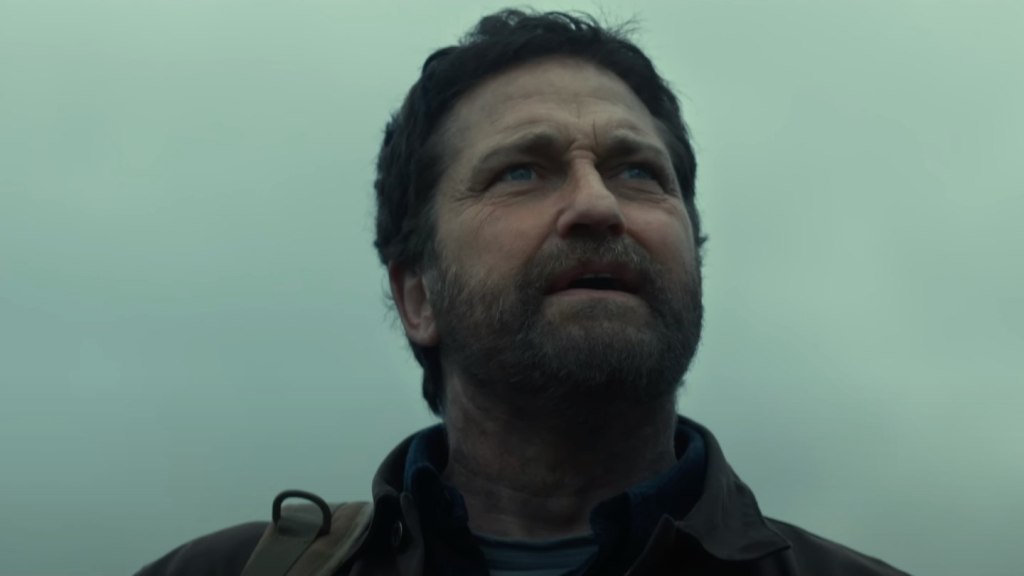
In the apocalyptic world of Greenland: Migration, family is all about sacrifice. Family is everything and everything must be sacrificed to ensure its continuation. In Ric Roman Waugh’s sequel to 2020’s Greenland, family man John Garrity leads a band of survivors after the destruction of Greenland Station on an expedition to a scientifically anomalous paradise in a crater somewhere in the south of France, where the possibility of life reflourishing might still exist. As it turns out, this international trek across oceans and land masses ends up being little more than the single-minded effort of one father to secure the future of his family. Throughout the film, the entire cast of side characters that offer to help John, wife Allison, and son Nathan ironically all die in the wake of this family’s mission. Rather, everything in their wake gets destroyed, whether by soldiers, marauders, tsunamis, electromagnetic storms, or earthquakes, but always managing themselves to escape in the nick of time. Even institutions themselves—science, the democratic process, bureaucracy, the military, other families—are sacrificed on the altar of the American nuclear family.
John (played here with a convincing nuance by Gerard Butler), as established in the previous installment, is a successful structural engineer who is selected by the U.S. federal government to relocate with his family to an emergency shelter before the initial impact of fragments from the deadly comet, Clarke. Throughout the course of that film, the Garritys lose everything that John worked so hard to provide them. And so, with the loss of their suburban home and upper-middle class lifestyle, this John does whatever it takes to keep his family alive while the John of Greenland 2 does whatever it takes to reunite his family with all that they lost five years ago. Put simply, surviving versus thriving. Greenland 2 most obviously speaks to a generation of children who grew up socially isolated as a result of the coronavirus pandemic, but also to the fathers of these kids who see that what they were once able to build for themselves and their families is no longer obtainable for their kin. To add, the radiation sickness that John hides from Allison and Nathan adds dramatic weight to this fact: yet another emotional burden that the traditional family man must bear for those he promises to love and defend. It seems that only in the aftermath of a world-ending event like Clarke is it possible to imagine a young person living a life as materially secure and fulfilling as their parents’.
There is however one notable exception to the rule dictating death behind the trail of the Garrity family. After reaching Calais, the Garritys are taken in by a Frenchman, Denis Laurent, and his family, Camille, a daughter Nathan’s age, and a mute, wheelchair-bound wife. Despite their kindness and generous accommodations, the dying John is determined still to travel to the crater, this new Fertile Crescent, just for a rumor’s chance at a new life for his wife and son. Thus, Denis begs John to take his daughter with them, to accept her into his American nuclear family—ostensibly the only surviving relic of the old world that can withstand the shocks of Armageddon. This plea is the chance Denis takes for the continuation of his family; therefore, he remains unharmed by the wave of catastrophe hot on the trail of the Garritys, as he offers them a sacrifice in the form of his daughter, who is likely to form a romantic pair with John’s teenage son.
But for all this, the price must be paid. For all the sacrifices made for the future of his family, John must forfeit his life. The father must die. In the final minutes of Migration, John drifts into a peaceful sleep, having sustained a fatal gunshot wound protecting his loved ones but nevertheless delivering them to the summit of the crater’s paradise. Nathan, having earlier demonstrated skepticism toward heavenly salvation and religious ritual, kneels over the body of his father and wishes his soul safe passage in death. The overhead camera soars upward before fading to black, John rewarded with respite for a job well done. Yet, the work is not done. Over the final images of civilization reborn, John becomes a disembodied guiding voice(over) to the viewer speaking directly to them. God the Father and faith itself will continue to shepherd humanity in this next phase of its evolution. John the Father urges mankind that it is not too late to treat the planet and each other more justly, concluding the film on an optimistic note in an otherwise grounded look at the disappearance of the future, in this case, via environmental collapse. Therefore, Waugh settles his film, narratively and tonally, in opposition to other such works, for example, the speculative apocalyptic nightmare of Threads (1984, Mick Jackson). Does the family unit as we understand and abide by it have no place in the future? It seems to be but one element that will lead to our destruction while also being our salvation.


Leave a Reply