
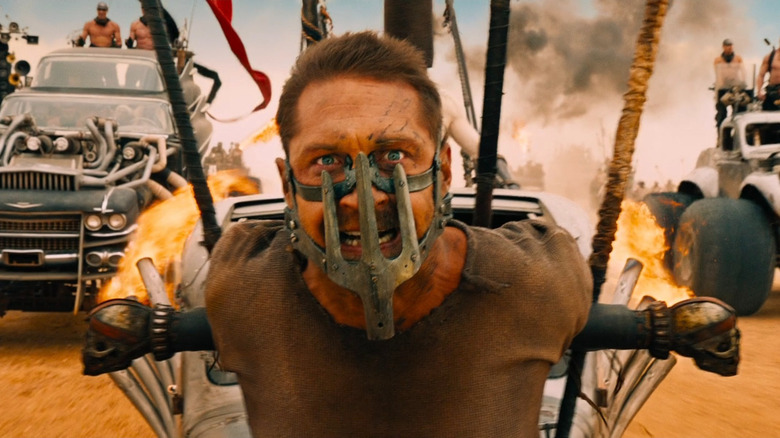
You know, hope is a mistake. If you can’t fix what’s broken, you’ll go insane.
I. MAX CAN’T STOP MOVING.
There is no paradise to which one can return; even if there was, there certainly wouldn’t be room for just one: it’ll have to be all or none. It’s a simple premise. A diverse group of characters must band together and share in the only instinct afforded to them in the desert wasteland of George Miller’s creation, that is, to survive, as Max establishes in the film’s opening soliloquy. Surviving until it feels like something more than just survival. Unparalleled visual poetry on an impossible scale. Yet still with such a precise and graceful hand, this movie speaks universally to life in the West (fittingly enough, all the characters we follow can be traced back diegetically to some notion of west—sex slaves, soldiers, and blood bags alike). The West, where life is constantly accelerating ever faster toward no future at all. Thus, the only one way to progress beyond hierarchical systems is to constantly stay ahead of them, to push out from within them. A process of deterritorialization that must outpace an opponent that is more machine than man. In this world, accelerating ahead of the machine requires deforestation, a perverse form of terraformation in the desert hellscape of Mad Max. It’s funny, I almost felt bad for the lone tree getting uprooted, but the tree is dead. It’d been dead. Rip out its roots and pull yourself out of the sour earth. Rip out its roots and plant something new. Rip out its roots and destroy your past. It was never about hope (in the world of Mad Max, such a possibility bears no fruit), it’s about activating the utopian potentialities within the dystopian, unearthing them. The tree wasn’t just destroyed, it was leveraged, teleologically endowed with a purpose alternative to that assigned it in life. Even in death, a thing can save a life. Max’s vision of a girl he failed to protect causes him to flinch and shield his eyes, blocking an otherwise fatal crossbow bolt. In Fury Road, people are things, subjects collapsed into objects. You own the objects (water, guzzolene, bullets), you own the people. Everything is a commodity. Miller offers two alternatives through Max and Furiosa. Furiosa ascends, bringing resources to the masses in the process. Max vanishes into the crowd. The last look they share is recognition of the other’s role: Furiosa the leader and Max the guerrilla. So, they are not mutually exclusive paths, but, in fact, two prongs of one attack to jumpstart the world out of its inertial stagnation. “An object at rest will stay at rest.” People are objects. “Unless acted upon by an unbalanced force.” There is no velocity without first acceleration, without first an initial force. Furiosa imagines a better world for Immortan Joe’s breeders, motivated by nostalgic escapism to return to the Green Place, a place that no longer exists. Miller does not allow any such fantasy to last for his audience either, enduring criticisms that “they just go in a big circle.” On the contrary, they travel in a line. “I suggest we go back the way we came,” says Max. Every action has an equal and opposite reaction.
II. WHAT MAKES MAX SO MAD?
Therefore, the structure of the narrative is not, in fact, deterritorializing or schizophrenic; rather contradictly, it’s expressly linear. And so, it is actually the character of Max who possesses these characteristics. He is haunted by hallucinations and has maintained his flat and withdrawn affect for an extended period of time, on their own enough to constitute a schizophrenic diagnosis. Mad Max receives a hallucination in the midst of a fight to the death, his mind invaded by a dead girl, reflexively jerking his hand upward to miraculously block a shot to the head. For a man who is merely surviving, Max is effortlessly and unconsciously crossing through the zones that comprise our picture of the world with this one gesture. His mind, recalling happenings from the social realm of his past, prompts his body to act automatically, which later allows him to bring the War Rig, with the corpse of Immortan Joe in tow, back to the Citadel, effectively altering the material reality of its inhabitants. To move history forward according to some notion of historical progress (even in a post-apocalyptic wasteland), a schizophrenic voice is needed, and as Fury Road demonstrates, it needn’t speak very often. For the other passengers of the War Rig, as well as the truck itself, are more markedly linear in their motivations and movements. Max breaks the mold. Everyone believes in hope ostensbily, except Max, who is the better off for it. He does not cling to linear notions of personal growth or historical progress. In the very first shot of Max, he tells us, “It was hard to know who was more crazy, me or everyone else.” He is the ultimate nomad, moving from place to place in a time and space where there is no sense of place. It’s not until he’s about to get branded (by a hot iron in the shape of Immortan Joe’s insignia) that he takes his line of flight, escaping from his captors. It is here that he goes from potential prison laborer to blood bag. To be branded is to be labeled, to become a subject, a demographic. The branded Imperator needs the nomad, the agent and object of deterritorialization. As the tagline reads, “The Future Belongs to the Mad,” and maybe that’s because they’re the only ones who can bring it about.
III. INSPIRATIONS AND INTERESTS
https://www.youtube.com/watch?v=2TE7HFBzf-w
https://journals.sagepub.com/doi/full/10.1177/1474474018787308


Leave a Reply