
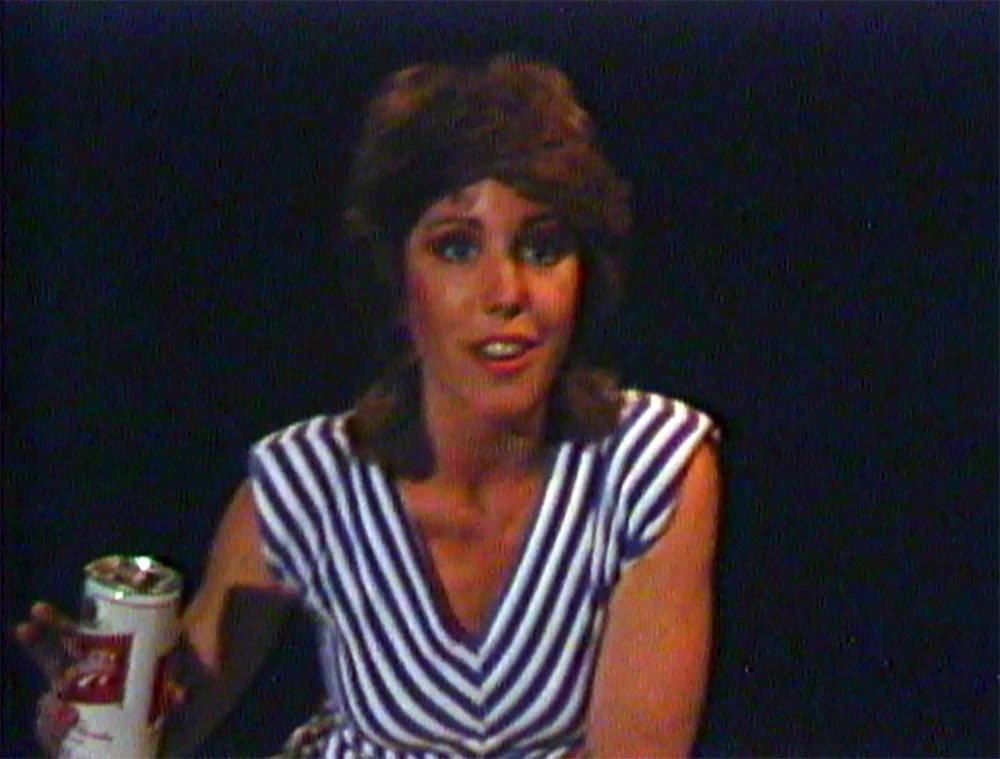
It struck me toward the end of Dale Herd and Barry Hall’s Dreamland Court that this experimental narrative videotape acts as a reversal of Michael Snow’s structuralist masterpiece. In Snow’s Wavelength (1967), an extended snail’s-pace zoom occurs for the entire duration of the film with characters passing through the space, the camera independent and indifferent to their presence. In Herd and Hall’s “performance tale” (based on the novel by Herd), the conceit is centered around a series of four characters shot alone and only in close-ups or medium shots, as they perform directly into the camera. Both works take place on the periphery, but with divergent approaches to narrative and mise-en-scene.
While the direct minimalist approach of Wavelength eschews emotional investment in its actors/characters, it does not entirely forgo characterization, offering only glimpses of some sort of narrative with the static, zooming camera registering actors more as mere set dressing. Dreamland Court, inversely, foregrounds its characters through claustrophobic yet empathetic framing. As for mise-en-scene, there isn’t any, not really anyway. Herd and Hall offer impressions of an inhabited space, but the effect is produced somewhere in between the images: that is, a change in the color of lighting, a new or recurring wardrobe, soft music or chatter in the background, thus signalling whether someone is back in jail or sitting at a dive bar or laying in their bedroom. The four characters (Johnny, Jackie, Carson, and Joann) are presented for the viewer’s scrutiny against a minimal or non-existent backdrop, inviting one to piece together the translucent dynamics that inform these four entangled lives. All this to be intimated without ever having to be seen, without ever seeing them act together; the rest is to be imagined. (Even now, I cannot tell whether the mise-en-scene I am able to recall was in fact videotaped by the camera or intimated by me according to contextual cues.) This approach hinges entirely on its four characters and the unbelievably compelling performances given by these talented, underappreciated actors. And for much of the video’s runtime, it is apparent they are all in some perverse form of dialogue with one of the others at some point. Even while oftentimes acknowledging one of the others or addressing them by name, as if speaking to them face-to-face, it never feels like shot/reverse shot. The rhythm achieved between the montage and the actors feels more like a series of epistolic vignettes than a conventional cinematic construction of legible, contiguous space-time.
From the first address of Johnny, a down-on-his-luck jailbird with a lucky streak, where he looks directly down the lens of the camera, Dreamland Court situates itself in contradistinction to Hollywood continuity editing. Each character is shot straightfoward as they talk to/about themselves, another character, or the audience—each inhabiting their own uniquely determined and identifiable spaces. Dialogue spoken exclusively as monologue adds a heightened degree of theatricality and hinders the possibility of the videotape’s editing as intercutting. To an outside observer, everything has already happened (in between the edit) before the next character reacts and gives their take on the events that were just described to us (i.e., a failed suicide-by-cop, a violent confrontation, or an accidental pregnancy). A constant game of catch-up for the viewer and these socioeconomic outcasts of 1980s LA. And so, the editing is not refusing narratively motivated cutting outright, but eyeline-matched shot/reverse shot as a foundational basis of spatiotemporal continuity is stretched beyond coherency. Dreamland Court as a text always feels gleefully disjointed as Johnny, Jackie (his unsatisfied wife), Carson (Johnny’s close friend and Jackie’s lover), and Joann (the teenager that Johnny presumably gets pregnant) are never pictured in the same place at the same time.
Like Wavelength pushing the bounds of its own central experiment (e.g., by mixing multiple film stocks, stitching together multiple shots, applying color filters, intensifying a nondiegetic, high-pitched whine, etc.), as Dreamland Court goes on, characters start to walk out of frame as they monologue, the camera refusing to track them as they leave their mark, or they’ll have their face framed in three-quarters profile and positioned mostly offscreen to accentuate the negative space, or indiscriminate zooms in and out. Moreover, in one instance, a dialogue overlap of Johnny onto a shot of Jackie rings more discontinuous than the device’s usual cinematic deployment for the sake of smoothing over stitches between shots/scenes. (Can these monologues even be called scenes? Between the many appearances of all four characters, there are little identifying markers to distinguish one appearance from the other beside a tightly-framed change in wardrobe or lighting.) In addition, the final two shots—Johnny and his naive teenage girlfriend, both talking about her possible pregnancy—stand out from the previous vignettes and forgo the typical spatiotemporal ambiguity of the video. These two appear to communicate more directly and immediately than any other instance in Dreamland, looking out at each other across space and time to somehow envision a happy life together, if such a possibility can even exist.
Where Wavelength drives toward its own death with unrelenting force, toward the photographic basis of cinema, Dreamland Court explores video as a medium in which to converse with oneself. Through the monologue and the video camera (with the actors likely witnessing their own image as live feedback via CRT monitor), Dreamland Court’s performance tale explores two intertwined threads of video since its inception: as narcissistic and/or therapeutic practice. At once, these self-aware/deluded inhabitants of the LA underworld are talking to/for themselves, “puking” (Johnny’s preferred term) their oftentimes embarrassing and turbulent emotions in a similar vein to therapy methods implemented six decades ago, involving patient self-confrontation via video. According to one such experiment conducted in 1963 at the University of Mississippi, the aim was that patients would see themselves objectively, as an object and as others see them, in order to motivate psychological growth (Collopy 109). To engage with and invest energy in the self-as-image was actually suggested as a cure to narcissism. Another experiment saw one subject conversing with himself as a means of self-conducted therapy and fostering a richer awareness of his ego (110). Famously and contradictorily, Rosalind Krauss formulated video as based upon a psychological medium rather than a material one, that of narcissism. She argues that the feedback loop causes artists, modulating and reacting to their images in real time, to invest energy inward, into selfhood, as opposed to an art object. And thus, Dreamland Court juggles these two oppositions of the video art dialectic expertly, mirroring the well-intentioned, forgotten, desperate, heated lives of a Los Angeles couple and their extramarital lovers. In their comitragic hoping against hope, Johnny, Jackie, Carson, and Joann find meaning and misery, heartbreak and a fresh start within their individual, collimate prisons—not to mention the emblematic jailhouse that habitually imprisons Johnny, testing the limits of all their relationships in turn.


Leave a Reply