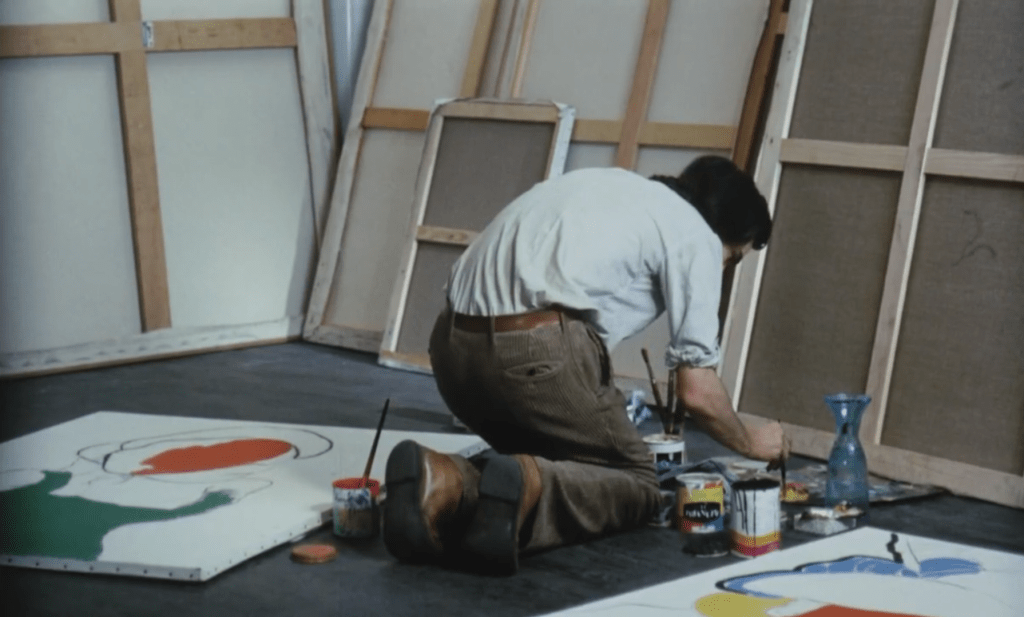
In the closing minutes of Bresson’s second color film and third Dostoyevsky “adaptation,” the usually perambulatory Jacques silently hunches over two partially painted canvases laid across the floor. Earlier in Four Nights of a Dreamer, the viewer catches a glimpse at a couple such paintings that have been more or less finished: large faceless portraits of women defined by bold outlining brushstokes of black uniformly filled with vibrant hues of pure primary and secondary color. The young artist tries to find his ideal woman on the streets of Paris and on the canvases that he leans against the walls or lays across the floor of his studio. Rather, he translates their fleeting forms onto the canvas. As a former colleague from Beaux-Arts tells Jacques, art is about absence, the dual-sided disappearance of the artist and the object. Unable to approach the women who catch his eye and whose eyes he catches, Jacques speaks longingly, poetically of imagined scenarios into his portable tape recorder. In his poetic musings and De Stijl-meets-pop-art portraiture, he removes their features, perhaps unable or unwilling to remember them after his countless failed “attempts” at romantic connection, or perhaps in search of their essence, what they can all be reduced to most essentially, but more than likely this project leads one to his own faint-hearted idealism. This is the impression Jacques offers when Marthe asks for his story, he having just pulled her from the ledge of a suicide attempt over the Seine, having spent one year in wait for a lover who has finally returned from abroad only to ostensibly forget about her. It is as if Bresson took Louis Daguerre’s famous photograph from the Pont Neuf—its panoramic view of the river, the bridges, and the two figures in the foreground, resposing in the shade—as the starting point for his most lovely, sensuous film. Said to be the first photograph taken en plein air and with a visible human figure—and even more, there are two of them. Maybe they are in love, maybe they are not, who is to say.
Let us step away from the impetus and back toward the end. In this scene before the last drowsy blink of the camera iris, Jacques paints an aural picture, a daydream reunion with Marthe: she will apologize profusely for her having abandoned him on their fourth and final night together in favor of her unnamed lover who passes them during the busy nighttime scene. He wants her to admit her mistake, to suffer “one thousand deaths” for him as a result of her decision, but more than anything else in that moment, he wants to be with her again. He ends his soliloquy, rewinds the tape, leaves the recorder at his bedside, and plays back the words he has just spoken. On the other side of the room, he kneels before his painter’s palette, surrounded by the reverse sides of several large paintings already completed with two primary works in progress situated on either side of him. His inability to focus on one or the other recalls the beginning of his story that first night on the bridge: Jacques spies an attractive woman through a shop window, they look at each other with interested glances, he follows her down the street but never approaches, and when he eventually loses her, another grabs his attention. His back turned to the camera, Jacques mixes yellow tube paint with water, trying to achieve a desired consistency, going back and forth between adding more paste and more water. He cannot seem to find the right balance—or maybe he is simply stalling, putting off the work he knows needs to be done—as with water-miscible oil paint, too much water will cause the paint to not adhere to the material support. He abandons this prolonged effort and turns away from the palette and the right hand’s canvas, twisting his focus toward the other open-faced canvas on the left, where an open red paint can sits between the bent artist and his work. Like the others, it is a portrait of a woman: he has finished most of the coloring on her dress green while the halted progress on her face divides her into two halves—one side, red brushstrokes; the other, blank. Without any need for water, he firmly presses and applies the red liquid onto the black-outlined area just above her expressionless, dichotomized face. The adjoining shapes become conflicting ones through their identical hue, marking a new direction for Jacques’s work, wherein previously no region of one highly saturated color is seen to border another of the same color. Further, in the first flashback at his studio, Jacques gets distracted by the conjurings of his own tape-recorded imagination while at work on a similar portrait; however, this red-skinned model’s hair is already in the stagnated process of becoming yellow. And so, the yellow paint Jacques was fussing over was intended to be the brown-blonde hair of Marthe. (He may have been watering down the paint, as when a water-soluble pigment—if that is what it in fact is—is greatly watered down, it will dry darker. Perhaps, Jacques was trying to recreate the subtleties of Marthe within the preestablished astringency of his minimalist style.) Instead he opts for red, the same unmistakable hue of the scarf he bought for her and lovingly wrapped around her head only moments before she left him alone on the street, for the man she believes herself to love more.
This is what becomes of the dreamer. Subsisting himself on fantasies from fleeting memories and imagined fancies, he can only think to expel these feelings outward into some great project he is too embarrassed to share with anyone. He sees his dream as “flat and boring,” but he is a slave to it. Jacques will not be able to get Marthe out of his mind until he captures something of her in his art, so that her canvas, her image can be flipped around and leaned against the wall with all the others, but the ideal will still persist and there is only so much room. The floor is filling up and the walls are bare. A man is condemned to dream, to chase his ideal until he is able to impress it into the mind’s of all men.
A question was posed to me recently. How is it that after hundreds of thousands of years of evolution we have not found any means to deal with the question of dust? The fact that our race has not found a way to effectively circumvent or prevent dust proves we must still have a use for it, no? We have not evolved past it because we have not evolved past the need for it.
Dust derives from non-use. Dust signifies lack. Dust is death. But dust is also smoke, and where there is smoke, there is fire.
Political art is dead. And while it is incredibly hacky to declare an entire insitution that no longer holds the cultural gravity that you wish it did as dead—poetry, cinema, music, cultural criticism—nonetheless, my visit this afternoon to the Cristin Tierney Gallery served to strengthen this sort of claim, even if it is a lazy one. Political art today is dog shit. So, let me rephrase: good political art is dead. I am not against political art, but I am becoming even more of an anti-moralist. Donald Trump and his consequences have been a disaster for the art world. (Adam Kotsko’s essay in the Atlantic on the adoption of evangelicism by the mainstream Left summarizes and critiques this problem excellently.) Gone are the days of Eisenstein and the “Dialectic Approach to Film Form”; say hello to the milquetoast headline-driven slop of rampant radical liberalism! At this point, I would take another film as thematically reprehensible and vile as The Birth of a Nation if it meant we got something that managed to be both formally groundbreaking and overwhelmingly popular.
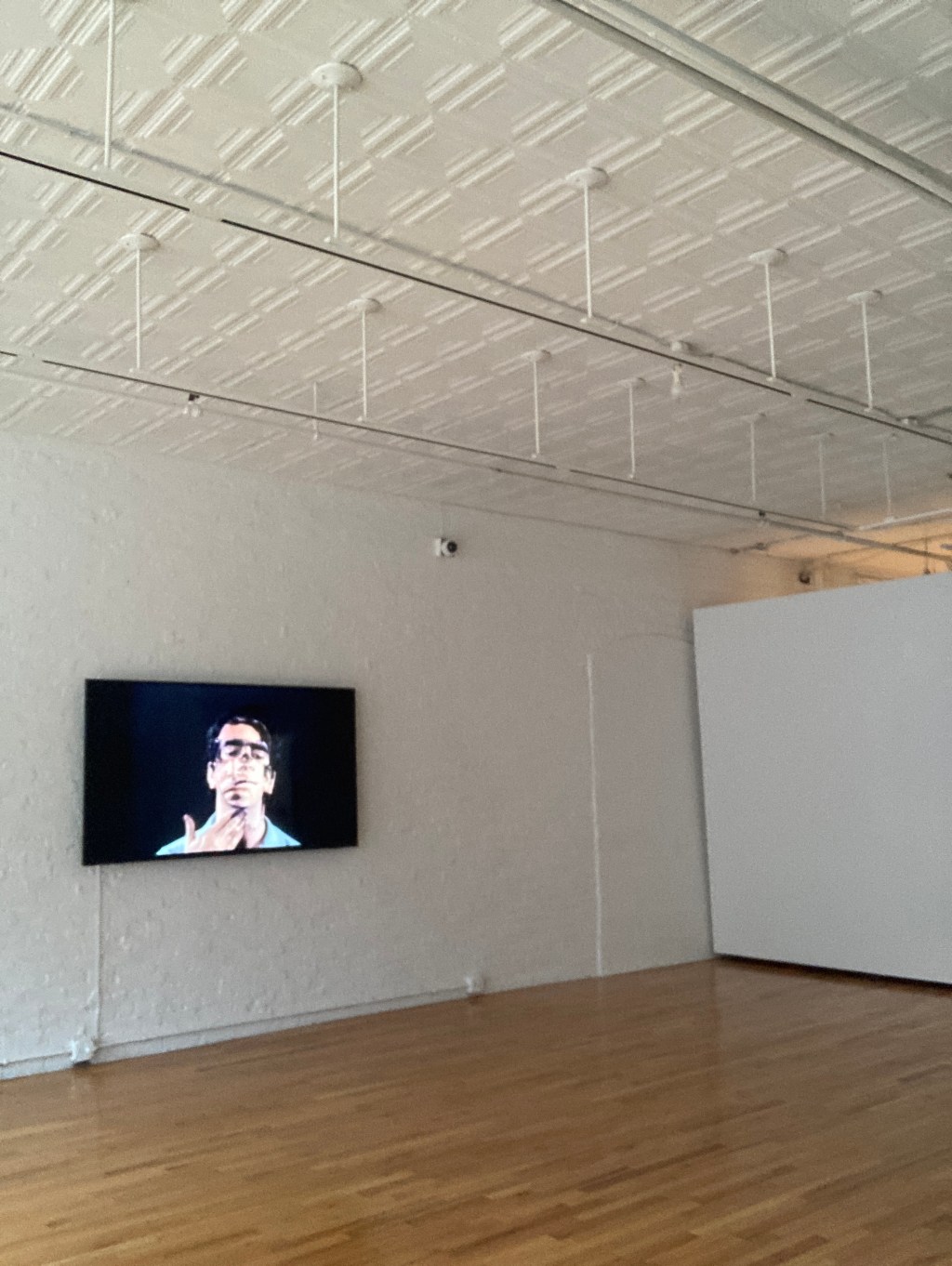
My visit was initially prompted by my research for the Three Transitions essay (that I just finally pushed into the good-enough-to-post stage yesterday), where I learned that this space would begin screening this video by the time that I would be in the city. The chance to see a Peter Campus in person was too good to pass up. The Cristin Tierney Gallery is a sleek space, its up- and downstairs walls entirely white with lots of open space due to the limited works on display. I knew Campus awaited me upstairs, but I walked through the lower level first: mostly paintings, some sculptures, a photograph or two, and a single-channel video—all a part of the ongoing Masculinity in Contemporary Art exhibition. None of it really did anything for me, but I do wish I would have stayed to watch the entire runtime of the video, as its cover image was the most striking and interesting on the gallery website.
The work that most annoyed me was a series of sculptures (?) by Jennifer Dalton, Mistakes Were Made, in which she just writes out slogans that are vaguely apologetic and clearly orbit around #MeToo. It was only after the fact when I read the exhibition information packet that I learned they were all apologies from famous men. So, sure, you could read these works as reflexively acknowledging the phony, placatory tone of these celebrities through the felt boards and chalkboards and cinema light boxes, but lazy moralizing and pandering became smug condescension when I read their titles (absent from the wall). Really, Matt Damon saying he should take a backseat on women’s issues and Joe Rogan admitting he’s said racist stuff is comparable to Kevin Spacey raping young boys? I know, patriarchy and White supremacy encompass all of these instances and they all contribute to their cultural proliferation, but what does this series hope to accomplish? “Please, clap.”
Kevin Spacey says “Honestly” So It’s Probably OK (2020, Jennifer Dalton)
Thinking more and more about it, I could see this piece critiquing that White liberal, virtue signaling, empty slogans in wacky fonts accompanied by flat illustrations, purely aesthetic style of politics (identified by Brad Troemel in his The Left Can’t Meme Report, also coinciding with the phenomenon he identifies as “literalism,” similar to Kotsko’s diagnosis that “we are all evangelicals now”); however, the rest of the gallery does not lead me to offer that charitable a reading. God forbid a work of art run the risk of “misinterpretation,” better tell everyone exactly what I think about a given issue, so I can’t be criticized for having the wrong opinion! The choice of media strikes me as not befitting of the subject matter either, as this bland appropriation of kitsch/camp aesthetics is practically inseperable from overly earnest liberal White women who don’t understand irony and love to drop words like “anti-racist” or “trauma” into every conversation. This style of post-Trump contemporary art practically broadcasts everything about it before you even get the chance to look it over a second time. Needless to say, I did not need to spend much time in this part of the gallery. What screams gentrification more than mediocre art in the middle of the Bowery? Maybe I’m just an asshole.
I walked out, went to the next door over and was buzzed in to go up to the main attraction. This space was even more open: only a flatscreen television playing Three Transitions on loop was on the wall as you walked into the large room. Opposite the large screen, a slick looking cathode ray-tube TV with a white chassis sat atop a white pedestal around chest height. And that was it. I did appreciate the choice to have the video playing in two forms, but I did prefer the smaller, low-definition screen for sure. Interestingly, the two videos were not synced—about half a full runtime’s length difference between them, if I had to guess—so, you could hear the rip of the paper barrier over your shoulder as you watched Campus paint his face in front of you. Not a complaint, just an observation.
I probably watched the whole thing a total of four times or so. The man who first greeted me at the top of the stairs came around the corner and approached me again. Based on the staff listing online, I assume he is William Petroni, Managing Director of Cristin Tierney. He asked me what I thought of the video. I told him I’m a fan of Campus’s work and was already well acquainted with this one in particular. I told him I felt the video strikes me as posthuman. “What do you mean by that?” I did my best to explain my reading on the spot as concisely as possible. I mentioned the deconstructionist tendency seen in video art of that period and the importance of the classical art object to Campus’s critique of self-portraiture by way of video. He said that was interesting, spoke to the confused sense of interiority and exteriority while highlighting the intensely psychological underpinnings, and then I left. On my way down the stairs, walking up is a pretty woman, and she makes eye contact with me. She could possibly be the model in these photographs, but I can’t tell.
I think I’d like to visit more museums and galleries and see which ones I like the best. I was performing that experiment with coffee shops, but I think I’ve found my usual spot already—free wi-fi and plenty of outlets, not too crowded either, good Colombian empanadas. I don’t know how these places normally work, but I liked that this gallery was free, plus it was completely empty; a complaint I had about my visit to the Museum of Modern Art last Monday was how crowded it was (and $15 definitely isn’t free), but to be expected. The free postcards with a screengrab from the third transition was a great addition as well and will definitiely be going on my wall at some point. Although I had already read the press release online over a month ago probably, I took a physical copy, and I do like that the artspeak is pretty toned down from some of the more pretentious and egregious examples that are all too common.
So, I did enjoy my time there as a whole. Seeing such a monumental work in person in a similar capacity to how it would’ve been viewed fifty years ago was certainly a worthwhile experience. I’m glad I brought my back pocket notebook because I took some notes on details I hadn’t noticed that I want to add to my essay. It’s still the fiftieth anniversary, so I wanna see if I can get this thing published by someone for that reason alone, or at least get some eyes on it. I’m saying it here so I have to do it, but Peter Campus has his email on his website, so I wanna send it there and see if I get a response. Maybe he’s like Chomsky and replies to all the emails he recieves. I still keep saying I’m gonna email that old gnome before he croaks, but I don’t have anything I really want to ask. Tomorrow, I’ll go to the library for the third time to make my edits to the essay. Nothing crazy, but the details I noted today seem so obvious in hindsight and will work themselves well into the established mold, plus I think they’ll really help make it a stronger commentary.
This essay is the second piece I wanted to elaborate on, as I think the readings I teased out have not been previously discussed, to my knowledge, by any of the previous scholarship surrounding this videotape by Peter Campus. This was originally “Response Paper 5” for my History of Video Art class in my final semester, a low stakes weekly assignment, meant only to be 250 words, to ensure we were engaging with class materials. However, in my preparatory rewatches of Three Transitionsfor the assignment, I was propelled to keep riffing and digging further and see where it took me—much past 250 words. When I thought I had said everything I had to say, there was another idea that jumped out ahead of me, necessitating that I push forward. Once more, this text ended up being more ambitious than I had originally imagined: that is, I found myself having much more to say all over again—new angles, new complications—a year and 3,000 words later. So, here is a little something to mark the fiftieth anniversary of one of the most important contributions to the history of video art.
In relation to fine art, Peter Campus’s Three Transitions did not immediately remind me of the standard self-portrait. Campus’s addition struck me as something else, operating by an entirely new set of principles, diverging from the usual artist posing in medium close-up. In my mind, if we were to compare this video to any self-portraits, what seems a more suitable comparison are those paintings that foreground the process of the artmaking within the self-portrait itself, pushing or playing with the genre’s conventions rather than focusing on a realistic re-presentation of artist likeness. Diego Velázquez or Adélaïde Labille-Guiard with their self-portraits in a group, for example: Las Meninas (1656) and Self-Portrait with Two Pupils (1785), respectively. In addition, Pieter Claesz with the combination of self-portrait and allegorical still life in Vanitas with Violin and Glass Ball (1628), or Johannes Gumpp’s two self-portraits (ca. 1646) and Norman Rockwell’s Triple Self-Portrait (1960) that see the artists each represent themselves three times in one painting. In all these examples, the artist is seen at work, creating, within that very work that is now displayed for the viewer. And while the latter three reveal the material supports of their self-portraits upon the canvas itself, Campus, despite working with a different medium with its own set of formal apparatuses, also opts to highlight these same fixtures of two-dimensional art in his work, namely, paper and paint. But to create his own version of a triple self-portrait, Campus superimposes two video feeds, adjusting the alpha channels of the layers to double his likeness for each of the three transitions. (So, is that two-self portraits total; one for each layer? Three; for each vignette? Or six; for the total number of Peter Campuses onscreen over the video’s duration?) Despite the multiplications of himself, Campus’s gesture is not one wholly in line with self-portraiture. Unlike those artists, Campus is picturing his body in order to “destroy” it. Two layers of visual information are glaringly (and repeatedly) fused to form an anti-self-portrait triptych. In Three Transitions, Campus plays on the art tradition of the self-portrait, challenging its celebration of artist identity and individual subjecthood by employing video abstraction, alongside two-dimensional art media, as tools of deconstruction.
In what I see as aligned with typical early video art fashion, Campus is concerned primarily with deconstruction without necessarily planning any sort of reconstruction. In the first scene, after appearing to cut and then step through his own superimposed back, Campus shoddily tapes the ripped paper barrier back together. In the second, he applies paint atop his face, and due to differences in his movement and position before the camera in each layer of footage, reveals a second face that appears to have been waiting underneath the “real” thing. And the third sees Campus burn a piece of paper that holds his own moving image through the same principle of chromatic substitution explored in the second. Across all three of his transitions, Campus is taking fine art media and repurposing them to dis-figure his own image and question assumptions upheld by the self-portrait tradition, a tradition previously only made possible by similar supports. In the scholarship surrounding this video too much attention is paid to Campus himself and the changes undergone by his body-image and what that means he means about subjectivity in the age of instantaneous feedback, etc., etc. I am more interested in the objects at hand. Too much focus on the self and not the portrait, the support, the media that organizes the form.1 The “self-ish” approach seems antithetical to the project of a video centered on breaking down boundaries. Rather, what is the video saying about self-portraiture? about artistic tradition? about itself and its medium within said tradition?
For instance, one could note several similarities between Campus and Gumpp’s acts of tripled self-portraying (and by extension to Rockwell’s appropriation of the latter as well); however, Gumpp’s goal is one of “defiance . . . by means of art,” an act of preservation from a mysterious, overlooked artist acutely aware of his “impending absence” after the work’s completion (Blasone 3). As scholar Pino Blasone astutely notes, art critic Jean-Luc Nancy and artist Norman Rockwell in their own responses to Gumpp’s portrait omit the symbolic additions of the cat and dog on either side of the artist. As I see it, scholarship surrounding Three Transitions fails to accommodate the significance of Campus’s symbolically reflexive mise-en-scène as well.
The relationship between painting and moving images goes further back than Campus and his critique of the subject and the limitations of self-portraying. Long before video, film took from painting its core language, but film was about real time—images in motion. When consumer-grade video equipment was made available to the public, artists who adopted the new medium (in the mid-60s and into the early 70s) made themselves the objects of their art, many often performing alone in their studios. These video pioneers added the elements of time, motion, and sound to the act of self-portraying as artistic expression. They took advantage of the instantaneous feedback allowed by the advent of video—to see oneself in real time, to interact with one’s own image, and thus, act according to it. Not to mention, analog video also contributed to the destabilization of art as tangible object. At the time, video was stored on a physical tape, but the images were not viewable through this mechanism alone, as on a reel of film. You could not handpaint on magnetic videotape or physically cut it like film. Unlike film, unlike painting, video processes were all electronic. And so, by employing two-dimensional art media, Campus reflexively acknowledges the historical basis of this new form of moving image media in order to produce something aesthetically radical.
By foregrounding paint media, Campus returns to the linguistic basis of filmic cinema in order to forge a new mode of looking, one more adapted and adaptable to the world of screens and simulations.2 After all, video (Latin for “I see”) is an action, while film is a technology. In her “Aesthetics of Narcissism” essay, Rosalind Krauss identified this looking as one directed back on the artists’ self when she prescribed onto video a psychological model of medium: narcissism. She argues that the mainstay motif of nascent video art, that is, the monitor, creates a closed loop of space-time with the camera, and it is within this loop of space-time that the artist operates, manipulating their own image by engaging with their own image (Krauss 50). Put simply, an “investment of energy in selfhood” characterized the video art medium more so than any common material basis (Jurgess). Whenever I engage with Krauss’s assessment, I always find myself agreeing and disagreeing (no doubt a testament to its rhetorical brilliance and academic longevity). For example, while Campus does observe his own image offscreen to direct the movement of his body, by the finale of the video, he begins the move to remove him-self from the image, absorbed into the frame. He allows the viewer a peek into the pregnant nothingness beyond the human. All one needs to participate in the camera-man cyborg is hands—the only parts of his body left. And so, Three Transitions, although largely spotlighting the artist’s corporeality, searches for a new mode of looking that attempts to peer beyond the subject. In the liberal Western world, social institutions—including, and especially, those involving art and artmaking—are centered around the concept of the individual, the subject. Perhaps, we can never escape this narcissism or self-possession, I don’t even think Campus completely does (or can), but he suggests the possibility and necessity for other “models of posthuman distributed subjectivity” not centered around the human (Jurgess). After all, Campus titles this work Three Transitions, not Three Self-Portraits,foregrounding the progression and destruction of his body-as-art-object through time, emphasizing transformation, evolution, moving beyond. But toward what?
According to Steven Shaviro, “An artist is somebody who wants to turn the whole world into images; but he usually ends up making more objects instead.” However, Campus with the ending to his most famous video—a video that has overshadowed the rest of his oeuvre, essentially rendering him into an image, in a manner of speaking—typifies this desire to turn the world into images. Video only conjures images, not objects. For Shaviro, an image is nothing like a solid object. By placing his image over paper, by painting his face, and only by videotaping these acts, Campus registers the unique ability of video to flatten the world into images, especially the art world and its traditions of self-representation à la object construction. Why go to a museum to view the works of the Old Masters when the entire canon of Western painting exists free of charge as images online? He burns the old media until its just a camera recording darkness. “Images are premised upon a visibility so extreme that it relegates the world to a state of almost transparency” (Shaviro). Campus accelerates this process toward its logical conclusion, removing art media and artist from the picture—no, from the screen.
In an increasingly visual culture increasingly concerned with surfaces and interfaces, Campus becomes these very things himself. For example, in the final transition, Campus is the only visible thing, placed in the foreground as well to highlight his role as surface, as image (as he also holds his own image in his hands). Of specific importance here as well, the background gets noticeably darker from the first to the second to the third transition, paradoxically adding and subtracting a sense of depth within the frame. Both self-portraiture and Three Transitions convert three-dimensional models to two-dimensional image to create the illusion of depth; now, the camera does most of that work for you, allowing the artist to focus on different, newer questions alongside the age-old quandaries. And so, it is all a flattening into surface: the transfer from 3D to 2D, from life to analog (and once more now to digital). Video is concerned with nothing but surface, that is, with what we can see.
The void is absent, the void is revealed, the void is darkened, and it is here, at its darkest, its most impending and impregnable state, that Campus stages the crux of his critique.
In the first two sections of Three Transitions, things return to how they were, albeit changed: the paper barrier is more or less intact, Campus still has a face (or two?). But in the last episode, the protruding brow of Campus shrinks back out of frame as the paper—as stand-in for classical painting media—withers away. The first two vignettes could be read as a dual-sided repetition of destruction-creation but the last is a destructive gesture toward subject and two-dimensional fine art tradition, especially the self-portrait. Yet destruction seems too harsh a label for this misleadingly simple video short. It is more a change of matter into new forms, as its title implies. The video triptych follows Campus’s phase transitions through the three states of matter. In other words, the first section is solid (paper), the second is liquid (paint), and the third, gas (fire). It should be noted that fire is a chemical reaction: through video, art and the human body are ultimately undergoing a sort of molecular transformation. The reappearance of paper in the finale is not a return to the groundedness of the initial solid phase, as it is not solids or liquids that combust but the gaseous vapors produced once heated.3 After reaching its flashpoint, this chroma-keyed sheet of paper, once ignited, cannot be repaired like the first, destroying the possibility of any ultimate reconstruction.
However, there is a fourth, more elusive state of matter, and I do not believe Three Transitions leaves it out. Without definite shape or volume, plasma as a medium is quasi-neutral, infinitely conductive, and dominated by electrical and magnetic fields. Videotape could be described in much the same way, interacting with both these fields, encoding audiovisual information by magnetically recording electronic signals. Like its first appearance, the paper in this final section once more acts as a barrier, separating the “real” Campus from the black void before him, the camera from the void, viewer from void. As it burns, an indefinite space of possibility is revealed; it makes itself known, finally apparent to the viewer so trained to focus on the artist and art objects. That buck stops here for Campus, with video. No longer is the author the final word on the creation of meaning. For the final four seconds before the credits, the disembodied hands of the artist appear as if those of the camera—the camera now functioning like POV. Campus-as-camera. This final action captures the ready-to-hand synthesis of man and video. Film may have developed the language, but video handed out the paper and pen (or rather, paper and paint) to everyone.
Then, Campus cuts the video short. The paper is never fully allowed to burn. He will eventually have to let it go; an action that we will never see. The edit does not allow the viewer to witness the artist dropping the old media/tradition nor does it allow any legitimate destruction to the artist’s body. As I work through the problem of this video over and over, the self-portrait reasserts itself more than originally considered. Yet, there is a cut. That is the brilliance of Three Transitions: it is both humorously deadpan and disorienting, it is self-portrait and not all at once. Shaviro affirms this paradox more broadly: “images have a weightlessness that is both mysterious and soothing.” Campus’s career aside, as a standalone text, the video and the state of the artist end ambiguously (i.e., what becomes of the artist and his hands, previously tasked to rip, tape, and paint?). Nothing. The paper is always still there, even if it is burning, but the face is always erased by the end, however, the perpetual loop of the gallery will always be sure to bring it back; the gallery monitor and canvas work in tandem after all, preserving the order of things. Like postmodernism to medium specificity, video interrupts, but it does not undo. Yet no video since has captured the potentially deconstructive, emancipatory power of video as succinctly as Peter Campus’s Three Transitions. Video is the next state; the void, its reflection. Video was the next state, but it is not the final state.4 Nonetheless, video still has the power to move art and subjecthood effortlessly between each phase of matter until there is nothing left but two sets of pinched fingers clenching ashen paper in a void, perhaps where something new can spring forth.
Notes
It would seem that the current direction of Campus’s career (i.e., opting to work in the vain of what he refers to as “videographs”—static long shots of natural landscapes recorded with a digital video camera—which followed his period as a nature photographer from the late 70s to mid-90s) and the choice to now stylize his name and works without capitalization spells a move that aims to de-privilege the subject. ↩︎
According to André Bazin in “The Ontology of the Photographic Image,” the essence of photography is centered on its realism, taking over the realistic function of painting maintained up until the late nineteenth century. As a result, cinema took over as the primary arbiter of realism, producing the richest imitation of reality: “André Malraux has described the cinema as the furthermost evolution to date of plastic realism, the beginnings of which were first manifest at the Renaissance” (Bazin 10). Campus makes uncanny the realism once proclaimed to be embodied in the photographic arts. To paint one’s face to reveal the same face via chroma key technique figures the fledgling video medium as markedly and consciously departing from realism, or, at the very least, concerning itself much less with such notions while reflexively operating within this filial thread of the (moving) image. (And so, it can be said that video has the baggage of two other art forms to carry.) However, and/or for example, the locked, static framing in Three Transitions recalls the “simplicity” of silent cinema tableaux, in turn derived from the landscapes and genre painting of nineteenth-century French Realism. Even the videographs mentioned in the previous note also invoke this historicity. So, maybe Campus is not all that far off? ↩︎
Additionally, paper serves a different function between the first and third transition, appearing in the latter to behave almost like a monitor or even a mirror. Ironically, the next and now current stage of video in its digital iteration has been regarded by scholars like Lev Manovich as more akin to painting than traditional cinema or videotape (3). Not to say that Campus predicted digital video, but he certainly foresaw and/or ushered in the conditions that allowed the (post-)medium to literally supplant itself over physical media, overtaking those cultural spaces once dominated by print and paint before the Information Age. ↩︎
But what will supersede video and the digital? This article suggests the quantum, which oddly enough returns in some sense to the analog model. The difference between digital status and quantum state is also perhaps relevant—something to think about and develop later. I don’t know anything about science, but it all sounds very exciting. Even further reading: https://www.inc.com/thomas-koulopoulos/the-end-of-digital-revolution-is-coming-heres-whats-next.html. ↩︎
Works Cited
Blasone, Pino. “Mirrors, Masks and Skulls: For a Phenomenology of Portraiture.” 2010, pp. 1–32. Academia, www.academia.edu/1102002.
Bazin, André. “The Ontology of the Photographic Image.” What Is Cinema? Volume I, edited and translated by Hugh Gray, U of California P, 2004, pp. 9–16.
What is left in a world in which we have burned our images?
Perhaps, in fact, we have reached the void that Campus foresaw, having walked face first, full of excitement for all its promises only to find there was no global village, there was no more counterculture, and there was nothing beyond our selves. We only got more images. The digital revolution changed everything and nothing. We are unhappy not because we have become images or because images have been exposed as always having been the “real” thing, but because we mistake the images as anything other than what they are. An image is an image is an image.
La vague (1869/1870, Gustave Courbet)The Unchanging Sea (1910, D. W. Griffith)a wave (2009, peter campus)