
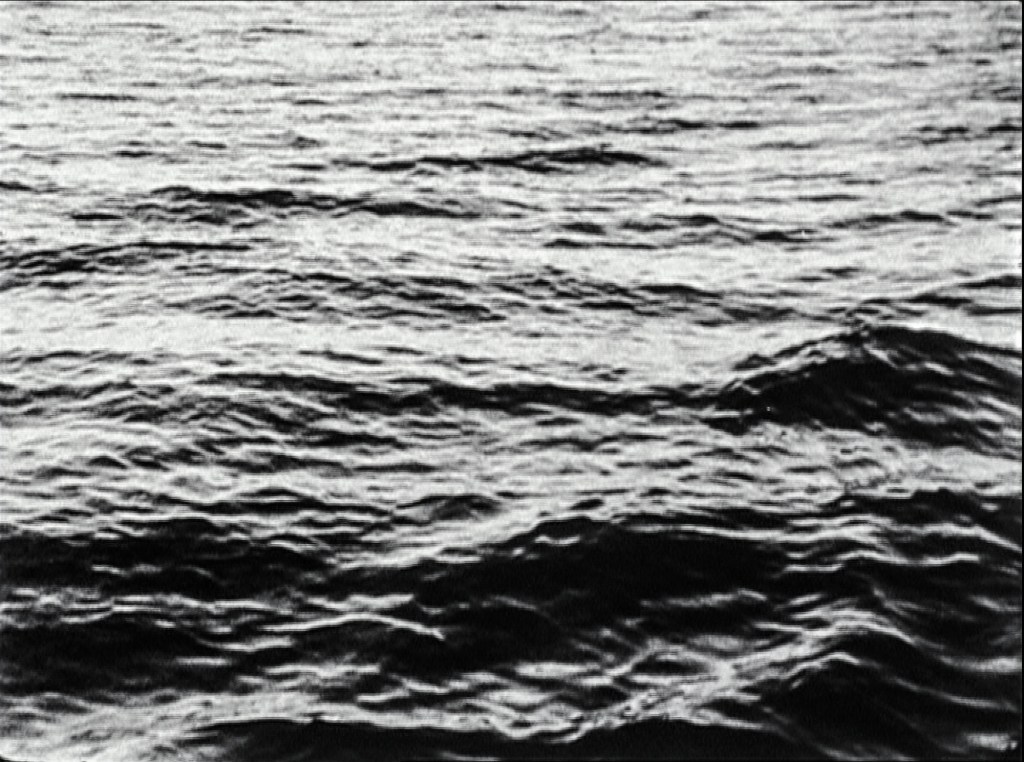
“I really don’t know why it is that all of us are so committed to the sea, except I think it is because in addition to the fact that the sea changes and the light changes and ships change, it is because we all came from the sea. And it is an interesting biological fact that all of us have in our veins the exact same percentage of salt in our blood that exists in the ocean, and, therefore, we have salt in our blood, in our sweat, in our tears. We are tied to the ocean. And when we go back to the sea, whether it is to sail or to watch it, we are going back from whence we came.”
John F. Kennedy, Jr., Remarks at the America’s Cup Dinner Given by the Australian Ambassador, September 14, 1962
Michael Snow’s Wavelength (1967) opens with a team of people moving a shelf into a room. Throughout the course of the film’s structuralist experiment, the shelf remains mise en scene until the persistent and linking zoom segments slowly bury it in the illegibility of extradiegetic space. The frame: everything onscreen eventually becomes everything offscreen. That is the nature of the camera, exemplified here by the continuous, encroaching zoom at the center of the film. At the apex of the experiment lies a photograph, prefiguring the cinematic obsession with (its own) death. A moment that will never occur again arrested in time and space and flattened forever; the zoom must also come to an end, there is a limit even to the lengthiest and most penetrative gazes, otherwise, what you have is not cinema. Snow’s quasi-long take zoom gives motion to death. This is really no different than any other film, but the fundamental elements of Wavelength do not obscure this fact, in fact, quite wholly and only the opposite.
The addition of the empty shelf in the opening of the film mirrors the room and the medium itself, each cell is space to be filled with matter. Yet, herein lies the central paradox of film: still images are only indexed onto these film cells via light, and only when projected in time do these “dead” images come to “life.” As Prospero reflects in The Tempest, “These our actors, / As I foretold you, were all spirits, and / Are melted into air, into thin air.” The photographic intervention transforming subject into object, something even less: an image—a flicker that delights across the screen. To shoot is to record, but to replay is to reanimate. The bookshelf remains empty, lined with only dust and light, like the strip of spectral images of the object itself.
And so, the same applies with either of the windows on the back wall; however, they (and the room at large) do become populated with subjects/objects, yet the central paradox still holds true, further emphasized by their fleeting nature onscreen. None of these things last. At the outset, watching Wavelength feels like being a fly on the wall, observing life events unfold from a singular and determined vantage point, never receiving context for the glimpses of actualities beyond and within these four walls. Women chat, cars pass, men die. In other words, there is a narrative in Wavelength—somewhere in between its forty-five-minute runtime—but one the spectator is not privileged to, unable to escape the confines of this Canal Street loft. Despite its overwhelming lack of furnishings and relentless forward propulsion, the viewer is always acutely aware of the larger picture. Women chat, cars pass, men die, and film rolls. The ceaseless thrust toward the final image, toward the film’s death, toward our own, despite the aforementioned signs of life—the photographed waves a worthy figure of this death drive.
That is, photography is the only means by which to capture it. Film absorbs the waves of the visible light spectrum and channels it here into fluid momentum. All that is Wavelength is the cresting of the wave that just begins to crash back down in its final formal gesture—the image of the water tacked to the back wall washes away in blur. Final frame: like a radio being tuned to catch different waves of transmission, the image finally revealed and held in all its detail starts to lose clarity until its ripples and waves are lapped into shallow focus, swept into the nothingness of the camera apparatus. Across several different film stocks and print processes, Snow pushes us toward the pull of the void. When one wave crashes, another is formed in its ripples, and so on ad infinitum. To the sea, to the photographic basis of cinema, to the mortality of men, or to the end of the film itself, Wavelength returns the viewer back whence they came.


Leave a Reply