• Drowning? Enter the Net

    I’m already drowning again. I still have no clue what to do about it. It’s such a beyond trite observation at this point, but it is too much for any one person to have access to the entire wealth of the world’s knowledge without so much as a second thought toward the matter. The Library of Alexandria beaming its binary-coded information into your skull, absorbed unblinkingly. Only this time the library can seemingly never burn, and perhaps, we are all the worse for it. The accumulation of knowledge for the sake of itself. There can be no love of wisdom if we can never experience the risk of losing it all for good. Now, one source may just get washed away in a boundless sea of others until it all becomes too much to tread. The Library of Alexandria, and a house of ill repute; it is as if the greatest monument to human thought also had the best bathrooms for cruising, with the most popular peep shows in town. That’s what the internet is. Ready-to-hand access to any and all information, the ability to have just about any person you could ever desire, naked and performing, for you. Choose Your Own Adventure and Build-a-Harem. Equal parts Demetrius of Phalerum and Hugh Hefner. The tree of knowledge and the forbidden fruit.

    Decades ago, one was forced to visit physical places to access either, forced to interact with other people to temporarily acquire that which they sought. You had to research, you had to peruse, you had to risk—trial and error. I’m not being nostalgic—and frankly, I wasn’t alive or old enough to enjoy the heyday of library archives or adult video arcades, restroom glory holes, or what have you—but, this purgatory we find ourselves in now just cannot be sustained, at least not by the human. It’s simply not tenable. I so desperately want to find a way, or rather a more interesting answer to the question, “what should we do?,” then simply walking away from it all, electing against every impulse to take no part in it. Aside from the fact this option is an impossible one, it is simply not helpful and, worst of all, hopelessly boring. Everyone already knows it. However, what is possibly the alternative? All things in moderation? There is no moderation. Our economy (although having undergone horrifying Gigerian transformations in the last century, let alone the last decade or two) has never run on such a principle, so we cannot either, especially not now. The powers that be need us more than ever to exist without temperance or taste. So, it seems it is a question of how do we navigate endless surplus and advertisement.

    What’s the only other option? Kill yourself? Get a lobotomy? Give up on everything until you are homeless and starving? While noble in a Bartlebian sense, it’s only a proposition appealing to the living, romanticizing the mere thought experiment or justifying the bitter end of some sad sap who was willing to do what it takes but thankfully was not us. All for some sort of intellectual edge? No! What can I do right now? Everything seared into my head by the digital bibliotheca/bordello is designed to make me feel inferior. I don’t think any modern innovation captures both of these binary oppositions into one form more than the dating app. The left/right swipe feature mimics the simulation of page-turning from print media, then coupled with the neverending stream of seductive images and promising prospects. It always comes back to the buying and selling of potential, alternative, better futures. A product, solely designed to extract as much money/time from you as possible before you kill yourself; for those who don’t spend, less success is owed them and likely all the more reason to end it.

    If it didn’t feel like drowning, it’d be significantly easier to let go, to sink and be forgotten; however, modern man has in him still that innate fear of drowning and the primal refusal of the horrible death it brings. A man’s gotta make a splash, as it were. It is in response to a life lived in a constant fluid state of alienated hyperarousal (fight-or-flight): a maelstrom of paranoia, self-loathing, distrust, obsession, brain fog, powerlessness. I want to do something that doesn’t just feel like staying afloat for a few more breaths before the inevitable. I want to be rescued. I don’t care if I’m the one who has to do it, I just need to know how. I don’t want to do just anything. I only want to do something great. And so, it is bombardment after bombardment of ideas that will go nowhere but notepads. The sinking weight of works unfinished. You know, I, like I am sure many others, make fun of those people who can only fall asleep or eat a meal accompanied by podcasts or let’s-plays or television or music—for fear of forming a single thought—but they’re right. They are right to feel that way. I do not claim to be above them nor do I enjoy ridiculing them. In many respects, I envy them; for I cannot just let go and embrace the new homeostasis.

    At this point, I’m helplessly and juveniley trepidatious when it comes to reading books or essays or watching movies, because like great works should, they inspire some mechanism within me to create something of my own, incorporating that first impulse of an idea—a phrase, a scene, a shot, a truth—into something that does not exist. Yet, they never go anywhere and float helplessly in the water with me, bobbing in the waves of the tide and my own thrashing. Surrounded by this debris, drowning without ever knowing exactly when or what caused the wreck that sent you to your inevitable watery grave. Trying to cling to anything to stay afloat as your biological fail safe kicks in, only serving to push it all farther away or causing it to crack and sink. Put less figuratively, more ideas equal more things not getting done. How can this feeling of inability be channeled into the completion of some project?

    In Albert Camus’s The Fall, the judge-penitent witnesses and does not intervene in the suicide of a woman leaping from a bridge. Yet, it was not necessarily the fall that killed her, but the water below that drowned her. In addition, it was the permission of one man to do nothing that condemned them both to the fall. Similarly, Hito Steyerl in her essay, “In Free Fall: A Thought Experiment on Vertical Perspective,” speaks to the contemporary philosophical dilemma of “groundlessness.” She remarks on the lack of stable ground or horizons on which to plant and align ourselves and our visions, likening this disoriented state to one of constant free fall. In each of their works, Camus and Steyerl assure us that falling, succumbing to its effects, can be liberating, that is, that liberation can be found within the act itself, as well as corruption and apocalypse. At the end of the novel, Camus’s absurd man shuts down, in the final lines, the hypothetical chance to go back and save the woman who jumps. He ridicules the hypothetical offer, smugly but not unjustly refusing to entertain the possibility of an alternative to events already happened: “Brr…! the water is so cold! But let’s reassure ourselves. It’s too late now, it will always be too late. Fortunately!” If the fall can carry with it a freedom, even a freedom to which one is condemned, then can drowning? Wherein lies the intellectual turn here?

    We have collapsed and been flattened into the horizon, it is no longer visible or measurable because we have fallen off the ship and into the water. In her essay, Steyerl proffers the example of J. M. W. Turner’s The Slave Ship (1840) as one artistic expression of the aesthetic/political move from linear perspective toward “one or several other visual paradigms.” The lack of an easily identifiable horizon line disorients the viewer, attention shifts to the drowning slaves, displacing the viewer’s desperate eye, frantic for a visual life raft. There is no vanishing point for your gaze to follow to some determined endpoint, no, only the wreckage of the present historical moment. No longer looking from a linear vantage point, one that implies linear temporality, as we no longer look out at potential futures teleologically promised to us. In his essay, “The Metaphysics of Crackle,” Mark Fisher argues that the repercussions of postmodernity on a broader (white European) culture reflects a similar and previous “temporal disjunction that has been constitutive of the Afrodiasporic experience since Africans were first abducted by slavers and projected from their own lifeworld into the abstract space-time of Capital.” More concisely, black people were the first postmodern people, several centuries before the rest of us were accelerated to this point. We are all drowning now, jagged little images of men surrounded by flesh-hungry sharks with nothing to swim toward and no visible horizon with which to orient ourselves. Herein lies the paradigm of drowning, less visual and more phenomenological.

    So, what is drowning, or more importantly, what does it feel like? Drowning induces panic, fatigue, hopelessness in its victims, with many reporting what most would describe as their life flashing before their eyes, especially regrets, dreams never lived. Then, there is calm as you embrace your fate in the waning moments of consciousness. Total surrender. And so, drowning compels the drowned in their panic to look backward: (1) spatially, to constantly turn about face, hoping against hope for any sign of rescue or refuge, (2) temporally, as your mind retreats into life review for your final moments, and (3) intrusively, for survivors, in the form of post-traumatic flashbacks. Survivors of drowning also report heightened states of euphoria immediately after first inhaling water: “I felt at peace,” “I was looking through a kaleidoscope of pretty colours,” “the most pleasant experience I’ve ever had.” Now, how do we achieve the euphoria of surrendering to death while alive?

    I am afraid there is no exciting, subversive answer to that question, at least not from any of the avenues that have come to inform my thinking. Embrace the absurd, pushing the boulder up the hill eternally? Become an object, living forever as an image? The more I think the more these notions seem like theoretical flights of fancy, no matter how rhetorically or aesthetically alluring to my romantic, critical sensibilities. But really, what on Earth would either of those maxims actually look like in practice? They are certainly seductive ideas, or rather images of ideas, but at this point, I have not the slightest clue how to realistically incorporate them into my life. (Am I not, by trying to live these images in material reality, forgoing the trap of representation (as outlined by Steyerl) in favor of the bountiful possibilities of direct participation in the image?) Alas, I am not an object, as it were, even if I wish so desperately I was (without even really comprehending what that means, rather vaguely, intellectually clinging to whatever that signifies for some sort of disaffected air of superiority). Rather, objects do not concern themselves with drowning. As an object, I would be free to float, or even sink or have already been sunk; it would not matter. An object drowned will simply sink and there it will remain. The object does not struggle in the current, it merely records its flows and violences onto its form, acting as an indexical record. Man is not indifferent to his body swallowed into the horizon, panicking and glimpsing his own struggling hands—hands only trained to consume—in the bobbing expanse of incomprehensible fluid infinity that immediately envelopes him. We cannot hold onto anything.

    Perhaps, the pleasurable kaleidoscope is not some transcendental state where we’ll glimpse our future again, but nothing more than the endless scroll of algorithimic feeding, the relentless swiping of a finger up that sinks you deeper and deeper down into yourself, temporarily forgetting the murky darkness that is always just outside of you. Rather, the object pulls you deeper and deeper into itself, into the image. In this near-death experience, this state of pre-death, one achieves ultimate bliss and capitulation, your brain slowly shutting down. “It was more of a numb feeling than anything. Kind of distant, like I was watching everything unfold from a different perspective, like it wasn’t really me that was experiencing everything. I think my mind was too dulled by panic and fear and exhaustion to really notice any pain at all.” In the struggle to remain afloat, one does not possess the faculties or demeanor to concern oneself with the drowning of others, although we certainly know they are there, just as ultimately helpless. The object has taken its revenge on the subject, revealing us to be, as Thierry de Duve (channeling and translated by Rosalind Krauss) puts it, “thing[s] of absolute narcissism.” Beings fastened unto objects, force fed and chasing escapist, self-destructive, hedonistic desires for some sensation of comfort. Every person screaming out into an inky void of noise, trying to quickly accumulate influence to keep their head above the deep, only and understandably fixated on their own position, unable to lend attention to the thoughts of others helplessly drowning just out of sight and reach. The NSA describes this narcissistic condition rather aptly: “We’re drowning (not waving) in a sea of data.”

    As if looking up at the sun from below the ripples of the ocean surface, I find myself struggling to breach the upper limit of not only my intelligence and will but my imagination. It should be at this point where a more levelheaded and proper theorist would build to the subversive but optimistically contrarian turn. However, I suspect the author never truly believes in their submission to faith in the unrealized radical potential futures of their dissected subject matter; more than anything, it feels like the standard generic convention of critical theory. When will we learn that everything theorized (by McLuhan, by Steyerl, by Haraway, by Hardt and Negri, by Deleuze and Guattari, and on and on) has come to pass in some way or the other but without the political liberation. The future arrived and it is terrifyingly bleak. Thus, I simply cannot extract myself or do not believe in any redemptive opportunity within the phenomenology of drowning. Exponentially rising sea levels, the overwhelming, ever-increasing sea of data, the endless stream of content—our future has been taken underwater. We will have to wait—and not long now—until the drowning become the drowned before we can be reunited with the sunken treasure of our once-future. The only thing left to do: to stop swimming and just get on with it.

    , ,
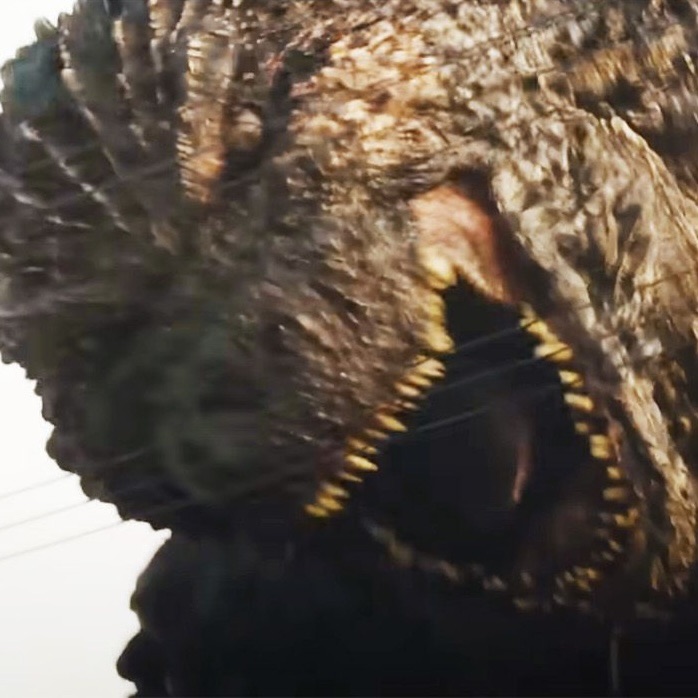
  • Godzilla Minus One is a film that delivers exactly what is promised by the kaiju genre in spite of a “shoestring” budget within the industrial economy of the blockbuster. According to the film’s director, the film cost even less than the $15 million amount that had been reported as its official budget. Nonetheless, the film delivers compelling action set pieces, a charming love story, and a cast of stock side characters that are memorable and likable. But better yet, the film makes a promise that is unforeseen—in my limited memory—within the blockbuster form, and it keeps it. In the third act, as the retired Japanese Navy men prepare their plan to defeat the monster, engineer Kenji declares that this final mission will have zero human casualties. And the film executes exactly that—not even a single redshirt-esque, “unimportant” death; however, as the viewer, I did not feel like this was a cop-out or a concession made on the grounds of less-than-ideal funds or irritating plot armor, despite some glaring examples of deus ex machina and bait-and-switch deaths. Rather, writer-director Yamazaki Takashi, by returning to the immediate postwar period of Japan, envisions a future founded upon collective care, one that not only masterfully reckons with a decades-old national guilt but introduces a level of care not present in the contemporary (American) blockbuster.

    As film scholar Scott Ferguson puts it, the blockbuster “allegorizes its own operations,” and the thirty-third installation in the Toho Godzilla franchise, despite its low budget and care-ful approach, is no expection (145). Such examples illustrated in the blockbuster typically see characters employing the assistance of targeting computers or holographic displays or any such futuristic/fantastic technology to register and align abstract phenomenological data, which according to Ferguson, represses the the “boundless co-presence” and “mysterious mediations” of abstraction (147). The blockbuster envelops its viewer in an ecstatic audiovisual spectacle both comforting and suffocating. An “insufficient [form] of care” for the neoliberal age (147). By returning to midcentury Japan, merging the blockbuster with the historical epic, there is no such diegetic technology present (although this does not entirely diminish its hyper-Newtonian aesthetic, rather sidelining it for a surprising amount of the runtime). In the place of the aforementioned hi-tech gadgets are printed charts and maps, handdrawn diagrams, and most importantly, the film photograph.

    If the film recenters interpersonal networks of human connection in the midst of Godzilla’s leveling of Tokyo (as well as the flattened landscape of contemporary cinema), Yamazaki registers this attempted realignment most demonstrably through the figure of the photograph. It is through the photograph that the film’s mission is allegorized. In the film, one can practically see the human element behind the film in part to its low budget. The viewer sees the man behind the film through its endearingly economical effects. And as a mangaka offers a more intimate, even amateurish approach to comic artmaking than major American comic book publishers, more often than not collapsing the role of illustrator and writer into one singular artist, Yamazaki is both writer and director and VFX supervisor. This (relatively) scrappy, DIY approach is almost entirely unheard of in blockbuster filmmaking—certainly in the last decade—which has made increasingly Fordist and atomized the production process: uninvolved (boards of) directors relegating creative labor to outside VFX houses and/or highly specialized teams with whom they are unfamiliar whether due to time constraints, the juggling of other multimillion dollar commitments, or the breakneck pace demanded by a cross-media, instantly streamable multiverse—the nature of the business. “That’s just how things are done here.” No. Both of these highly-grossing franchises have recently released their thirty-third entry, so what’s the excuse? Godzilla Minus One offers a rendition on the most pervasive cinematic form that treats its subject matter, craft, and audience with a more involved hand, one guided by care.

    So, Godzilla allegorizes its mission through the recurrence of photography throughout the film. In many ways, it can be said that photography motivates the main characters and drives the plot. (Of course, the act of photographing actors to make a motion picture also performs both these functions in an extradiegetic sense; so, by reflexively acknowledging the photographic basis at the heart of cinema, Yamazaki likewise recognizes interpersonal care as the center of any culture.) To take a photograph, to hold onto a photograph is a sign of care, as the film routinely demonstrates. Yet, according to theorist Roland Barthes, the figuration of the photographic image supposes a paradoxical and simultaneous preservation of life and production of death: “This will be and this has been” (96, 92). The earliest and longest lasting instance of photography in the film—the photos of the dead Odo Island mechanics given to Koichi, after his failure to attack Godzilla, by their sole survivor Tachibana—comes to thoroughly encompass both of these poles of photography. The guilt-ridden kamikaze pilot carries these photos, refusing to let go of the shame he carries after depriving the Japanese empire of one more honorable suicide and his subsequent failure to fire on an invincible sea monster.

    In Camera Lucida, Barthes reflects on the death of his mother and her postmortem existence by photographic means, commenting on her absence/presence. He sees a photo from her youth and remarks, “she is going to die” (96). In her photograph, he sees his own impending death. Through this exercise, Barthes has “no hope of ‘finding’ her” (63). Koichi has no hope of finding these men either. He has nightmares of his own death. The bundle of photographs given to Koichi once aboard the rescue vessel depict scenes from the fallen men’s lives, with most appearing to be posed family portraits. These photographs are documented proof of the lives these men once lived, a collective testament to the fact that they once cared and were cared for. It is not until he begins to care for himself—by being forgiven by Tachibana, by admitting his feelings for Noriko after her death, by finally wanting to live, by forcing himself to bear the weight of these photographed lives, by allowing himself to care and be cared for—that there exists the possibility of such a future for all. Kenji declares that no one will die on G-Day, maintaining that their future cannot—it will not—be built upon anymore neglect and death.

    The second major instance of photography takes as its subject Noriko, whom Koichi accepts into his dilapidated Tokyo home along with the child in her care, Akiko, following his return from war. After taking employment as a Pacific minesweeper, Koichi creates a bond with the crew and they are invited for dinner at the “family” home of Koichi, Noriko, and Akiko. A photograph is taken of Noriko at the dinner table, visibly uncomfortable at the insistence her likeness be recorded. To capture her life force with an image signals her death later in the film during the Godzilla attack on Ginza. “She is going to die.” After her death, her picture reemerges and finds itself in the cockpit of Koichi’s fighter. After this point, the status of the photograph is uncertain. Afterward, Koichi is informed that Noriko is in fact alive, having regained consciousness in a hospital; however, I find myself preoccupied still with the status of the photograph. When Koichi flew the plane into Godzilla’s mouth, did he eject with it? Did it burn in the explosion? For all intents and purposes, the photograph is destroyed. It is never seen again in the remaining final scenes. For the sake of the viewer, the photo is gone, as Noriko gets to live again (minus one eye and a mysterious indexed mark on her neck; a burn from Godzilla’s atomic breath? a scar? radiation poisoning?). He ejects from the plane and destroys the somber, deathly image of her visage, choosing to live in honor of his memory of her and for the life of his young, “adopted” child. It is only then that she can return to the picture, as it were. It is only then that their future can begin.

    However, the final instance I would like to discuss is not even a photograph at all. It is a child’s drawing. Akiko draws a family portrait: her, Noriko, Koichi. Significantly more abstract than the photographic image, the drawing is also more iconic than indexical, according to C. S. Peirce’s semiotic formulation. But the truth claim of the photographic arts is not only founded upon indexicality. According to film historian Tom Gunning, it is in combination with iconicity that such a claim can be proposed (42). The iconic is necessary and cannot be overlooked. With Akiko’s drawing, there exists no indexical connection between the subjects and the light that allows her to see them, unlike the photochemical reaction of film photography. The “compelling sense of directness” implored by photography in its reproduction of the world is made increasingly abstract through the iconic nature of drawing media (Sadowski 332). And so, it is here I also believe to be some nugget of care extractable toward some collective future that remains unexplored. Although bearing little resemblance to any of the three, the picture nonetheless imagines a future where they are finally together as a family. It is not realistically figured—the three subjects are next to indistinguishable from each other, their expressions are blank and openended, there is no indication of setting or mise-en-scène—and returns an air of abstraction to the family unit, to the representational arts, and the blockbuster. In the final moments of the film, Akiko gets her wish.

    But at the end of the day, Godzilla Minus One is a blockbuster, and like Godzilla at the end of this film, it is still the dominant form that is not going away anytime soon, no matter how many times it is sunk. Although, in recent years, the blockbuster has become increasingly stale not just to a critical audience but for the mainstream to which it widely appeals: the visual effects so lackluster as to reverse the once seemingly dialectical progression of digital imaging capabilities (as in the recent outputs of the MCU since the start of its “Multiverse Saga”), or on the other hand, so sublime and immersive, that is to say, too believable and realistic (as is the case in Avatar: The Way of Water), as to arise no sense of transcendental wonder within the viewer at all. As film critic Leonard Goi remarks, “[The Way of Water’s] visual charms can often trigger the opposite [of their intended] effect, yanking you out of Pandora rather than drawing you in.” Spielbergian form without the requisite and resultant Spielberg Face. The average consumer, so conditioned by the digital information society, understandably demands more from their media, having come to depend on a never-not-unavailable stream of personally marketed content flows algorithmically curated to their interests. Or, as Steven Shaviro puts it, the consumer has become adapted to flexibility, no longer content with “Fordist standardization and uniformity” that lacks input for customization and personal preference (14). However, flexibility goes beyond the consumer, even ordering the consumed.

    Shaviro’s conception of flexibility, drawing from Deleuze and David Harvey, can be employed to trace the entangled relationship between the blockbuster and neoliberalism, not so coincidentally birthed as formalized regimes around the same time. First and foremost, flexibility is the prerequisite for the Information Age: “an ability to take on any shape as needed, a capacity to adapt quickly and smoothly to the demands of any form, or any procedure, whatsoever” (14). Shaviro delineates two reasons why flexibility is cultivated in the contemporary moment: the first being as a means to reduce costs through what he calls “just-in-time production.” The second reason is of particular interest to the discussion at hand:

    flexibility is the attribute that “new economy” corporations
    look for in their employees: workers must be “adaptible [sic] and
    flexible, able to switch from one situation to a very different one,
    and adjust to it; and versatile, capable of changing activity or
    tools, depending on the nature of the relationship entered into
    with others or with objects” (Boltanski and Chiapello 2007, 112).

    And so, we can think of the blockbuster as under the employ of the neoliberal. The blockbuster—as economic model, as aesthetic form, as pop culture entertainment—comprises, in part, the culture industry of capital, performing the indispensable function of pacifying the masses via consumption. The culture industry, as a machination of capital instills new desires in its subjects; desires only achievable through products only it can provide (for a price, of course). “Advertising has us chasing cars and clothes, working jobs we hate, so we can buy shit we don’t need,” as Tyler Durden put its in Fight Club. All art has become advertisement. Only now, it’s not selling products necessarily but rather experiences, “escape.” We are purchasing affect. Consumption as affective labor. And while there is a whole industry of toys and collectibles and comic book tie-ins and box sets that has spawned out of the Lucas-Spielberg model, that is in no way the main product of the neoliberal culture industry. We buy in to the fantastical, spectacular worlds of the blockbuster and its larger-than-life characters. And so, outside the envelope of the theater seat with built-in haptic effects, the curved widescreen, and Dolby surround sound, we look for heroes to catch and save us from our free fall. But all our heroes died decades ago.

    However, the blockbuster machine, despite its exclusion of “abstraction’s endless co-presence,” which “furnish[es] nervous sensoria with disastrously insufficient forms of collective care,” is nonetheless an impressive marvel, owed to its technological advancements to the (post)cinematic arts, thanks to all the capital pumped into it (Ferguson 147). The omnipresence of the blockbuster mimics the spread of neoliberal network society into all corners of the Earth—physical, virtual, affective, psychological, etc.—to become the undisputed global order. So, like any good employee, the blockbuster must be flexible, its aesthetic preoccupations merging with the documentary, the art film, the historical drama, television, video games. I am not moralizing about the state of cinema, and declaring its death as has been done hundreds of times over. I am not condemning the blockbuster. As Godzilla Minus One highlights, there is still plenty to admire. In fact, I don’t believe the first step toward a new kind of approach to cinema can be constructed within the cinema. Things will happen as they will. Instead, it is the work of the critic, a really good critic, the professional contrarian, to exalt the seemingly mediocre and the overlooked, to point out what you and I cannot yet see, what we feel is unworthy of being seen. What started as a half-baked review idea transmogrified into an ode to Steven Shaviro and his style of criticism, especially his Post-Cinematic Affect. But, in the meantime, if this is all we’re gonna get, shouldn’t we at least have an iteration that is not only more enjoyable but also more audacious?

    Merry Christmas. War is over, if you want it.


    Works Cited

    Too lazy to do this right now…

    Ferguson, Scott. Declarations of Dependence: Money, Aesthetics, and the Politics of Care.

    Gunning, Tom. “What’s the Point of an Index? or, Faking Photographs.”

    Barthes, Roland. Camera Lucida: Reflections on Photography.

    Sadowski, Piotr. “Between Index and Icon: Towards the Semiotics of the Cast Shadow.”

    https://rbc-cataloging-manual.beinecke.library.yale.edu/comic-books-and-graphic-novels

    https://www.traileraddict.com/star-wars-4/targeting-computer

    Shaviro, Steven. Post-Cinematic Affect. https://www.xenopraxis.net/readings/shaviro_postcinematicaffect.pdf

    https://mubi.com/en/notebook/posts/the-current-debate-the-cornball-sincerity-of-avatar-the-way-of-water

    https://w1.chainsawman-online.com/manga/chainsaw-man-chapter-148/

    https://twitter.com/Trey_Explainer/status/1578421650961203200

    https://pbs.twimg.com/media/Fejxdg5XEAIep28?format=jpg&name=large

    , ,
  • I have been thinking it would be fun to go back and look at some of my old essays I submitted for school. The purpose is to fix up some of these texts and/or to expand some into more lengthy, thoughtful projects with better direction and scope, now that I have graduated and can do whatever I want really. Plus, I need to start building some kind of public “portfolio” to prove to some imaginary prospective future employer that I actually do, in fact, write with a relative amount of competency. Also, I felt that this essay could serve as a bit of a companion piece to the video I just finished, and while they don’t necessarily go together, I am picking up on many of the same threads that were on my mind at the time I was writing (December 10, 2022).

    The following essay was the last piece of writing I ever submitted in my three-and-a-half years at my undergraduate program within the Film and New Media Studies department. This essay was my final contribution to my time in college and the cherry on top of a one-on-one directed study with a professor of mine who came to be a trusted cinephile-mentor over the years, an advocate for my writing, and a good friend. The semester prior I had completed my “final” project for my Humanities Seminar, a paper almost twice as long as the one I am about to reproduce and horrifyingly bland and academic when I went back to reread it. I can only describe this piece as my reaction against that style of writing.

    Although much of the layout/form of the writing/images that I messed around with on the original Word document will be changed due to the alien nature of the blog format, I think the message should not be too harmed; however, I would recommend whoever happens to find themselves reading this here now, that you take the time to at least watch Pulse (2001, Kiyoshi Kurosawa), Ichi the Killer (2001, Takashi Miike), and Demonlover (2002, Olivier Assayas), as they will all be discussed, or perhaps don’t, that in and of itself could offer a fun, alternate reading. So, here is maybe the best thing I have ever written, over a feverish few days.

    When cinema “ended” it had already been the end of history. It just had not caught up yet until the digital exposed what was already apparent: film, as the everlasting, pure cinematic medium, was a fantasy no longer tenable. Years after the fact, I have caught up too. It is the end of my last semester. What comes next? As I see it, the end of history and the digital merged aesthetically onto a cinematic formulation that mirrors what Hito Steyerl calls the “groundlessness” of the present (13). The simulations of the postmodern were imbedded into the cinema. Capital, as much as gravity, pulls us back to Earth again. Inertia is a historical process.
    Falling,

    Falling, ever faster. If there is no end,

    can it be disaster?

    In her thought experiment, Steyerl characterizes the inability to rally behind progressive metanarratives or offer foundational truth claims as free fall—the feeling of disorienting weightlessness that comes with falling (13). Only there is no ground. One falls ostensibly forever, having forgotten the time before when they were not. As a result of the shattered horizon—shattered in its linear form and shattered, as in, realized to be a manmade fiction—of the present and the digital revolution, aerial perspective has been the dominant way of looking (14).

    Postmodern simulation dominated mainstream cinema around the dawn of the new millennium, when the digital revolution, already in progress for decades, was going global. This fin-de-siècle cinema thematized the growing digital neoliberalization of the planet, equally paranoid as enthusiastic. The exciting, untapped relations to new media technologies and processes found its way not only into the diegetic realm but into the films’ form as well. The previously privileged analog truth of film was increasingly overwritten with computer-generated effects, digital nonlinear editing systems, digitized negatives, and of course, the digital video camera (Rodowick 6-8).

    In the decade or so surrounding the new millenium era (let us say, 1996-2004), several moving image texts were tapped into the precarity of the digital revolution: that is, what would become of the cinema? The image is changing, digital video patrols the skies unseen. The relation between viewer and viewer as well, that which constructs the view and those who view it. The digital underscored the groundlessness of film as a medium, challenging notions of indexicality and reality in their anxiety about evolving new media technologies.

    Linear perspective is spatial relation that makes the image navigable; however, there is also the notion of linear time that it introduces, as its spatial construction allows the “calculation of future risk” (Steyerl 18). Predictable linear time is modernist in its ideation of linear historical progress: “The future might be a ways away, but it is inevitable.” In order for these calculations and narrative constructions to exist, the horizon must be imagined as stable. The index, the human, the medium. Cinema takes its core language from painting, so it would not be a stretch to map linear perspective onto film, as also evidenced by the film strip’s material (linear) composition, in opposition to digital video’s free fall perspective. Linear perspective is built around one eye looking in space, the cyclopic lens of film maintains this linearity. With the digital, a lens may not even need be present.

    Vertical perspective, similar to linear perspective’s construction of grounded spectator and stable horizon, creates floating spectator and stable ground. This aerial view reflects the distancing effect of “surveillance technology and screen-based distractions” (Steyerl 24). To be above is no longer to escape. God is not in His heaven—the cinema is—and all is not right with the world. I have spent time wondering what draws me to this period, only ever able to come up with the lackluster post hoc excuse of time travel: to return to birth, where it all began in 2001 with a pulse.

    And so, I am just as much concerned with beginnings as I am with endings. In Kiyoshi Kurosawa’s Pulse, vertical perspective spells the end. After two hours of digital ghosts moving between digitality and reality, the gaze itself becomes equally disembodied and haunting, perhaps even more so. The final shot is an aerial shot, no different than one found on Google Earth really, or a video feed from a drone—that is, until we are shut out. Kurosawa turns the TV off, defeated. The last image before the screen goes black is a sad little ship in a deep blue sea. Realizing cinema, which extended the “detached observant gaze” from photography, was, of course, going to become only more elaborate in this respect (Steyerl 24). Even when the world has ended, verticality ensures that it will be rebuilt in exactly the same dysfunctional image. The digital captures “the world as a picture,” as Steyerl points out in How Not to Be Seen. Maybe the apocalypse was the digital, but the digital is the only thing that can survive to witness it. Nuclear winter.

    The final shot freezes in time before the camera zooms out (or the image sinks into void), only then does Kurosawa switch it off. The freeze frame is the dying breath of the filmic trying to reassert itself at the dawn of the digital century, but the screen zooms, the freeze frame itself a frame within a frame of the digital before the image is turned off remotely. But as I watch this scene over and over, this photographic gesture is never actually a still image: “its ontological structure is of a constantly shifting or self-refreshing display”—subverted once more, this time by the digitality of my computer monitor (Rodowick 138). The closing song over the credits, “~lay down my arms~,” signals Kurosawa’s admitted defeat before his name fades to black. “Now, alone with my last friend in the world, I have found happiness.” Michi, the woman from the frame narrative, tells us this revelation as Kawashima dissolves into digital particles. Her last friend is no longer there, but she still acknowledges his spectral outline on the wall. A ghost: half-present, half-absent. A new kind of indexicality? This might as well be Kurosawa talking through the screen. Having come to terms with the false fantasy of cinema as a distinct medium with its own essence, Kurosawa embraces the uncertainty, although quite reluctantly and only at the signs of inevitability, admitting that it’s “not coming back,” “there’s nothing left now.” The ghost of Kawashima, the digital particles resist gravitational pull, and in the next shot, he becomes vertical perspective himself.

    “Pilots have even reported that free fall can trigger a feeling of confusion between the self and the aircraft” (Steyerl 13). The cybernetic conjunction of man and machine was exacerbated even further by the automatic qualities of video compared to film: instantaneous playback, on-site improvisational synthetization, its grab-and-go consumer appeal. Pulse highlights confusion of person and digital image machines, where the machinic component of the cybernesis has subsumed the human element. The end occurring on a boat is of importance here as well. Boats once relied on the horizon for navigation. Now maritime navigation is subservient to aerial. The camera floats above the imagined stability of the observer on a boat’s deck. This aerial perspective gives no information, makes nothing visible that was already otherwise so. The move upward of the camera extends the walls of the frame, the ship forever trapped in the middle of the sea during the apocalypse, the ship to be seen constantly from above, trapped within the confines of the frame in space and time. It has nowhere to dock. The epitome of linear perspective travel/navigation has been outmoded. It can never dock. Film likewise threatened by video. The linearity of film, its images miniaturized and sequenced in rows, has been compounded by the chameleonic single frame of the digital numerical. Aerial perspective, its tie to video, transports us away from reality, Kurosawa notes. It creates a distancing god’s eye in place of indexical immediacy.

    Once more: 2001, Japan: Takashi Miike’s Ichi the Killer diagrams a similar confusion of self and machine. Antagonist Jijii (played by Shinya Tsukamoto) removes his loose-fitting garments to reveal the physique of a bodybuilder. The grotesque bodily transformations of the famous body horror auteur go digital: the filmmaker’s face uncannily superimposed onto an ill-fitting muscular form. Tsukamoto snaps bodyguard Takayama’s neck in bone-crunching POV. The walls of the frame are doubly claustrophobic; free fall channeled by the socioeconomics of the apartment building. The snapped neck looking up implies thwarted desire to fly out of free fall to accelerate upward to break the illusion of relational weightlessness. The snapped neck indexes the highly stratified society of new millennium Japan, “intensified class war from above” as seen from below (Steyerl 26). Rather than looking up to the sun, the nationalist pride of Japan, we are met with a washed-out sky. So then, even if we did climb the floors, what is waiting at the top?

    To fall back down again. In slo-mo, Kakihara balances on the railing of the rooftop staircase, having been kicked by Ichi. The moment right before one is condemned to free fall feels as if it would never end. “What do you mean history has ended?” He is expected to catch himself, but he loses control and enjoys the fall. After Tsukamoto discovers the body, Kakihara is pictured in a liminal space washed in blue light, recognizable as the place where Karen, and presumably Boss Anjo, once tortured Kakihara for his own masochistic pleasure. Although he fell to ground to escape the unfulfillment of his digital desires (digital media creates impossible desires: Kakihara deals in pornographic videotapes), he cannot escape the limbo of groundlessness. Even death offers no reprieve. With history killed, where do the dead go? They haunt the present. Like a video image allows one to see one’s image instantaneously, to see oneself outside of oneself, to haunt oneself—Peter Campus’s dilemma, the “displacement of image.

    Let us return to Tsukamoto’s Jijii: even the cyberpunk director cannot escape becoming a cyborg, modified by the digital, incorporated into it, nay, constituted by it! If we follow this logic, the other major characters can be ascribed with a cinematic positionality. Ichi is easily video with his slick black costume, hikikomori relation to TV and videogames, and false, programmed memories inserted by Tsukamoto are coated in digital noise. Tsukamoto’s orchestrative relationship to Ichi as well as his digital chimera body marks him as film with digital modifications, a partly video aesthetic merged to film. He is Miike. Kakihara is the most difficult to characterize, until I read Tom Mes’s assessment of the film, wherein he resolves the trinity quite nicely. Kakihara, in such a libidinally unsatisfying film with despicable and pathetic characters, is the only “identification figure” left for the audience, both him and the viewer participating in violence with a laissez-faire attitude (Mes 235). He is like you and me.

    In the end, mastermind Tsukamoto—no motives ever explained—kills himself, like Kakihara. Ichi, although never seen again after the rooftop, survives alongside the child Takeshi who kicks him as revenge for his father’s murder. Kakihara’s blue purgatory is prompted by Tsukamoto looking up the apartment shaft, and before that, when he looks up, montage implies that he intuits Ichi’s helpless state as well. Tsukamoto (film as a medium in its own limbo) realizes his mortality in the pathetic fates of the unstable yet precise ones and zeroes of digital video and the audience. After the masochistic spectatorship is lost to free fall, our new identificatory figure is Takeshi; he registers the camera at the end after a computer-generated crow flies by his head—a new relation between a new audience and a new form of cinema is forged after the digital continues to infiltrate postmodern society (no longer merely onscreen violence but a part of nature itself). Digital cinema requires a new mode of viewing, of interacting with the world. It starts by recognizing the gaze, only then can we deploy digital cinema to examine critically our contemporary institutions. 

    Like Kakihara’s delight in free fall, the audience loves the fleeting hyper-Newtonian thrills enhanced by digital technologies which leads to the birth of the acritical audience, a viewership that desires spectacle enabled by digital special effects. The death of cinema begets the death of the audience. Although now, it would seem the causality is reversed. However, it was all an illusion. Kakihara was not kicked off the roof; the digital did not thrill the audience. The index of Ichi’s knife boot on Kakihara’s forehead, as a sign that is marked by direct causality, is a hallucination. Video has no index, no relation to the real from the perspective of the filmic semiotic paradigm. Puppet master Tsukamoto’s filmic persona as the one to reveal Kakihara’s unmarked forehead confirms this illusion. It does not matter. It is Tsukamoto’s actions that still lead to the death of Kakihara and the humiliating dissolution of Anjo gang. Ichi—a voyeuristic, isolated, amorphous avatar for Tsukamoto—did not cause Kakihara’s death as Tsukamoto had planned. Tsukamoto looks up at the sight of the aerial perspective framed by the apartment building. He recognizes his own fate—suspended in air, around the neck, from a tree. Takeshi ignores him for the camera, and after humiliating the two biggest sadists in the film, demonstrates a sort of mastery over Ichi the Digital and Tsukamoto the Analog Hybrid.

    After free fall, the audience is left feeling like Kakihara, trapped in the blues of our empty sadomasochistic chamber, completely unfulfilled in either impulse. The hanging chains in the foreground key us into the shackles of verticality. The camera cuts to close-up: Kakihara looks up at the high-angle lens, his digital extendo mouth falls open, his eyes expressionless. Cornered by the camera on all axes. The horizontal tessellation of the non-place walls overpowered by the free-falling chains. The intermixed horizontal and vertical credits reconfigure this visual contrast metacinematically. The last chain of text is vertical and ends with the year: 2001.

    The stability once afforded by linear perspective and its privileging of the horizon has been superseded by “multiple perspectives, overlapping windows, distorted flight lines, and divergent vanishing points” (Steyerl 13). 

    “Digital practices call for transformation, dissemination, recontextualization, and even transmutation into other kinds of perceptual outputs. Their identity is inherently multiple and open to viruslike mutations into ever-renewable series” (Rodowick 133). 

    The following year, Olivier Assayas’s Demonlover carries the torch. The ending sees Franky interfacing with an automatically scrolling selection of snuff livestreams spotlighting female torture. Aligned in a row in the center of the frame, the Hellfireclub thumbnails roll from left to right consecutively, resembling a perversely digital film strip. Gravity is inevitable, and thus, so is free fall. As Franky contemplates over a model of DNA, the tortured Diane looks back at the surveillance camera beaming her image to viewers and voyeurs alike, like us and Franky. Here, Assayas claims that this turn of events, the end of cinema, the end of history was always to pass. A digital determinism. Hardwired. Diane’s face strikes the same visual chords as Kakihara’s—both in limbo, both watched and aware of it; his desires shaped by digital mediation, desires of others pasted onto her through the digital. “These hands could’ve moved mountains.” The lyrics of the closing credits indict the filmmakers but also mourn the potentialities of the digital that continues and makes more efficient the exploitation of women under capital and moving image culture. Franky embodies Steyerl’s floating spectator, safely inputting his fantasies from a high-angled distance thanks to daddy’s credit card. Aerial perspective is male, White, and wealthy: it is not afforded to everyone. After the film’s form effectively kills itself and then returns to continuity stasis, after its defeatist conclusion, Demonlover takes the motif of visual entanglement (“tangled in shit”) from Ichi’s purgatory and makes it auditory in the credits. Two simultaneous voices, singing different lyrics, are heard. 2002 (palindrome): the digital and analog, two ongoing threads in not-quite-yet-certain relation. The fear is not the future but that the future will bring nothing new, in fact, only arriving with the same old failures. No new solutions. All films picture some purgatory—whether trapped inside a monitor, a retired space of sexual fantasy, or, as in Demonlover, some present combination of the two.

    These films by Kiyoshi Kurosawa, Takashi Miike, and Olivier Assayas react to digital disorientation of cinema, the invasion of multi-screen displays and aerial perspectives onto linear filmmaking. In addition, they react to the decentering of the individual subject as a result of this new perspective paradigm. Ichi the Killer seems most willing to embrace the digital with its laughably over-the-top, grotesque computer effects. It is also the most confident in its embrace of the digital absurd, the figure of Takeshi offering some generative possibility under the digital regime. In the years before and those that followed, the digital absorbed cinema and did cinema better. Pulse knows this truth, Ichi and Demonlover too. Cinema’s own genetic makeup and language created its death, as its formal conventions were programmed into the digital. If we are to consider Rodowick’s assumption that the digital image does not “occupy space,” then the digital is spectral—a ghost from the future that haunted cinema even before its new millennium revolution, a harbinger of the death of cinema (134). And so, the linear perspective once coded into digital machines and software has taken on a new gaze that Rodowick fails to address (132). “Photorealism was displacing abstraction as the driving goal of research in digital image simulation” (Rodowick 132). Now, the entire world is digital simulation with surveillance situated atop it, maintaining it. 

    “Falling is corruption as well as liberation, a condition that turns people into things and vice versa”: Pulse’s phantasmagoric computer virus turns people into images (Steyerl 28). But Kurosawa images this transformation as much epochal as it is apocalyptic. Twenty-one years later, self-objectification might be our only chance to render ourselves invisible, or at least organized under some new solidarity. If the boat were removed from the final shot, the film would end on a much less dour note. The endless sea would be a place of play with its open possibilities: sink or swim.

    History has been halted. My future as well. Suspended in air. However, if history ended half a century ago, then it was certainly confirmed last week. Recent advances in artificial intelligence processes [Midjourney and, more recently, OpenAI] spell, once again, the end of the human, and I do not mean this in any alarmist, “end-of-cinema” sense. OpenAI GBT-3.5, for example, an application programming interface in open beta, can write an essay about Hito Steyerl’s concept of the poor image, for example, or answer ethical and philosophical dilemmas faced by the postmodern subject, with oftentimes surprising mindfulness—that is, humanlike, student-like. This software exposes the inhuman manner of writing upheld by humanities scholarship. Academic publishing institutionalizes and protects stale form, never rewarding anyone for challenging it. In few years’ time, AI will surpass academia in this form of writing that it blindly teaches. Of course, it will; it can do it better! “Did you internalize the content?” “Can you swallow information and spit it back out?” In the near future, an undergraduate could receive a degree largely by submitting assignments (partially or mostly) written by AI—undetectable to Turnitin and editors. OpenAI even allows one to edit text according to customizable instructions, allowing overworked and underpaid professors and teaching assistants to grade and add comments faster, if desired. AI will grade AI, simulations of simulations. The sort of education that regurgitates formula should be over. The infinite conversation must come to an end. AI art will continue to produce and then consume itself to produce more AI art, until humans are pathetically pushed out of the loop. The same will happen with online discourse, etc., etc. We are made external to the infinite conversation after believing ourselves to be enlightened for centuries, and the end of that process is to digitally recreate ourselves via feedback loop that no longer needs us. The end of (the end of) history. Thus, I do not think there is no future. While technology and media will devolve into the mindless never-ending discourse we finds ourselves engulfed in today, we will have the ability to walk away and start again, to refuse to watch the forty-seventh installment in the Marvel Cinematic Universe produced entirely by AI, to escape free fall. The freedom to choose, but the choice is always yours.

    The digital is one means by which we can turn writing into a living document.

    With this, I have relinquished the linearity of my academic track and the style of scholarship it produces for the uncertainty of free fall outside of its bubble. Here, I have taken up the impossible challenge of concluding an entire semester’s worth of theory across all my classes, plus the last three-and-a-half school years of undergraduate knowledge, all while attempting to discover (over just a few days) some alternative form that will satisfy me, that will convert narcissistically (in)coherent thought process to poetic, nonlinear magnum opus. And I have failed, but it is all there somewhere in between.

    Works Cited

    Mes, Tom. “Ichi the Killer.” Agitator: The Cinema of Takashi Miike, revised edition, FAB Press, 2006, pp. 226–243.

    Rodowick, David. The Virtual Life of Film. Harvard U Press, 2007.

    Steyerl, Hito. “In Free Fall: A Thought Experiment on Vertical Perspective.” The Wretched of the Screen, e-flux, 2012, pp. 12–30.  

    , , , ,
  • It got to the point where I was so hungry and fatigued that my eyes would not even look straight. Staring at the ceiling, and my body was too tired for even that. I wouldn’t move my head but my vision would drag itself from the patched popcorn ceiling to the dingy gray wall all on its own. So, I would reset my eyes and they would fall again to the same spot between the window and the corner next to the empty side of the bed, like clockwork. When I would focus on one spot—so my pupils couldn’t roll away—everything just spun. Me, we, they, you, none of it’s going anywhere, but everything is constantly moving about an indifferent axis, out of our control. If you lose your marbles in a world obsessed with hyperbolized gravitational physics, witnessed in the very spatiotemporal fabric of our popcorn entertainment—the only comfort/distraction from the everyday—they’ll eventually sink right back into place.1 It’s just gravity. That’s what holds (consumer) society together. In the age following the revolutionized nostalgia of Neo(liberal)-Hollywood aesthetics, there are now three certainties in life: death, taxes, and gravity.

    Death cannot be cheated per se, but geneticists continue to pursue the discovery of (and extension toward) some sort of innate biological expiry, pushing it further off, but taxes certainly can be cheated: unless, that is, you’re stupid enough to be poor, then sorry (60% of Americans living paycheck to paycheck), you’re likely outta luck.2 So, where does that leave Big G? It has become a play-thing, another game to be played (and therefore, cheated), just another variable to be modulated at will. Plug and chug. Force to be consumed. On the screen, we believe a man—a good ol’ American farm boy—can fly. But on the ground, outside the theater, is a different story, yet we still believe ourselves to be exceptional individuals of worthwhile merit. Steinbeck’s temporarily embarrassed capitalists. We have forgotten that the only place to spit in a rich man’s house is his face.

    As it stands, gravity is the medium to be controlled—to control—rather than money, no, in service of top-down monetary control—austerity. “Who needs the nanny state!? I have my Funko Pops and baby movies and ‘hot takes,’ thank you very much.” We want to believe so badly that a man can fly, break through the barrier of the inertial present and its people, to rise above all the austerity, whether that condition be understood as free fall (Steyerl), flattening (Jameson), capitalist realism (Fisher), the end of history (Fukuyama), etc.3 Yet, not even Superman, a demigod proclaimed to be made of the same material that supports the towering financial district, can fly forever. No (super)man can control capital: it is a machine, after all. Only the machinic itself could stand a chance to dismantle it, physically or symbolically. One who defies gravity defies all the potentialities of money in service of those on the ground, in favor of quarter after quarter of record-breaking corporate profits. The machine is propped up for one more year until it can be handed off to the next guy who also doesn’t know what the fuck to do.4 The fear of collapse is always child’s play when daddy is always in the other room to clean up your mess when the tower of blocks starts to wobble. One who defies gravity is surely waiting for the blow–back down to Earth.

    “Faster than a speeding bullet, more powerful than a locomotive, able to leap tall buildings in a single bound [emphasis added].”5

    Even in the opening narration to his earliest animated iteration in 1941, the Man of Steel’s superhuman feats are measured against the monuments of capital and its progress. His first appearance in Action Comics #1 sees him leap a “twenty-story building,” for example.6 In both versions, what goes up must come down.

    The phenomenological soothing/suffocating caress of gravity, it’s there even when I sleep. I don’t like how soft my bed is, I sink; I’m not even heavy; and it’s hot, so I sweat. It really is a bed too big for one person. Has anyone ever gotten so hungry they couldn’t see straight? Of course they have.

    That was two days ago, I think. (It was.) Yesterday morning I woke up after half-sleeping in humid heat. I dread going to work more than usual. My first waking thought is automatic—in Thom Yorke’s droning singsong, “a job that slowly kills you”—and it makes me smile. (Not actually.) Getting ready, the sun fails to peak behind the clouds and through the blinds at its usual time. I was right to feel dread. I walk to the bus in the gray, start reading Venus in Furs, and walk to work in the same climate. It’s supposed to rain as I get there. (It doesn’t.) On ugly days, the restaurant never gets busy, doesn’t matter that it’s Friday morning. (I was right.) I’ll be fortunate if my tip share is even $20 after a 6-hour opening shift. (It was not.) I’m not even making $8/hour base pay, and not even $11.50 with my tip cut. (Did I really give up the one thing I’m good at, the one area where I was encouraged, for this? What am I trying to prove by shunning grad school for hustling and minimum wage employment?) Not to mention, this past week my scheduled hours were much less than average. I thought to take that free time to finally start to get my shit together, move on, away—do something. (I did not.) I might get caught in the rain when I leave. (I don’t.) I’m still thinking of that window, its light dimmed from the other side, like a cold eye in a dead face.

    Roll over. Sink in, sweat out. Invite a friend. Leave a stain. Whatever that means to you. (What is it that you’re thinking as you lay there?)

    If you can’t sleep, move to the other side. After that, all you can do is wash the sheets.

    Notes

    1. Dr. Scott Ferguson describes, what he calls, the “hyper-Newtonian phenomenology” of the New Hollywood blockbuster as possessing an “immersive, contiguous physics of locomotion [emphasis added].” Much of the critique of the New Hollywood blockbuster hinted herein comes from Dr. Ferguson’s lectures and texts, so I am very indebted to and inspired by his ideas. For more on blockbuster aesthetics and the history of animation, check out this fantastic podcast episode (skip to ~1:13:51 for second quotation above). Beaman, Will and Scott Ferguson, hosts. “Can the Little Mermaid Speak?” Money on the Left, Spotify app, 14 Jan. 2023. https://open.spotify.com/episode/2uZm0JxwQiYPMcycp4co0l?si=1e44656e8e564001.
    2. Pino, Ivana. “More than Half of All Americans Are Living Paycheck to Paycheck, According to a New Report.” Fortune Recommends, Fortune, 28 Apr. 2023, https://fortune.com/recommends/banking/more-than-half-of-americans-living-paycheck-to-paycheck.
    3. In Nick Mullen’s reading of the dipshit crypto bros who lost all their money to ape jpegs, there are parallels to my figuration of the Superman character—that is, we made fun of their loss because we secretly wanted them to succeed, to hope that it really could be that easy to become rich, to defy gravity. It’s a really well-written essay of COVID self-loathing and alienation that is worth the short read. Mullen, Nick. “Haircut Day.” Nick Mullen, 15 May 2022, https://www.mull.dog/haircut-day.
    4. PlasticPills, host. “Bernard Stiegler and Posthumanist Post-Marxism (ft. Diego Ruzzarin).” Pill Pod, episode 119, PlasticPills – Philosophy and Critical Theory Podcast, Spotify app, 14 Apr. 2023. https://open.spotify.com/episode/3N6Nykisq6w5M2QXxFXUkN?si=c071dd14e10d488a.
    5. “Superman (1941) – Quotes.” IMDb, https://www.imdb.com/title/tt0034247/quotes/?ref_=tt_trv_qu.
    6. Siegel, Jerome and Joe Shuster. Superman. Action Comics, no. 1, DC Comics, June 1938. WordPress, https://whynotcomicbooks.files.wordpress.com/2018/06/action-comics-1.pdf.

    Images

    1. Peak, Bob. Poster. Circa 1978. WordPress, https://cordaro9418.files.wordpress.com/2013/09/superman.jpg.
    2. Johnstone. Spacetime Curvature. 2 Mar. 2004. Wikimedia Commons, https://commons.wikimedia.org/wiki/File:Spacetime_curvature.png.
    , , ,