Personal

  • Desensitized Young Man

    As far as I know, 9/11 may very well be the first thing I ever saw on television. My father has told me on an occasion or two that I was sitting on his knee, an infant having only known consciousness for mere months, in front of the screen as the World Trade Center crashed into the streets below. I’ll never know if it went exactly like that, but it might as well have.

    As children, my brother and I weren’t permitted to watch TV, save on Fridays when we’d veg out after school on Nickelodeon or Cartoon Network. Luckily, when The Clone Wars aired, it was on a Friday night, where it quickly became a weekly tradition for the three of us. That same day President Bush bails out Wall Street for 700 billion dollars.

    When I was born my grandma made for me a time capsule from that year with artifacts: a red-white-and-blue Beanie Baby, a US Mint proof set, an issue of National Geographic. Every time I rediscovered it, the item that fascinated me more than any other was a videotape—along its spine: “September 11, 2001.”

    I graduated from college in December and went back to visit my father and stepmother. The top shelf of the closet in a bedroom that is no longer mine still had the cardstock box that grandma had curated for me. I fished out the tape for when I returned from my final winter break.

    It was while on a second date—where we first stopped to borrow a DVD from the library—that I saw the perfect opportunity to finally watch the tape on the only VCR around. Images I have lived the effects of that I had never actually sat down to take in in themselves. I inserted the tape into the slot at the bottom of the small box. No matter if wound forward or back, the display only remained blue. Somewhere in between two decades, it had been wiped. Things don’t exist in themselves.

    Pandora’s box had already been opened. The images unconsciously burned onto the hivemind of a nascent generation. A digital Ludovico technique early in the stages of psychosexual or prenatal development. And ever since, those same kids have been chasing the cultural contact high of the greatest cinematic event in human history. The Holocaust wasn’t so lucky as to have video cameras, live broadcast, or satellite TV, and is thus ineligible.

    The Holocaust was a hole in history, a blindspot. For Godard, the monumental failure of the moving image. The cinema did nothing to prevent the extermination of millions. However, this failure to represent and thus reckon with the greatest human atrocity was only one of cinema’s many trumpeted deaths. It would also later be killed at the hands of the television set.

    As it unfolded, the Holocaust did not have the inundating novel forms that would come to epitomize the era surrounding the birth of the new millenium, like massively multiplayer online gaming or reality TV. The big bang of the global century was characterized by the overabundance, the over(re)production, the replayability of the traumatic image and from every angle and at every time slot. In case you even thought about it, they made sure you never had the chance to forget.

    And so, while it took several decades for a new tragedy to come along and be added to the pantheon of those worthy enough to never be forgotten, it took exponentially less for the events of September 11 to be scrutinized, ridiculed: its plot full of holes, its shock value diminished. Like any other, it just became one more thing that just was. It was the butt of a constantly running joke, like on a date with a friend of a friend of a friend asked out over Instagram—blissfully unaware that we were really only ever in pursuit of that first hit.

    After a certain age, the taboo of TV wore off in my household. My parents were still playing by the rules of their own generation and that of their parents, failing to recognize that the box in the living room had lost its awe for us. The television hardly took center stage at sleepovers either, unless it was Project X or The Wolf of Wall Street or Zoey 101 reruns on Nick at Nite, but even so, we watched them so many times until they dissolved into quotable background noise.

    On nights spent with the kid across the street we’d look up pictures of naked girls on our 3DSs or his mom’s iPad 1, and be baffled at why it was so difficult to find any that were our age. Around that time he introduced my brother and I to his friend in the neighborhood across from us. That first time was my introduction to Omegle and Chatroulette: two preadolescents awake before anyone else, me and the boy across the street and a laptop, treading a sea of dicks to ask grown women if we could see their boobs, and somehow with moderate success. My first sexual experience.

    Back at my house, we finally bought our first laptops. On the nights spent over there, we ventured into Lemon Party, Meatspin, Blue Waffle, Tub Girl, 1 Man 1 Jar, 1 Man 1 Screwdriver, and gagging at the infamous 2 Girls 1 Cup, intermittently slamming the Lenovo clamshell shut before returning like it was nothing to song parodies and Jerry Springer clips on YouTube or inviting our Club Penguin girlfriends back to our iggys. Just more fodder for lunch table debriefs with my school friends.

    As we matured and honed our skills in the Hyperbolic Time Chamber of chatroom cyberspace, the game evolved. One could asl their way into titty pics from some teenage girl a few years older by moving from anonymous online chatting to Kik instant messaging. It felt like landing a fish, and in these cases we really were catfishing. And it often was required to have first swindled a grown man out of his dick pics to lend credibility to the aims of the primary sock account. All’s fair in love and war. It was a sport, played for the love of the game and the admiration of your fellow athlete.

    At any gathering of enough boys it’s only a matter of time before pornography makes an appearance. Typing random phrases (like “night vision” or “monkey costume”) into Google then adding “porn” before hitting enter, or flipping channels until stumbling upon the finale hot tub scene of a porn film underscored by a song, sounding like a bizarre parody of Kanye’s “Flashing Lights,” called “Bouncing Boobies.” You can imagine our reaction when we came across the same film channel surfing another night.

    In high school, now going steady with my school friends, ISIS beheadings watched in a Discord call on a $2,000 gaming PC were more la prise du jour. I’d had enough of T&A—that stuff was for kids—watching Muslims obliterate town squares or Asians eat bowls of live baby mice was now where it was at. We simply weren’t interested in girls like that anymore.

    In less than a decade and a half I’d seen more disturbing things than my father had in his almost four and a half, and with him none the wiser. I never felt any kinda way about it. I remember the big stink one morning when I casually admitted to having just watched Not Another Teen Movie on my laptop. What’s the big deal? I’ve already seen the world.

    Yet we pretend like all this did not happen. The latchkey generation don’t want to take the blame, but that just won’t do to satisfy the vindictive bloodlust of the digital natives. As if exhuming the crimes of those who came before will wipe our own slate clean. All the devils are here. In this generational cold war, neither can bring themselves to confess. And at this point, what would even be the point? You can’t unsee what has already been seen; you can’t unrape a childhood.

    The moral panic over media violence was always a wash. Neither side can hope to pin down the other. Media figures and industry reps could debate concerned parents and psychologists over onscreen violence all the live long day on TV, while back at home the computer had already usurped each of their social functions, silently replacing both flesh and plasma.

    We never stood a chance; there was never a choice. There is no more undiscovered country through which to transgress. The romantic hero of old remains a trace within his memetic variant, the sensitive young man of today, a man no less violently impressionable or romantically inclined or socially alien than a Hamlet or Young Werther, but now plagued by the banal anhedonia of a boy who’s already seen everything there is to see, and in all that expanse, glimpsed nothing sacred.

    , , ,
  • Goldfish Bowl

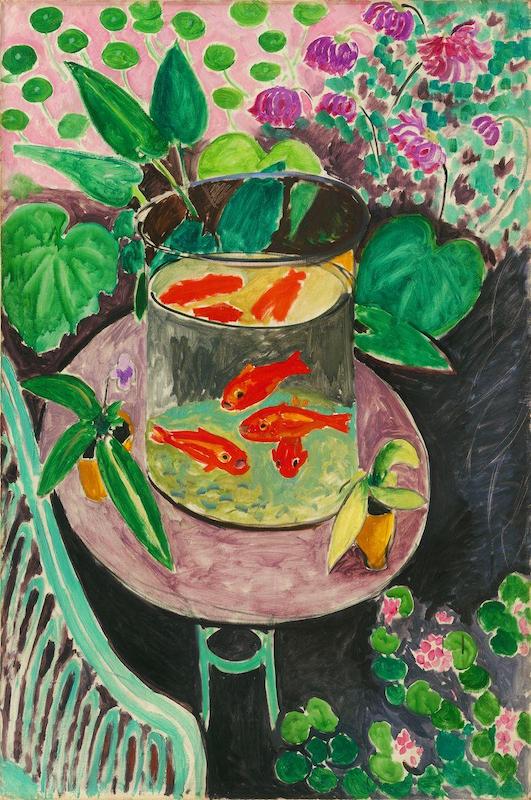
    Woman before an Aquarium (1921-1923, Henri Matisse)

    It has taken me so long—writing and rewriting, revising and rearranging, rereading and rereading and rereading: incessantly so—because, I think, I have things I want to say, but they cannot be said honestly. What needs to be said are not noble words, but I try to wriggle out of my obligation, trying to twist them into such. I just couldn’t buy into them myself, those dulcet, discarded fragments. We have enough of those between us, and frankly, I am fed up with them. I don’t want to be the Romantic hero anymore. There’s a reason Young Werther killed himself. I’ve been trying too hard when less is more. Of course, I finally accept that only after having dedicated a literal novel’s worth of confession to you; however, I can’t put the bow on it and just be done with it. I can revisit, reflect on how I felt then, but I don’t know how I feel now. My moods keep swinging, and too frequently. Am I afraid of you like someone who avoids the sun, too scared of their own shadow? And so, no, I think it is me I am afraid of. I don’t know how I feel about you now, but I assure you, I think of you so much.

    I think I see part of the problem. I still cling to the notion of being liked, and I have convinced myself that it’d mean the most coming from you, so I am just as convinced that it’d hurt all the more to turn away from you for good. I got carried away in my rumination and I’m sick of seeing you splash about in yours and I’m sick of subjecting myself to watching you do it. For me now, reading something you wrote feels like what Moses must have thought to himself when he climbed Mount Sinai and was bestowed with those two stone tablets. Most of this is ridiculous and overwrought, but it is God after all, so we must be grateful. I really have no idea what to do, but whenever I sit down to write you, you always come out the other end a deity, clothed with the sun and covered in shit, making you all the more lovely to the compulsive dumpster-dweller. I know, in reality, you are shrouded in neither. I know you so well. I know you too much. You’re a sadistic fuck. I don’t know you at all. I have toiled tirelessly and with unparalleled devotion, having already staved off sleep night after night to dissect your open letter as if it were a bifurcated chest cavity upon an operating table amid an autopsy. I felt I had to work fast or risk losing my favorite patient. I was convinced you would grow bored and forget about, stop caring for, me and our covert, digital, no-contact, long-distance, sadomasochistic union. After all my efforts, I have nothing to show for it.

    But you tapped the glass and spooked the goldfish, and it’s been the longest three seconds of my fucking life. I am swimming in frantic circles within the green-glass bubble that I cannot escape. After all this time apart, it feels like I’ve only ever known you in this way—even our time together being subsumed—through the eyes of a fish stuck inside its bowl. But I must admit, I am losing faith in you. I want to continue to glorify you, but I’m afraid it’s just not in me anymore. Nonetheless, my goldfish brain still desires your secular presence, even as I fitfully pore over the revived possibility, the subsequent consequences of—in all likelihood now—actually seeing you again. But I assure you, that is not to say that I don’t crave this reunion, that I have not fantasized about it endlessly, outlined elsewhere—in the waste—how I’d like it to pass.

    I think I know why I am so afraid, why I have been so hesitant to reply. I have nothing left to say according to the positions in which we have fortified ourselves: the woman who finds herself the torturer and the man who loves to be tortured. I am wiped out from the trip down memory lane. I yield. Yet, if you saw the thousands of words abandoned in pursuit of your eager reception, you would likely disagree. Look, there’s so much still to say. But there’s a reason I’m here and they’re not. Each attempt always overflowed out of control before it had to be dumped. It’s all just too much to bear. It seems you don’t await another story but a proper response—to unveil myself for you—and I have tried and tried, but I cannot write one that contents me and faithfully captures everything I want to tell you. I don’t know how to write that, I don’t want to write about myself; and I wish you’d write about anything other than yourself—your body and its organs, your desire and its past—because your words are wasted on you; but they needn’t be about me. I’m tired of seeing you like this, from within this fish bowl that refracts our vision and reflects our own images back at us. I cherish you, I do, for you have given me so much, but I have to return to the current, but maybe I’ll see you when you get here.

    I pervertedly miss you.

    ,
  • A Steam Room of Troubles

    There is no escape, there is simply the
    given, and there is nothing that we can do.
    —Harold Bloom, “Interview,” Diacritics

    Throw your soldiers into positions whence
    there is no escape, and they will prefer
    death to flight. If they will face death, there
    is nothing they may not achieve.
    —Sun Tzu, The Art of War

    I cannot break my months-long fixation with the metaphor of drowning. I notice it, more than ever now, everywhere. It started up once again this time with another fascination: monasticism, or rather the men themselves who were individually and obsessionally committed to it. (What is the place of/for the ascetic in the modern world, if there is any at all?) These two forces coalesced before me in Thomas Merton’s The Wisdom of the Desert, wherein the writer-monk posits that the Desert Fathers—the fourth century ascetics who turned their backs on the realm of the social and walked into the same deserts that propagated the earliest known human civilizations in order to live a life of solitude in the ruins of these empires—opted to “swim for [their lives] in an apparently irrational void.” And for this, Merton lauds them, gently urging his reader to follow in the footsteps (although not quite literally) of these humble Christian forefathers. It would seem that he proposes we willingly accept that going-under feeling (an existential impulse in search of an “‘anarchic’ desert ideal” not entirely divorced from Camus’s train of thought previously referenced) as he celebrates a “leap into the void,” the detachment of oneself from ego, although in surrender to and devotion toward God. Thus, according to The Wisdom of the Desert, this frustratingly slippery answer to the question of drowning cannot be an intellectual one but rather only and wholly a personal, spiritual one. Therefore, he proposes an individualistic solution to a collective social dilemma, which no matter how appealing or personally helpful (and I do find his reflections to have made a beneficial impact in my own thinking), I cannot find satisfactory. So, the fixation remains.

    But for all this talk of the desert, one’s entry into almost all Christian denominations is heralded by christening, baptism, that is, by some submersion of the mortal body in water; this ritual not only undergone for the purposes of initiation but even more so a necessary component of the salvation doctrine. Put plainly by Geoffrey Bromiley in the Theological Dictionary of the New Testament, “[t]he goal of baptism is eternal life.” To add, the act is itself a symbolic conquering of the primary primal(/mammal) fear. It is the very defiance of drowning that inducts one officially into the embrace of God’s undying love. It is no coincidence that the biblical Greek text employs the verb báptō, denoting several water-related actions, namely, “to dip,” “to immerse,” “to bathe,” and “to drown.” However, it is only baptism if you can manage to get out of the water.

    Suffocating in my own snot for the past two months, my body produces this mucus for its own defense against some unknown foreign contaminant. The sickness comes in waves, off and on again. The only recourse, especially when the inability to breathe renders sleep improbable, seems to be the image, to submerge my chills and body aches in hyper-consumptive normality, one shimmering spectacle immediately followed by another with no time to come up for air.

    To allow just one breath of their flows into your system causes your airway to seal itself as to prevent the entry of anything further into your lungs, your body essentially asphyxiating itself. The spasmed voice box eventually fatigues, releasing its dam and allowing fluid to flow freely into your airways post loss of consciousness. Laryngospasm and aspiration, as described, comprise the most common mechanism of drowning. Aspiration, “when something that’s supposed to be in your stomach . . . gets into your airways,” as Cleveland Clinic puts it; on the other hand, aspiration, as in the object of one’s dreams or desires, a goal or ideal to strive toward. The confusion of consumption with respiration in combination with the connotation of aiming toward a yet-unrealized future spells out the exhausting stalemate of the contemporary dilemma of drowning. Much has already been said of the collective inability to imagine a future that is not worse than that dictated by our current downard spiral trajectory. And so, consumption is the new respiration, having effectively replaced it to where it is no longer possible to imagine life without this ubiquitized, digitized, convenient version of it. (Note how false prophets who extol such solutions as the “dumb phone” or call for the resurgence of pre-streaming technologies all must look backward: this is precisely not imagination, this is nostalgia and self-help guruism.) We have nothing left to aspire to.

    When the sickness washes out with the tide (and like any tide, only temporarily), I have to reckon with the consequences of this gross submersion: not the endless coughing to remove the excess phlegm from my nasal and escophagal passages, but the new habit I have picked up over and over again, the one that nobody can seem to kick for good.

    “Modern life is a sea of images”: this is how Camille Paglia establishes her historical tracing of Western art in her 2012 book, Glittering Images, with the very first line. Paglia believes us, especially children, to be dangerously flooded with overstimulating digitized distractions, proposing “self-education in art” as the salve to ease our detiorating socio-politico-cultural landscape and turn back our declining attention spans, seductively worded with plenty of aqueous metaphors. Again, I do not even necessarily disagree, but find this answer ultimately unable to grapple with the phenomenology of drowning on the basis of its do-it-yourself, individualist stance, an iconoclastic one that is informed by Paglia’s personal brand of libertarian feminism. Is there nothing outside ourselves that can save us from this boundless, mesmerizing sea?

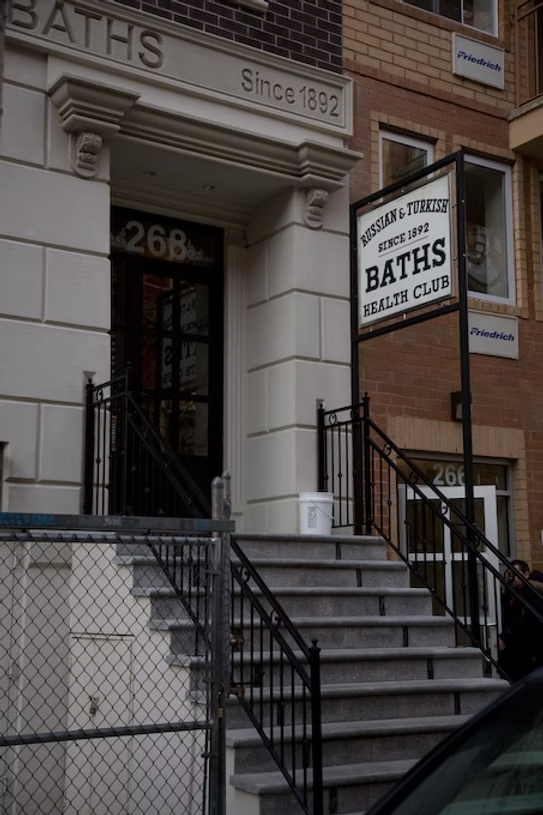
    It was not until I took my first visit to a bathhouse that I gained some insight, or at least anecdotal experience, regarding the implications of a contemporaneity figured in a constant state of drowning. Sitting in the warm caress of an 118-degree steam walk-in, I first noticed changes in my breathing within a few minutes. My ability to inhale oxygen felt dampened, my breathing shallow. Attention moves solely to breathing, as you force deep breaths in and out in spite of the oppressively humid atmosphere. You find it is not impossible, only requiring more effort and focus as you readjust to the new climate. As the hot water pours into the bucket on the floor and fills the tile chamber with water vapor, you retreat further into yourself, losing sight of the other bathers sitting only several feet in front of you. To not lose your cool, to resist the panicky feeling of drowning, it is almost as if you are actively required to continually and wholly center your own bodily experience. Then, in a moment, you begin to think about every single bead of water on your body, the sweat being pulled out of every pore, until you feel every little thing with exacting acuity. Behind a cloudy visual field, your body and the environment begin to merge in your mind. Is this particular drop of liquid rolling down my back from the room or from me, condensation or perspiration? The air begins to clear, the fog slowly dissipating but never disappearing; the hissing, boiling water from the faucet into an overflowing bucket runs slower but never gets cold. The collective comes back into frame in the breathing room, where one can once again see and hear the reassuring dissonance of others’ labored breathing. The site of arduous labor and pointed focus returns momentarily to a site of communal recovery and socialization. When all is said and done, for lack of a better word, it feels like microdosing drowning.

    “Hence baptism has no purely external efficacy and in itself is unimportant,” writes Bromiley. Much like the lack of a unified scientific consensus on the positive health benefits of heat immersion, the purpose of the steam bath is more appealing as an internal exercise, a test of will not wholly unlike the retreat of the ascetics into the desert. (It is no coinicidence that it is cultures outside of or adjacent to the Occident that tout the physiological/psychological benefits.) Nonetheless, not a discredit to its potential as therapeutic practice, forcing oneself to reckon with the sensation of drowning in a controlled environment. Yet, to further reiterate, drowning seems particularly unaccomodating to solutions of intellectual- or spiritualization, at least in terms of a large scale, collective response against its imposition on every human tendency toward life (if that is something even worth looking for).

    All that being said, as my avocational trip into the mist reminded me, there is no building a tolerance to drowning. At the end of the day, drowning is simply drowning. It is a metaphor that has haunted the greatest dramatic minds and works of the Western world. In Shakespeare’s magnum opus, the eponymous prince of Denmark for all his courtly brilliance, like the very playwright behind his words, could not remedy the drowning problem. In the most famous verse ever written in the English language, Hamlet asks, “Whether ’tis nobler in the mind to suffer // The slings and arrows of outrageous fortune, // Or to take arms against a sea of troubles, // And by opposing end them.” It always comes back to the same binary choice: kill yourself or suffer. Shakespeare explicitly ties the deathly option with water, worded as if double entendre, invoking warfare against “a sea of troubles” and the physical action of swimming, that is, “tak[ing] arms against” the determined direction of a most powerful current. “To take arms against a sea of troubles” is to “swim for one’s life in an apparently irrational void” is to tread water until exhausted strength drags under an unwilling body. And so, there really is no choice in the matter at all: it is always and simply, suffer and then die. Therefore, it would seem that the question of drowning is no question at all, but an indispensable fact of human existence: that is, that the human condition is the condition of drowning. Yet, we insist on creating for ourselves infinite petites morts—little drownings, figurative ones, ontologically pharmakonic—to avoid facing la grande noyade.

    In his science fiction novel, The Futurological Congress, Stanisław Lem differentiates between the two drownings. Throughout these passages taken from the memoirs of the fictional Ijon Tichy, Lem’s absurd man experiences hallucinatory breakdown after hallucinatory breakdown of an eccentric future world that itself already resembles a psychoactive drug-induced hallucination. As Tichy succumbs to the dissolution of his reality, he is transported into other illusory ones, sometimes even residing within them for extended periods of time, like the alternative lifetimes lived by those under the influence of a salvia trip. The world of this novel and the starting point reality of Tichy is one already heavily medi(c)ated by a laundry list of hallucinogenic drugs with any single expectant emotion existing in dosage form. Before his Dantesque descent into the bowels beneath his reality (literally as he takes refuge from a terrorist attack in the sewers), Tichy mistakenly drinks the tap water at the hotel hosting the conference. As a result, he accidentally acquaints himself firsthand with the psychotropic effects of benignimizers, a class of mind-altering substances that do exactly what it sounds like:

    Every analytical reflex was as if submerged in thick syrup, wrapped and smothered in a porridge of self-satisfaction, all dripping with the honey of idiotic optimism; my soul seemed to sink into the sweetest of oozes, like drowning in rosebuds and chocolate icing.

    It is here that the reader encounters the only instance of the word “drowning” in the entire novel, in a novel that bombards the reader with an overstimulating overabudance of absurd scenarios, characters, and visual images, in addition to its motif of water, especially submersion. It is worth highlighting that the only form of the verb “to drown” is conjugated in the present continuous tense here and, more importantly, presented as a simile. After Tichy’s persistent trips into alternate realities and consciousnesses, he awakens, as if from a dream, from these altered states when he rolls over into the waste water beneath the Costa Rica Hilton.

    In the non-place of the Hilton, after enduring the effects of the drug-laced water, he remembers he was not seen anyone drink any water. This is a future where just about everything except water is consumed. If someone is thirsty during the Futurological Congress, “they would have a coke, or a schweppes,” always something prepackaged and for sale. Perhaps in this avoidance of the nectar of life, the inhabitants of this funhouse mirror world have drowned out their fear of drowning, and as a result, their connection to its life-giving properties. It is precisely this interaction with that insurmountable animal impulse within all humanity that snaps Tichy back to “reality” one last time, finding himself once more fallen into the “stinking, blessed waters closing over [his] head . . . choking on the foul swill, but happy, happy!” Here, Lem expresses the necessity for contact with the threat of “real” drowning as opposed to the “false” drowning of addiction and self-medication but also, even more so, psychiatry and overmedicalization. Realizing that he has finally made it to the second day of the convention, Tichy laughs uncontrollably, startling one of his colleagues who drops the manuscript he is fussing over. The document falls into the dark water, “float[ing] away—off into the unknown future.” Here, Lem concludes his work on an uncertain yet contently fatalistic note, and working within a genre that conjures the present in its vision of imagined futurity, does not pretend to hold the answers.

    I do not feel so bad if even the greatest English dramatist in his finest poetic hour or the most widely read science fiction writer channeling Aldous Huxley could not write us beyond this fatalistic condition. I can accept that and it. I do not believe any one can pull us out, for life is sin. You pay for the mistakes of the past with your advancing age. Your bones creak from the abuses of adolescence. Your relationships all mirror those that came before you. That which was done unfortunately unto you, you will unfortunately do unto others. Everything that has been done has already been paid for, someone has already picked up the tab. We are fallen, and the water is rising. If history has proven anything it is that the world will keep ending for generations to come. Memento mori ad infinitum. There is no reversing it, despite the feeble protestations of those suggesting lofty, impossible radical (re)turns, to some manner of means by which we used to or ought to be conducting ourselves. I cannot go back. I have no memory. We can never afford to go back, to pay back. Everything that has ever happened is right here with/in/out us. Full steam ahead.

    , , ,
  • Drowning? Enter the Net

    I’m already drowning again. I still have no clue what to do about it. It’s such a beyond trite observation at this point, but it is too much for any one person to have access to the entire wealth of the world’s knowledge without so much as a second thought toward the matter. The Library of Alexandria beaming its binary-coded information into your skull, absorbed unblinkingly. Only this time the library can seemingly never burn, and perhaps, we are all the worse for it. The accumulation of knowledge for the sake of itself. There can be no love of wisdom if we can never experience the risk of losing it all for good. Now, one source may just get washed away in a boundless sea of others until it all becomes too much to tread. The Library of Alexandria, and a house of ill repute; it is as if the greatest monument to human thought also had the best bathrooms for cruising, with the most popular peep shows in town. That’s what the internet is. Ready-to-hand access to any and all information, the ability to have just about any person you could ever desire, naked and performing, for you. Choose Your Own Adventure and Build-a-Harem. Equal parts Demetrius of Phalerum and Hugh Hefner. The tree of knowledge and the forbidden fruit.

    Decades ago, one was forced to visit physical places to access either, forced to interact with other people to temporarily acquire that which they sought. You had to research, you had to peruse, you had to risk—trial and error. I’m not being nostalgic—and frankly, I wasn’t alive or old enough to enjoy the heyday of library archives or adult video arcades, restroom glory holes, or what have you—but, this purgatory we find ourselves in now just cannot be sustained, at least not by the human. It’s simply not tenable. I so desperately want to find a way, or rather a more interesting answer to the question, “what should we do?,” then simply walking away from it all, electing against every impulse to take no part in it. Aside from the fact this option is an impossible one, it is simply not helpful and, worst of all, hopelessly boring. Everyone already knows it. However, what is possibly the alternative? All things in moderation? There is no moderation. Our economy (although having undergone horrifying Gigerian transformations in the last century, let alone the last decade or two) has never run on such a principle, so we cannot either, especially not now. The powers that be need us more than ever to exist without temperance or taste. So, it seems it is a question of how do we navigate endless surplus and advertisement.

    What’s the only other option? Kill yourself? Get a lobotomy? Give up on everything until you are homeless and starving? While noble in a Bartlebian sense, it’s only a proposition appealing to the living, romanticizing the mere thought experiment or justifying the bitter end of some sad sap who was willing to do what it takes but thankfully was not us. All for some sort of intellectual edge? No! What can I do right now? Everything seared into my head by the digital bibliotheca/bordello is designed to make me feel inferior. I don’t think any modern innovation captures both of these binary oppositions into one form more than the dating app. The left/right swipe feature mimics the simulation of page-turning from print media, then coupled with the neverending stream of seductive images and promising prospects. It always comes back to the buying and selling of potential, alternative, better futures. A product, solely designed to extract as much money/time from you as possible before you kill yourself; for those who don’t spend, less success is owed them and likely all the more reason to end it.

    If it didn’t feel like drowning, it’d be significantly easier to let go, to sink and be forgotten; however, modern man has in him still that innate fear of drowning and the primal refusal of the horrible death it brings. A man’s gotta make a splash, as it were. It is in response to a life lived in a constant fluid state of alienated hyperarousal (fight-or-flight): a maelstrom of paranoia, self-loathing, distrust, obsession, brain fog, powerlessness. I want to do something that doesn’t just feel like staying afloat for a few more breaths before the inevitable. I want to be rescued. I don’t care if I’m the one who has to do it, I just need to know how. I don’t want to do just anything. I only want to do something great. And so, it is bombardment after bombardment of ideas that will go nowhere but notepads. The sinking weight of works unfinished. You know, I, like I am sure many others, make fun of those people who can only fall asleep or eat a meal accompanied by podcasts or let’s-plays or television or music—for fear of forming a single thought—but they’re right. They are right to feel that way. I do not claim to be above them nor do I enjoy ridiculing them. In many respects, I envy them; for I cannot just let go and embrace the new homeostasis.

    At this point, I’m helplessly and juveniley trepidatious when it comes to reading books or essays or watching movies, because like great works should, they inspire some mechanism within me to create something of my own, incorporating that first impulse of an idea—a phrase, a scene, a shot, a truth—into something that does not exist. Yet, they never go anywhere and float helplessly in the water with me, bobbing in the waves of the tide and my own thrashing. Surrounded by this debris, drowning without ever knowing exactly when or what caused the wreck that sent you to your inevitable watery grave. Trying to cling to anything to stay afloat as your biological fail safe kicks in, only serving to push it all farther away or causing it to crack and sink. Put less figuratively, more ideas equal more things not getting done. How can this feeling of inability be channeled into the completion of some project?

    In Albert Camus’s The Fall, the judge-penitent witnesses and does not intervene in the suicide of a woman leaping from a bridge. Yet, it was not necessarily the fall that killed her, but the water below that drowned her. In addition, it was the permission of one man to do nothing that condemned them both to the fall. Similarly, Hito Steyerl in her essay, “In Free Fall: A Thought Experiment on Vertical Perspective,” speaks to the contemporary philosophical dilemma of “groundlessness.” She remarks on the lack of stable ground or horizons on which to plant and align ourselves and our visions, likening this disoriented state to one of constant free fall. In each of their works, Camus and Steyerl assure us that falling, succumbing to its effects, can be liberating, that is, that liberation can be found within the act itself, as well as corruption and apocalypse. At the end of the novel, Camus’s absurd man shuts down, in the final lines, the hypothetical chance to go back and save the woman who jumps. He ridicules the hypothetical offer, smugly but not unjustly refusing to entertain the possibility of an alternative to events already happened: “Brr…! the water is so cold! But let’s reassure ourselves. It’s too late now, it will always be too late. Fortunately!” If the fall can carry with it a freedom, even a freedom to which one is condemned, then can drowning? Wherein lies the intellectual turn here?

    We have collapsed and been flattened into the horizon, it is no longer visible or measurable because we have fallen off the ship and into the water. In her essay, Steyerl proffers the example of J. M. W. Turner’s The Slave Ship (1840) as one artistic expression of the aesthetic/political move from linear perspective toward “one or several other visual paradigms.” The lack of an easily identifiable horizon line disorients the viewer, attention shifts to the drowning slaves, displacing the viewer’s desperate eye, frantic for a visual life raft. There is no vanishing point for your gaze to follow to some determined endpoint, no, only the wreckage of the present historical moment. No longer looking from a linear vantage point, one that implies linear temporality, as we no longer look out at potential futures teleologically promised to us. In his essay, “The Metaphysics of Crackle,” Mark Fisher argues that the repercussions of postmodernity on a broader (white European) culture reflects a similar and previous “temporal disjunction that has been constitutive of the Afrodiasporic experience since Africans were first abducted by slavers and projected from their own lifeworld into the abstract space-time of Capital.” More concisely, black people were the first postmodern people, several centuries before the rest of us were accelerated to this point. We are all drowning now, jagged little images of men surrounded by flesh-hungry sharks with nothing to swim toward and no visible horizon with which to orient ourselves. Herein lies the paradigm of drowning, less visual and more phenomenological.

    So, what is drowning, or more importantly, what does it feel like? Drowning induces panic, fatigue, hopelessness in its victims, with many reporting what most would describe as their life flashing before their eyes, especially regrets, dreams never lived. Then, there is calm as you embrace your fate in the waning moments of consciousness. Total surrender. And so, drowning compels the drowned in their panic to look backward: (1) spatially, to constantly turn about face, hoping against hope for any sign of rescue or refuge, (2) temporally, as your mind retreats into life review for your final moments, and (3) intrusively, for survivors, in the form of post-traumatic flashbacks. Survivors of drowning also report heightened states of euphoria immediately after first inhaling water: “I felt at peace,” “I was looking through a kaleidoscope of pretty colours,” “the most pleasant experience I’ve ever had.” Now, how do we achieve the euphoria of surrendering to death while alive?

    I am afraid there is no exciting, subversive answer to that question, at least not from any of the avenues that have come to inform my thinking. Embrace the absurd, pushing the boulder up the hill eternally? Become an object, living forever as an image? The more I think the more these notions seem like theoretical flights of fancy, no matter how rhetorically or aesthetically alluring to my romantic, critical sensibilities. But really, what on Earth would either of those maxims actually look like in practice? They are certainly seductive ideas, or rather images of ideas, but at this point, I have not the slightest clue how to realistically incorporate them into my life. (Am I not, by trying to live these images in material reality, forgoing the trap of representation (as outlined by Steyerl) in favor of the bountiful possibilities of direct participation in the image?) Alas, I am not an object, as it were, even if I wish so desperately I was (without even really comprehending what that means, rather vaguely, intellectually clinging to whatever that signifies for some sort of disaffected air of superiority). Rather, objects do not concern themselves with drowning. As an object, I would be free to float, or even sink or have already been sunk; it would not matter. An object drowned will simply sink and there it will remain. The object does not struggle in the current, it merely records its flows and violences onto its form, acting as an indexical record. Man is not indifferent to his body swallowed into the horizon, panicking and glimpsing his own struggling hands—hands only trained to consume—in the bobbing expanse of incomprehensible fluid infinity that immediately envelopes him. We cannot hold onto anything.

    Perhaps, the pleasurable kaleidoscope is not some transcendental state where we’ll glimpse our future again, but nothing more than the endless scroll of algorithimic feeding, the relentless swiping of a finger up that sinks you deeper and deeper down into yourself, temporarily forgetting the murky darkness that is always just outside of you. Rather, the object pulls you deeper and deeper into itself, into the image. In this near-death experience, this state of pre-death, one achieves ultimate bliss and capitulation, your brain slowly shutting down. “It was more of a numb feeling than anything. Kind of distant, like I was watching everything unfold from a different perspective, like it wasn’t really me that was experiencing everything. I think my mind was too dulled by panic and fear and exhaustion to really notice any pain at all.” In the struggle to remain afloat, one does not possess the faculties or demeanor to concern oneself with the drowning of others, although we certainly know they are there, just as ultimately helpless. The object has taken its revenge on the subject, revealing us to be, as Thierry de Duve (channeling and translated by Rosalind Krauss) puts it, “thing[s] of absolute narcissism.” Beings fastened unto objects, force fed and chasing escapist, self-destructive, hedonistic desires for some sensation of comfort. Every person screaming out into an inky void of noise, trying to quickly accumulate influence to keep their head above the deep, only and understandably fixated on their own position, unable to lend attention to the thoughts of others helplessly drowning just out of sight and reach. The NSA describes this narcissistic condition rather aptly: “We’re drowning (not waving) in a sea of data.”

    As if looking up at the sun from below the ripples of the ocean surface, I find myself struggling to breach the upper limit of not only my intelligence and will but my imagination. It should be at this point where a more levelheaded and proper theorist would build to the subversive but optimistically contrarian turn. However, I suspect the author never truly believes in their submission to faith in the unrealized radical potential futures of their dissected subject matter; more than anything, it feels like the standard generic convention of critical theory. When will we learn that everything theorized (by McLuhan, by Steyerl, by Haraway, by Hardt and Negri, by Deleuze and Guattari, and on and on) has come to pass in some way or the other but without the political liberation. The future arrived and it is terrifyingly bleak. Thus, I simply cannot extract myself or do not believe in any redemptive opportunity within the phenomenology of drowning. Exponentially rising sea levels, the overwhelming, ever-increasing sea of data, the endless stream of content—our future has been taken underwater. We will have to wait—and not long now—until the drowning become the drowned before we can be reunited with the sunken treasure of our once-future. The only thing left to do: to stop swimming and just get on with it.

    , ,
  • Dust Drive

    A question was posed to me recently. How is it that after hundreds of thousands of years of evolution we have not found any means to deal with the question of dust? The fact that our race has not found a way to effectively circumvent or prevent dust proves we must still have a use for it, no? We have not evolved past it because we have not evolved past the need for it.

    Dust derives from non-use. Dust signifies lack. Dust is death. But dust is also smoke, and where there is smoke, there is fire.

    Pages: 1 2 3 4

    , ,
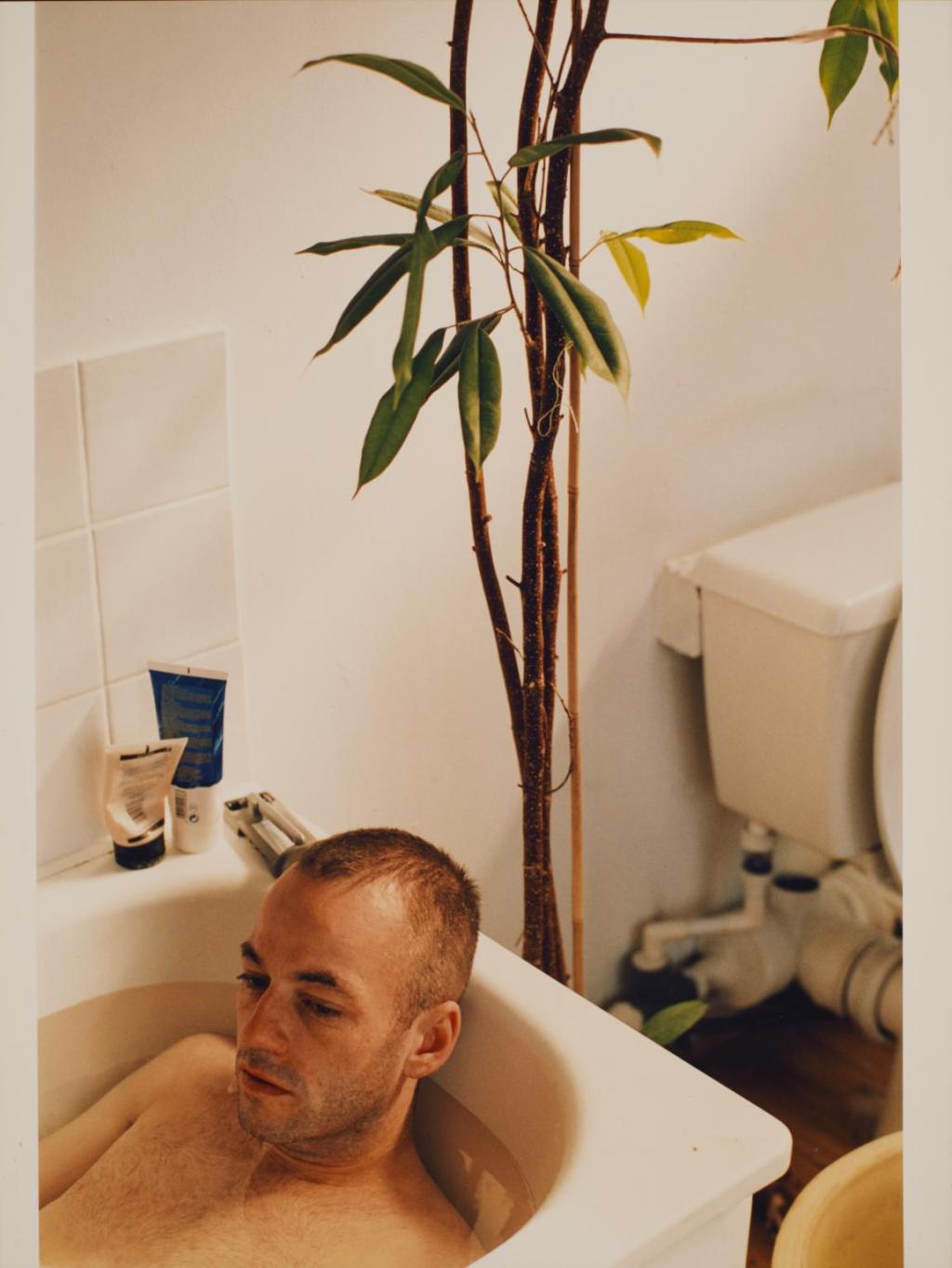
  • Jochen taking a bath (1997, Wolfgang Tillmans)

    When I die, I’d like it to be in the bathtub. Why is it that water is associated with death? It could be the innate mammalian fear of drowning or the association of anti-consciousness with the amniotic fluid whence we were conceived. It could be mythological or ritualistic, the ancient Egyptians believing souls were ferried across a river of death while their physical bodies were washed and purified before mummification. The source of this union could be etymological, derived from the proto-Indo-European root *wed-, containing within it the noun water as well as the verb to well (that is, to dig a hole into the ground to obtain water). Well cognatively links to will, introducing connotations of desire and choice while recalling the future tense and the inevitability of things that have not yet come to pass: as in, you will die. All in all, no one is really sure and water has more or less always just kinda been water; like time or death, it has always been there with us.

    But it is being in the tub, either standing or sitting, that situates one in an overdetermined site of ritual and allows one to confront death in one’s own tiled sensory deprivation chamber. As soon as the warm water hits your skin and the concurrent wave of pleasure has enveloped your senses, your mind dissociatively absorbs into your body. Here, all the things you should have said or the things you should have never said flood your mind or you formulate conversations that have never and never will happen. Paradoxically, it is also here you find the compulsion to keep your eyes always open for fear of an attacker appearing on the other side of the curtain. And so, it is being in water for an extended period of time that makes the tub the perfect site of death, as the past and the future converge within you, all the while acutely aware of the naked vulnerability of living.

    However, we know now that death is never so permanent. We can’t let the water run forever, forced to eventually return to the chill on the other side of the vinyl barrier. Man created plastic to defy death. You have to rip it back, ending your appointment with death, yet ironically returning to the domain in which it will likely claim you. Sometimes, after being submerged for far too long, well after my fingers have started to prune, I’ll find myself overflowing with too many ideas. As I dry off, I’ll repeat mnemonic phrases from each over and over in my head for the next fifteen minutes of my nightly routine, in order to not forget them before I can make it to the bedroom and write them down. Not all of them make it that far. It seems almost poetic that in the shower one’s skin begins to prune and wrinkle, as if the body is beginning to accelerate toward its own end. It is the reminder of death, the reminder that there is still work to be done that causes the eternal ritual of death to give way to the defiant, powerless, anachronistic one of preservation.

    The man in the tub, like the fly in ointment, the fire in the water. The Proto-Indo-Europeans believed in an ancient deity, *H₂epom Nepōts (or Descendant of the Waters), known by such a contradictory symbol as the latter. This mythological entity thus suggests the proximity toward death—whenever consciousness is submerged or showered in water—as not only defiant but divine. The aforementioned paradox between mind and body and life and death is thereby maintained. It is from this deity that the early Eurasians derived the root *h₂ep- (“body of water”), a passive configuration of the active root *wed- (simply “water”). To slip into the shower, it is a surrender to water and to death in order to create something, to give birth. In the shower, in death, you can be anyone, but you have to get out of the water.

    ,
  • It Can’t Be Done

    Electoral politics is designed to individualize.
    Everything about modern life is designed to individualize.
    I am individualized; therefore, I am liberalized.
    I am an individual; therefore, I am a liberal.

    Part I (of II)

    On the one hand, the onus should not be on the individual to vote if they do not wish to select either/any candidate for any reason. They are not to blame for the failure of another’s desired outcome. On the other, is it not also individualistic for the non-voter to abstain from their right, “to have their voice heard,” whether out of systematic disillusionment or outright refusal to vote for a candidate that does not reflect their values? To hold out entirely because of non-negotiable steadfastness to individual convictions. But then, there is the dilemma of your fellow man: don’t you owe it to them? Wouldn’t lesser-evilism, harm reduction, settling, voting blue no matter who, be the responsible thing to do? Nothing changes when you do; it’s all a fundraising racket that convinces the subject that they can make a difference, be a part of something larger than themselves. But then, the right to vote is only granted precisely because it is such an unsubstantial part of politicking; plus, anything that can be given can and will certainly be taken away. Not to mention, that it’s not even your vote that elects your officials, it goes to a college of electors, who so graciously take the burden off your shoulders. (However, even they have no opportunity for individual political expression, lest they be deemed “faithless” and replaced with someone who will tow the party line.) And yet, despite it all, when things don’t go the way they were supposed to, the burden always shifts to the shoulders below yours nonetheless. Rinse and repeat all of the above: this debate can ouroboros itself ad nauseam.

    I say this all as someone who did not vote just one week three months ago. I had to work. Yes, I could’ve made time: officially changed my residence and gotten a new state ID weeks or months prior, or looked into requesting an absentee ballot. But I had to work. It makes sense to me that the impetus for electoral engagement should default back to the party. You have to rally the masses out of their inertial comfort. (However, if a global pandemic couldn’t even do that, it’d be ridiculous to imagine electoralism as a stronger oppositional force, somehow succeeding in moving an immovable needle the other way. On the contrary, electoralism is part of the illness, this condition that arrests the movement of those who may not even realize they were never moving to begin with.) The people have to be sold. Everything is advertising and I wasn’t advertised to convincingly enough, at least not by anyone I would want in office. If you can’t even pull me away from my job that I hate, you can’t get me to do anything. There, again, it’s all about me, the individual always wants their way. “Why should I?” “What do I get?” “How does this help me?” I didn’t make things this way. Make it easier to vote and I will. Make me excited to vote and I will. Do that and I will play along. But what is it I’m voting for exactly? The economy? The president doesn’t even have the power to control the masters’ house, but we have to pretend he does. One person always has to be there to take credit or take blame. That’ll make me feel better, won’t it?

    Pages: 1 2 3

    , ,
  • Letters of Resignation (2/2)

    “I was young when I left home / And I’ve been out rambling ’round / And I never wrote a letter to my home”
    “I Was Young When I Left Home” (1961, Bob Dylan)
    If I didn’t have an elderly grandmother I swear to God I would’ve stuck to the plan. I would’ve left without saying anything, except when opportunistically and absolutely necessary. I do really think she is the thread that I’m hanging on by. I only told her I was leaving the afternoon before my bus was scheduled to depart. She had no idea that, when I came into her room and tried my best not to break down, my bags were already packed in the other room and the ticket had been purchased days before. I only told her I was leaving just hours before two friends came to pick me up, to spend the night with before they drove me to the station the next morning. Grandma promised not to tell my dad outright, but if he called and asked about me, she would not lie.

    As it turns out, he called me with impeccable timing, having just arrived at my destination. I had just gotten out of the shower. In an upstate New York suburban home only minutes from Lake Ontario, meeting for the first time my future first roommate, whom I had found through one of those roommate-finding apps that never seem to work for anyone. The phone is still ringing and he goes to voicemail before I can answer. I had a second phone and a brand new SIM card, I could’ve made the switch anytime over the past two days and thousand-plus miles. I could’ve continued to delay accountability, but that would be antithetical to the reason for moving away. I made a promise to myself and I was going to see it through. I said I wasn’t gonna look back, and that I was, in fact, prepared to do, but I did pick up the phone. The first crack in the myth I was trying to make for myself.

    Now, still transfixed on this sort of ridiculous nonsense that I feel most people never even think twice about, I cannot help but feel I should’ve committed one way or the other. I did both half-assed: instead of leaving it all behind and creating something new for myself like the dutiful mythologizing individualist I wish so desperately I wasn’t, I cut people out and feel obligated to get them back since I hear they’re upset I left without saying goodbye. Yet, even now, this is mythology I want to live by, but maybe that’s my whole problem, aside from these juvenile obsessions that I unrealistically want to uplift myself toward in the first place (all because they got a nice ring to them). It’s mythology, it’s a story that I’ve made up to be told around a campfire, to entertain, to make people feel some kind of way. I left the warmth of a perfectly good fire to whittle at kindling, in the hopes that I could build something even better, and then everyone would want to be around my bonfire, congratulating me on what a great flame I built all on my own. But, I’d only want them to want to be around it. It doesn’t matter since I have neither heat nor light. No one told me it was always gonna rain.


    Bob Dylan’s “I Was Young when I Left Home,” coming from early in his catalogue, is a nostalgic lament, in which its narrator ostensibly wants nothing more than to return home. Hearing news of all the familial tragedies that he missed since his departure, it is a song that sees the narrator grappling with his regret and his own (past) self-conviction.

    The original folk tune from a fresh-faced Dylan employs various forms of repetition within and between lines and across verses to establish a thoroughly nostalgic tone. More specifically, Dylan creates a closed circuit of nostalgic narcissism, as lines are often preceded by anaphora (e.g., “Not a shirt on my back / Not a penny to my name” or succeeded with epistrophe (e.g., “Gonna make me a home out in the wind / In the wind, Lord in the wind / Make me a home out in the wind).” In the anaphoric verse, the narrator only repeats himself twice, before further indulging himself with epizeuxis and a self-pitying outcry: “Well I can’t go home thisaway / Thisaway, Lord, Lord, Lord / And I can’t go home thisaway.” On the other hand, the epiphoric verse is the greatest example of uninterrupted repetition with three successive lines. Therefore, despite bemoaning the loss of his previous domestic life, whether already unconsciously convinced or currently trying to convince himself, the narrator has made his decision and will live with it, even if the reader can practically picture the lonesome traveler holding his head in his hands as he laments his self-imposed exile from home.

    Further, the song hinges on one of the most oft-repeated phrases, “thisaway,” a masterful double entendre in its own right. The polyvalent phrasing of the line (“But I can’t go home thisaway”) expresses both figurative and physical connotations of the narrator’s current state. Firstly, he is overwhelmed by feelings of inadequacy, considering himself unworthy to return home until he has made something of himself. And so, his reaction: to repeat—both formally and psychologically (that is, to fixate on the past); the young Dylan crafting here a formidable form-follows-function. And secondly, in the more literal sense, he cannot go back home by continuing to live away from home. However, also, in the same line, the same lyrics nonetheless convey steadfast reluctance in his reasons for leaving home: that is, he can’t just go-home away his problems. Thus, in the same breath, he recognizes that nostalgia will get him nowhere physically, but also especially in that aforementioned figurative sense.

    Even in the deepest drunken stupor of nostalgia, as you passively retreat into fantasy, it projected before you on the ceiling, pleading to relive the past, you’re still looking for any excuse to break free of its addiction, even if, in this very moment, you are unable to pull yourself away.


    With this vacation, I returned to the grounds of the fire that had warmed me, and there was no one left. All this talk (I guess, really thought) over the last few years—of the posthuman, the digital, the nostalgia of neoliberalism, anti-individualism, anonymity— is how I compensate for an unshakably selfish nature. Consider this my resignation.

    “I can’t go home thisaway”

    , ,
  • Two Weeks’ Notice (1/2)

    I had forgotten what it’s like to sleep without socks on and how much the people in my family love to talk. For the first time, in one year’s time, I took a vacation. I went back to a few of the places I come from and I stayed with my wise, wonderful ol’ grandmother. These are just some of things that I wanted to record in the couple weeks I left behind.

    “They’re particularly gay in this one.”
    My grandma, making me watch my first episode of Queer Eye

    “Guess what’s coming out?”
    My grandma, turning her phone around to show me a Facebook post about a fake Shawshank Redemption sequel

    There’s a Trader Joe’s that just opened up in my unincorporated community of a hometown sometime in my absence. At checkout, I notice someone I recognized in the line behind us: a kid I met in elementary school. We became friends in middle school, and then became removed from each other by high school. In tenth grade, he spread the nudes of one girl he was talking to. Justifiably and hilariously, she called him a “pencil-dicked curry muncher.” Of course, being in high school, you make fun of the whole situation amongst friends, but by yourself—by myself—I just remember feeling horribly sorry for her. I remember her being in my first period physics and second period driver’s ed. She was always nice to me. He’s in considerably worse shape and balding now, so I guess that’s his just deserts. I wonder how often I, she, those days cross his mind.

    “Walking is the reason I’m also not on life support.”
    Shortly after my grandma told me this, her best friend Nancy died. Nancy who went to UMN with Bob Dylan, smoked like a chimney, and loved the ocean. In the days after her passing, I heard several stories from her and my dad about this woman whom I had only superficially interacted with as a child and teenager. One story goes that one of Nancy’s sorority sisters even dated Dylan.
    “She was ready to go.”
    “I outlived them all.”

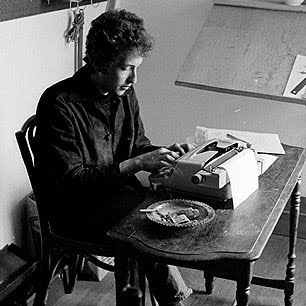
    The Caine Mutiny was on while she got the news about Nancy. I wasn’t much use at all when it came to comforting her. I was mostly transfixed by how much May Wynn looked like my grandma as a young woman. I thought back to the photograph on my bedroom wall back in New York. When I first moved into my grandma’s condo after my post-graduation lease ended, she was in Virginia staying with family. There were patterned boxes on the floor next to the head seat at the dining room table. All alone in her house, one of the first things I did was take the time to look through every single printed memory. (At this point, the unshakable idea that I had to move up, and on my own without telling a soul, was almost at its peak: it had never felt more attainable.) I found a photograph with a duplicate, “ / 1957 / Ind. U” written on the back of only one. That’s the one I keep and take with me. That’s the picture that looks like May Wynn, smiling as she looks up from her typewriter. In my grandpa’s old room, the one that I moved into, I find a transparent Kodachrome slide lying in a woven basket. It’s a photo of him and a little girl who’s holding a striped cat: “Christmas 62.” Here, he reminds me of Robert Francis, if he had a more coy, reticently devilish grin that liked to creep out from behind a stoic exterior every now and then. No one knows I took either of these tokens for my self.

    It almost pains me to write it, but I was feeling nostalgic. I’ve tried to live life like I would never have any regrets at all, but it didn’t work. I’ve just about removed the last threads of Camus’s existentialism that weaves itself into the minds of annoying, less-than-extraordinary 20-year-old men, unspooling itself until it becomes a twisted, knotted mess of intellectual machismo and melancholic superiority. It was time to cut the cord and let the spool fall where it may. I suppose I agree with Orson Welles now: “I can’t imagine not having a regret about almost everything.” The chance to see your self in a completely different life; to treat your life as one big what-if. But almost contrary to expectation, being back in the past makes me think about the people who only know me now. It’s funny to think that they met a dried husk of that former young man. God, I used to be so cool. I used to write well and have unprotected sex with crazy women. Only kidding. I don’t really wanna go back (and I’m not too cool for Camus).

    After the first stop on my Grand Apology/Reunion tour, an extended breakfast with the last two people I saw before I left home, I come back to a clogged toilet. All my old shit is coming back up and I can feel the panic begin to rise inside me as the soiled water inside the bowl rises almost to the top, stopping right before it would spill over onto my grandmother’s white tiles. One flush isn’t gonna wash anything away, it takes a little effort, maybe even getting a little shit on your hands. I don’t know what the plunger would be in this analogy. I don’t know why I’m suddenly going for these rather straightforward conceits, that doesn’t seem very like me. Nevertheless, I carefully got the toilet unclogged and it was all flushed down the pipe in an instant.

    “People always go away, so they can forget where they were.”
    Martin, to Christina before she leaves Pittsburgh forever, from Martin (1977, George A. Romero)

    “I’ve had one man. Why would I want another?”
    Grandma, filling me in on her septuagenarian neighbor getting a new boyfriend and offering her two cents

    “I always thought I was adequate. Maybe that’s the best way to be.”
    Grandma tells me that there is a pivotal moment in someone’s life that breaks them and they never quite bounce back from it. At least that’s how she sees it in my family, particularly among her male children. My uncle cut from the Texas Rangers, my father failing to make his middle school basketball team. She swears that’s what did it. That last one didn’t make sense to me at first, that it’d be something so seemingly minor and childish; yet, I think it’s those little letdowns that lead to the most devastating what-ifs. It got me thinking about what my one moment would be—the greatest singular disappointment internalized into an all-encompassing, haunting personal failure. Which one would be it? I’ll tell you exactly what it was. It was the incomplete production of a micro-budget short called Dark Chamber. Before we had a chance to finish shooting, I moved in with Grandma, then I moved away. I still have half a movie around here somewhere. Back “home” I had promise, everyone would come to me for anything related to film or writing. I get to New York and there are thousands just like me. I don’t lament the shattered illusion of my uniqueness (although my first time at Anthology Film Archives was a wake-up call on that front)—no!—I see myself reflected back in all these young people who were the brightest minds from their own shitty suburbs or small towns. They had potential too, and everyone left behind believed they’d make it. Now all I have is waste.

    “Everyone has one flaw, and that’s yours!”
    Grandma, on my not being a pet lover

    “The sky is trembling and I must leave fast”
    —Bob Dylan (1965, “Farewell, Angelina”)
    I think they say two weeks is the perfect length for a vacation, that way you can begin to miss home, ready to return to the routine recently refreshed. It was sometime in the second week that the trip down memory lane stopped being a fun carnival ride and started becoming a crushing weight, as the staggering heights of the entire amusement park above started to collapse on top of me. Floating through the Tunnel of Love on a heart-shaped bed unable to move, my gaze unable to point anywhere but up, as skyscraper confections and steel beams crash through the smoke and mirrors into the lazy river around me. My mattress raft, slowly going under from the load, is swirled and spat out the end of the stream onto desert sand, just moments before I would’ve been fully submerged. In the smoldering pile of rubble, I can finally move. I don’t know what to do or what to think. I spin around to flee, and it’s Bob Dylan, the Shadow King, who’s there to catch me—off-guard. He stares into the evacuated hearts of fevered eyes and refuses to speak. As my head races with questions and pleas for help or advice or comfort, my mind feels like it’s tearing itself away from my body. He keeps staring with an ambiguous glare. I go to speak, but cut myself off before any sound touches the air. A mercurial apparition, what I take to be my mind, temperamentally hovers and surges about my frame like a solar flare, as if eager to abstract itself from its tether. He leans forward, ever so slightly, hiding his eyes in his brow and giving me his ear. I’d just like to ask him one thing.

    “Do you still have visions of Johanna?”

    , ,
  • I don’t wish you were here, but I do wish you well.

    What is to be done with bridges after they’ve burned? To rebuild is to admit defeat. Even in the smoldering mess of my own making, I don’t want to mend: matches still in my hand. That bridge had people on it. What would you see if you looked at my eyes now? I don’t think I’m recognizable, I probably don’t deserve more than an averted glance. When I moved away, I thought my parents would resent me and my friends would be proud of me, but my friends resent me and my parents are proud of me. It’ll all end horribly or not at all. Best to leave it alone. I’ll build some new bridges, and hopefully, they’ll last a little longer.

    I had to do something.

    No one told me that my parents were gonna get old. Away indefinitely for over a year now and I realize my father won’t always be forty for me. Going back home is a reminder of death. The only thing that brings me close to tears anymore is the thought of the old dying. They deserve it least of all.

    I’ve become and always have been a cliche.

    I only had the little ink that was left in a single engraved pen. I’m tired of metaphors. Why is it that I can’t write about myself? I want to be a robot on an assembly line, tuning parts and fitting them together—all day, everyday. I want to be a robot, all the desire excised from my body. Then, I wouldn’t want to be a robot.

    I have feelings I can’t express.

    A woman, a truly wonderful, life-changing, devastatingly beguiling woman, only seems to come once every couple years. I think there’s been four so far. It might be too early to call it. But, does anything ever change? It’s the same every time. Maybe it’s the women who can never love you that change you the most.

  • Rock Bottom Maxims

    1. Fun seems foreign.
    2. New York makes you evil.
    3. “Who gives a fucking shit about anything?” Repeat thrice daily.
    4. You were designed to be impotent.
    5. Any accomplishment was manipulation.
    6. Every hour of the day feels insomniaic.
    7. No posture is comfortable, not even hunched.
    8. Bartelby yourself.
    9. Fantasize about buying a gun and commiting a realtor genocide.
    10. Starving and saving are one and the same. The same applies to brain fog and brainstorm.
    11. All means of digital expression must be broken: phone, camera, laptop, computer. You had nothing to say anyway.
    12. Do not lean on me.
    ,
  • It’s now been seven months of living in a closet.

    That’s the only line immediately worth keeping from another self-pitying, entitled, raving, last minute, pointless, self-loathing diatribe that has already been scrapped and spat on. The opening line. So, let’s try again and try to salvage this mess.

    I keep pulling myself from the cliff of a full-scale mental breakdown by the collar of my shirt, the magnitude of which would match the bringing of the brain fog four-and-a-half years ago. I can’t even call it a brain fog anymore, this is just how I am.

    Some context: my roommates are animals and I hate them and am overworking myself to be able to move out (and also probably to avoid running into them), I don’t have a window or air conditioning, and my laptop’s keyboard is broken for good, so I haven’t been writing. There is good news, however. My actual computer is currently being shipped to me, just in time for the death of the dedicated understudy. Until now, I had just about snapped and was looking to give up on all things writing or video, a least, give up on showing them to anyone; although, I do still believe everything I’ve made in recent memory has been utter garbage. I’d say I’m washed up, but I was never good to begin with.

    That being said, I have some new ideas.

    The kind of breakdown I’ve been interested in lately I don’t have the strength to commit to. To crisis of consumption leads to the crisis of creation, and I’ve just about had it with both. Bartelby knew that consuming was a shameful act, staying behind his divider screen and sustaining himself on gingernut cakes and pieces of cheese discreetly delivered him. Consumption promotes inspiration, and unfortunately, I don’t have the stoic wherewithal of Melville’s character to remove myself from the samsaric wheel just yet.

    Yes, you could say I finally have a few morsels left to keep me going before starvation seems the only viable alternative. Another short, one that will hopefully be completed unlike the phantasmic failure of Dark Chamber, this time only involving myself. I’ve never written a screenplay before, but I think I’d like to finally try something feature-length as well, after having several premises I’ve wanted to expand upon from the last five years, but never did for a plethora of reasons that will always compound in cowardice. And like the previous attempt at a short film, my bedroom plays a more important role than I do, and once again, my decision to go through with a more ambitious project like this coincides with my established plan to move. That’s how the last one only got shot halfway through. I still feel that bullet in my gut when I think about it.

    The reintroduction of my computer back into the question also raises from the dead several projects that I can finally finish. I am the type of person who thinks once I get everything crossed off the bulleted lists, I can finally rest easy. I also know that they will go on forever, living in a constant state of overwhelmed. It’ll be good, even just to say I finished something. The return of the tenth grade gaming rig is only gonna make matters worse in my tiny New York closet, but I’ll manage.

    I’m gonna keep saving and looking for something better with a little help from my friends. After a miserable, grinding summer, I can afford to give myself a little bit more air to breathe. I especially have not been eating enough—out-of-commission kitchen and pinched pennies—putting me in the most horrific, irritable mood. Not to mention, my self-esteem is at about rock bottom because I’m a huge loser and a gigantic pussy, to put it briefly, but if I write it out, maybe I can turn things around.

    I’m disturbed because nothing’s changed. What happened is what normally happens when changes aren’t made: things slowly slip into the realm of worse-than-before. No changes necessary.

  • I don’t see her come in.

    She comes up to the counter and asks for two cups, smiling the entire time. It’s more her eyes.

    She comes back out from the theater some time later and buys something—a water bottle maybe; candy? She walks back toward the door and looks over her shoulder and smiles. I don’t have my glasses on, but I can see she’s smiling and looking to me to look back at her. My stomach hurts for real.

    Break: I can get my food and come back and eat it before her movie ends. I’ll make sure I clean the theater when it gets out. My glasses are on.

    The first few people leave, so I go to sweep while the credits roll, looking down. There’s a man with her in the next seat. She’s looking at me and smiling as I walk up and down the aisle. I wait a few rows back while the rest plays out.

    She walks past me with him right behind. I can’t say anything. She’s smiling and looking at me, of course.

    I take their two tickets left in the cup holder. J6. Everything else goes in the trash. The End.

    The broom and dustpan go back in the closet. The lobby’s empty. I go back behind the counter. She comes out of the bathroom and out the entrance door. As the door closes, she looks back over her shoulder, through the shrinking gap of the doorway, just to make sure I’m still looking. Out of sight.

    But together with whoever, the two of them walk back along the row of glass doors. I can’t move. That’s it. Exit. I look out the window like a dog waiting for master until it’s time to get back to work.

  • God’s Postmodern Man

    I have no memory. I have no history. I am God’s postmodern man.

    Anthony the Great, Father of All Monks
    The current image has no alternative text. The file name is: 503f3357-6dfc-453c-a09d-4b202ee6c0c7-2089938840-e1705172063462.jpeg

    I will have no memories left by the time I become an old man. Yet another storehouse of memories has been destroyed by time and carelessness. (Is it really careless on my part if the mechanism is designed to break, designed to be superfluously delicate?) I will have no photos to share with my children and grandchildren, in a world where I choose to start a family. Children keep your stories alive, but I have no stories and likely will have no children. There will be no record—no footprint. This is the second or third time something like this has happened. It’s especially annoying considering, only months ago, I individually went through six-thousand photos and managed it to a respectable thirty-five hundred. I have mourned the loss of a hard drive or old device as I did the loss of some friends. To be fair, it did not take much time to get over either instance. I come to accept that it was simply time to move on, it is of no matter whether it was my choices that caused the outcome or not.

    Is it surface imperfection or rotten at the core?

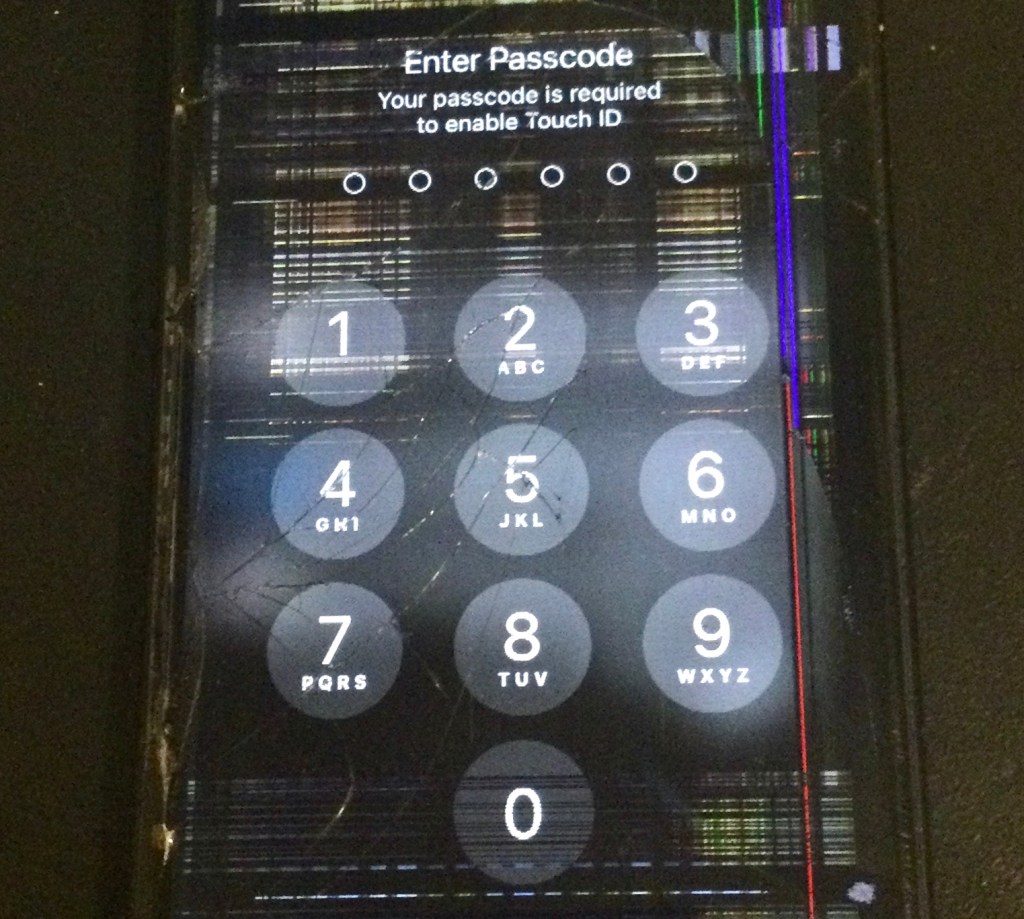
    Two years ago, on the day of moving back home for my last summer vacation, my phone falls from a mundane height at just-the-right angle, dislodging shreds of glass from the screen. (Even now, without a camera roll as reference, it is difficult to construct a coherent timeline from my position in the present.) At the time, I was on a video call with the first woman I had ever fallen in love with. Ironically, the relationship did not last very much longer after that. As the years passed, more of the screen chips away, spiderweb fractures spread across the back glass, and the camera gets a hole in it that quickly fills with sand, now only able to capture impressionistic swathes of light and subject through its broken lens. The second day of this new year, a properly tremendous drop adds a new array of colored lines under the initial impact almost two years ago. It is completely unusable by the middle of this week. A keyboard with a mind of its own gives way to a screen with zero haptic response. My first fear is that I had just lost the first time I was in love. Yes, I still have my own memories, encoded and stored; however, the problem now lies in the retrieval, lacking the specific visual stimuli designed to conjure memories. A photograph is an instance, allowing one to recall a time now passed. Without the instance of the photograph from which to ground my re-collection, all these moments—whether shared or having only been perceived by me—will be lost. The issue is not technology; the issue is memory, and mine has been failing for four years. A brain fog that will never pass.

    I knew it was hopeless, but I set an appointment the next day to have the screen fixed with money I really could not afford to spend, knowing it was likely an issue that had gone beyond mere display. All they could offer was to essentially replace the phone for more than double the price of a screen repair. While not the most terrible deal, all my photos would be trapped on the locked phone with no conceivable way to access them. There is no backup. All anyone can muster in the aftermath of these situations is well-meaning advice to back up your data before the next time this will undoubtedly happen again. It never matters. Even if you do your best, something still goes wrong. If I were to tally all the happenings since my having moved to New York, on paper, the deltas would surely outweigh the pluses. However, no one lives life on paper anymore.

    But then, sometimes, things are not as bad as you thought. Wading in the midst of the rubble, you think to check elsewhere and, sure enough, there exists a partial catalog. The last year-and-a-half in images might still be missing, but it is something. It has saved what you feared was gone forever. For you, it’s enough. So, do you consider yourself spared?

    I suppose it is rather fitting that the act of deleting was the last time I will ever see each and every one of those pictures, having gone through the last eight years of lives in order to trim the digital fat. It is certainly devastating to think about: all the planned video ideas that can never be started, let alone finished, the loss of an ongoing record that provided some sense of linear time, all those instances you want to always have on demand. Yet, what else can I do but accept my fate, even try to enjoy it? For a second, I worried about publishing this—it’s too personal, too much about me—but I will wake up in the morning a completely different person. After all, I am unburdened by the depths of memory. I cannot be upset. I have already forgotten.

    Pages: 1 2

    ,
  • New Headphones

    I am only writing to stave off the impending depressive episode that I can feel building up in my body. This is gonna be all off the top. I feel too overwhelmed by choice in this city. I’m too obsessive for this. Just yesterday, hanging out with my new NYU friend for the first time, she takes me to a market and I can’t decide what cookies to buy. Most of the options were too expensive and I knew whatever I chose it wasn’t gonna be very good and I didn’t need to be buying them in the first place, so I made myself pick up a cheap, day-old black-and-white cookie after much pacing and deliberation and complaining. My next essay that I’ve been researching and outlining is gonna take so much time and energy and I don’t think it’s gonna turn out that good. It’s not a novel idea it turns out, so I’m not sure how best to go through with it. The laptop I have is a real piece of shit and it’s a hassle to get it to do the simple things I want it to do. I miss my computer back home. How pathetic is it that my happiness is tied to a machine? I guess it’s not that pathetic to be like everyone else. The only Übermensch is that man you will never see or hear from, living away from everyone according to his own beliefs, on his own terms. If the Nietzschean ideal can be surmised as the warrior-poet, I see not many better contenders than Ted Kaczynski. I feel like every man at his core is a libertarian: deep down, we all want to be homesteaders. An entire class of people that cannot stomach being told what to do. And I see videos of these guys going out into the wilderness with next to no survival skills and an iPhone, where they’ll learn how to live off the land and build a house and gather food, like a real man. Yet, they have to post. It’s a compulsion. I genuinely believe it’s just our evolution. The Call of the Wild is overwritten by the Cry for Attention. I try to reject—more like, moderate—all this technology that wastes time and kills attention spans, while, on the other hand, I exalt it in the abstract as maybe still possessing some liberatory potential. The Accelerationist Manifesto professes this doctrine as well: that is, technology can be repurposed under a new economic organization: it can liberate us! the Keynesian future isn’t dead, it just got delayed! However, not even a machine is born with a completely blank slate. There’s too much us in them. As a species, we have always been searching out care. It’s our nature to seek it. I suppose seeking always ends in destroying. I won’t shit on these guys for wanting to get some likes by uploading their lives. I’m not a primitivist, and from what little I know, I honestly think it seems like an ineffectual political philosophy, but aesthetically it just makes sense to me. There is a beauty there, an appreciation that emanates from my bones— something I can neither question nor adequately describe. I wouldn’t want to. Jameson is wrong. There is no waning of affect. On the contrary, there is an overproduction (and thus, a manufactured overconsumption of this surplus affect). Yeah, I’ve been reading a lot of Shaviro lately. I was introduced to him in college and I agree that no one’s doing it like him when it comes to writing on film—although I find myself legitimately and equally excited by the stuff he’s written on any other subject. I have finished a handful of books and essays in just the past week or so, which feels great (with many of these PDFs just picked up on random urge and finished in just a few sittings or less), but then it all gets too overwhelming again. I can’t read everything and I certainly won’t understand a good chunk of what I do read, I can’t possibly comment on all of it. This next big essay idea keeps finding new sources for itself, and like the last one, will take months to fix together. I need to focus on other things to stay sane, but then it’s just there weighing on my mind, so how can I do anything else? So, I don’t do anything. It feels like a black hole honestly. Maybe that’s just writing in general. The obsessive-compulsive cannot be broken, it seems. It’s so frustrating to be someone so easily discouraged and afraid of criticism and rejection, but then after putting forth the minimum amount of effort to convince myself “well I tried, didn’t I?,” knowing full well that I’m not gonna get anywhere, I can’t learn to just give up. I can’t throw a punch, but I can take one. I like to call myself a “not-angry person,” but it was only yesterday I actually realized how angry I still am. My anger is not outward, but I don’t feel it’s inward either. Freud believed melancholia to be a manifestation of anger toward oneself. I genuinely don’t know if I’m angry at myself. I certainly don’t express it outwardly. There are no vocal outbursts, no smashed keyboards, no hatchets through doors, no slamming fists. I don’t think anyone will ever see or hear that again. But, there is that venom. If not inward, then interior. Whenever I see something so mundane that it really should not even be given a second thought or garner any more than a nanosecond’s reaction, I try to mediate between myself and the anger, but that doesn’t make the feeling go away. That’s because it’s not a feeling: it only becomes an emotion when you try to rationalize the affect. I eventually forget, and then I’m angry again at the next thing. You can pull a man out of anger, but you cannot pull the anger out of a man. It’s the only emotion we’re taught is acceptable, says bell hooks. It feels like I have to undo all the damage of purposefully making myself as invisible as possible over the last decade. I don’t get to be mad that no one wants to pay attention to me. I don’t want it, but I do. I won’t pretend to be above the want for validation. I’m not better than that. I’m not above scrolling on my phone for far too long or wishing for the perfect partner to help alleviate my problems. My Bluetooth headphones broke for good right before I moved here, then the iPhone adapter for these awful old CD player earphones broke, and then yesterday, the speakers on my phone stopped making sound altogether, which isn’t even the first time that’s happened. I walked to Target to go buy Swiffer pads and headphones. I didn’t care what kind they were. I was going in there and getting whatever: no looking for a better deal online, no standing there reading the back of every box; I just bought the standard Apple EarPods with a new adapter and left. Cleaning the floor and listening to music. I knew that would pick me up. I always kinda thought the music-as-therapy/music-makes-you-feel-less-alone crowd were annoying, but I did feel it working. I still kinda feel like shit again. Now, I’m trapped with these headphones. I can’t hear anything without them. After two days of training for my new job, I decided to stop showing up. I hated it there. I hated those people. The second day wasn’t just giving it a second chance, but an exercise in figuring out what it was that was rubbing me the wrong way about this place. I can only describe its “culture” as bro-ish. It felt like going in to work at a frat house. It was even funnier when I learned that this shitty Scandinavian company for all its emphasis on “chill vibes” was sued not too long ago for misogynistic hiring practices. It all made sense. I didn’t want to feel like the weird kid who got caught sneaking into a Sigma Chi party and was now being publicly humiliated in front of everyone for thinking he could have ever gotten away with pretending to be one of them. The majority of that training felt more like hazing than any sort of learning. I am a quitter. I’m proud of it. I don’t care. I don’t care enough to describe it in anymore detail, but it made me smile to think of their reaction when I wasn’t there the next day. Of course, they don’t actually care. It’s whatever, I got paid for the online courses and the two days I showed up. I want to find something better. The backbone of my pseudo-justification for moving here was to get closer to a thriving artistic and filmic culture. No, it’s because three years ago I was the angriest and unhappiest l’d ever been and wanted to leave everything behind. I really thought that was possible. I said that I was going to move to New York City. I had to! Even after clawing myself out of that hole, I still felt compelled to go through with this promise. I forget that me now is not the same as me then, or maybe I forget the opposite. I really don’t know. On the one hand, I made it here, which is insane; yet, I’ve already put up my hand to throw in the towel. I’ve barely tried to find a job that won’t make me want to kill myself. Wasn’t that the whole point, to find something that relates to my passions? Whatever, I got paid to learn how to make coffee and juice for a few days. I’ll see your $150 and raise you a pair of new earbuds. It was only a matter of time before I had no other recourse but to admit that I too get lonely and in need of comfort.

    ,
  • Unemployed (In)activities

    ***Post got un-uploaded, originally published yesterday***

    I spent an entire day going through all my folder of bookmarks on Firefox and found this old Mark Fisher post I had saved however long ago. It is one of the most relatable things I’ve re-read in a while, and some remarks from another bookmarked essay by Alan Kirby resonated with Fisher’s (and my) sentiments on (un)employment after university.

    For me, it was absolutely a question of being projected into a space between classes. When I did work in factories, I was either pitied or pilloried. Every job seemed impossible: manual work because of my feckless diliatoriness, graduate jobs because, well, I wasn’t the sort of person who could do them. Me, a teacher, a journalist or a lawyer – surely not.

    Mark Fisher, “No I’ve never had a job” (2010)

    This technologised cluelessness is utterly contemporary: the pseudo-modernist communicates constantly with the other side of the planet, yet needs to be told to eat vegetables to be healthy, a fact self-evident in the Bronze Age. He or she can direct the course of national television programmes, but does not know how to make him or herself something to eat – a characteristic fusion of the childish and the advanced, the powerful and the helpless.

    Alan Kirby, “The Death of Postmodernism and Beyond” (2006)

    I STILL HAVE NO JOB. I like being unemployed, but it’s starting to feel like a chore. For example, I make sure not to go do too much fun stuff on any given day, because I’ll feel guilty since I should be looking for a way to pay rent before my savings run out. No, it’s not guilt, I would just rather not run out of money, but I cannot seem to care all that much. I’m dragging my feet and not taking it all too seriously. I’m not that pressed. I have time. I should be making the most of acquainting myself with the city. That has been fun—walking around, no headphones, no nothing. My days of unemployment are coming to an end, I feel/fear. I’ll probably have a job by the end of the month. My dad likes to describe it as finding “gainful employment,” but what exactly am I gaining? It’s a negative gain: I have the privilege of selling myself in order to fend off starvation and homelessness. (Another bookmarked page offered a comparison between Schopenhauer and Nietzsche on suffering. Schopenhauer, influenced by the translations of Buddhist texts made newly available to the West, asserts that life is indeed suffering; therefore, to experience pleasure is only ever temporary relief from the ongoing, natural human state of pain. Nietzsche agrees that the uniquely human consciousness of time contributed to the life-as-suffering dilemma, but to pessimistically resign from the world was to admit defeat. I agree with Nietzsche actually.) In my eyes, nothing is more gainful than unemployment; however, to be unemployed fully on one’s own terms is probably next to impossible and most are unwilling to try. An idea for a future disappearing act?

    I AM INCAPABLE. I feel I am too incompetent for any job. It doesn’t matter what: graduate job, graduate student, or any entry-level “unskilled” position. I am an “insect” like Fisher. I am no writer, I am no barista or data entryist. (Kirby’s “silent autism” that characterizes his “psuedo-modern” age is so scarily relevant, especially at the prevalence of that word un/ironically today and the seeming omnipresence of neurodivergence. Those hypochondriacs and self-diagnoses, ironic or otherwise, were correct all along: we are all autistic.) Yet, I felt I had to leave the validation bubble behind; everyone goes on and on about how you shouldn’t go to grad school in the humanities: it’s not worth it, they say, as they are currently in or have already gone through the academy. Maybe I gave into the pressure to get a real job. I don’t know, maybe not. I did put a lot of thought into it first. I didn’t feel I was ready to teach others anything. I was scared. I can barely explain the things of which I am most knowledgeable. In other words, moving to the largest city in the country with no job or long-term plan for the future is the most elaborate and expensive way for me to build my confidence. I don’t know how long I’ll give it a shot out here on my own. You always hear late night talk show tales of big-name actors moving to LA or NYC and giving themselves an arbitrary deadline—”if I’m still getting nowhere by 30, . . .—before they were going to pack up their dreams and go home. For them, it’s never not a success story.

    I CANNOT FOOL MYSELF. The human penchant for delusion is extraordinary, but I do believe I am being honest when I say I am an academic at heart and I need to be around people who actually know a thing or two about the thing or two that I know (and care) about. If I keep going down this hole, I’m gonna will myself into feeling bad about myself and whatever it is I am trying to accomplish, or let alone simply do out here. But as it stands, I’m definitely not as big a depressive as Fisher. I feel good. My initial goal was to be closer to more opportunities, but I’m still typing into a vacuum and getting nowhere. At least, I’m enjoying it. Networking sounds abysmal, but it can serve as a half-baked justification for maybe finally going to a movie theater or visiting more galleries and museums on the slim off-chance I meet someone who likes the things I like. I am the most active passive person.

    I KNOW I AM CAPABLE. Where are the days of just walking into a manager’s office, making solid eye contact, extending a firm handshake, and landing a cushy, useless executive position at some company that was destroying the planet before anyone really cared about that? On the one hand, I know I can literally do any job if given the opportunity, but sometimes I cannot help feeling like a helpless child. That’s why I don’t like the person I become around large numbers of family members: they’re accomplished and I am only reminded of my complete lack of real-world skills. The salesman might as well be good as dead. (Sorry, Dad!) But now, my relationship with my parents seems stronger than ever. Distance is good here, necessary I would say. I’m being funny and charming again “around” them. I can’t even remember the last time I made my dad laugh that much during our most recent phone call almost two weeks ago. Who knew all I had to do was leave home without so much as a word of warning?

    I AM WRITING AGAIN. That feels really good. I’m getting new ideas. But, I need an actual computer to enact a good deal of them. I joke that I’m gonna befriend an NYU student, so I can use their school ID to get access to the computer lab with Adobe Creative Cloud. It’s more than likely doable; I looked it up. The six or seven year-old laptop I brought with me as a temporary understudy (and quick cash backup plan if I ended up needing money that badly) allows me to write when I get free café or library Wi-Fi, but it can’t edit video and has a wonky USB port, and I have a lot of things I am itching to get finished. I feel like my headspace changes so quickly that I have to churn out whatever I’m working on while I still have whatever feelings that motivated the idea in the first place, otherwise I get bored and move on and relegate yet another probably-never-to-be-completed work-in-progress to the purgatory pile.

    I NEED FRIENDS. I think all this half-doubt goes away as soon as I make some new friends. That’s another thing I think myself incapable of, but it works out every time. Having a roommate is fine, I guess, but I feel like her role at this point is just to say “what are you doing?” every time I start making random sounds to myself. We don’t have a whole lot in common in terms of interests or character. I’ll make some friends eventually—it is a priority for me—but I am a social camel. Honestly, I’m not really that worried about anything. It’s been more than a whole month; it’s only been like a month. Ya know?

    Pages: 1 2

  • White Flight of the Bus Boy

    What have you been putting off doing? Why?

    The current image has no alternative text. The file name is: 72167849035__b0f12bd4-2c55-434f-9b9a-832e085f4bc7-1.jpg

    I thought I was gonna have to watch my grandma die on Thursday. It was only for a second. I wasn’t even sad: I was petrified. She’s collapsed on the grass—a dizzy spell from fasting and working outside—and I’m standing there thinking of what life would be like without her. I wouldn’t be in this tiny seat right now, pushing northbound: 12 of the 36 hours now behind me. Thankfully, her neighbor was talking to her outside, able to catch her and lay her down. I do feel terrible about leaving her after something like that. Leaving and the days leading up were supposed to feel good, but it felt shitty after that. For a day, I felt like Stan in that episode of South Park where everything he sees and hears is literal shit. I bought the tickets that night anyway. I still wanted to go, but it felt different than I imagined. It’s not even that I romanticized it, but a plan three years in the making is gonna have unforeseen side effects. I’m not the same angry lil’ guy anymore, trying to run away from his problems. If I thought I was making a mistake, I would’ve called it off. The idea was to just leave, me and my three bags, and explain myself afterward. I couldn’t do that to her. It felt really fucking bad to drop a bomb like this on my grandma on my last afternoon living with her. I don’t know why I’m so secretive. Maybe the answer lies less than two miles down the road in the house I grew up in.

    I was gonna document how my feelings toward my leaving changed over the day-and-a-half of bus rides, but I don’t feel any reservations or butterflies. I feel so calm, so level. Packing only the essentials and moving my life to a new city feels no different than a commute to work. For four hours I had to sit in a bus station, waiting for my first transfer, and I literally did nothing. I helped an old lady use her credit card to buy Cheetos from the vending machine—which reminded me how my grandma thinks I’m a computer genius for setting up her new router and modem—and I updated my diary for an hour, but that was it. I just sat there and felt the rest of time.

    Every time I see an old skinny White man with a white beard and an outfit I would wear, I swear I’m looking in a time travel mirror. I would love to make it to old age just to look like Noam Chomsky. I’m now on the second leg of my trip. Mr. Chomsky is sitting next to me. We’re wearing comparable khaki jackets and jeans. He has a gray skullcap with a small “S” on it. He doesn’t talk much, but he’s got a voice that’s higher than you’d expect; less gravelly too: it’s gentle, and I notice that he’s a conscientious person. Although he looks like the 94-year-old linguist, he rocks an Attack on Titan backpack and lifts himself up when he has to fart. Stopped at Brunswick, Chomsky randomly says that he’s never seen a Chinese bus driver before and then goes on to say how our driver seems much nicer than some of the nastier White drivers he’s had in the past. I love how matter-of-fact old people are about race, it’s refreshingly honest and hilarious. Anyone should be given the job if they’re good at it, he says. “Discrimination is illegal, ya know.” This guy fucking rocks. He shakes my hand and moves to the now empty pair of seats one row ahead in order to stretch out and sleep. If he is anything like me, he likely won’t be able to.

    The fearmongering over taking any kind of bus is completely unwarranted. In my years of taking school buses, different city bus lines, and now Greyhound, I have never had a bad experience. Yeah, sometimes a person might smell a little bad or refuse to wear headphones, but who cares? I think this is my favorite way to travel. I would love high-speed rail as much as everyone else, but a bus just hits home. As it stands, I like it even better than Amtrak: it’s cheaper and takes the same amount of time to get where I need to go. I feel absolutely no anxiety about moving across the country to go live with someone I only “met” not even two weeks ago. I only have several thousand dollars, maybe half of all my winter clothes, and no job. What a day a diff’rence makes.

  • Polyp Stage

    The current image has no alternative text. The file name is: img5.jpg

    I always thought it was a dumb question to ask people what animal they would want to be in another life. And I thought it was even stupider when people wanted to be anything other than a human again if given the choice. But now, I wouldn’t be too mad if I was reincarnated as a jellyfish. I could see myself enjoying life as a transparent, immortal, hermaphrodite blob. I don’t know if jellyfish enjoy things. I don’t feel like learning that much about them, but they seem interesting. I’m positive a plethora of bad articles already exists about how they’re the perfect creature that are far superior to humans because they just go with the flow or something. I’m not going to paraphrase their life cycle because I don’t feel like learning about it that deeply nor do I have anything insightful to say about it. It’s just cool and I’d give it a try.

    At the pool today, I heard a woman’s voice singing opera from over the fence. A jellyfish couldn’t have heard that. It felt almost surreal to hear this beautiful, faceless voice when no one else was around to hear it with me. Before it really registered, my brain was already contemplating how I could climb onto the gazebo roof to see who it was, or I could at least try peeking over the fence. I just stood up in the water and listened before returning to my laps.

    I used to be scared of swimming alone for fear of a shark spontaneously appearing in the pool and then proceeding to eat me. Maybe it was because of Finding Nemo and that chase scene through the naval mines. But whenever my brother would get out of the pool, I’d get out too a couple minutes behind him. I was scared of sharks and vampires and the dark for the longest time. I was reading an illustrated children’s copy of Dracula I had gotten from the library and there was this terrifying vampire woman with a pale blue face that took up an entire page, so I made myself kiss it as a way to conquer my fear. I still turned around whenever I was in front of the mirror though.

    I don’t know how old I was, but as a kid, I made myself a time capsule. On the bottom of the wooden box, I wrote to only open it on my birthday in the year 2030. I wrote it in pen. I remember I forgot to paint one side of the lid. It bothered me for a long time whenever I’d see it because I always meant to go back and fix it. The only thing I actually remember putting in there was a small article about polyps, like an actual small piece of paper. It might’ve been one of those informational cards you could tear out of a kid’s science magazine. My aunt got my me and my brother a subscription to Ranger Rick for Christmas one year, I believe. I don’t think that’s where it came from actually. And maybe I put a small stuffed animal in there too. It wasn’t a very big box.

    For the first time in forever, it feels like I am not writing for anyone.

  • Wed, Sep 14, 2022
    11:46 PM – Bedroom
    Jean-Luc Godard died yesterday morning.

    The most important director of the last century died on this day one year ago. In very French fashion, he was relieved by assisted suicide around the same time that I ended up going to sleep early that morning. The day after was a Wednesday, meaning I had to wake up earlier than usual for my directed study meeting with Todd. He usually kicked me out ten minutes before the hour, so he could gather his notes before History of Video Art at 11 (which I was also in). I’m waiting on a bench in the middle of the hallway before class starts in room 356. Todd comes out of his office around the corner and tells me Godard had just died. It really is difficult—just as a mental exercise—to conceive of such a monumental figure no longer living: a man who was still making films as an octogenarian. But, I didn’t cry; I didn’t know him. It’s odd to think about it. The most important mentor in my academic and artistic life was now informing me that the greatest influence on my passion for cinema had just died. Godard was next to his wife, Anne-Marie Miéville, ​the woman who collaborated with him for decades, and partly responsible for him adopting a more matured, experimental, and feminist edge that is not as pronounced in his New Wave canon. I don’t think you can ask for a greater death. He was tired and had nothing left to say, so he left: no funeral, no body but the unrivaled body of work he left.

    Last September was a good time for me. I had just started working my first real job, I was watching great movies, and the 26th is probably still the best day of my life. A year ago, I felt on top of the world. I was confident, committed to not taking shit, and ruthlessly dedicated to my studies in a final semester with an absolutely stacked course lineup. Right now, I’m not doing so awesome, but I’m still good. I believe I may have developed a sort of litmus test to see how I’m faring mentally at any given time, but it can’t be employed too often or it won’t have an effect. It’s an old poem I wrote. It was selected to be included in a book of other students’ poetry, so every time I find this book and remember I have it, I open it to page 158 and read it a few times. (I’m able to remember the number because Cartoon Network was channel 58 on Bright House.) And so, two years before last year, I was in my old bedroom, I took A Celebration of Poets off the shelf, opened it, and I broke down. “How have I gotten to this point?” This gay little poem from the mind of a nine-year old made me cry.

    I used to be ashamed when I was younger that a stupid poem I had written about rainbows in a fourth grade writing workshop was the one that my teachers thought was worthy of publication. I would’ve told you I had better. But now, how could I be ashamed of myself at all? I was a little kid. I wrote only what came to mind. I am proud of it. (Although, reading the one below mine kinda puts my poem to shame a little bit, haha.) I couldn’t believe how much it impacted me. It’s one of the finest things I’ve ever written or read; I wasn’t trying at all, and after 11 years, I remembered how honest I could be. But at that point, what did any of us know about love or loneliness or metaphor? Absolutely nothing.

    So, every once in a while, when I take the time to read it, it means something completely different to me. When I read it now, I smile to myself and remember all the rainbows that have came and went. Sometimes I weigh the options to myself about the best thing I’ve ever written and I think the running joke I’ve always made turned out to be true. Maybe I did peak in elementary school.

    See for yourself.

    Because you speak to me in words and I look at you with feelings.
    RIP le Fou (1930-2022)

    , ,
  • Won’t you please let me go?
    These words lie inside, they hurt me so
    And I’m not the kind that likes to tell you
    Just what I want to do
    I’m not the kind that needs to tell you
    Just what you want me to

    I saw you this morning
    I thought that you might like to know
    I received your message in full a few days ago
    I understood every word that it said
    And now that I’ve actually heard it
    You’re going to regret
    And I’m not the kind that likes to tell you
    Just what you want me to
    You’re not the kind that needs to tell me
    About the birds and the bees

    Do you find this happens all the time?
    Crucial point one day becomes a crime
    And I’m not the kind that likes to tell you
    Just what I want to do
    I’m not the kind that needs to tell you, ooh

    Lost you, I’ve lost you, I’ve lost you, I’ve lost you, I’ve lost you
    Lost you, I’ve lost you, I’ve lost you, I’ve lost you, I’ve lost you
    Lost you, I’ve lost you, I’ve lost you, I’ve lost you, I’ve lost you

    Ooh-ooh, ooh
    Ooh-ooh, ooh
    Ooh-ooh, ooh
    Ooh-ooh, ooh
    Ooh-ooh, ooh
    Ooh-ooh, ooh
    Ooh-ooh, ooh
    Ooh-ooh, ooh
    Ooh-ooh, ooh

    Ooh!

    The above lyrics are taken from this wonderful piece of songwriting from one of my favorite musical groups at the moment. The italics are mine, to distinguish between the two distinct timbres of Bernard Sumner’s singing, to be addressed momentarily.

    I am living by a new rule where I stop giving a shit about people who don’t give a shit about me to combat the creeping exhaustion I feel (emotionally, physically). I invest too much in other people’s shit: fix your own problems! leave me be! I am in the midst of a great uprooting: my 30-day notice signaling the end of my rental agreement at the end of this month, my two-week notice marks my exit from my job with my last day being tomorrow, I have way too many projects going on right now: an essay/collection of related essays/book I wanna start researching/outlining/writing, two short-form videos both started but not finished, a public art experiment, my short movie, an impromptu feature-length movie of sorts that needs to be stitched together, and I have no phoneit’s at a new friend’s house (I have been spending a considerable amount of time with her because I enjoy her company and conversation, it’s hard for me to find people I actually find funny and charming and worthy of respect) and I don’t have transportation or time to go get it (not that I particularly need it; wait, yes I kinda do, I gotta call my grandma to tell her I plan on taking her up on her offer to live at her house for the remainder of the summer), so day three without a phone begins tomorrow. No matter.

    I was reminded of someone who was at the foreground of my mind some months ago (go back and see for yourself) today. I had been sticking to my new rule, but today was such a good day, although I can think of absolutely no particularly discernible reason why, so after I walked home from the bus stop in the rain, I decided to perform a dreaded check-in—a 21st-century digital phenomena wherein a rejected party masochistically, and therefore, often routinely, keeps tabs on the person(s) who have turned them away. It has been about two months probably since I told myself to finally cut that shit out, and in my stubborn resolve, I stuck to it rigidly and absolutely. It was this person too that came to mind when I listened to the first song off my first playthrough of New Order’s Power, Corruption and Lies (May 26th). As I kept returning to the song in the following days and weeks, the two intonations of the vocals struck a chord within me. Now, the more I mull it over, the more I think this is such an obtuse observation, but I see the two timbresone high and strained, one low and tiredas a man and a woman, the complementing objects of the song. But, they are not having a conversation. Each of their respective verses like a telegraph through time to the other, not even certain if the other will hear it, let alone respondsent out into the ether to be picked up, only if they happen to stumble on the right digital crater, that is, if the breadcrumbs were followed correctly. It’s a game, simple sign exchange, word=play, and the best part, you don’t even know if they’re even playing at all.

    Yet, what I am also just now realizing is the vocalizations at the end of the song are sung in the higher-pitched voice. Across space-time, the response of his lover is lost, made blurred and indistinct by the distance, “further all the time.” Curtis’s choice of further instead of farther denotes the distance as a metaphorical one, bridged by a technological (in)capability that compresses physical space into modulated waves, a relationship of re-/delayed mediation.1 Stretched too thin. Are they cries? shouts? elation? guilt? anger? or symbolic of everything left unsaid? An understanding, yes.

    Oh, and so what did I find on this walk through the museum gallery of the digital Other? Words that I take as written only for me. They found me and plucked all the same chords, so they are only for me. And once more, their words inspired me to action, stirred an idea that had been brewing internally, now poured out into the ether. Read my thoughts. Who knows if I’ll get back to youwhen? Two months later, my bad idea got its proper conclusion after only two weeks, as it turned out, unbeknownst to me. You see, it was after my message was received in full that I made my rule to get my shit together. I knew it wasn’t a bad idea: it was absolutely necessary.

    The beauty of the excruciating situation of the song and the events recalled to me tonight? None of it was meant for me. It means absolutely nothing. The song can be interpreted according to any number of readings, as one voice or two or entirely otherwise, all at once. The message I found carefully framed on the wall could be about me or anyone else. How brilliant! You write poetry, I write nonsense. I feel so much better. It’s not even a question.

    You sly dog, you do think about me! Did you check in?! I’m calling it there, that’s what I’m telling myself. Look how much fun this is. It is beautiful.

    Hello?

    Do you read me?

    Huh, guess no one’s home.

    Note

    1. The alternative meaning of further as adjective (i.e., moreover, furthermore) not shared by farther manifests that the “touching” is happening “all the time” precisely because of the “distance”the constant contiguity of techno-mediation. It’s just digital screens instead of analog radios.
    , ,
  • I wish I could go see a therapist, or even more interestingly, for better or worse, a psychoanalyst. Sitting down with a licensed professional to talk about the glitchy, rhizomatic workings of my brain would certainly scratch my intellectual itch to deconstruct and read into everything. But, maybe that would not be a good thing. I would not want to be told what to think about what I think, having my mental intrusions and dreams traced onto some preexisting top-down schema, but to have new pathways of understanding grow in addition. I certainly overanalyze my emotions, however, I don’t think I do that as substitute for feeling them. The chicken or the egg? The critic certainly came before the artist in my mind. I bring up these thoughts and questions because last night I wrote in my diary that, for me, it really only takes one person. I only need one person. One person’s belief is enough to get me off my ass. I put no faith in anything, but I expect godly devotion to me in return, but I only need it from one. I wish I could go back in time and fistfight my parents for making me someone who is driven by praise but not before sealing it with a lack of confidence and anxious character. I yearn to disrupt from my subjected state of paralysis. “Drive” is too strong a word, I get along just fine without positive affirmations, but it really does feel great. On my own, I am incredibly unmotivated to create anything and share it. The second person grounds me, they don’t even need to really do anything. Someone to study next to, for instance, someone to sit next to me while I work—even better if they have good ideas and input and interest in what I’m working on. In some instances, it doesn’t really matter who; does that qualify as using people? I just need a body there. I am an empathetic person at the outset, but the more I dwell on these questions that do not even need to be asked, the more I see myself as an opportunist, narcissistically manipulating people to my advantage, means to accomplish my ends. Perhaps, I am giving myself too much credit. To be fair, I have stopped caring a considerable amount about how people perceive me, but I could not bear to be thought as a narcissist. I might have taken it too far. I rarely talk about myself, much preferring to listen and observe, speaking only when spoken to and retreating once more after the interaction, I am quick to cut people off, I have forsaken social media and eradicated most traces of a digital footprint, for the longest time, I carried myself purposefully in a way that I would be as invisible to an Other as possible, becoming illusory and nondescript. When I set out to do things, I do them. When my parents became merely roommates, I vowed to become that invisible to everyone else. I don’t know, I’m trying to be my own therapist, but even if I come to the most correct conclusions, the catharsis will never be the same as a real session. I need another person. And so, yet, I think I may have finally shed the last bit of that modernist air of superiority, as if I unconsciously treated myself as if to have existed independent of all systems. I think most people are like that. You see, narcissism is the medium after all, I didn’t want to wholly accept it, but Krauss is right. I concede her that, but I throw back, an equally simple question to her own simple, brilliant thesis: “Who cares?” “Okay, so what?” It is interesting that I have such a love for video coupled with a crippling phobia of narcissism. I don’t know what that means and I’m too tired to work that out right now. I told myself I would stop doing this shit where I wallow in my guilt and all my ugliness, because it really is as simple as consciously choosing to no longer think in that space. I’m tired of whining to no one. Ever since I can remember, I wanted to be a rockstar. I can recall one specific gray memory of childhood. It’s a couple days before my seventh, maybe eighth, birthday. My mother gifts me a necklace with a pendant that I wear currently on a new chain. It is after my parent’s separation/divorce, so maybe it is my eighth birthday. That would make it 2009. Or maybe it’s before, but my father just isn’t home. The details are not important nor the images, but the thought. I don’t know what prompted the daydream after that moment, but I imagined myself singing in front of an arena of adoring fans. (I probably was watching too much American Idol.) A wannabe object infatuated with objects. Why fight it? It’s exhausting and boring. Video is my narcissism and my foxhole—I need mediation between me and the outside. I hide behind my long hair, but not today. I will reappear only to disappear too soon, both aesthetic projects, orchestrations in their own right.

  • Breadstick Sociology

    There is a rule at work that you have to ask a manager before you eat a breadstick. It’s a stupid fucking rule, because no one who is hungry and on the clock is gonna go track down an authority figure to eat some greasy, oversalted bread. So, no one actually asks, obviously. However, if a manager or restaurant professional does happen to see you eating one, it’s always, “did you ask to get that?” The kneejerk reaction is to lie and end it there, but you might jokingly admit that you, in fact, did not. “You know you’re supposed to ask.” Everyone knows that, but no one, especially not management, actually cares. The thing that strikes me as ridiculous is that they know no one is gonna ask to eat fucking bread, especially when we’ve been rushing around nonstop for hours and finally have a chance to take a 30-second break to eat the only available food—then back to work before anyone notices. That’s the way it goes. Even though you know nothing will actually happen if you’re caught, you cannot help but eat one only when you know no managers are around, and when you don’t know for certain where they are, you go hide in the piss-poor excuse for a “breakroom” (dry storage) that doesn’t even have any chairs or tables. Eat if you will, but it won’t be a break.

    And one might think, “oh, they’re enforcing dumb policies to hold even more power over their workers,” and yeah, sure, but it’s more complicated than that, because this unwritten rule is not ridiculous at all from their perspective. They know with absolute certainty that this one rule will be broken: that is quite literally what it was designed for. This one little asinine mode of control is the only one constantly harped on precisely for this reason. You are allowed to break this nominal rule, so long as you obey all the other big ones: report all your tips accurately, card all guests who order alcohol, don’t commit “time theft,” and so on. This one rule sets the entire tone for the workplace dynamic. An uneasy, steady alliance of we-know-what-you’re-doing and you-know-what-we’re-doing. A delicate balance atop a straight razor. Eat the bread without asking, but don’t organize, don’t steal, don’t demand what’s owed you. You wouldn’t dare.

    I should go across the street and work at Red Lobster instead, they got way better bread anyway.

    ,
  • L’énigme

    I could not even begin to record for you the number of bad ideas I have had that I almost went through with. The figure would be astonishing. What’s even more is how clever I thought they were and how, just like that, I changed my mind in the nick of time, but often it is simply inaction over time long-enough that leads to the defusal. I have one idea right now, but I don’t think it’s all bad. After all this time, I cannot shake it—actually a continuation of an aborted idea some months previous. Now, that plan was bad I’ll admit and I’m glad I came to my senses when I just watched as the last chance to follow through began to walk out the door. (Thank God for that guardian angel!) But since, I’ve reconsidered and repackaged and now I think the consequences would be much less dire for everyone, perhaps even welcomed? I still stand by it, in its more mature form. Enough time has passed, but h*pefully not too much. Doesn’t matter honestly, it’s kinda now or never.

    I even have experience with such dumb ideas of this caliber, one time in the past, and I gotta say, I think I felt much better afterward. I mean, beforehand, I was nervous and sweating like crazy and shaking and stalling and I had to take a shit right before ’cause I was so anxious, but it felt good to get everything out in the open. If I hadn’t I would’ve regretted it, assuming it wouldn’t have eaten me from the inside-out first, and I do not regret anything. Ever. The reverse face of hope. That time turned out fine, better than fine, so…why not?

    You know what? I think I will do something slightly stupid. I’ve convinced myself who was already convinced. What’s the harm, right? I’ll act while it’s still hot and fresh life and death. So, how best to do it? My stomach is falling out from within me. I need to alleviate this hollow, hurting feeling.

  • [From my copy of Collected Poems (1956) by Edna St. Vincent Millay, originally published in The Harp-Weaver and Other Poems (1923)]

    Had I known that you were going
    I would have given you messages for her,
    Now two years dead,
    Whom I shall always love.

    As it is, should she entreat you how it goes with me,
    You must reply: as well as with most, you fancy;
    That I love easily, and pass the time.

    And she will not know how all day long between
    My life and me her shadow intervenes,
    A young strong girl,
    Wearing a black skirt and a crimson sweater
    And a narrow band of ribbon about her neck.

    I used to say to her, “I love you
    Because your face is such a pretty colour,
    No other reason.”

    But it was not true.

    Oh, had I only known that you were going,
    I could have given you messages for her!

    ,
  • October 17, 2020; 12:16 am

    I am sorry. I have been away for far too long. I have put aside my passions in favor of cheap distractions, both breathing and inanimate. I have been afraid to set pen to paper, to turn the first page, to start anew. Until now, I have failed you. I have been fearful to create something I could proudly and wholly call my own. To innovate. To exist. To make art; something truly for myself. But fear is quick to overtake the mind, and subsequently, breeds anxiety. I have been paralyzed—no longer fear toward trivialities but toward my own existence! And thus, I have become obsessive. I have been obsessed with people who meant much to me and those who I gather now, meant little at all. Nonetheless, they were all crucial in this midnight awakening. I do not regret a second of it but it is no longer time for dealing with others. It is time that I take precedence for once. I am finally alone. In this moment, I have no one. But I have you, that’s enough. The clown Pagliacci I will be no longer, I will be the ghost that haunts his existence and tells his story. The only story I know well enough to tell. The story, the collection of masturbatory incoherence only I know. And I choose to keep it confined within me no longer. From now on, I will be his ghost.

  • Daily writing prompt
    What topics do you like to discuss?

    I can’t talk to most people about most things I want to. They talk out of their ass and bore me or I start talking out of my ass ’cause I’m bored. I don’t do that anymore. I’d rather sit in my boiler room and think of more interesting conversations with the most interesting people. Not reliving old ones (no, I try not to be nostalgic), but imagining new ones. Sometimes I write them down—my little scenes on little notes strewn across my desk, or bulletin board, or tucked away in folders. Maybe I’ll use them for a project if I can ever do anything about anything. But I can never finish them. After a certain point, I don’t know what you’ll say next. If people ever venture into my double-monitor sauna, I’ll have to hide these scraps that I ration myself on. I don’t like people looking over my shoulder before it’s done, and even if it reaches completion, I have trouble with confessional. (I probably sound really ungrateful. I like my friends, and my grandma is my favorite person in the world, and I have wonderful, memorable conversations with both, but not about the things I can never talk about, not because they are forbidden, nothing like that, but, as people, they are so literal, and I wouldn’t know where to even begin with them.) Everyone is so goddamn literal.

    I like people who can speak without opening their mouth—the body, the eyes have their own language. I’m reminded of Nietzsche and his well-documented love for dance: “Dancing in all its forms cannot be excluded from the curriculum of all noble education; dancing with the feet, with ideas, with words, and, need I add that one must also be able to dance with the pen?” I can’t move very fluidly or even speak without losing an entire train of thought or tripping over the ten simultaneous rushing thoughts, none of which are fleshed out, mind you, but if I could just get them all down and work through them and connect the dots to then disconnect them, then I could definitely make something great. Plus, the most I can muster is a trance-like stumble to “Venus in Furs” in the solitary dark; however, I know that I can dance with written words. But Nietzsche does not stop there: “I do not know what the spirit of a philosopher could more wish to be than a good dancer. For the dance is his ideal, also his fine art, finally also the only kind of piety he knows, his ‘divine service.’” For the dancer is my ideal, and so on, and so on.

    To dance is to stretch. I feel constrained by words one after the other, linearity, continuity, rows and columns—how do I make the words do what I want, arrange them into a new (dis)organization, while making them somewhat legible to the people who will get what I’m trying to do, or at least appreciate it? That’s what I’m trying to figure out, how to manage the impossible challenge of putting a form onto the formless, or rather, the unformable—a stretch, one might say. With dancing, I would imagine that you have to stretch before and after, so is there ever a point where a dancer is not dancing? Their body is in constant, undying service to dance, fighting time and age and weather to contribute to the craft they crave. I wonder what it’s like to think in dance. For me, I think it’s shots and cuts—fragments, images, objects, assembled together after the fact, plan beforehand or not. Video: “I see.”

    If we take Nietzsche at his word, then I think we could just as easily turn to Shakespeare and his metaphor-of-choice for life—the stage. “All the world’s a stage, // And all the men and women merely players” (As You Like It, II, vii). He continues in Macbeth, performed some years later: “Life’s but a walking shadow, a poor player // That struts and frets his hour upon the stage” (V, v). And I don’t think it would be a stretch to substitute dancers where he supposes players, given that both “[strut]” and “[fret]” on a stage. To dance is to stretch, to spread oneself thin in one’s life performance(s) atop that tragicomedic Shakespearean stage. And so, it is the second line—a perfect form-follows-function—of Macbeth’s soliloquy that catches my eye: everything stretches out into “Tomorrow, and tomorrow, and tomorrow.” Mind/body stretched too thin in time—into sheer surface. I can see my hand through it. It’s thin and white. The weight of a letter never sent. Paper beats rock, but two rocks create fire.

    POSTSCRIPT But you know what’s even funnier about the man who trumpeted the death of God? In “On Reading and Writing” from Zarathustra he writes, “I would believe only in a god who could dance” (41, trans. Kaufmann). But if he would’ve been there that night, he would’ve seen his dancer-god. Yet, I was there and I didn’t even realize the presence, the gravity of what I saw and heard until a lifetime had already eclipsed; because that night, I wasn’t there to be looking for her onstage. Time was out of joint. I wish I could play it back with what I know now. I wouldn’t move my eyes from her, tracking every slight expression in order to glimpse what she hides away under cryptic lock and key. I wouldn’t adjust in my seat. I wouldn’t blink. I wouldn’t breathe. I would be converted by nothing else. I, her most pensive spectator. Now, we’ve come full circle, back to sitting in the dark to watch a most generous God perform for me without knowing it. The first recurrence in our eternity current. I will not die happy until I see the encore, but I won’t be around the next time she goes up.

    ,
  • It got to the point where I was so hungry and fatigued that my eyes would not even look straight. Staring at the ceiling, and my body was too tired for even that. I wouldn’t move my head but my vision would drag itself from the patched popcorn ceiling to the dingy gray wall all on its own. So, I would reset my eyes and they would fall again to the same spot between the window and the corner next to the empty side of the bed, like clockwork. When I would focus on one spot—so my pupils couldn’t roll away—everything just spun. Me, we, they, you, none of it’s going anywhere, but everything is constantly moving about an indifferent axis, out of our control. If you lose your marbles in a world obsessed with hyperbolized gravitational physics, witnessed in the very spatiotemporal fabric of our popcorn entertainment—the only comfort/distraction from the everyday—they’ll eventually sink right back into place.1 It’s just gravity. That’s what holds (consumer) society together. In the age following the revolutionized nostalgia of Neo(liberal)-Hollywood aesthetics, there are now three certainties in life: death, taxes, and gravity.

    Death cannot be cheated per se, but geneticists continue to pursue the discovery of (and extension toward) some sort of innate biological expiry, pushing it further off, but taxes certainly can be cheated: unless, that is, you’re stupid enough to be poor, then sorry (60% of Americans living paycheck to paycheck), you’re likely outta luck.2 So, where does that leave Big G? It has become a play-thing, another game to be played (and therefore, cheated), just another variable to be modulated at will. Plug and chug. Force to be consumed. On the screen, we believe a man—a good ol’ American farm boy—can fly. But on the ground, outside the theater, is a different story, yet we still believe ourselves to be exceptional individuals of worthwhile merit. Steinbeck’s temporarily embarrassed capitalists. We have forgotten that the only place to spit in a rich man’s house is his face.

    As it stands, gravity is the medium to be controlled—to control—rather than money, no, in service of top-down monetary control—austerity. “Who needs the nanny state!? I have my Funko Pops and baby movies and ‘hot takes,’ thank you very much.” We want to believe so badly that a man can fly, break through the barrier of the inertial present and its people, to rise above all the austerity, whether that condition be understood as free fall (Steyerl), flattening (Jameson), capitalist realism (Fisher), the end of history (Fukuyama), etc.3 Yet, not even Superman, a demigod proclaimed to be made of the same material that supports the towering financial district, can fly forever. No (super)man can control capital: it is a machine, after all. Only the machinic itself could stand a chance to dismantle it, physically or symbolically. One who defies gravity defies all the potentialities of money in service of those on the ground, in favor of quarter after quarter of record-breaking corporate profits. The machine is propped up for one more year until it can be handed off to the next guy who also doesn’t know what the fuck to do.4 The fear of collapse is always child’s play when daddy is always in the other room to clean up your mess when the tower of blocks starts to wobble. One who defies gravity is surely waiting for the blow–back down to Earth.

    “Faster than a speeding bullet, more powerful than a locomotive, able to leap tall buildings in a single bound [emphasis added].”5

    Even in the opening narration to his earliest animated iteration in 1941, the Man of Steel’s superhuman feats are measured against the monuments of capital and its progress. His first appearance in Action Comics #1 sees him leap a “twenty-story building,” for example.6 In both versions, what goes up must come down.

    The phenomenological soothing/suffocating caress of gravity, it’s there even when I sleep. I don’t like how soft my bed is, I sink; I’m not even heavy; and it’s hot, so I sweat. It really is a bed too big for one person. Has anyone ever gotten so hungry they couldn’t see straight? Of course they have.

    That was two days ago, I think. (It was.) Yesterday morning I woke up after half-sleeping in humid heat. I dread going to work more than usual. My first waking thought is automatic—in Thom Yorke’s droning singsong, “a job that slowly kills you”—and it makes me smile. (Not actually.) Getting ready, the sun fails to peak behind the clouds and through the blinds at its usual time. I was right to feel dread. I walk to the bus in the gray, start reading Venus in Furs, and walk to work in the same climate. It’s supposed to rain as I get there. (It doesn’t.) On ugly days, the restaurant never gets busy, doesn’t matter that it’s Friday morning. (I was right.) I’ll be fortunate if my tip share is even $20 after a 6-hour opening shift. (It was not.) I’m not even making $8/hour base pay, and not even $11.50 with my tip cut. (Did I really give up the one thing I’m good at, the one area where I was encouraged, for this? What am I trying to prove by shunning grad school for hustling and minimum wage employment?) Not to mention, this past week my scheduled hours were much less than average. I thought to take that free time to finally start to get my shit together, move on, away—do something. (I did not.) I might get caught in the rain when I leave. (I don’t.) I’m still thinking of that window, its light dimmed from the other side, like a cold eye in a dead face.

    Roll over. Sink in, sweat out. Invite a friend. Leave a stain. Whatever that means to you. (What is it that you’re thinking as you lay there?)

    If you can’t sleep, move to the other side. After that, all you can do is wash the sheets.

    Notes

    1. Dr. Scott Ferguson describes, what he calls, the “hyper-Newtonian phenomenology” of the New Hollywood blockbuster as possessing an “immersive, contiguous physics of locomotion [emphasis added].” Much of the critique of the New Hollywood blockbuster hinted herein comes from Dr. Ferguson’s lectures and texts, so I am very indebted to and inspired by his ideas. For more on blockbuster aesthetics and the history of animation, check out this fantastic podcast episode (skip to ~1:13:51 for second quotation above). Beaman, Will and Scott Ferguson, hosts. “Can the Little Mermaid Speak?” Money on the Left, Spotify app, 14 Jan. 2023. https://open.spotify.com/episode/2uZm0JxwQiYPMcycp4co0l?si=1e44656e8e564001.
    2. Pino, Ivana. “More than Half of All Americans Are Living Paycheck to Paycheck, According to a New Report.” Fortune Recommends, Fortune, 28 Apr. 2023, https://fortune.com/recommends/banking/more-than-half-of-americans-living-paycheck-to-paycheck.
    3. In Nick Mullen’s reading of the dipshit crypto bros who lost all their money to ape jpegs, there are parallels to my figuration of the Superman character—that is, we made fun of their loss because we secretly wanted them to succeed, to hope that it really could be that easy to become rich, to defy gravity. It’s a really well-written essay of COVID self-loathing and alienation that is worth the short read. Mullen, Nick. “Haircut Day.” Nick Mullen, 15 May 2022, https://www.mull.dog/haircut-day.
    4. PlasticPills, host. “Bernard Stiegler and Posthumanist Post-Marxism (ft. Diego Ruzzarin).” Pill Pod, episode 119, PlasticPills – Philosophy and Critical Theory Podcast, Spotify app, 14 Apr. 2023. https://open.spotify.com/episode/3N6Nykisq6w5M2QXxFXUkN?si=c071dd14e10d488a.
    5. “Superman (1941) – Quotes.” IMDb, https://www.imdb.com/title/tt0034247/quotes/?ref_=tt_trv_qu.
    6. Siegel, Jerome and Joe Shuster. Superman. Action Comics, no. 1, DC Comics, June 1938. WordPress, https://whynotcomicbooks.files.wordpress.com/2018/06/action-comics-1.pdf.

    Images

    1. Peak, Bob. Poster. Circa 1978. WordPress, https://cordaro9418.files.wordpress.com/2013/09/superman.jpg.
    2. Johnstone. Spacetime Curvature. 2 Mar. 2004. Wikimedia Commons, https://commons.wikimedia.org/wiki/File:Spacetime_curvature.png.
    , , ,