
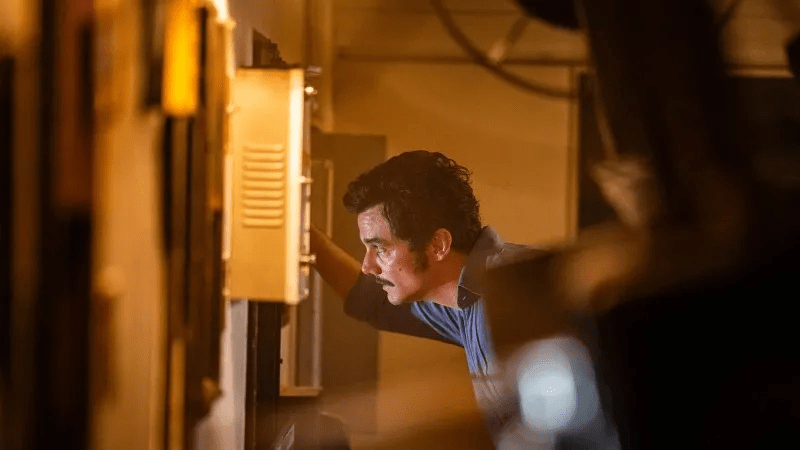
After all, it is a worthwhile question. The movie otherwise faithfully and palpably recreates the Brazil of the late ‘70s through its locations-based production, set design, music selection, color palette, and so on. The filmmaking on display here is also clearly indebted to those who were working contemporaneously to the events depicted onscreen. The audience can easily identify traces of New Hollywood aesthetics: e.g., the “documentary sensibility” of a Friedkin,1 for instance, the split diopters of a De Palma, the recurring allusions to Spielberg’s Jaws. Thus, The Secret Agent (2025, Kleber Mendonça Filho) employs devices and conventions that can be traced to a particular moment of film history (or of history on film), but nonetheless commits to a digital imaging system, a digital aesthetic. As a result, the film produces an almost uncanny effect, a disjointedness in the form itself—vintage Panavision B series anamorphic lenses mounted to the self-professed “gold standard of digital cinematography,” the ARRI Alexa 35.2 So, why—ultimately—the refusal of the analog medium? For anyone who may have asked themselves this question, the curious and the purists alike, the film provides an answer within its very structure.
After the first cut to the present day—halting, accelerating beyond the flow of Recife 1977—the audience becomes aware that this story is being constructed in a sort of historical mind’s eye via cinematic language: that is, it is being told from the vantage of now from an objective, impersonal observer—almost half a century later. This is what the film itself is. The Secret Agent is a fictional story being metafictionally constructed, calling attention to its status as mass media object (one about narrative mass media as social-political-cultural memory), to its status as constructed images about the construction of images. And so, the first image of this interlude that breaks the established projection of a past spatiotemporality is none other than a smartphone, something so unmistakably belonging to the next—to our century.3 It is only after this image that the new timeline and its new protagonist Flavia (Laura Lufési) can be properly introduced. As a student of history, she researches and sorts through archival materials, listening to tapes and reading newspaper scans from online databases in order to experience and understand the tumultuous “period of great mischief,” finding herself drawn to the story of professor-turned-political-dissident Marcelo/Armando (Wagner Moura). His story, his life and times, are diegetically and industrially created from 2025 Brazil. This is a story of/by/from the present historical moment.
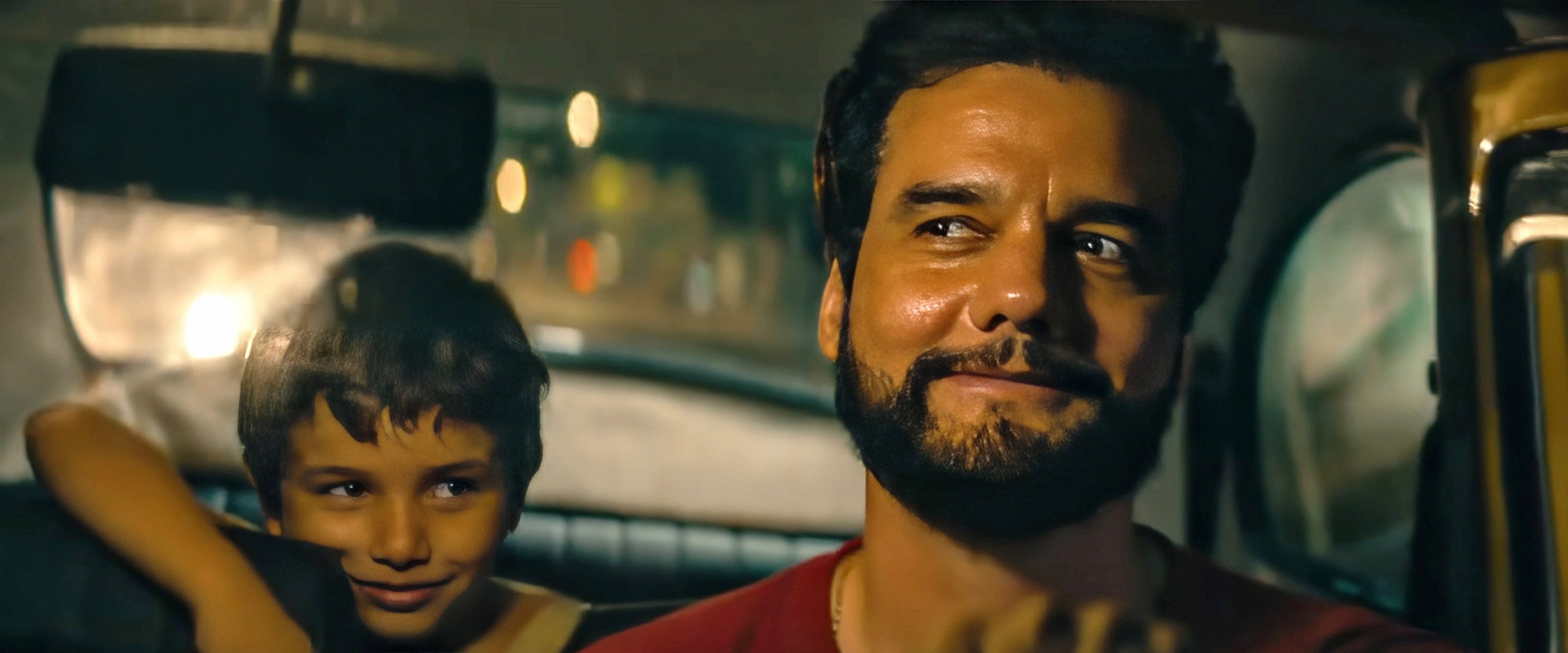
However, like Flavia, eventually you have to return the tapes: for the audience and the filmmakers, the artifacts, the borrowed aesthetics of the past. If the first shot of 2025 itself did not clue the viewer in as to why cinematographer Evgenia Alexandrova opted to shoot entirely on digital (electing to merely “[treat] the colors differently on set and in post”),4 then the final sequence in the blood bank certainly brings it all home. Flavia has tracked down the last living relative of this man she has been obsessively researching, Armando’s only child, Fernando, the boy now grown into a middle-aged man, also played by Moura. Flavia gives Fernando, now older than his father ever was by about a decade,—“killed at 43” reads one digitized newspaper caption—a flash drive with audio recording related to his father and the network of political subversives who lived alongside him and tried to aid their flight from the country. Flavia offers the son a digital copy of the father he can no longer remember, despite once being that same boy, who with stars in his eyes, ran up and hugged him, upon his return to Recife. That boy who dreamed of finally getting to live together with his only living parent after the death of his mother—for things to go back to a normal that never was and can never be. The drive, an externalized memory, as it were—a digital re-collection of these moments we have lived through as an audience for the past 140 minutes. (In much the same way, the film is itself a digital re-collection of late ‘70s Brazil.)5 And so, Fernando remembers the first time he finally got to see Jaws, but not his own father, nonetheless the memory of him is still there inside him, emphasized by the dual performance of Moura. A mirror not of space but of time, the film’s political resonance with international audiences—its Oscar noms, the Palme d’Or—no doubt enunciates this fact. As Armando tells Fernando in the nighttime car ride after their reunion, when you think about someone it is like they are still there with you. This sentiment is formalized by the insistence—the intrusion—of digital technologies present in the film(making). And while the digital subsumes (and thus erases according to its exclusions) (recorded) history, this film nonetheless asserts the other side of the dialectic, that is, its capacity to unearth the potentialities of the past snuffed out by the curatorial malfeasance of authoritarian regimes, and then to preserve and disseminate these lost threads of history to the masses: to reiterate the ebbing rhizomatic spirit of the digital world.6 It is how Flavia finds Armando, how she finds Fernando, it is how the audience finds these characters, it is how critics find readers, it is how readers become viewers. Even though the cassettes were forcibly recalled from Flavia due to the reclassification of the sensitivity of their information, she nonetheless makes a copy as a gift, a totem.
The Secret Agent, like any other movie, first and foremost, is about its own time, the period in which it was created refracted through its cinematography, sound, plot, mise en scene, and editing. The cold sterility of the present—taking place overwhelmingly within the confines of institutions (civic, academic, medical), i.e., monumental records of human society, centers of collective memory—is hyperbolized by the flat, translucent sheen of digital video. Even still, some might then wonder, why not just shoot the past on film and the present on digital? Yet, such a stylistic choice would ultimately undermine the construction of memory and its transformation in the post-digital world for the sake of nostalgic pedanticism and a more robust contrast ratio.7 History has been subsumed into the digital, film as well, the latter revealed only to be no more than a filter to select from a drop-down menu rather than the ontology it was once taken for, flattened into sheer surface and uploaded as freeplaying signifier, ones and zeros to be plugged and chugged at will in the wake of a digitized cinema.
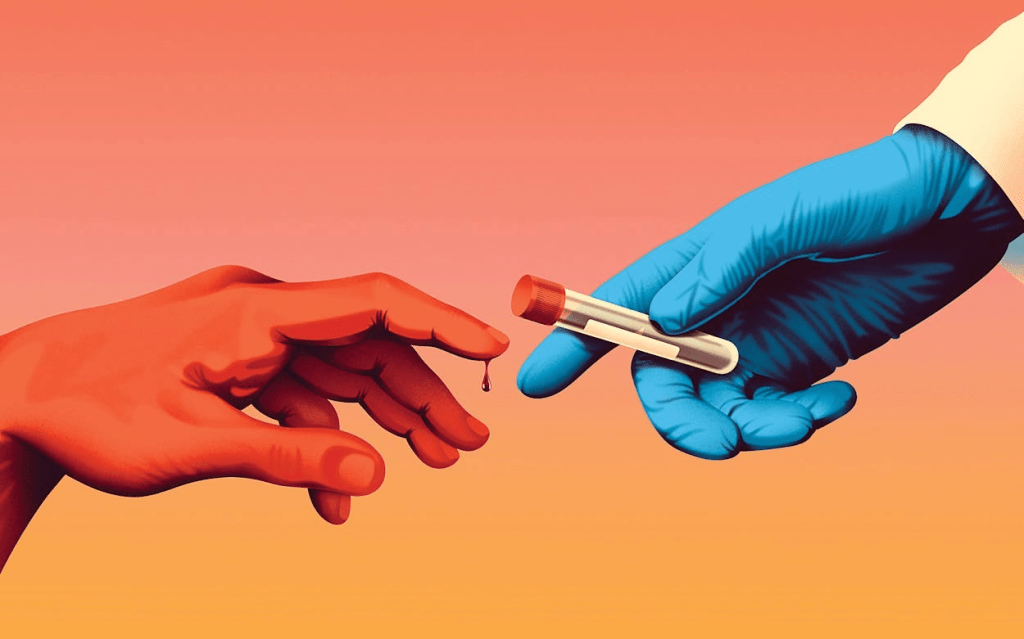
The digital is irremovably a part of our physiologies, our psychologies, our pathologies; it has supplanted our ability to remember. Thus, it is no mistake that the grown Fernando, now a doctor at a blood bank, agrees (even half-jokingly) to accept Flavia’s request for an interview if only she first donates blood. This is the price she must pay for further information, for that which she has already gathered: with information of her own. It is payment for convening with the dead, no matter if they are digital—to give back life. A testament to the vitality of her living, an offering of such to the fact of the deceased. Blood is like memory. Blood is memory, passed down from generation to generation. It is filial and bodily at the same time it is digitized, now able to be offloaded, backed up into the regime of the digital. So then, both fluid structures of forensic information hold within them all that has happened and all that is to come. Like Flavia’s blood, memory—cinema as such—can be readily drawn, donated, transfused, and passed down into new bodies. According to Armando’s own philosophy, he is now with(in) Flavia after all the time she has spent getting to “know” him. After handing the drive over to Fernando, he can now be with him too, now able to refigure a mental image of the father lost to him, murdered at the hands of the state. This young orphaned boy, now an older man, can fuse the limited recollections of his father with the recordings, the scans, the photographs contained on that little thumb drive.
They don’t call it the digital for nothing.
Sangue por sangue.
- https://www.indiewire.com/features/craft/the-secret-agent-cinematography-interview-making-of-1235161345. ↩︎
- https://www.arri.com/en/camera-systems/cameras/legacy-camera-systems/alexa-35. ↩︎
- The phone sits face up on the desk with its display powered on, prominently displaying the time, further signaling that the plot’s jump in time is mediated through digital technologies—the smartphone at once an increasingly sophisticated piece of imaging and networking capabilities, a signifier of seemingly limitless interconnectivity across time and space. Time is told through technology. ↩︎
- https://www.indiewire.com/features/craft/the-secret-agent-cinematography-interview-making-of-1235161345. ↩︎
- This movie is shot with digital camera sensors that convert image data via light into binary code. Most films about the medium itself tend to explore the indexicality of the filmic apparatus, but The Secret Agent does so with the digital, treating it with the same amount of gravitas and respect. Flavia giving Fernando the drive full of digital files copied from increasingly inaccessible locations microcosmically sums up the entire film. The images we have been watching, according to the diegetic world and the production of the film, were generated by an omniscient digital extremity turning abstract code into a legible document. The film is explicit in maintaining this is not the movie in the mind of Flavia, although she would certainly have her own imaginings that might align with what we see onscreen, but rather from the technologies she uses themselves. ↩︎
- The Hairy Leg scene also testifies to the subversive role of mass media under circumstances of state-sanctioned violence against the most vulnerable groups of society. For more on the history of this local legend, in which a Recife journalist deployed the recurring figure of the Hairy Leg as a means to bypass state censorship in order to report on the homophobic violence of the military police, read this article. ↩︎
- Hinting here at an entirely different conversation on the aesthetics of film versus video, and the limitations of a digital cinema that desperately and poorly imitates its filmic predecessor, Alex Bailey takes the words right out of my mouth with his stellar essay, “The Future of Film Is Texture.” ↩︎


Leave a Reply