As far as I know, 9/11 may very well be the first thing I ever saw on television. My father has told me on an occasion or two that I was sitting on his knee, an infant having only known consciousness for mere months, in front of the screen as the World Trade Center crashed into the streets below. I’ll never know if it went exactly like that, but it might as well have.
As children, my brother and I weren’t permitted to watch TV, save on Fridays when we’d veg out after school on Nickelodeon or Cartoon Network. Luckily, when The Clone Wars aired, it was on a Friday night, where it quickly became a weekly tradition for the three of us. That same day President Bush bails out Wall Street for 700 billion dollars.
When I was born my grandma made for me a time capsule from that year with artifacts: a red-white-and-blue Beanie Baby, a US Mint proof set, an issue of National Geographic. Every time I rediscovered it, the item that fascinated me more than any other was a videotape—along its spine: “September 11, 2001.”
I graduated from college in December and went back to visit my father and stepmother. The top shelf of the closet in a bedroom that is no longer mine still had the cardstock box that grandma had curated for me. I fished out the tape for when I returned from my final winter break.
It was while on a second date—where we first stopped to borrow a DVD from the library—that I saw the perfect opportunity to finally watch the tape on the only VCR around. Images I have lived the effects of that I had never actually sat down to take in in themselves. I inserted the tape into the slot at the bottom of the small box. No matter if wound forward or back, the display only remained blue. Somewhere in between two decades, it had been wiped. Things don’t exist in themselves.
Pandora’s box had already been opened. The images unconsciously burned onto the hivemind of a nascent generation. A digital Ludovico technique early in the stages of psychosexual or prenatal development. And ever since, those same kids have been chasing the cultural contact high of the greatest cinematic event in human history. The Holocaust wasn’t so lucky as to have video cameras, live broadcast, or satellite TV, and is thus ineligible.
The Holocaust was a hole in history, a blindspot. For Godard, the monumental failure of the moving image. The cinema did nothing to prevent the extermination of millions. However, this failure to represent and thus reckon with the greatest human atrocity was only one of cinema’s many trumpeted deaths. It would also later be killed at the hands of the television set.
As it unfolded, the Holocaust did not have the inundating novel forms that would come to epitomize the era surrounding the birth of the new millenium, like massively multiplayer online gaming or reality TV. The big bang of the global century was characterized by the overabundance, the over(re)production, the replayability of the traumatic image and from every angle and at every time slot. In case you even thought about it, they made sure you never had the chance to forget.
And so, while it took several decades for a new tragedy to come along and be added to the pantheon of those worthy enough to never be forgotten, it took exponentially less for the events of September 11 to be scrutinized, ridiculed: its plot full of holes, its shock value diminished. Like any other, it just became one more thing that just was. It was the butt of a constantly running joke, like on a date with a friend of a friend of a friend asked out over Instagram—blissfully unaware that we were really only ever in pursuit of that first hit.
After a certain age, the taboo of TV wore off in my household. My parents were still playing by the rules of their own generation and that of their parents, failing to recognize that the box in the living room had lost its awe for us. The television hardly took center stage at sleepovers either, unless it was Project X or The Wolf of Wall Street or Zoey 101 reruns on Nick at Nite, but even so, we watched them so many times until they dissolved into quotable background noise.
On nights spent with the kid across the street we’d look up pictures of naked girls on our 3DSs or his mom’s iPad 1, and be baffled at why it was so difficult to find any that were our age. Around that time he introduced my brother and I to his friend in the neighborhood across from us. That first time was my introduction to Omegle and Chatroulette: two preadolescents awake before anyone else, me and the boy across the street and a laptop, treading a sea of dicks to ask grown women if we could see their boobs, and somehow with moderate success. My first sexual experience.
Back at my house, we finally bought our first laptops. On the nights spent over there, we ventured into Lemon Party, Meatspin, Blue Waffle, Tub Girl, 1 Man 1 Jar, 1 Man 1 Screwdriver, and gagging at the infamous 2 Girls 1 Cup, intermittently slamming the Lenovo clamshell shut before returning like it was nothing to song parodies and Jerry Springer clips on YouTube or inviting our Club Penguin girlfriends back to our iggys. Just more fodder for lunch table debriefs with my school friends.
As we matured and honed our skills in the Hyperbolic Time Chamber of chatroom cyberspace, the game evolved. One could asl their way into titty pics from some teenage girl a few years older by moving from anonymous online chatting to Kik instant messaging. It felt like landing a fish, and in these cases we really were catfishing. And it often was required to have first swindled a grown man out of his dick pics to lend credibility to the aims of the primary sock account. All’s fair in love and war. It was a sport, played for the love of the game and the admiration of your fellow athlete.
At any gathering of enough boys it’s only a matter of time before pornography makes an appearance. Typing random phrases (like “night vision” or “monkey costume”) into Google then adding “porn” before hitting enter, or flipping channels until stumbling upon the finale hot tub scene of a porn film underscored by a song, sounding like a bizarre parody of Kanye’s “Flashing Lights,” called “Bouncing Boobies.” You can imagine our reaction when we came across the same film channel surfing another night.
In high school, now going steady with my school friends, ISIS beheadings watched in a Discord call on a $2,000 gaming PC were more laprise du jour. I’d had enough of T&A—that stuff was for kids—watching Muslims obliterate town squares or Asians eat bowls of live baby mice was now where it was at. We simply weren’t interested in girls like that anymore.
In less than a decade and a half I’d seen more disturbing things than my father had in his almost four and a half, and with him none the wiser. I never felt any kinda way about it. I remember the big stink one morning when I casually admitted to having just watched Not Another Teen Movie on my laptop. What’s the big deal? I’ve already seen the world.
Yet we pretend like all this did not happen. The latchkey generation don’t want to take the blame, but that just won’t do to satisfy the vindictive bloodlust of the digital natives. As if exhuming the crimes of those who came before will wipe our own slate clean. All the devils are here. In this generational cold war, neither can bring themselves to confess. And at this point, what would even be the point? You can’t unsee what has already been seen; you can’t unrape a childhood.
The moral panic over media violence was always a wash. Neither side can hope to pin down the other. Media figures and industry reps could debate concerned parents and psychologists over onscreen violence all the live long day on TV, while back at home the computer had already usurped each of their social functions, silently replacing both flesh and plasma.
We never stood a chance; there was never a choice. There is no more undiscovered country through which to transgress. The romantic hero of old remains a trace within his memetic variant, the sensitive young man of today, a man no less violently impressionable or romantically inclined or socially alien than a Hamlet or Young Werther, but now plagued by the banal anhedonia of a boy who’s already seen everything there is to see, and in all that expanse, glimpsed nothing sacred.
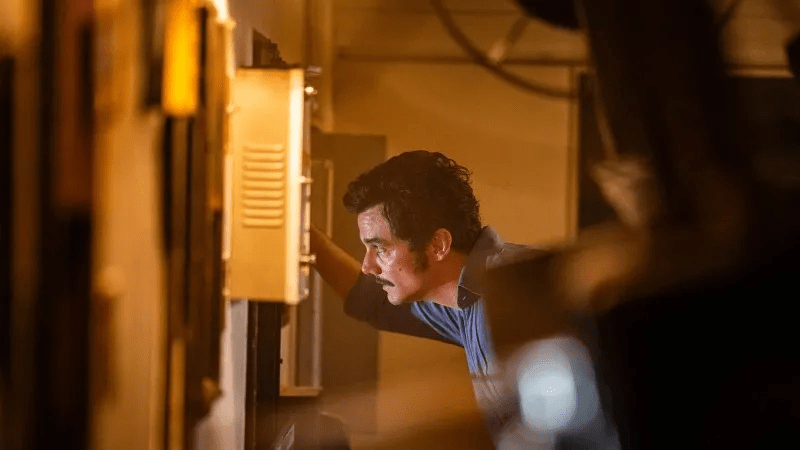
After all, it is a worthwhile question. The movie otherwise faithfully and palpably recreates the Brazil of the late ‘70s through its locations-based production, set design, music selection, color palette, and so on. The filmmaking on display here is also clearly indebted to those who were working contemporaneously to the events depicted onscreen. The audience can easily identify traces of New Hollywood aesthetics: e.g., the “documentary sensibility” of a Friedkin,1 for instance, the split diopters of a De Palma, the recurring allusions to Spielberg’s Jaws. Thus, The Secret Agent (2025, Kleber Mendonça Filho)employs devices and conventions that can be traced to a particular moment of film history (or of history on film), but nonetheless commits to a digital imaging system, a digital aesthetic. As a result, the film produces an almost uncanny effect, a disjointedness in the form itself—vintage Panavision B series anamorphic lenses mounted to the self-professed “gold standard of digital cinematography,” the ARRI Alexa 35.2 So, why—ultimately—the refusal of the analog medium? For anyone who may have asked themselves this question, the curious and the purists alike, the film provides an answer within its very structure.
After the first cut to the present day—halting, accelerating beyond the flow of Recife 1977—the audience becomes aware that this story is being constructed in a sort of historical mind’s eye via cinematic language: that is, it is being told from the vantage of now from an objective, impersonal observer—almost half a century later. This is what the film itself is. The Secret Agent is a fictional story being metafictionally constructed, calling attention to its status as mass media object (one about narrative mass media as social-political-cultural memory), to its status as constructed images about the construction of images. And so, the first image of this interlude that breaks the established projection of a past spatiotemporality is none other than a smartphone, something so unmistakably belonging to the next—to our century.3 It is only after this image that the new timeline and its new protagonist Flavia (Laura Lufési) can be properly introduced. As a student of history, she researches and sorts through archival materials, listening to tapes and reading newspaper scans from online databases in order to experience and understand the tumultuous “period of great mischief,” finding herself drawn to the story of professor-turned-political-dissident Marcelo/Armando (Wagner Moura). His story, his life and times, are diegetically and industrially created from 2025 Brazil. This is a story of/by/from the present historical moment.
However, like Flavia, eventually you have to return the tapes: for the audience and the filmmakers, the artifacts, the borrowed aesthetics of the past. If the first shot of 2025 itself did not clue the viewer in as to why cinematographer Evgenia Alexandrova opted to shoot entirely on digital (electing to merely “[treat] the colors differently on set and in post”),4 then the final sequence in the blood bank certainly brings it all home. Flavia has tracked down the last living relative of this man she has been obsessively researching, Armando’s only child, Fernando, the boy now grown into a middle-aged man, also played by Moura. Flavia gives Fernando, now older than his father ever was by about a decade,—“killed at 43” reads one digitized newspaper caption—a flash drive with audio recording related to his father and the network of political subversives who lived alongside him and tried to aid their flight from the country. Flavia offers the son a digital copy of the father he can no longer remember, despite once being that same boy, who with stars in his eyes, ran up and hugged him, upon his return to Recife. That boy who dreamed of finally getting to live together with his only living parent after the death of his mother—for things to go back to a normal that never was and can never be. The drive, an externalized memory, as it were—a digital re-collection of these moments we have lived through as an audience for the past 140 minutes. (In much the same way, the film is itself a digital re-collection of late ‘70s Brazil.)5 And so, Fernando remembers the first time he finally got to see Jaws, but not his own father, nonetheless the memory of him is still there inside him, emphasized by the dual performance of Moura. A mirror not of space but of time, the film’s political resonance with international audiences—its Oscar noms, the Palme d’Or—no doubt enunciates this fact. As Armando tells Fernando in the nighttime car ride after their reunion, when you think about someone it is like they are still there with you. This sentiment is formalized by the insistence—the intrusion—of digital technologies present in the film(making). And while the digital subsumes (and thus erases according to its exclusions) (recorded) history, this film nonetheless asserts the other side of the dialectic, that is, its capacity to unearth the potentialities of the past snuffed out by the curatorial malfeasance of authoritarian regimes, and then to preserve and disseminate these lost threads of history to the masses: to reiterate the ebbing rhizomatic spirit of the digital world.6 It is how Flavia finds Armando, how she finds Fernando, it is how the audience finds these characters, it is how critics find readers, it is how readers become viewers. Even though the cassettes were forcibly recalled from Flavia due to the reclassification of the sensitivity of their information, she nonetheless makes a copy as a gift, a totem.
The Secret Agent, like any other movie, first and foremost, is about its own time, the period in which it was created refracted through its cinematography, sound, plot, mise en scene, and editing. The cold sterility of the present—taking place overwhelmingly within the confines of institutions (civic, academic, medical), i.e., monumental records of human society, centers of collective memory—is hyperbolized by the flat, translucent sheen of digital video. Even still, some might then wonder, why not just shoot the past on film and the present on digital? Yet, such a stylistic choice would ultimately undermine the construction of memory and its transformation in the post-digital world for the sake of nostalgic pedanticism and a more robust contrast ratio.7 History has been subsumed into the digital, film as well, the latter revealed only to be no more than a filter to select from a drop-down menu rather than the ontology it was once taken for, flattened into sheer surface and uploaded as freeplaying signifier, ones and zeros to be plugged and chugged at will in the wake of a digitized cinema.
The digital is irremovably a part of our physiologies, our psychologies, our pathologies; it has supplanted our ability to remember. Thus, it is no mistake that the grown Fernando, now a doctor at a blood bank, agrees (even half-jokingly) to accept Flavia’s request for an interview if only she first donates blood. This is the price she must pay for further information, for that which she has already gathered: with information of her own. It is payment for convening with the dead, no matter if they are digital—to give back life. A testament to the vitality of her living, an offering of such to the fact of the deceased. Blood is like memory. Blood is memory, passed down from generation to generation. It is filial and bodily at the same time it is digitized, now able to be offloaded, backed up into the regime of the digital. So then, both fluid structures of forensic information hold within them all that has happened and all that is to come. Like Flavia’s blood, memory—cinema as such—can be readily drawn, donated, transfused, and passed down into new bodies. According to Armando’s own philosophy, he is now with(in) Flavia after all the time she has spent getting to “know” him. After handing the drive over to Fernando, he can now be with him too, now able to refigure a mental image of the father lost to him, murdered at the hands of the state. This young orphaned boy, now an older man, can fuse the limited recollections of his father with the recordings, the scans, the photographs contained on that little thumb drive.
The phone sits face up on the desk with its display powered on, prominently displaying the time, further signaling that the plot’s jump in time is mediated through digital technologies—the smartphone at once an increasingly sophisticated piece of imaging and networking capabilities, a signifier of seemingly limitless interconnectivity across time and space. Time is told through technology. ↩︎
This movie is shot with digital camera sensors that convert image data via light into binary code. Most films about the medium itself tend to explore the indexicality of the filmic apparatus, but The Secret Agent does so with the digital, treating it with the same amount of gravitas and respect. Flavia giving Fernando the drive full of digital files copied from increasingly inaccessible locations microcosmically sums up the entire film. The images we have been watching, according to the diegetic world and the production of the film, were generated by an omniscient digital extremity turning abstract code into a legible document. The film is explicit in maintaining this is not the movie in the mind of Flavia, although she would certainly have her own imaginings that might align with what we see onscreen, but rather from the technologies she uses themselves. ↩︎
The Hairy Leg scene also testifies to the subversive role of mass media under circumstances of state-sanctioned violence against the most vulnerable groups of society. For more on the history of this local legend, in which a Recife journalist deployed the recurring figure of the Hairy Leg as a means to bypass state censorship in order to report on the homophobic violence of the military police, read this article. ↩︎
Hinting here at an entirely different conversation on the aesthetics of film versus video, and the limitations of a digital cinema that desperately and poorly imitates its filmic predecessor, Alex Bailey takes the words right out of my mouth with his stellar essay, “The Future of Film Is Texture.” ↩︎
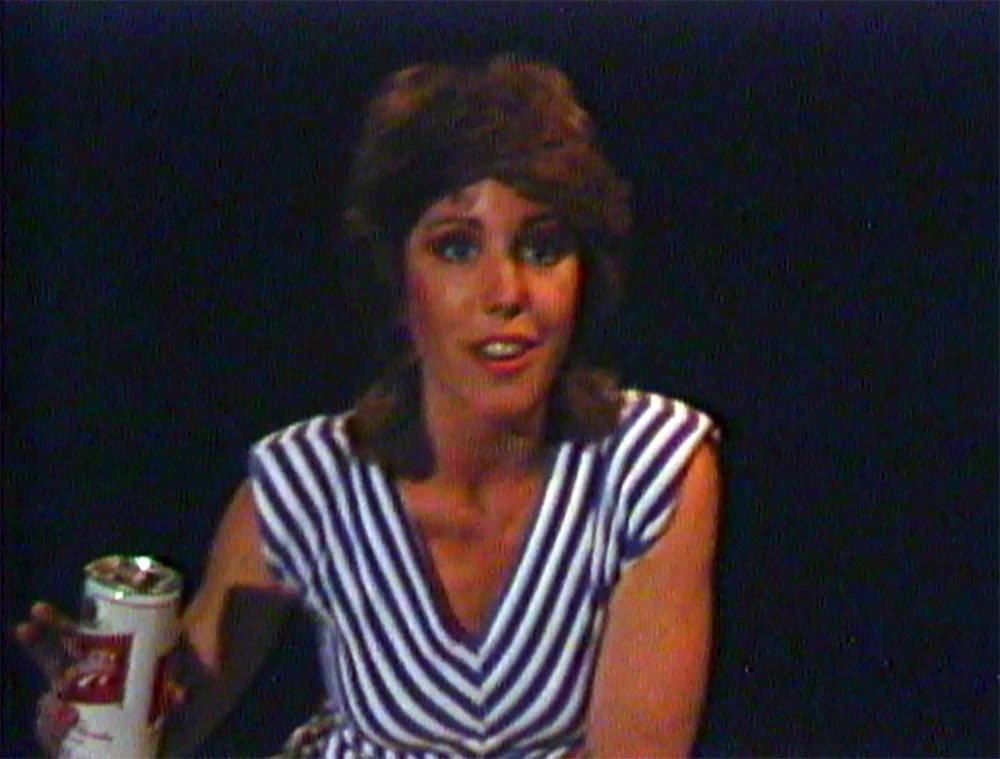
It struck me toward the end of Dale Herd and Barry Hall’s Dreamland Court that this experimental narrative videotape acts as a reversal of Michael Snow’s structuralist masterpiece. In Snow’s Wavelength (1967), an extended snail’s-pace zoom occurs for the entire duration of the film with characters passing through the space, the camera independent and indifferent to their presence. In Herd and Hall’s “performance tale” (based on the novel by Herd), the conceit is centered around a series of four characters shot alone and only in close-ups or medium shots, as they perform directly into the camera. Both works take place on the periphery, but with divergent approaches to narrative and mise-en-scene.
While the direct minimalist approach of Wavelength eschews emotional investment in its actors/characters, it does not entirely forgo characterization, offering only glimpses of some sort of narrative with the static, zooming camera registering actors more as mere set dressing. Dreamland Court, inversely, foregrounds its characters through claustrophobic yet empathetic framing. As for mise-en-scene, there isn’t any, not really anyway. Herd and Hall offer impressions of an inhabited space, but the effect is produced somewhere in between the images: that is, a change in the color of lighting, a new or recurring wardrobe, soft music or chatter in the background, thus signalling whether someone is back in jail or sitting at a dive bar or laying in their bedroom. The four characters (Johnny, Jackie, Carson, and Joann) are presented for the viewer’s scrutiny against a minimal or non-existent backdrop, inviting one to piece together the translucent dynamics that inform these four entangled lives. All this to be intimated without ever having to be seen, without ever seeing them act together; the rest is to be imagined. (Even now, I cannot tell whether the mise-en-scene I am able to recall was in fact videotaped by the camera or intimated by me according to contextual cues.) This approach hinges entirely on its four characters and the unbelievably compelling performances given by these talented, underappreciated actors. And for much of the video’s runtime, it is apparent they are all in some perverse form of dialogue with one of the others at some point. Even while oftentimes acknowledging one of the others or addressing them by name, as if speaking to them face-to-face, it never feels like shot/reverse shot. The rhythm achieved between the montage and the actors feels more like a series of epistolic vignettes than a conventional cinematic construction of legible, contiguous space-time.
From the first address of Johnny, a down-on-his-luck jailbird with a lucky streak, where he looks directly down the lens of the camera, Dreamland Court situates itself in contradistinction to Hollywood continuity editing. Each character is shot straightfoward as they talk to/about themselves, another character, or the audience—each inhabiting their own uniquely determined and identifiable spaces. Dialogue spoken exclusively as monologue adds a heightened degree of theatricality and hinders the possibility of the videotape’s editing as intercutting. To an outside observer, everything has already happened (in between the edit) before the next character reacts and gives their take on the events that were just described to us (i.e., a failed suicide-by-cop, a violent confrontation, or an accidental pregnancy). A constant game of catch-up for the viewer and these socioeconomic outcasts of 1980s LA. And so, the editing is not refusing narratively motivated cutting outright, but eyeline-matched shot/reverse shot as a foundational basis of spatiotemporal continuity is stretched beyond coherency. Dreamland Court as a text always feels gleefully disjointed as Johnny, Jackie (his unsatisfied wife), Carson (Johnny’s close friend and Jackie’s lover), and Joann (the teenager that Johnny presumably gets pregnant) are never pictured in the same place at the same time.
Like Wavelength pushing the bounds of its own central experiment (e.g., by mixing multiple film stocks, stitching together multiple shots, applying color filters, intensifying a nondiegetic, high-pitched whine, etc.), as Dreamland Court goes on, characters start to walk out of frame as they monologue, the camera refusing to track them as they leave their mark, or they’ll have their face framed in three-quarters profile and positioned mostly offscreen to accentuate the negative space, or indiscriminate zooms in and out. Moreover, in one instance, a dialogue overlap of Johnny onto a shot of Jackie rings more discontinuous than the device’s usual cinematic deployment for the sake of smoothing over stitches between shots/scenes. (Can these monologues even be called scenes? Between the many appearances of all four characters, there are little identifying markers to distinguish one appearance from the other beside a tightly-framed change in wardrobe or lighting.) In addition, the final two shots—Johnny and his naive teenage girlfriend, both talking about her possible pregnancy—stand out from the previous vignettes and forgo the typical spatiotemporal ambiguity of the video. These two appear to communicate more directly and immediately than any other instance in Dreamland, looking out at each other across space and time to somehow envision a happy life together, if such a possibility can even exist.
Where Wavelength drives toward its own death with unrelenting force, toward the photographic basis of cinema, Dreamland Court explores video as a medium in which to converse with oneself. Through the monologue and the video camera (with the actors likely witnessing their own image as live feedback via CRT monitor), Dreamland Court’s performance tale explores two intertwined threads of video since its inception: as narcissistic and/or therapeutic practice. At once, these self-aware/deluded inhabitants of the LA underworld are talking to/for themselves, “puking” (Johnny’s preferred term) their oftentimes embarrassing and turbulent emotions in a similar vein to therapy methods implemented six decades ago, involving patient self-confrontation via video. According to one such experiment conducted in 1963 at the University of Mississippi, the aim was that patients would see themselves objectively, as an object and as others see them, in order to motivate psychological growth (Collopy 109). To engage with and invest energy in the self-as-image was actually suggested as a cure to narcissism. Another experiment saw one subject conversing with himself as a means of self-conducted therapy and fostering a richer awareness of his ego (110). Famously and contradictorily, Rosalind Krauss formulated video as based upon a psychological medium rather than a material one, that of narcissism. She argues that the feedback loop causes artists, modulating and reacting to their images in real time, to invest energy inward, into selfhood, as opposed to an art object. And thus, Dreamland Court juggles these two oppositions of the video art dialectic expertly, mirroring the well-intentioned, forgotten, desperate, heated lives of a Los Angeles couple and their extramarital lovers. In their comitragic hoping against hope, Johnny, Jackie, Carson, and Joann find meaning and misery, heartbreak and a fresh start within their individual, collimate prisons—not to mention the emblematic jailhouse that habitually imprisons Johnny, testing the limits of all their relationships in turn.
“The disaster ruins everything, all the while leaving everything intact.” —Maurice Blanchot
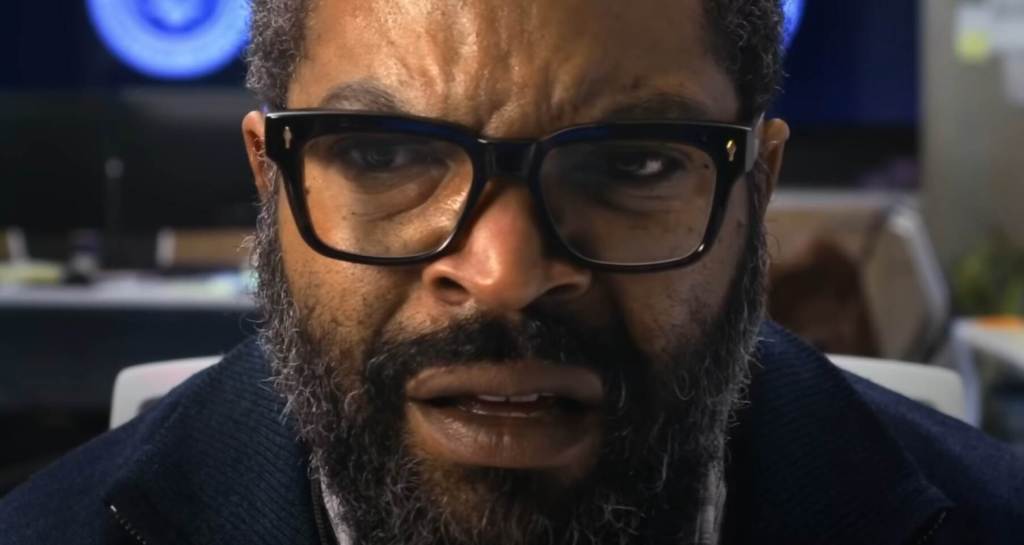
To have this movie be an adaptation of The War of the Worlds—a respected science fiction property that has been remixed by the likes of Orson Welles, Steven Spielberg, and Classical Hollywood—is hysterical and is so bold in its ridiculousness that it horseshoes itself back into being almost brilliant. Think of Ice Cube’s oft-repeated lines when on video call with his colleagues or children: “I’ll circle back.” Each of the aforementioned and adored adaptations, like another popular science fiction novel turned classic film(s), Invasion of the Body Snatchers, has been tackled by several filmmakers who all impart their own social critiques into the central figure of the alien invader. And it is here that I feel this movie and its screenlife style try to accomplish something interesting. A production impacted by the pandemic five years ago, War of the Worlds (brought to you by a music video director and a big tech giant with a $2 trillion market cap) adopts a stylistic approach that mirrors (1) the diegetic patriarchal surveillance of DHS dad Will Radford (Ice Cube), (2) the extradiegetic constraints imposed on people in lockdown, and (3) the formal and economic limitations of a film industry in the midst of a global pandemic. Like another release from this year, Ari Aster’s Eddington, this film (although less expressly) sorts through the wreckage of a world torn apart by Covid-19 as mediated by the increased presence of digital communications technologies in our lives.
What struck me almost immediately about this film is its depiction of care onscreen, or rather how care as we experience it now can only be accurately depicted via screens. In particular, this protective but somewhat distant father (a result of his wife’s death) switches through dozens of windows and tabs and dialog boxes in order to watch over his pregnant daughter Faith: commandeering CCTV cameras and surveillance drones, checking her Apple Watch heart rate monitor, remotely breaking into her MacBook to read her text messages, etc. In one hilarious scene after an alien attack on her lab, Will guides his bleeding-out biologist daughter into a Tesla that he has hacked into, instructing and reassuring her over FaceTime, as a towering tripod alien lumbers toward her position. “Focus on me,” he tells her, as he clicks, scrolls, and zooms through his surveillance application software (aptly named Guardian), all the while simultaneously watching news coverage of the invasion and firing off messages to colleagues. In an affective sense, this is exactly how it feels to live in a post-pandemic world, how it feels to live in the aftermaths of the apocalypses that characterize twentieth-first century life. For example, many still work from home or at the very least are never not answering work texts and emails: the balance between work and life continuing to erode, the internet only having made everyone all the more productive. A consequence of neoliberal network society, the digitized privatization of everyday life. With the younger generations, this takeover looks a little different: Will begrudges his son Dave for staying home and streaming himself playing videogames, but this is a very real (albeit parasocial) response when one is faced with the inability to physically/emotionally connect with one’s peers in person after a year of staying home with only immediate family. Will goes as far as to remotely access his son’s PC and uninstall the new game as an act of tough love. The world feels so much different now, and so does care.
Cinema feels so different now too. Likewise, most of the formal devices employed in War of the Worlds are thoroughly post-cinematic, this film taking place largely on a desktop; however, when director Rich Lee on the rare occasion opts for a standard cinematic device (e.g., a fade to black or a static shot from a nondiegetic camera toward the end of the film), it is these select moments that actually feel jarring and offputting: that is, the language of cinema that we have become accustomed to for over a century is no longer adequate to reflect that which is current. It is exactly that this movie does not take place, take up space1, that heightens its postmodern affectiveness. In other words, the limitations of physical life are dwarfed by the phenomenological demands and precarious neuroses of our internalized virtual environments.
The cameras are off their tripods, so to speak, and like the curses escaped from Pandora’s box, they can never be put back. The camera is no longer even a camera. Moreover, after cybersecurity analyst father and leader-of-the-resistance hacker son team up and fail to infect the data-mining tripods with an “old school” computer virus, the spacecraft-esque heads detach from their robotic legs and fly toward the locations of each member of the Disruptor hacker team, having tracked their IP addresses. In this situation, the camera liberated from its support and itself, we have become not the imagemakers but the images themselves. Ice Cube is relegated to a little box on a Discord call as he watches on helplessly, his home ostensibly destroyed, believing to have just lost his son who he was finally beginning to connect with as well as any trace of his wife, having never cleared out her belongings. Will frantically commandeers a nearby surveillance drone to watch the rubble and cinders. Every man his own Twitch streamer, forced to react when constantly confronted and never not inundated with a feed of all the world’s horrors. Taking this point even further with wonderfully clunky irony, we learn from human characters, who are only ever interacting with each other via screen mediation (there is one marked exception, maybe more on that in a later post), that the occupying threat are hybrid organisms containing both biological and cybernetic components.2 This confusion of man and machine—watcher and watched, invader and invaded—invokes precisely that we ourselves have become the hosts for digital imaging and networking technologies and in turn have attached ourselves to other people primarily and irremovably through these pathways.
And so, according to this digital regime, turning men into cyborgs, how might love, for example, between a father and his family, look and feel? At first, Will is obsessive: he sends his dead wife messages on Facebook everyday, he repeatedly listens to a mundane voice memo she left him, and he spies on his own children in order to feel close to them. So then, what does love feel like at the end of the movie, after this character changes throughout the course of this invasion? Love, as it turns out, is letting people into your system, like a virus. In the finale, as Will ventures out from the safety of his command center for the first time, he relinquishes remote control of his computer to Faith, who has to navigate his multi-screen displays, seeing how her father sees the world and interacts with others, as she guides him through the bowels of the Department of Homeland Security headquarters. In addition, she must also guide her brother as he hacks into military drones in order to destroy the oncoming alien attacks (that look straight out of Action Movie FX, which is in no way derogatory) that are targeting an Amazon delivery drone flying through DC, which is manned by her delivery driver boyfriend Mark, to get to Ice Cube in order to bring him a thumb drive for the “cannibal code,” newly converted from the DNA sequences of a cancer cure into computer code, that will deactivate the U.S. government’s top-secret data collection program, and thus deactivate the data-sucking space invaders. And so, rather than voyeuristically keeping tabs on his own family, the workaholic dad learns to let go and trust himself to trust his children.
Despite its dull insistence on sentimentality and the redemptive power of the family unit, War of the Worlds nonetheless offers an amusing and thought-provoking illustration of the collision, the event horizon between the digital world, the world of data, and the real world, the world of people. As Ice Cube likes to tell Eva Longoria over at NASA whenever she asks him about the recent abnormal weather events that prelude the invasion, “I told you, I watch people.” Even that simple statement alone maintains this confused, collided perspective; after all, he does not actually watch people, he watches images. Yet perhaps that begets the question: what’s the difference?
While I do not think this is an evil or unconscionable movie or even an unwatchable one, it is certainly a self-exculpating venture. When the aliens from another world first arrive, the on-the-ground news coverage style footage immediately invokes climate disaster: one shot especially conjuring the recent forest fires that ravaged California in the last year. Not to mention, when they first arrive, the tripods attack such sites as natural gas pipelines and electric grids, emphasizing the continuing and irreversible acceleration toward ecological destruction. One character remarks that this coordinated assault is not only attacking necessary human resources but also our ability to collectively respond to them. The tripods specifically target these stockpiles, but none are more important than the data centers. And so, this film poses a critique of our economy’s obsessive, full-steam-ahead attitude toward surplus and accumulation by having these parasitic invaders attack sites of abundance and wealth generation for tech oligarchs.3 However, this film premiered exclusively on Prime Video, a streaming platform that belongs to the largest information technology corporation in the world.4 So, of course, Amazon has countless data centers of its own, each comprised of tens of thousands of servers. (No wonder data is said to be the most valuable resource over and over.) In fact, these data centers are responsible for hosting Amazon Web Services (AWS), lending cloud storage services to some of the biggest companies in the world (e.g., Netflix, Twitch, LinkedIn); in fact, approximately one third of all internet traffic passes through AWS.5 Thus, it would not be an exaggeration to say that if Amazon data centers went down, a good chunk of the internet would also be affected. And so, the environmentalist and big tech anxieties become empty platitudes, as these data centers require enormous expenditures of energy in order to store our digital footprints, just for them to be sold as discrete packages of information to advertisers, credit and insurance companies, or even law enforcement. So, these vampiric, bionic reapers (that are invoking climate disaster in the film) are behaving themselves much like these corporations who are significantly causing and entangling these crises in the first place.
Like many projects in this faux populist turn within Hollywood (or really just Hollywood writ large), this film reifies the status quo but now with a little added lip service, but perhaps that is giving too much credit to a movie that no one took seriously. Nonetheless, War of the Worlds would like you to believe that only the federal government with its bloated bureaucracies and bad actors is the one responsible for burning a hole in the ozone layer or for selling out your data to be kept behind glass in case of emergency.6 It is the same blame shifting, buck passing that Disney did with WALL-E; however, this time, it appears that no one is buying it. Frankly, one could easily trace this ethos all the way back to the very inception of the blockbuster form, to fellow H. G. Wells admirer, Steven Spielberg, fifty years ago.7 And so, when any movie tells you how bad things are and that all you need in spite of that is a little Faith, just remember, as this film’s trailer tells us outright, “it’s worse than you think.”
Notes
Diegetically, it consists mostly of screen recorded desktop footage of a man in his office. Formally, there is no physical medium onto which the images shot are imprinted and those images are further distanced by being frames within frames within frames. Metatextually, as this movie was swept under the rug and dumped onto Prime Video only yesterday with a trailer dropped only a week before that. ↩︎
In Invasion of the Body Snatchers, as in War of the Worlds, we learn that maybe we are not so different than those who enslave us. Body Snatchers never just about the infiltrating communist threat—although it certainly reflects that Cold War anxiety—but also certainly the stark conformity already present in suburban 1950s America. This same polyvalency can be applied no doubt to Lee’s War as well. ↩︎
As a result of the alien assault on data centers, Will looks on frantically as the Facebook messages with his wife, the last trace of her voice, her pictures—that is, her digital footprint—are scrubbed from an internet under attack: her digital death. By having the widower retreat into his work following her biological death, the obsession with the digital reflections of his wife, his constant tormenting of himself and inability to let her go, is intrinsically linked to capital’s obsession with constant accumulation for its own sake, way past the point of profit. The latter informs the former. ↩︎
Not to mention, in terms of self-exculpation, War of the Worlds has for one of its heroes an Amazon delivery driver, saving the day by having someone place an order to activate his delivery drone. ↩︎
This essay is the second piece I wanted to elaborate on, as I think the readings I teased out have not been previously discussed, to my knowledge, by any of the previous scholarship surrounding this videotape by Peter Campus. This was originally “Response Paper 5” for my History of Video Art class in my final semester, a low stakes weekly assignment, meant only to be 250 words, to ensure we were engaging with class materials. However, in my preparatory rewatches of Three Transitionsfor the assignment, I was propelled to keep riffing and digging further and see where it took me—much past 250 words. When I thought I had said everything I had to say, there was another idea that jumped out ahead of me, necessitating that I push forward. Once more, this text ended up being more ambitious than I had originally imagined: that is, I found myself having much more to say all over again—new angles, new complications—a year and 3,000 words later. So, here is a little something to mark the fiftieth anniversary of one of the most important contributions to the history of video art.
In relation to fine art, Peter Campus’s Three Transitions did not immediately remind me of the standard self-portrait. Campus’s addition struck me as something else, operating by an entirely new set of principles, diverging from the usual artist posing in medium close-up. In my mind, if we were to compare this video to any self-portraits, what seems a more suitable comparison are those paintings that foreground the process of the artmaking within the self-portrait itself, pushing or playing with the genre’s conventions rather than focusing on a realistic re-presentation of artist likeness. Diego Velázquez or Adélaïde Labille-Guiard with their self-portraits in a group, for example: Las Meninas (1656) and Self-Portrait with Two Pupils (1785), respectively. In addition, Pieter Claesz with the combination of self-portrait and allegorical still life in Vanitas with Violin and Glass Ball (1628), or Johannes Gumpp’s two self-portraits (ca. 1646) and Norman Rockwell’s Triple Self-Portrait (1960) that see the artists each represent themselves three times in one painting. In all these examples, the artist is seen at work, creating, within that very work that is now displayed for the viewer. And while the latter three reveal the material supports of their self-portraits upon the canvas itself, Campus, despite working with a different medium with its own set of formal apparatuses, also opts to highlight these same fixtures of two-dimensional art in his work, namely, paper and paint. But to create his own version of a triple self-portrait, Campus superimposes two video feeds, adjusting the alpha channels of the layers to double his likeness for each of the three transitions. (So, is that two-self portraits total; one for each layer? Three; for each vignette? Or six; for the total number of Peter Campuses onscreen over the video’s duration?) Despite the multiplications of himself, Campus’s gesture is not one wholly in line with self-portraiture. Unlike those artists, Campus is picturing his body in order to “destroy” it. Two layers of visual information are glaringly (and repeatedly) fused to form an anti-self-portrait triptych. In Three Transitions, Campus plays on the art tradition of the self-portrait, challenging its celebration of artist identity and individual subjecthood by employing video abstraction, alongside two-dimensional art media, as tools of deconstruction.
In what I see as aligned with typical early video art fashion, Campus is concerned primarily with deconstruction without necessarily planning any sort of reconstruction. In the first scene, after appearing to cut and then step through his own superimposed back, Campus shoddily tapes the ripped paper barrier back together. In the second, he applies paint atop his face, and due to differences in his movement and position before the camera in each layer of footage, reveals a second face that appears to have been waiting underneath the “real” thing. And the third sees Campus burn a piece of paper that holds his own moving image through the same principle of chromatic substitution explored in the second. Across all three of his transitions, Campus is taking fine art media and repurposing them to dis-figure his own image and question assumptions upheld by the self-portrait tradition, a tradition previously only made possible by similar supports. In the scholarship surrounding this video too much attention is paid to Campus himself and the changes undergone by his body-image and what that means he means about subjectivity in the age of instantaneous feedback, etc., etc. I am more interested in the objects at hand. Too much focus on the self and not the portrait, the support, the media that organizes the form.1 The “self-ish” approach seems antithetical to the project of a video centered on breaking down boundaries. Rather, what is the video saying about self-portraiture? about artistic tradition? about itself and its medium within said tradition?
For instance, one could note several similarities between Campus and Gumpp’s acts of tripled self-portraying (and by extension to Rockwell’s appropriation of the latter as well); however, Gumpp’s goal is one of “defiance . . . by means of art,” an act of preservation from a mysterious, overlooked artist acutely aware of his “impending absence” after the work’s completion (Blasone 3). As scholar Pino Blasone astutely notes, art critic Jean-Luc Nancy and artist Norman Rockwell in their own responses to Gumpp’s portrait omit the symbolic additions of the cat and dog on either side of the artist. As I see it, scholarship surrounding Three Transitions fails to accommodate the significance of Campus’s symbolically reflexive mise-en-scène as well.
The relationship between painting and moving images goes further back than Campus and his critique of the subject and the limitations of self-portraying. Long before video, film took from painting its core language, but film was about real time—images in motion. When consumer-grade video equipment was made available to the public, artists who adopted the new medium (in the mid-60s and into the early 70s) made themselves the objects of their art, many often performing alone in their studios. These video pioneers added the elements of time, motion, and sound to the act of self-portraying as artistic expression. They took advantage of the instantaneous feedback allowed by the advent of video—to see oneself in real time, to interact with one’s own image, and thus, act according to it. Not to mention, analog video also contributed to the destabilization of art as tangible object. At the time, video was stored on a physical tape, but the images were not viewable through this mechanism alone, as on a reel of film. You could not handpaint on magnetic videotape or physically cut it like film. Unlike film, unlike painting, video processes were all electronic. And so, by employing two-dimensional art media, Campus reflexively acknowledges the historical basis of this new form of moving image media in order to produce something aesthetically radical.
By foregrounding paint media, Campus returns to the linguistic basis of filmic cinema in order to forge a new mode of looking, one more adapted and adaptable to the world of screens and simulations.2 After all, video (Latin for “I see”) is an action, while film is a technology. In her “Aesthetics of Narcissism” essay, Rosalind Krauss identified this looking as one directed back on the artists’ self when she prescribed onto video a psychological model of medium: narcissism. She argues that the mainstay motif of nascent video art, that is, the monitor, creates a closed loop of space-time with the camera, and it is within this loop of space-time that the artist operates, manipulating their own image by engaging with their own image (Krauss 50). Put simply, an “investment of energy in selfhood” characterized the video art medium more so than any common material basis (Jurgess). Whenever I engage with Krauss’s assessment, I always find myself agreeing and disagreeing (no doubt a testament to its rhetorical brilliance and academic longevity). For example, while Campus does observe his own image offscreen to direct the movement of his body, by the finale of the video, he begins the move to remove him-self from the image, absorbed into the frame. He allows the viewer a peek into the pregnant nothingness beyond the human. All one needs to participate in the camera-man cyborg is hands—the only parts of his body left. And so, Three Transitions, although largely spotlighting the artist’s corporeality, searches for a new mode of looking that attempts to peer beyond the subject. In the liberal Western world, social institutions—including, and especially, those involving art and artmaking—are centered around the concept of the individual, the subject. Perhaps, we can never escape this narcissism or self-possession, I don’t even think Campus completely does (or can), but he suggests the possibility and necessity for other “models of posthuman distributed subjectivity” not centered around the human (Jurgess). After all, Campus titles this work Three Transitions, not Three Self-Portraits,foregrounding the progression and destruction of his body-as-art-object through time, emphasizing transformation, evolution, moving beyond. But toward what?
According to Steven Shaviro, “An artist is somebody who wants to turn the whole world into images; but he usually ends up making more objects instead.” However, Campus with the ending to his most famous video—a video that has overshadowed the rest of his oeuvre, essentially rendering him into an image, in a manner of speaking—typifies this desire to turn the world into images. Video only conjures images, not objects. For Shaviro, an image is nothing like a solid object. By placing his image over paper, by painting his face, and only by videotaping these acts, Campus registers the unique ability of video to flatten the world into images, especially the art world and its traditions of self-representation à la object construction. Why go to a museum to view the works of the Old Masters when the entire canon of Western painting exists free of charge as images online? He burns the old media until its just a camera recording darkness. “Images are premised upon a visibility so extreme that it relegates the world to a state of almost transparency” (Shaviro). Campus accelerates this process toward its logical conclusion, removing art media and artist from the picture—no, from the screen.
In an increasingly visual culture increasingly concerned with surfaces and interfaces, Campus becomes these very things himself. For example, in the final transition, Campus is the only visible thing, placed in the foreground as well to highlight his role as surface, as image (as he also holds his own image in his hands). Of specific importance here as well, the background gets noticeably darker from the first to the second to the third transition, paradoxically adding and subtracting a sense of depth within the frame. Both self-portraiture and Three Transitions convert three-dimensional models to two-dimensional image to create the illusion of depth; now, the camera does most of that work for you, allowing the artist to focus on different, newer questions alongside the age-old quandaries. And so, it is all a flattening into surface: the transfer from 3D to 2D, from life to analog (and once more now to digital). Video is concerned with nothing but surface, that is, with what we can see.
The void is absent, the void is revealed, the void is darkened, and it is here, at its darkest, its most impending and impregnable state, that Campus stages the crux of his critique.
In the first two sections of Three Transitions, things return to how they were, albeit changed: the paper barrier is more or less intact, Campus still has a face (or two?). But in the last episode, the protruding brow of Campus shrinks back out of frame as the paper—as stand-in for classical painting media—withers away. The first two vignettes could be read as a dual-sided repetition of destruction-creation but the last is a destructive gesture toward subject and two-dimensional fine art tradition, especially the self-portrait. Yet destruction seems too harsh a label for this misleadingly simple video short. It is more a change of matter into new forms, as its title implies. The video triptych follows Campus’s phase transitions through the three states of matter. In other words, the first section is solid (paper), the second is liquid (paint), and the third, gas (fire). It should be noted that fire is a chemical reaction: through video, art and the human body are ultimately undergoing a sort of molecular transformation. The reappearance of paper in the finale is not a return to the groundedness of the initial solid phase, as it is not solids or liquids that combust but the gaseous vapors produced once heated.3 After reaching its flashpoint, this chroma-keyed sheet of paper, once ignited, cannot be repaired like the first, destroying the possibility of any ultimate reconstruction.
However, there is a fourth, more elusive state of matter, and I do not believe Three Transitions leaves it out. Without definite shape or volume, plasma as a medium is quasi-neutral, infinitely conductive, and dominated by electrical and magnetic fields. Videotape could be described in much the same way, interacting with both these fields, encoding audiovisual information by magnetically recording electronic signals. Like its first appearance, the paper in this final section once more acts as a barrier, separating the “real” Campus from the black void before him, the camera from the void, viewer from void. As it burns, an indefinite space of possibility is revealed; it makes itself known, finally apparent to the viewer so trained to focus on the artist and art objects. That buck stops here for Campus, with video. No longer is the author the final word on the creation of meaning. For the final four seconds before the credits, the disembodied hands of the artist appear as if those of the camera—the camera now functioning like POV. Campus-as-camera. This final action captures the ready-to-hand synthesis of man and video. Film may have developed the language, but video handed out the paper and pen (or rather, paper and paint) to everyone.
Then, Campus cuts the video short. The paper is never fully allowed to burn. He will eventually have to let it go; an action that we will never see. The edit does not allow the viewer to witness the artist dropping the old media/tradition nor does it allow any legitimate destruction to the artist’s body. As I work through the problem of this video over and over, the self-portrait reasserts itself more than originally considered. Yet, there is a cut. That is the brilliance of Three Transitions: it is both humorously deadpan and disorienting, it is self-portrait and not all at once. Shaviro affirms this paradox more broadly: “images have a weightlessness that is both mysterious and soothing.” Campus’s career aside, as a standalone text, the video and the state of the artist end ambiguously (i.e., what becomes of the artist and his hands, previously tasked to rip, tape, and paint?). Nothing. The paper is always still there, even if it is burning, but the face is always erased by the end, however, the perpetual loop of the gallery will always be sure to bring it back; the gallery monitor and canvas work in tandem after all, preserving the order of things. Like postmodernism to medium specificity, video interrupts, but it does not undo. Yet no video since has captured the potentially deconstructive, emancipatory power of video as succinctly as Peter Campus’s Three Transitions. Video is the next state; the void, its reflection. Video was the next state, but it is not the final state.4 Nonetheless, video still has the power to move art and subjecthood effortlessly between each phase of matter until there is nothing left but two sets of pinched fingers clenching ashen paper in a void, perhaps where something new can spring forth.
Notes
It would seem that the current direction of Campus’s career (i.e., opting to work in the vain of what he refers to as “videographs”—static long shots of natural landscapes recorded with a digital video camera—which followed his period as a nature photographer from the late 70s to mid-90s) and the choice to now stylize his name and works without capitalization spells a move that aims to de-privilege the subject. ↩︎
According to André Bazin in “The Ontology of the Photographic Image,” the essence of photography is centered on its realism, taking over the realistic function of painting maintained up until the late nineteenth century. As a result, cinema took over as the primary arbiter of realism, producing the richest imitation of reality: “André Malraux has described the cinema as the furthermost evolution to date of plastic realism, the beginnings of which were first manifest at the Renaissance” (Bazin 10). Campus makes uncanny the realism once proclaimed to be embodied in the photographic arts. To paint one’s face to reveal the same face via chroma key technique figures the fledgling video medium as markedly and consciously departing from realism, or, at the very least, concerning itself much less with such notions while reflexively operating within this filial thread of the (moving) image. (And so, it can be said that video has the baggage of two other art forms to carry.) However, and/or for example, the locked, static framing in Three Transitions recalls the “simplicity” of silent cinema tableaux, in turn derived from the landscapes and genre painting of nineteenth-century French Realism. Even the videographs mentioned in the previous note also invoke this historicity. So, maybe Campus is not all that far off? ↩︎
Additionally, paper serves a different function between the first and third transition, appearing in the latter to behave almost like a monitor or even a mirror. Ironically, the next and now current stage of video in its digital iteration has been regarded by scholars like Lev Manovich as more akin to painting than traditional cinema or videotape (3). Not to say that Campus predicted digital video, but he certainly foresaw and/or ushered in the conditions that allowed the (post-)medium to literally supplant itself over physical media, overtaking those cultural spaces once dominated by print and paint before the Information Age. ↩︎
But what will supersede video and the digital? This article suggests the quantum, which oddly enough returns in some sense to the analog model. The difference between digital status and quantum state is also perhaps relevant—something to think about and develop later. I don’t know anything about science, but it all sounds very exciting. Even further reading: https://www.inc.com/thomas-koulopoulos/the-end-of-digital-revolution-is-coming-heres-whats-next.html. ↩︎
Works Cited
Blasone, Pino. “Mirrors, Masks and Skulls: For a Phenomenology of Portraiture.” 2010, pp. 1–32. Academia, www.academia.edu/1102002.
Bazin, André. “The Ontology of the Photographic Image.” What Is Cinema? Volume I, edited and translated by Hugh Gray, U of California P, 2004, pp. 9–16.
What is left in a world in which we have burned our images?
Perhaps, in fact, we have reached the void that Campus foresaw, having walked face first, full of excitement for all its promises only to find there was no global village, there was no more counterculture, and there was nothing beyond our selves. We only got more images. The digital revolution changed everything and nothing. We are unhappy not because we have become images or because images have been exposed as always having been the “real” thing, but because we mistake the images as anything other than what they are. An image is an image is an image.
La vague (1869/1870, Gustave Courbet)The Unchanging Sea (1910, D. W. Griffith)a wave (2009, peter campus)
Three tapes, 60 minutes each. That’s all we had going into this trip. I’m sure you can see, as time passes onscreen, how we interacted with and staged time differently as illustrated in the changing relationships between the images from tape to tape. In my mind, I was always going to go back and cut out “bad” takes or repetitive imagery to create a better rhythm—something that would feel more intentional, more elevated or artistic to whoever happened to watch. When I got back home and I ran back all three tapes and converted them from analog to digital, I did not want to cut anything out. (Although not a clear-cut conversion outright, since Digital8 is already itself an odd hybrid of analog 8mm recording mechanisms plus a digital encoding codec in order to write the image-sound signals to guarantee clearer results for both, and therefore, allowing “digital images to be recorded on . . . tape.”) I realized something so obvious when I was marveling at the flow of images and each of our competing and complimenting approaches to moving image form on my first playback through these events I had just lived. Everything we did was intentional. If that red button was pressed, even by accident, it nonetheless created an impression (rather than an index) of our living and goings-on in Tampa, on the train, in Philadelphia, in New York, and then back again.
Surely, I could have crafted a tighter narrative, centered on any number of things, and certainly that was my goal at first: the best candidate for a singular protagonist being Matthew with the most definable arc, or more explicitly paralleling or reframing juxtapositions between all three cities, or adding the guiding voice of god through narration or subtitles, or whatever. From there, I could have whittled down what we had shot, but the in-camera feel would have been lost. Although I was often shooting, and reshooting, with the after-the-fact edit in mind, in which I would pick which of the two shots of the same thing were better, I instead opted to keep in both. It is important that each tape can hold around 60 minutes because that is what we knew from the beginning we had to work with. Digital8 processes only give you, as we found out, a little over an hour of allotted time to record on a 120-minute 8mm videotape. So, although I was thinking of the edit (both cutting out “bad” takes on my computer and the in-camera question of how the previously recorded shot would line up with the one I was looking at through the viewfinder), it was still all up to the camera. I am wholly subservient to it. I surrender to the image cult in my rejection of further endless digital manipulation at the hands of my hands relying on Premiere Pro. The result was only to be revealed to me once I was back home alone.
With her idea of the “possessive spectator,” Laura Mulvey in Death 24x a Second, essentially argues (and I agree, albeit less inclined toward the psychoanalytic), digital cinema and its associated systems of perpetually evolving sign exchange and spectatorship enhance, make more convenient the desire for “cinematic repetition compulsion.” With nonlinear video editing software and chapters on DVD/Blu-ray menus and the easily accessible array of other electronic aids, the digital viewer—often alone, or at least in the shared isolation of their homes—can manipulate the sequencing, speed, or any number of adjustable settings and sliders of varying technical complexities if they only learn how. Now, I do not think this kind of digital spectatorship is a bad thing, I cannot stand (most of) that old-timey scholarly fearmongering over digital cinema with no credit given to its innovation and unique aesthetic capabilities. I stand in stark opposition to that line of thinking. However, her model for a more thoughtful, “pensive” form of spectatorship—one more acutely aware of time and what is past and the stillness of the image that digital technologies now reveal as always beneath the rush of images with the press of a button—would be welcome simply for the fact that it is different and new and it is about time we had something different and new. Or maybe, I actually don’t agree. The possessive is no less new, and better yet, it is already here. Why are we trying to legitimate the digital by means of the index? If digital video is more akin to a “sub-genre of painting,” why are we still clinging to the old rules of legitimation? Be possessive, be fetishistic, join the winning side of objects over subjects, that is, images.
On the one hand, yes, I am lazy and wanted to get this project done and over with minimal effort, so I could focus on others that will require a greater deal of my time and energy, but also the idea of having a project that relied on in-camera editing was recently planted in my head by my old professor; this set of tapes was the perfect candidate. Plus, I think it’s funny to completely eschew the ethos of meticulous planning that often comes with working in-camera, generally a film camera. Ironically, cameras with digital capabilities presented a less costly and mentally exhausting alternative industrial model to filmmakers who were burning money whenever film was rolling, making the once necessitated economics of the in-camera model largely obsolete for penny pinching purposes. We just did it anyway, playing with an outmoded form on an outmoded camera that contributed to outmoding the very style I adopted for our tapes.
Yet, I feel editing in this sense seems too active a verb, which also highlights my concern with the term moviemaker or the more refined, academic alternative, imagemaker. We don’t make images or bring them about, we have no control over them. We can manipulate them to our will, but we live in a world comprised almost entirely of images, and they do not care about us. We did not create the image of the image in our image, but our image in the image of the image. And so, I have felt for some time it is more accurate to describe such a profession or passion as imagefinding, its devotees, imagefinders—like the camera: viewfinder. I have no control over the camera, so I relinquish the imagined power I hold over it in the final cut. Let it be. The digital hailed as democratizing is too much about control. I do not handle a camcorder because of “nostalgic vibes,” but for this reason. It may seem sloppy or amateurish, but I think it is much more beneficial to the viewer to see it as is—to see the readjustment mid-shot after clearly whoever was behind the camera had a lightbulb moment they wanted to test out, or they try a couple times to get a shot, but it doesn’t quite turn out, the camera button might have gotten stuck and the shot lasted too long, the composition that looked good with the naked eye just didn’t translate well, etc.
Instead of curating the frames (by conjuring up an overarching story or removing filler or editing according to any thematic), I made it about the lack, the refusal to trim the excess, precisely because none of it is. We all contributed to its organization and submitted ourselves to the object-apparatus, so why would I get to choose what passes the final say after the fact? When you edit in-camera on the street, whether shooting on Super8 film or 8mm videotape, you know you have this much space to fill over this much time. And that’s it. We filled that space with little room for much else. For seven days, we were only thinking in minutes and seconds.
I have been thinking it would be fun to go back and look at some of my old essays I submitted for school. The purpose is to fix up some of these texts and/or to expand some into more lengthy, thoughtful projects with better direction and scope, now that I have graduated and can do whatever I want really. Plus, I need to start building some kind of public “portfolio” to prove to some imaginary prospective future employerthat I actually do, in fact, write with a relative amount of competency. Also, I felt that this essay could serve as a bit of a companion piece to the video I just finished, and while they don’t necessarily go together, I am picking up on many of the same threads that were on my mind at the time I was writing (December 10, 2022).
The following essay was the last piece of writing I ever submitted in my three-and-a-half years at my undergraduate program within the Film and New Media Studies department. This essay was my final contribution to my time in college and the cherry on top of a one-on-one directed study with a professor of mine who came to be a trusted cinephile-mentor over the years, an advocate for my writing, and a good friend. The semester prior I had completed my “final” project for my Humanities Seminar, a paper almost twice as long as the one I am about to reproduce and horrifyingly bland and academic when I went back to reread it. I can only describe this piece as my reaction against that style of writing.
Although much of the layout/form of the writing/images that I messed around with on the original Word document will be changed due to the alien nature of the blog format, I think the message should not be too harmed; however, I would recommend whoever happens to find themselves reading this here now, that you take the time to at least watch Pulse (2001, Kiyoshi Kurosawa), Ichi the Killer (2001, Takashi Miike), and Demonlover (2002, Olivier Assayas), as they will all be discussed, or perhaps don’t, that in and of itself could offer a fun, alternate reading. So, here is maybe the best thing I have ever written, over a feverish few days.
When cinema “ended” it had already been the end of history. It just had not caught up yet until the digital exposed what was already apparent: film, as the everlasting, pure cinematic medium, was a fantasy no longer tenable. Years after the fact, I have caught up too. It is the end of my last semester. What comes next? As I see it, the end of history and the digital merged aesthetically onto a cinematic formulation that mirrors what Hito Steyerl calls the “groundlessness” of the present (13). The simulations of the postmodern were imbedded into the cinema. Capital, as much as gravity, pulls us back to Earth again. Inertia is a historical process. Falling,
Falling, ever faster. If there is no end,
can it be disaster?
In her thought experiment, Steyerl characterizes the inability to rally behind progressive metanarratives or offer foundational truth claims as free fall—the feeling of disorienting weightlessness that comes with falling (13). Only there is no ground. One falls ostensibly forever, having forgotten the time before when they were not. As a result of the shattered horizon—shattered in its linear form and shattered, as in, realized to be a manmade fiction—of the present and the digital revolution, aerial perspective has been the dominant way of looking (14).
Postmodern simulation dominated mainstream cinema around the dawn of the new millennium, when the digital revolution, already in progress for decades, was going global. This fin-de-siècle cinema thematized the growing digital neoliberalization of the planet, equally paranoid as enthusiastic. The exciting, untapped relations to new media technologies and processes found its way not only into the diegetic realm but into the films’ form as well. The previously privileged analog truth of film was increasingly overwritten with computer-generated effects, digital nonlinear editing systems, digitized negatives, and of course, the digital video camera (Rodowick 6-8).
In the decade or so surrounding the new millenium era (let us say, 1996-2004), several moving image texts were tapped into the precarity of the digital revolution: that is, what would become of the cinema? The image is changing, digital video patrols the skies unseen. The relation between viewer and viewer as well, that which constructs the view and those who view it. The digital underscored the groundlessness of film as a medium, challenging notions of indexicality and reality in their anxiety about evolving new media technologies.
Linear perspective is spatial relation that makes the image navigable; however, there is also the notion of linear time that it introduces, as its spatial construction allows the “calculation of future risk” (Steyerl 18). Predictable linear time is modernist in its ideation of linear historical progress: “The future might be a ways away, but it is inevitable.” In order for these calculations and narrative constructions to exist, the horizon must be imagined as stable. The index, the human, the medium. Cinema takes its core language from painting, so it would not be a stretch to map linear perspective onto film, as also evidenced by the film strip’s material (linear) composition, in opposition to digital video’s free fall perspective. Linear perspective is built around one eye looking in space, the cyclopic lens of film maintains this linearity. With the digital, a lens may not even need be present.
Vertical perspective, similar to linear perspective’s construction of grounded spectator and stable horizon, creates floating spectator and stable ground. This aerial view reflects the distancing effect of “surveillance technology and screen-based distractions” (Steyerl 24). To be above is no longer to escape. God is not in His heaven—the cinema is—and all is not right with the world. I have spent time wondering what draws me to this period, only ever able to come up with the lackluster post hoc excuse of time travel: to return to birth, where it all began in 2001 with a pulse.
And so, I am just as much concerned with beginnings as I am with endings. In Kiyoshi Kurosawa’s Pulse, vertical perspective spells the end. After two hours of digital ghosts moving between digitality and reality, the gaze itself becomes equally disembodied and haunting, perhaps even more so. The final shot is an aerial shot, no different than one found on Google Earth really, or a video feed from a drone—that is, until we are shut out. Kurosawa turns the TV off, defeated. The last image before the screen goes black is a sad little ship in a deep blue sea. Realizing cinema, which extended the “detached observant gaze” from photography, was, of course, going to become only more elaborate in this respect (Steyerl 24). Even when the world has ended, verticality ensures that it will be rebuilt in exactly the same dysfunctional image. The digital captures “the world as a picture,” as Steyerl points out in How Not to Be Seen. Maybe the apocalypse was the digital, but the digital is the only thing that can survive to witness it. Nuclear winter.
The final shot freezes in time before the camera zooms out (or the image sinks into void), only then does Kurosawa switch it off. The freeze frame is the dying breath of the filmic trying to reassert itself at the dawn of the digital century, but the screen zooms, the freeze frame itself a frame within a frame of the digital before the image is turned off remotely. But as I watch this scene over and over, this photographic gesture is never actually a still image: “its ontological structure is of a constantly shifting or self-refreshing display”—subverted once more, this time by the digitality of my computer monitor (Rodowick 138). The closing song over the credits, “~lay down my arms~,” signals Kurosawa’s admitted defeat before his name fades to black. “Now, alone with my last friend in the world, I have found happiness.” Michi, the woman from the frame narrative, tells us this revelation as Kawashima dissolves into digital particles. Her last friend is no longer there, but she still acknowledges his spectral outline on the wall. A ghost: half-present, half-absent. A new kind of indexicality? This might as well be Kurosawa talking through the screen. Having come to terms with the false fantasy of cinema as a distinct medium with its own essence, Kurosawa embraces the uncertainty, although quite reluctantly and only at the signs of inevitability, admitting that it’s “not coming back,” “there’s nothing left now.” The ghost of Kawashima, the digital particles resist gravitational pull, and in the next shot, he becomes vertical perspective himself.
“Pilots have even reported that free fall can trigger a feeling of confusion between the self and the aircraft” (Steyerl 13). The cybernetic conjunction of man and machine was exacerbated even further by the automatic qualities of video compared to film: instantaneous playback, on-site improvisational synthetization, its grab-and-go consumer appeal. Pulse highlights confusion of person and digital image machines, where the machinic component of the cybernesis has subsumed the human element. The end occurring on a boat is of importance here as well. Boats once relied on the horizon for navigation. Now maritime navigation is subservient to aerial. The camera floats above the imagined stability of the observer on a boat’s deck. This aerial perspective gives no information, makes nothing visible that was already otherwise so. The move upward of the camera extends the walls of the frame, the ship forever trapped in the middle of the sea during the apocalypse, the ship to be seen constantly from above, trapped within the confines of the frame in space and time. It has nowhere to dock. The epitome of linear perspective travel/navigation has been outmoded. It can never dock. Film likewise threatened by video. The linearity of film, its images miniaturized and sequenced in rows, has been compounded by the chameleonic single frame of the digital numerical. Aerial perspective, its tie to video, transports us away from reality, Kurosawa notes. It creates a distancing god’s eye in place of indexical immediacy.
Once more: 2001, Japan: Takashi Miike’s Ichi the Killer diagrams a similar confusion of self and machine. Antagonist Jijii (played by Shinya Tsukamoto) removes his loose-fitting garments to reveal the physique of a bodybuilder. The grotesque bodily transformations of the famous body horror auteur go digital: the filmmaker’s face uncannily superimposed onto an ill-fitting muscular form. Tsukamoto snaps bodyguard Takayama’s neck in bone-crunching POV. The walls of the frame are doubly claustrophobic; free fall channeled by the socioeconomics of the apartment building. The snapped neck looking up implies thwarted desire to fly out of free fall to accelerate upward to break the illusion of relational weightlessness. The snapped neck indexes the highly stratified society of new millennium Japan, “intensified class war from above” as seen from below (Steyerl 26). Rather than looking up to the sun, the nationalist pride of Japan, we are met with a washed-out sky. So then, even if we did climb the floors, what is waiting at the top?
To fall back down again. In slo-mo, Kakihara balances on the railing of the rooftop staircase, having been kicked by Ichi. The moment right before one is condemned to free fall feels as if it would never end. “What do you mean history has ended?” He is expected to catch himself, but he loses control and enjoys the fall. After Tsukamoto discovers the body, Kakihara is pictured in a liminal space washed in blue light, recognizable as the place where Karen, and presumably Boss Anjo, once tortured Kakihara for his own masochistic pleasure. Although he fell to ground to escape the unfulfillment of his digital desires (digital media creates impossible desires: Kakihara deals in pornographic videotapes), he cannot escape the limbo of groundlessness. Even death offers no reprieve. With history killed, where do the dead go? They haunt the present. Like a video image allows one to see one’s image instantaneously, to see oneself outside of oneself, to haunt oneself—Peter Campus’s dilemma, the “displacement of image.”
Let us return to Tsukamoto’s Jijii: even the cyberpunk director cannot escape becoming a cyborg, modified by the digital, incorporated into it, nay, constituted by it! If we follow this logic, the other major characters can be ascribed with a cinematic positionality. Ichi is easily video with his slick black costume, hikikomori relation to TV and videogames, and false, programmed memories inserted by Tsukamoto are coated in digital noise. Tsukamoto’s orchestrative relationship to Ichi as well as his digital chimera body marks him as film with digital modifications, a partly video aesthetic merged to film. He is Miike. Kakihara is the most difficult to characterize, until I read Tom Mes’s assessment of the film, wherein he resolves the trinity quite nicely. Kakihara, in such a libidinally unsatisfying film with despicable and pathetic characters, is the only “identification figure” left for the audience, both him and the viewer participating in violence with a laissez-faire attitude (Mes 235). He is like you and me.
In the end, mastermind Tsukamoto—no motives ever explained—kills himself, like Kakihara. Ichi, although never seen again after the rooftop, survives alongside the child Takeshi who kicks him as revenge for his father’s murder. Kakihara’s blue purgatory is prompted by Tsukamoto looking up the apartment shaft, and before that, when he looks up, montage implies that he intuits Ichi’s helpless state as well. Tsukamoto (film as a medium in its own limbo) realizes his mortality in the pathetic fates of the unstable yet precise ones and zeroes of digital video and the audience. After the masochistic spectatorship is lost to free fall, our new identificatory figure is Takeshi; he registers the camera at the end after a computer-generated crow flies by his head—a new relation between a new audience and a new form of cinema is forged after the digital continues to infiltrate postmodern society (no longer merely onscreen violence but a part of nature itself). Digital cinema requires a new mode of viewing, of interacting with the world. It starts by recognizing the gaze, only then can we deploy digital cinema to examine critically our contemporary institutions.
Like Kakihara’s delight in free fall, the audience loves the fleeting hyper-Newtonian thrills enhanced by digital technologies which leads to the birth of the acritical audience, a viewership that desires spectacle enabled by digital special effects. The death of cinema begets the death of the audience. Although now, it would seem the causality is reversed. However, it was all an illusion. Kakihara was not kicked off the roof; the digital did not thrill the audience. The index of Ichi’s knife boot on Kakihara’s forehead, as a sign that is marked by direct causality, is a hallucination. Video has no index, no relation to the real from the perspective of the filmic semiotic paradigm. Puppet master Tsukamoto’s filmic persona as the one to reveal Kakihara’s unmarked forehead confirms this illusion. It does not matter. It is Tsukamoto’s actions that still lead to the death of Kakihara and the humiliating dissolution of Anjo gang. Ichi—a voyeuristic, isolated, amorphous avatar for Tsukamoto—did not cause Kakihara’s death as Tsukamoto had planned. Tsukamoto looks up at the sight of the aerial perspective framed by the apartment building. He recognizes his own fate—suspended in air, around the neck, from a tree. Takeshi ignores him for the camera, and after humiliating the two biggest sadists in the film, demonstrates a sort of mastery over Ichi the Digital and Tsukamoto the Analog Hybrid.
After free fall, the audience is left feeling like Kakihara, trapped in the blues of our empty sadomasochistic chamber, completely unfulfilled in either impulse. The hanging chains in the foreground key us into the shackles of verticality. The camera cuts to close-up: Kakihara looks up at the high-angle lens, his digital extendo mouth falls open, his eyes expressionless. Cornered by the camera on all axes. The horizontal tessellation of the non-place walls overpowered by the free-falling chains. The intermixed horizontal and vertical credits reconfigure this visual contrast metacinematically. The last chain of text is vertical and ends with the year: 2001.
The stability once afforded by linear perspective and its privileging of the horizon has been superseded by “multiple perspectives, overlapping windows, distorted flight lines, and divergent vanishing points” (Steyerl 13).
“Digital practices call for transformation, dissemination, recontextualization, and even transmutation into other kinds of perceptual outputs. Their identity is inherently multiple and open to viruslike mutations into ever-renewable series” (Rodowick 133).
The following year, Olivier Assayas’s Demonlover carries the torch. The ending sees Franky interfacing with an automatically scrolling selection of snuff livestreams spotlighting female torture. Aligned in a row in the center of the frame, the Hellfireclub thumbnails roll from left to right consecutively, resembling a perversely digital film strip. Gravity is inevitable, and thus, so is free fall. As Franky contemplates over a model of DNA, the tortured Diane looks back at the surveillance camera beaming her image to viewers and voyeurs alike, like us and Franky. Here, Assayas claims that this turn of events, the end of cinema, the end of history was always to pass. A digital determinism. Hardwired. Diane’s face strikes the same visual chords as Kakihara’s—both in limbo, both watched and aware of it; his desires shaped by digital mediation, desires of others pasted onto her through the digital. “These hands could’ve moved mountains.” The lyrics of the closing credits indict the filmmakers but also mourn the potentialities of the digital that continues and makes more efficient the exploitation of women under capital and moving image culture. Franky embodies Steyerl’s floating spectator, safely inputting his fantasies from a high-angled distance thanks to daddy’s credit card. Aerial perspective is male, White, and wealthy: it is not afforded to everyone. After the film’s form effectively kills itself and then returns to continuity stasis, after its defeatist conclusion, Demonlover takes the motif of visual entanglement (“tangled in shit”) from Ichi’s purgatory and makes it auditory in the credits. Two simultaneous voices, singing different lyrics, are heard. 2002 (palindrome): the digital and analog, two ongoing threads in not-quite-yet-certain relation. The fear is not the future but that the future will bring nothing new, in fact, only arriving with the same old failures. No new solutions. All films picture some purgatory—whether trapped inside a monitor, a retired space of sexual fantasy, or, as in Demonlover, some present combination of the two.
These films by Kiyoshi Kurosawa, Takashi Miike, and Olivier Assayas react to digital disorientation of cinema, the invasion of multi-screen displays and aerial perspectives onto linear filmmaking. In addition, they react to the decentering of the individual subject as a result of this new perspective paradigm. Ichi the Killer seems most willing to embrace the digital with its laughably over-the-top, grotesque computer effects. It is also the most confident in its embrace of the digital absurd, the figure of Takeshi offering some generative possibility under the digital regime. In the years before and those that followed, the digital absorbed cinema and did cinema better. Pulse knows this truth, Ichi and Demonlover too. Cinema’s own genetic makeup and language created its death, as its formal conventions were programmed into the digital. If we are to consider Rodowick’s assumption that the digital image does not “occupy space,” then the digital is spectral—a ghost from the future that haunted cinema even before its new millennium revolution, a harbinger of the death of cinema (134). And so, the linear perspective once coded into digital machines and software has taken on a new gaze that Rodowick fails to address (132). “Photorealism was displacing abstraction as the driving goal of research in digital image simulation” (Rodowick 132). Now, the entire world is digital simulation with surveillance situated atop it, maintaining it.
“Falling is corruption as well as liberation, a condition that turns people into things and vice versa”: Pulse’s phantasmagoric computer virus turns people into images (Steyerl 28). But Kurosawa images this transformation as much epochal as it is apocalyptic. Twenty-one years later, self-objectification might be our only chance to render ourselves invisible, or at least organized under some new solidarity. If the boat were removed from the final shot, the film would end on a much less dour note. The endless sea would be a place of play with its open possibilities: sink or swim.
History has been halted. My future as well. Suspended in air. However, if history ended half a century ago, then it was certainly confirmed last week. Recent advances in artificial intelligence processes [Midjourney and, more recently, OpenAI] spell, once again, the end of the human, and I do not mean this in any alarmist, “end-of-cinema” sense. OpenAI GBT-3.5, for example, an application programming interface in open beta, can write an essay about Hito Steyerl’s concept of the poor image, for example, or answer ethical and philosophical dilemmas faced by the postmodern subject, with oftentimes surprising mindfulness—that is, humanlike, student-like. This software exposes the inhuman manner of writing upheld by humanities scholarship. Academic publishing institutionalizes and protects stale form, never rewarding anyone for challenging it. In few years’ time, AI will surpass academia in this form of writing that it blindly teaches. Of course, it will; it can do it better! “Did you internalize the content?” “Can you swallow information and spit it back out?” In the near future, an undergraduate could receive a degree largely by submitting assignments (partially or mostly) written by AI—undetectable to Turnitin and editors. OpenAI even allows one to edit text according to customizable instructions, allowing overworked and underpaid professors and teaching assistants to grade and add comments faster, if desired. AI will grade AI, simulations of simulations. The sort of education that regurgitates formula should be over. The infinite conversation must come to an end. AI art will continue to produce and then consume itself to produce more AI art, until humans are pathetically pushed out of the loop. The same will happen with online discourse, etc., etc. We are made external to the infinite conversation after believing ourselves to be enlightened for centuries, and the end of that process is to digitally recreate ourselves via feedback loop that no longer needs us. The end of (the end of) history. Thus, I do not think there is no future. While technology and media will devolve into the mindless never-ending discourse we finds ourselves engulfed in today, we will have the ability to walk away and start again, to refuse to watch the forty-seventh installment in the Marvel Cinematic Universe produced entirely by AI, to escape free fall. The freedom to choose, but the choice is always yours.
The digital is one means by which we can turn writing into a living document.
With this, I have relinquished the linearity of my academic track and the style of scholarship it produces for the uncertainty of free fall outside of its bubble. Here, I have taken up the impossible challenge of concluding an entire semester’s worth of theory across all my classes, plus the last three-and-a-half school years of undergraduate knowledge, all while attempting to discover (over just a few days) some alternative form that will satisfy me, that will convert narcissistically (in)coherent thought process to poetic, nonlinear magnum opus. And I have failed, but it is all there somewhere in between.
Works Cited
Mes, Tom. “Ichi the Killer.” Agitator: The Cinema of Takashi Miike, revised edition, FAB Press, 2006, pp. 226–243.
Rodowick, David. The Virtual Life of Film. Harvard U Press, 2007.
Steyerl, Hito. “In Free Fall: A Thought Experiment on Vertical Perspective.” The Wretched of the Screen, e-flux, 2012, pp. 12–30.