
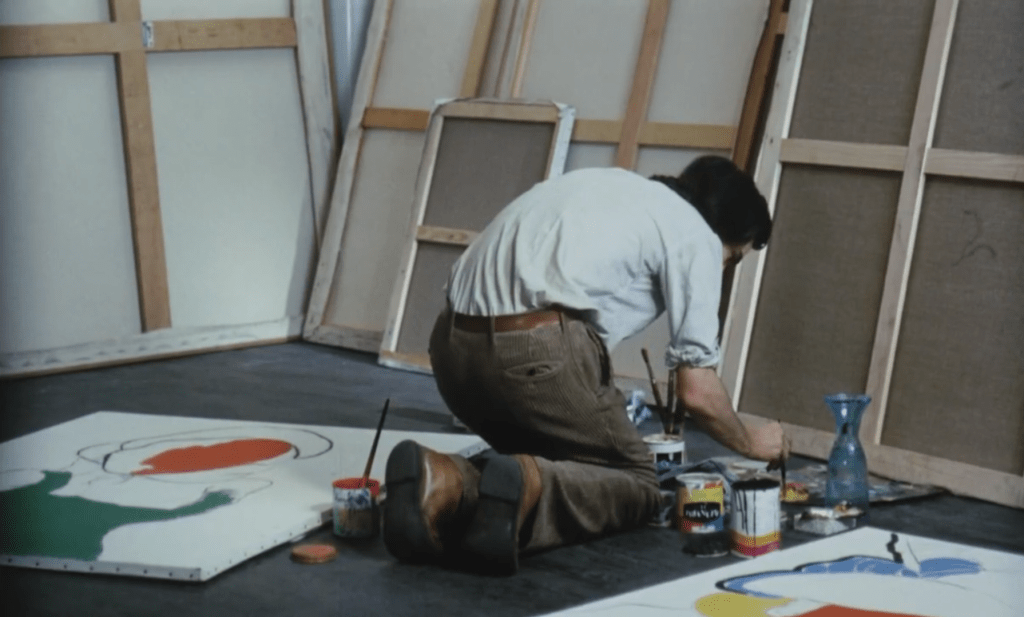
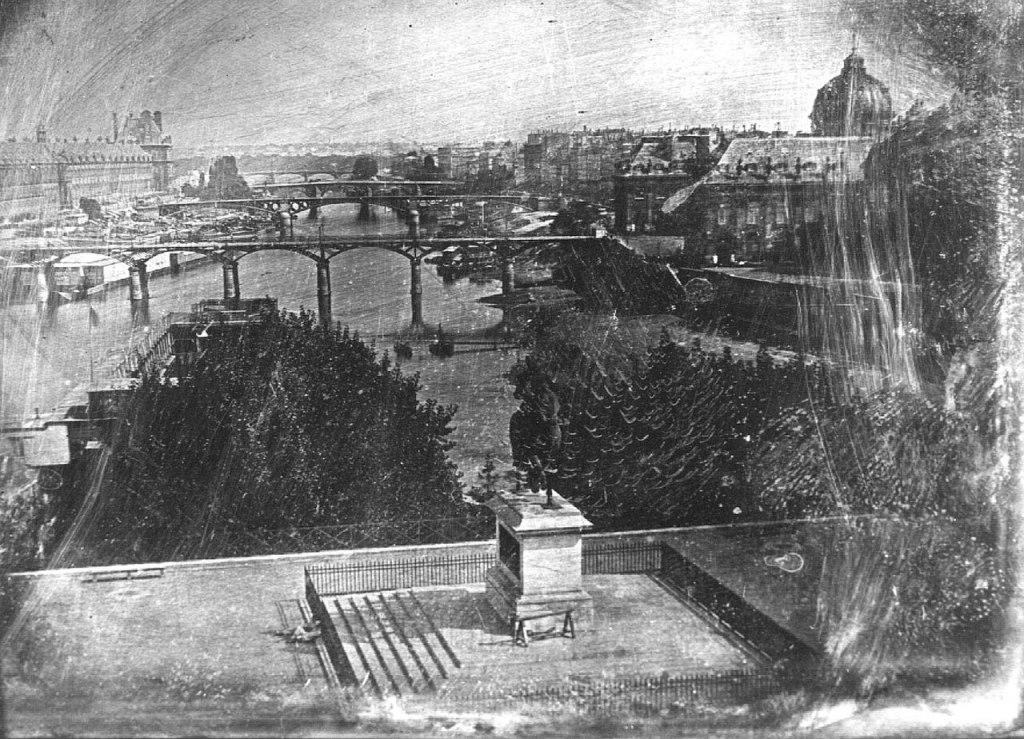
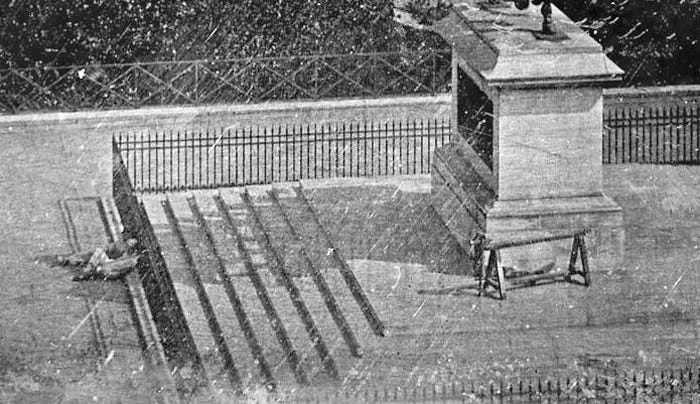
In the closing minutes of Bresson’s second color film and third Dostoyevsky “adaptation,” the usually perambulatory Jacques silently hunches over two partially painted canvases laid across the floor. Earlier in Four Nights of a Dreamer, the viewer catches a glimpse at a couple such paintings that have been more or less finished: large faceless portraits of women defined by bold outlining brushstokes of black uniformly filled with vibrant hues of pure primary and secondary color. The young artist tries to find his ideal woman on the streets of Paris and on the canvases that he leans against the walls or lays across the floor of his studio. Rather, he translates their fleeting forms onto the canvas. As a former colleague from Beaux-Arts tells Jacques, art is about absence, the dual-sided disappearance of the artist and the object. Unable to approach the women who catch his eye and whose eyes he catches, Jacques speaks longingly, poetically of imagined scenarios into his portable tape recorder. In his poetic musings and De Stijl-meets-pop-art portraiture, he removes their features, perhaps unable or unwilling to remember them after his countless failed “attempts” at romantic connection, or perhaps in search of their essence, what they can all be reduced to most essentially, but more than likely this project leads one to his own faint-hearted idealism. This is the impression Jacques offers when Marthe asks for his story, he having just pulled her from the ledge of a suicide attempt over the Seine, having spent one year in wait for a lover who has finally returned from abroad only to ostensibly forget about her. It is as if Bresson took Louis Daguerre’s famous photograph from the Pont Neuf—its panoramic view of the river, the bridges, and the two figures in the foreground, resposing in the shade—as the starting point for his most lovely, sensuous film. Said to be the first photograph taken en plein air and with a visible human figure—and even more, there are two of them. Maybe they are in love, maybe they are not, who is to say.
Let us step away from the impetus and back toward the end. In this scene before the last drowsy blink of the camera iris, Jacques paints an aural picture, a daydream reunion with Marthe: she will apologize profusely for her having abandoned him on their fourth and final night together in favor of her unnamed lover who passes them during the busy nighttime scene. He wants her to admit her mistake, to suffer “one thousand deaths” for him as a result of her decision, but more than anything else in that moment, he wants to be with her again. He ends his soliloquy, rewinds the tape, leaves the recorder at his bedside, and plays back the words he has just spoken. On the other side of the room, he kneels before his painter’s palette, surrounded by the reverse sides of several large paintings already completed with two primary works in progress situated on either side of him. His inability to focus on one or the other recalls the beginning of his story that first night on the bridge: Jacques spies an attractive woman through a shop window, they look at each other with interested glances, he follows her down the street but never approaches, and when he eventually loses her, another grabs his attention. His back turned to the camera, Jacques mixes yellow tube paint with water, trying to achieve a desired consistency, going back and forth between adding more paste and more water. He cannot seem to find the right balance—or maybe he is simply stalling, putting off the work he knows needs to be done—as with water-miscible oil paint, too much water will cause the paint to not adhere to the material support. He abandons this prolonged effort and turns away from the palette and the right hand’s canvas, twisting his focus toward the other open-faced canvas on the left, where an open red paint can sits between the bent artist and his work. Like the others, it is a portrait of a woman: he has finished most of the coloring on her dress green while the halted progress on her face divides her into two halves—one side, red brushstrokes; the other, blank. Without any need for water, he firmly presses and applies the red liquid onto the black-outlined area just above her expressionless, dichotomized face. The adjoining shapes become conflicting ones through their identical hue, marking a new direction for Jacques’s work, wherein previously no region of one highly saturated color is seen to border another of the same color. Further, in the first flashback at his studio, Jacques gets distracted by the conjurings of his own tape-recorded imagination while at work on a similar portrait; however, this red-skinned model’s hair is already in the stagnated process of becoming yellow. And so, the yellow paint Jacques was fussing over was intended to be the brown-blonde hair of Marthe. (He may have been watering down the paint, as when a water-soluble pigment—if that is what it in fact is—is greatly watered down, it will dry darker. Perhaps, Jacques was trying to recreate the subtleties of Marthe within the preestablished astringency of his minimalist style.) Instead he opts for red, the same unmistakable hue of the scarf he bought for her and lovingly wrapped around her head only moments before she left him alone on the street, for the man she believes herself to love more.
This is what becomes of the dreamer. Subsisting himself on fantasies from fleeting memories and imagined fancies, he can only think to expel these feelings outward into some great project he is too embarrassed to share with anyone. He sees his dream as “flat and boring,” but he is a slave to it. Jacques will not be able to get Marthe out of his mind until he captures something of her in his art, so that her canvas, her image can be flipped around and leaned against the wall with all the others, but the ideal will still persist and there is only so much room. The floor is filling up and the walls are bare. A man is condemned to dream, to chase his ideal until he is able to impress it into the mind’s of all men.


Leave a Reply