
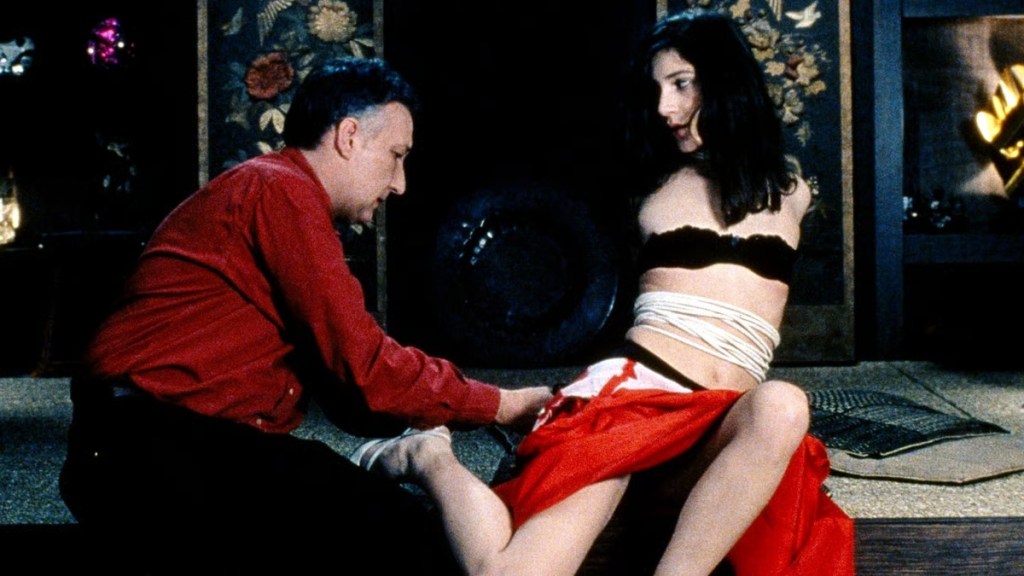
She looks older than she really is; the thumbnail for Catherine Breillat’s Romance belies the age of its actress. One expects a more mature woman upon starting the film, only to be met with the glaringly naturalistic youth of its star, Caroline Ducey as Marie. At a distance and on first glance, one would not be remiss in assuming her to be a woman approaching her middle years. Perhaps, the mixup of this painterly frame begins with mise en scène. Marie, a sexually frustrated schoolteacher exploring the misogynistic violence at the core of (her) sexuality and the seeming biological impossibility of heterosexual love, looks down on an older man (François Berléand), grasping at the red dress pulled down around her waist. The graying of his temples, the trendy lavishness of the apartment, and his unremarkable, buttoned-up appearance contextualize the still, imparting authority by association onto the disrobed woman. Her brushed-out dark hair falls down her chest and shoulders, obscuring her profile and lending an air of mystique to her femininity. In time, when the film itself arrives at this moment, the viewer has already been confronted with and acquainted to the stark dialectic that comprises Marie’s character: at once, the ability to be the juvenile, naïve young adult continually wading into ever deeper and treacherous sexual waters as well as the most levelheaded, intelligent, and self-aware person onscreen at any given moment, making the sadomasochistic dynamic with that same man, her school’s headmaster, all the more complex and unsettling. It is like meeting someone for the first time, that first impression that quickly melts away and is not ever forgotten but is never felt again, never to color the object of a gaze henceforth. In that respect, it is no different than meeting any other person really.
Ducey was in fact only 21 or 22 at the time of the film’s shooting, a film in which she takes a husband and bears a child. Did everyone’s parents convey that innocence, look that babyfaced, and act that impulsively when it was there time to bring children into this world? It has been assumed for some time now that it was the internet that, in its all-encompassing digital flattening of the historical and the social, bulldozed age along with everything else. The salaryman at his corporate email job, opening and closing a secret second window to some social media feed is the same as the student in the back of class scrolling on the hidden phone that nests between their legs. Online the two are allowed to rendezvous, an unspoken May-December affair. They meet together in secret and unbeknownst to each other—not even thinking to be known in the first place—to consummate the secret of the secret in itself, as it were. In the anonymizing embrace of the devouring Mother, all is accelerated or regressed back to an enforced and eternal pubessence. As a result of their shared language and expression, the salaryman and the student by default presume a mirror on the other side of lightning-fast connection that delivers their comments and communiqués before the gaze of the other through space and time. It is a portal between two screens that we mistake for a mirror. Maybe only unfortunate as opposed to incorrect. We have become one and the same, or as the misleading appearance of Miss Ducey suggests, loose strands of hair always fallen across her unblemished face even as she elegantly dons chic designer wear, perhaps this is the way things have always been. Children beget children.


Leave a Reply