
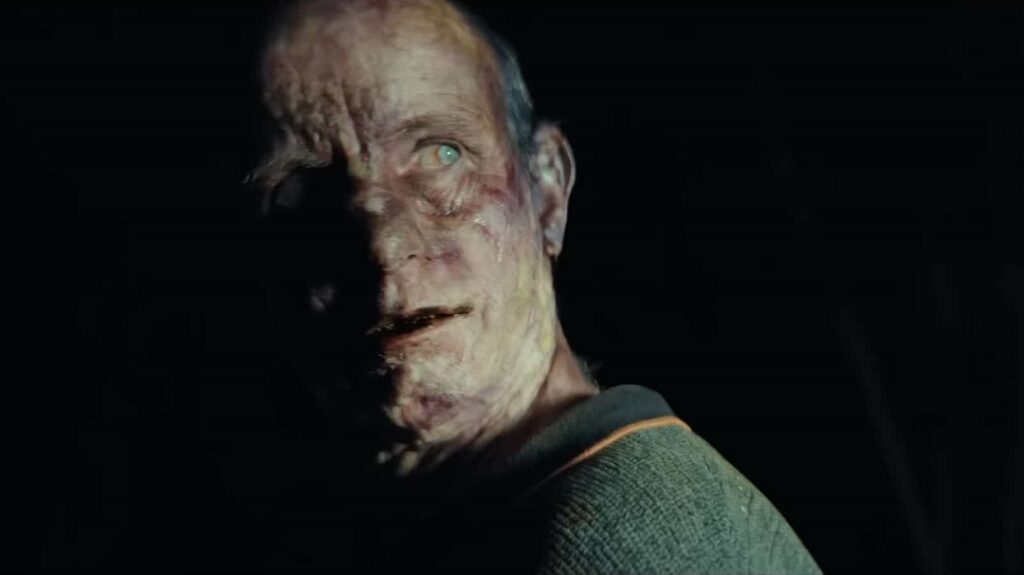
We Bury the Dead (dir. Zak Hilditch) happened to be the first in a long list of January genre releases (Mercy, Primate, 28 Years Later: The Bone Temple, Send Help, Shelter, Greenland 2: Migration) that I was looking forward to this new year. Easily the most memorable, touching scene of this unexpectedly quiet, tender zombie film occurs before American disaster relief volunteer Ava (Daisy Ridley) sets out on the final leg of her journey. The purpose of which—to travel to a seaside Tasmanian resort to locate and retrieve the possibly reanimated corpse of her late husband, his uncertain resurrection the result of an experimental American bio-weapon that halted the brain activity of every living thing within its fallout radius via electromagnetic signals. In her final night before her last day on the road headed south, Ava finds a Winnebago Leisure Seeker to hole up in for the night, carefully removing the brain-dead family of four and laying their bodies outside the camper door. In the middle of the night, she hears the reactivation of one of these corpses, and much to the vocal dismay of everyone in the theater, she goes out to investigate. On opposite sides of the residential vehicle, Ava prepares to dispatch the unwelcome visitor. She rounds the corner and the tension is cut. It is the father, wielding a shovel and digging a grave for the unanimated bodies of his family. He turns to Ava with a hauntingly blank, thousand-yard stare and then moves to continue his work.
The singular-minded heroine finds herself at this intersection with the dead after having only narrowly escaped the predatorily nostalgic demands of the strungout, isolated armyman Riley. After dressing up as his late wife and agreeing to give him just one dance in exchange for safe passage to the Enso Resort, Ava discovers the decomposing body of Riley’s very pregnant wife. It is here that we are explicitly introduced to the principle of “unfinished business,” as until this point it is proposed that only a random selection of the dead are able to regain their basic motor skills. However, according to Riley, it is only the ones with unfinished business that are permitted once more to walk the earth, waiting for his wife to return to him with their unborn child.
And so, it is the father that is chosen to perform a sort of last rites and lay his family to rest. But why is that? It seems as if his role as patriarch demands he is the one to return rather than the mother or one of the children, as if his social obligation within the family unit has informed his very biology ostenibly detached from any memory or emotion. The societal burden of your determined (and here, gendered) role stays with you in death. Is it perhaps pure affect, acting according to an unidentifiable pre-subjective social/ontological impulse? This inexplicable resurrection raises several complicating questions: why was the father the one to be resurrected? what did he do or fail to do in life that meant he had unfinished business in death? how aware is he of his actions in his undead state? why did he come back only after they were all removed from the RV? did the RV function as a sort of collective tomb that was then disturbed by Ava seeking refuge for the night? and what about all those that came before? Up to this point, the audience via Ava have only ever seen the reanimated quickly dispatched by the Australian army. The revelation of unfinished business and the resurrection of the father recontextualizes all the resurrections that We Bury the Dead handles with a careful, evasive hand. (It is the entire movie that is handled in this way, whether hiding its budget in several economical cuts to a wide, or a tightened frame restricting from view what is now only heard.)
In fact, this is the first time that we see someone physically burying anyone. It is only earlier in the film during the first door-to-door body retrieval parties that we see bodies being buried, not by people though, but by machines: bulldozers in the far background dumping mountains of bodies into mass graves. At this point, Ava is still far removed [literally, in the foreground talking to fellow volunteer Clay (Brenton Thwaites)] from the disposal of the dead, and although she is getting closer to meeting it, it is still somewhat of an abstraction to her. Likewise, when the smoke signals are pulled to alert the military forces to the walking dead, the audience is never afforded a look at the killshot, only the ring of a gunshot and the flash of a muzzle from a distance. It is the undead burying the undead that teaches Ava how to make the closure she needs for herself for when the time soon comes to face her husband. We have forgotten how to bury our dead, necessitating the dead come back to life to teach us how again. The father fulfilling his final duty as man of the house—with the help of this stranger from the living, no less obligated to her beloved—kneels silently and bows his head, turned away, on the far side of his completed makeshift family plot. The camera tilts up to frame Ava behind him on the other side of the opened earth, taking the shovel and raising it slowly above her head. She strikes the resigned man over the head and he falls into the ground. It is not merely paterfamilias, but the Protestant work ethic that follows a man into the land of the dead, Hilditch asserting the uncomfortable matter of fact that “a man must break his back to earn his day of leisure.” The political becomes the social becomes the biological becomes the ontological.
The conclusion of this film further affirms the above point in tandem with the principle of unfinished business. Driving back from the resort in Woodside, Ava (now reunited with Clay, presumed to have been dispatched earlier by the shady soldier) encounters once more the deceased expecting mother. Standing in the middle of the road, her baby bump gone, a bloody stain left in its place on her nightgown. A child can be heard crying not too far from the road. It was the mother’s unfinished business to not only give birth to this healthy, living child, but to find a home to care for it. In this case, it is to be “adopted” by a hetero-platonic pairing of a infertile widow who cheated on her now dead (and also unfaithful) husband and a man whose wife and child have removed themselves from his life, better off without him as it were. We Bury the Dead in its unexpectedly matter-of-fact affirmation of the social-biological-ontological continuum subverts then suggests a reconciliation (as renewal of/via friendship) of the family unit amidst the ruins of a cottage on the side of a deserted roadway, for the sake of this unnamed, ungendered life, for the sake of all things future and past.
But, in this world, can things ever be past? The digital brings everyone and everything that ever was back to life, into your life. They must be buried or we will be overrun. The digital, defying death in its insatiable zombification of the world-historical into sequential bits of discrete data, is thus itself encoded with death and vice versa. In We Bury the Dead, the dead walking is vaguely but expressly tied to digital communications technologies. After all, it is electromagnetic signals that essentially fry everyone’s brains, but not only that, more importantly, this information is disseminated via the only instance of digital technology in the entire film—a seatback television screen on the flight to Tasmania. It is in this introductory scene that death, the digital, and the photographic converge explicitly and inform the rest of the film, as the woman next to Ava fingers a locket’s photograph of her own lost relation. She remarks that she hopes it is true what they say, that it was a peaceful and painless blink into sleep.
Once in Tasmania, the volunteers, turning over their devices to the military before breaking into house after house in their mission to recover the dead (death itself?), are forced to reckon with overwhelming quiet but also intimate human contact—with the living and, more importantly here, the dead—without the mediating hand of the very forces that turn us into the braindead. It is the ever-modernizing world’s treatment of death (see Geoffrey Gorer’s “The Pornography of Death”) that characterizes the end of life as something simultaneously to consume for ecstatic pleasure and censor according to the puritanical mores of a repressed society; to dismiss and obsess over. And so, the camera that lingers on the artifacts of dead strangers, practically yearning to extract from these images some clue into their abruptly ended lives is not incompatible with that same society that would rally an international cooperative effort to quickly terminate and dispose of the (un)dead without hesitation or question. Yet, like the invasive gaze offered and encouraged us by social media and lives lived online, the audience through the eyes of Ava are permitted to enter these private domestic spaces of the deceased, the camera lingering on photographs of people who are just around the corner, waiting in the next room to be buried.


Leave a Reply