
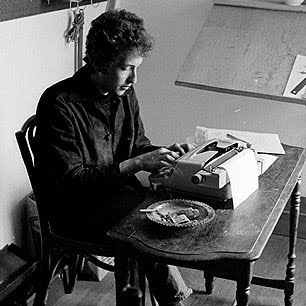
“I was young when I left home / And I’ve been out rambling ’round / And I never wrote a letter to my home”
—“I Was Young When I Left Home” (1961, Bob Dylan)
If I didn’t have an elderly grandmother I swear to God I would’ve stuck to the plan. I would’ve left without saying anything, except when opportunistically and absolutely necessary. I do really think she is the thread that I’m hanging on by. I only told her I was leaving the afternoon before my bus was scheduled to depart. She had no idea that, when I came into her room and tried my best not to break down, my bags were already packed in the other room and the ticket had been purchased days before. I only told her I was leaving just hours before two friends came to pick me up, to spend the night with before they drove me to the station the next morning. Grandma promised not to tell my dad outright, but if he called and asked about me, she would not lie.
As it turns out, he called me with impeccable timing, having just arrived at my destination. I had just gotten out of the shower. In an upstate New York suburban home only minutes from Lake Ontario, meeting for the first time my future first roommate, whom I had found through one of those roommate-finding apps that never seem to work for anyone. The phone is still ringing and he goes to voicemail before I can answer. I had a second phone and a brand new SIM card, I could’ve made the switch anytime over the past two days and thousand-plus miles. I could’ve continued to delay accountability, but that would be antithetical to the reason for moving away. I made a promise to myself and I was going to see it through. I said I wasn’t gonna look back, and that I was, in fact, prepared to do, but I did pick up the phone. The first crack in the myth I was trying to make for myself.
Now, still transfixed on this sort of ridiculous nonsense that I feel most people never even think twice about, I cannot help but feel I should’ve committed one way or the other. I did both half-assed: instead of leaving it all behind and creating something new for myself like the dutiful mythologizing individualist I wish so desperately I wasn’t, I cut people out and feel obligated to get them back since I hear they’re upset I left without saying goodbye. Yet, even now, this is mythology I want to live by, but maybe that’s my whole problem, aside from these juvenile obsessions that I unrealistically want to uplift myself toward in the first place (all because they got a nice ring to them). It’s mythology, it’s a story that I’ve made up to be told around a campfire, to entertain, to make people feel some kind of way. I left the warmth of a perfectly good fire to whittle at kindling, in the hopes that I could build something even better, and then everyone would want to be around my bonfire, congratulating me on what a great flame I built all on my own. But, I’d only want them to want to be around it. It doesn’t matter since I have neither heat nor light. No one told me it was always gonna rain.
Bob Dylan’s “I Was Young when I Left Home,” coming from early in his catalogue, is a nostalgic lament, in which its narrator ostensibly wants nothing more than to return home. Hearing news of all the familial tragedies that he missed since his departure, it is a song that sees the narrator grappling with his regret and his own (past) self-conviction.
The original folk tune from a fresh-faced Dylan employs various forms of repetition within and between lines and across verses to establish a thoroughly nostalgic tone. More specifically, Dylan creates a closed circuit of nostalgic narcissism, as lines are often preceded by anaphora (e.g., “Not a shirt on my back / Not a penny to my name” or succeeded with epistrophe (e.g., “Gonna make me a home out in the wind / In the wind, Lord in the wind / Make me a home out in the wind).” In the anaphoric verse, the narrator only repeats himself twice, before further indulging himself with epizeuxis and a self-pitying outcry: “Well I can’t go home thisaway / Thisaway, Lord, Lord, Lord / And I can’t go home thisaway.” On the other hand, the epiphoric verse is the greatest example of uninterrupted repetition with three successive lines. Therefore, despite bemoaning the loss of his previous domestic life, whether already unconsciously convinced or currently trying to convince himself, the narrator has made his decision and will live with it, even if the reader can practically picture the lonesome traveler holding his head in his hands as he laments his self-imposed exile from home.
Further, the song hinges on one of the most oft-repeated phrases, “thisaway,” a masterful double entendre in its own right. The polyvalent phrasing of the line (“But I can’t go home thisaway”) expresses both figurative and physical connotations of the narrator’s current state. Firstly, he is overwhelmed by feelings of inadequacy, considering himself unworthy to return home until he has made something of himself. And so, his reaction: to repeat—both formally and psychologically (that is, to fixate on the past); the young Dylan crafting here a formidable form-follows-function. And secondly, in the more literal sense, he cannot go back home by continuing to live away from home. However, also, in the same line, the same lyrics nonetheless convey steadfast reluctance in his reasons for leaving home: that is, he can’t just go-home away his problems. Thus, in the same breath, he recognizes that nostalgia will get him nowhere physically, but also especially in that aforementioned figurative sense.
Even in the deepest drunken stupor of nostalgia, as you passively retreat into fantasy, it projected before you on the ceiling, pleading to relive the past, you’re still looking for any excuse to break free of its addiction, even if, in this very moment, you are unable to pull yourself away.
With this vacation, I returned to the grounds of the fire that had warmed me, and there was no one left. All this talk (I guess, really thought) over the last few years—of the posthuman, the digital, the nostalgia of neoliberalism, anti-individualism, anonymity— is how I compensate for an unshakably selfish nature. Consider this my resignation.
“I can’t go home thisaway”


Leave a Reply