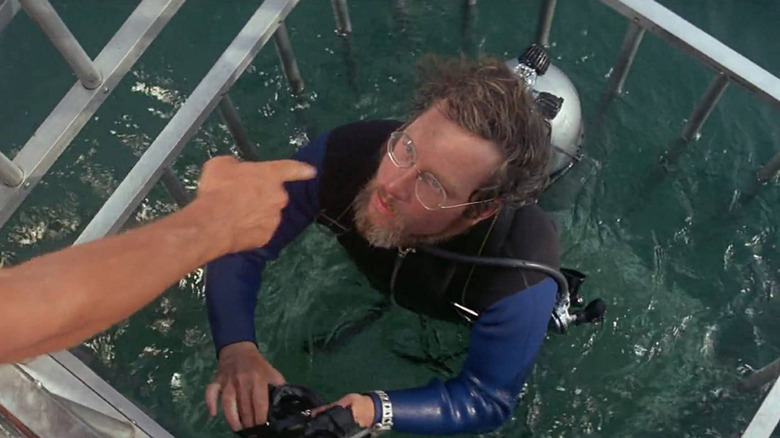
From the beginning, Jaws was always supposed to be the highest grossing film ever made. Widespread rollout into hundreds of theaters simultaneously during summer vacation, extensive television adverts, and a tie-in merchandise line all ensured its blockbusting capabilities before the film was ever screened before a paying audience. So began the industrial model of the blockbuster, an enterprise had it failed, would have meant (in a manner of speaking) the studio being “on welfare the whole winter,” as shark hunter Quint warns the Amity townsfolk. He could get the job done for three, but will accept nothing less than ten thousand. High risk, even higher reward. “This shark will swallow you whole,” that is, if you (the studios) fail to control this colossus never before seen. And so, this fear of being reduced back to working-class toil and all its insecurities and instabilities is the central anxiety at the bleeding heart of this film.
In Jaws, the individual reigns supreme, the deliberative power of the masses are manifested as corrupt, overly bureaucratic, ineffectual, and callous. No doubt a consequence of Nixon’s Watergate blunder the year before. After all, chief of police Martin Brody moved from New York City to the quiet Massachusetts resort town in order to escape the urban tumult and social alienation, to start his middle-class life on his new suburban waterfront property. He was afforded the opportunity of upward class mobility, not entirely uncommon for the time, but one that was increasingly waning well before the outset of the next decade.
Yet perhaps, the greatest element of fantasy in a film with a 25-foot killer shark is surmised by Brody’s insistence that “one man can make a difference.” However, in the world of Jaws, any attempt to come together is thwarted. Initially, Brody unilaterally closes the beach after the first attack, then relinquishes to their reopening at the behest of Mayor Vaughn. Furthermore, the civilian shark hunting parties are demonstrably disorganized and counterproductive, leading to the capture and killing of the wrong animal. Lastly, the final expedition of Brody, Hooper, and Quint goes horribly awry. Brody, with his fear of the ocean, clings to an onshore (stable) notion of collective support and accountability while at sea, attempting to radio for help in killing the great white; however, Quint, the self-made working man born and bred on a individualist diet of mistrust and self sufficiency, smashes the thing to bits. Right as the three men—a cop, a scholar, and the one man specialized for this kind of work—begin to get along, the shark attacks, leading to a damaged hull, a busted engine, and a dead captain.
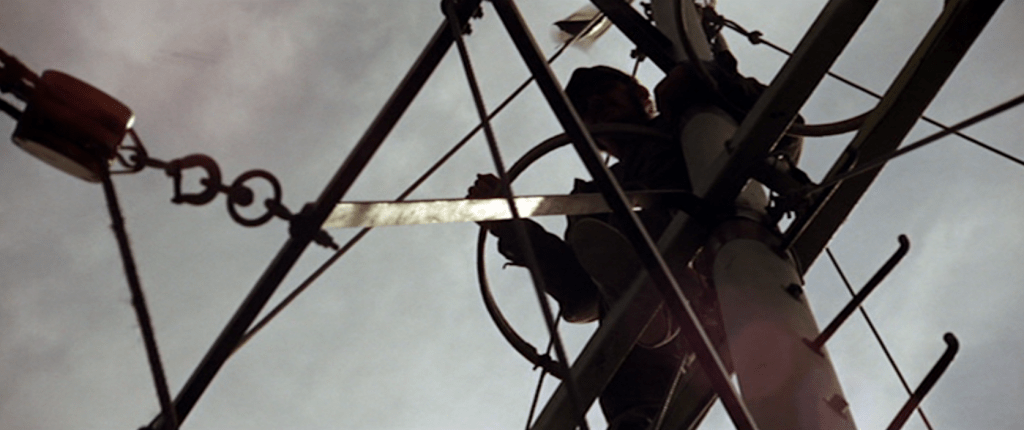
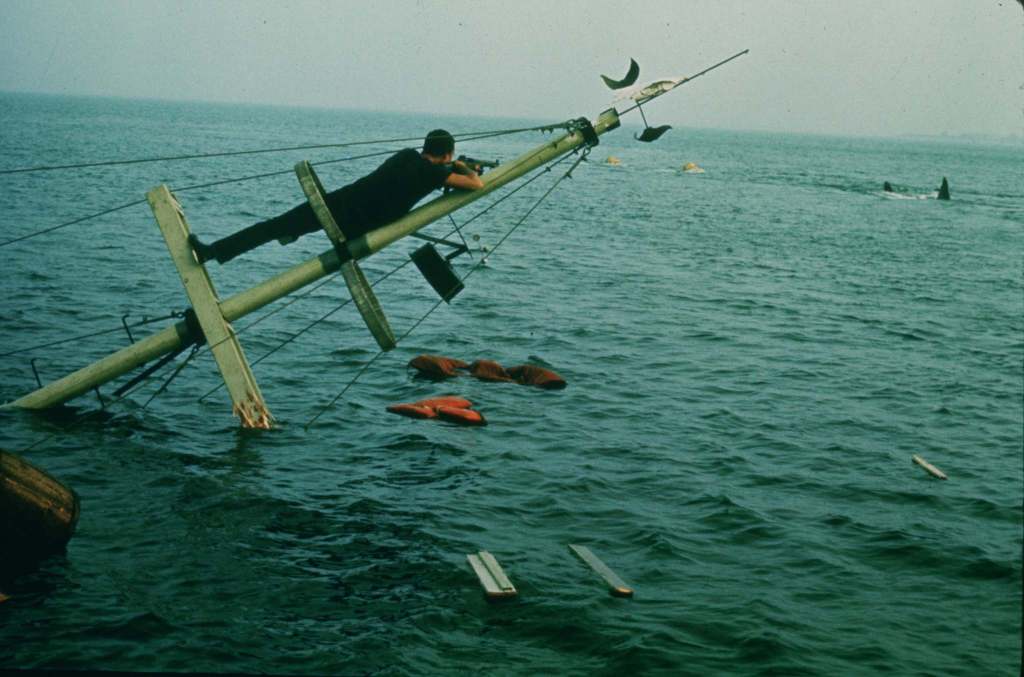
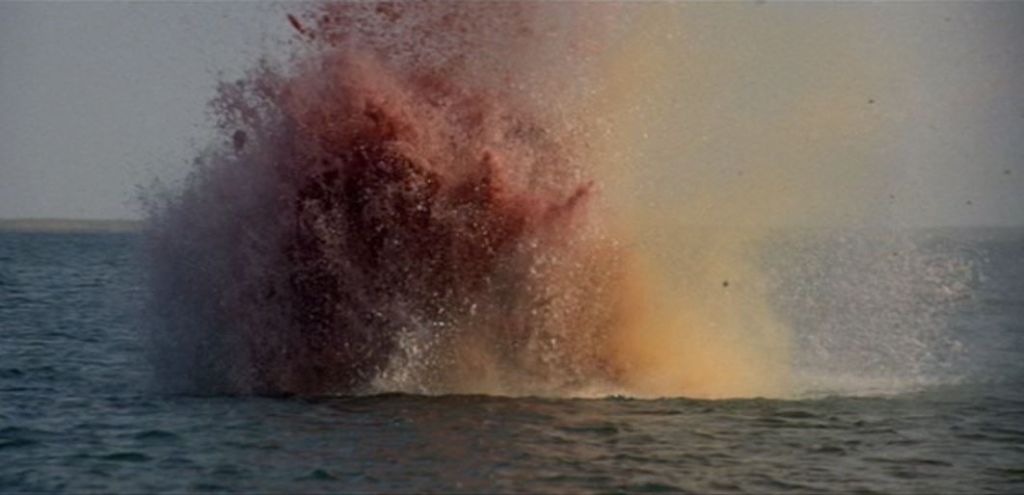
With Quint eaten alive and Hooper stranded underwater, Brody the surrogate of the state employs the former’s mode of safety and vantage with the latter’s tools to explode the relentless consuming machine. The ideal individual for the neoliberal age. Brody fully succumbs to the call of the individual after the death of the “working class hero” (Hooper’s jab at Quint). This middle-class savior now captaining the surviving duo of himself and the old money academic, kicking to shore in tandem, held afloat by flotation barrels. The state-regulated industrial patriarchy of Classical Hollywood gives way to the neoliberal network society. Every man for himself. Quint is not so fortunate. He succumbs to the gravity that the other two manage, as if a necessary sacrifice, sliding down the deck into the jaws that haunt him. The working man is consumed by the spectacle, pulled into the indiscriminate, all-devouring field of the shark.
In the theaters, the similarly stratified audience has become enraptured by the Spielbergian cinema; in addition, a sort of stratification of the audience itself was underway on the basis of class due to the growing suburbanization of theaters. Not to say that the early cinema was utopian and did not succumb to divisions and exclusions, but in just 70 years, gone are the days of the nickelodeon; here are the days of the mall multiplex and the drive-in theater. And then now, streaming and the home theater further continue the social atomization of spectatorship, especially with rising ticket costs turning cinemagoing away from its roots as a shared working-class pastime. However, in its depiction of a fraught relationship between the collective and the individual, Jaws does not simply and entirely willingly accept the cult of the individual. Likewise, outside the text, the pop auteur forges a formal language unique to himself, while appealing to the largest possible audience. Spielberg wishes to have it both ways, and like any good hyper-Newtonian blockbuster, things end up in the air.
That’s the only line immediately worth keeping from another self-pitying, entitled, raving, last minute, pointless, self-loathing diatribe that has already been scrapped and spat on. The opening line. So, let’s try again and try to salvage this mess.
I keep pulling myself from the cliff of a full-scale mental breakdown by the collar of my shirt, the magnitude of which would match the bringing of the brain fog four-and-a-half years ago. I can’t even call it a brain fog anymore, this is just how I am.
Some context: my roommates are animals and I hate them and am overworking myself to be able to move out (and also probably to avoid running into them), I don’t have a window or air conditioning, and my laptop’s keyboard is broken for good, so I haven’t been writing. There is good news, however. My actual computer is currently being shipped to me, just in time for the death of the dedicated understudy. Until now, I had just about snapped and was looking to give up on all things writing or video, a least, give up on showing them to anyone; although, I do still believe everything I’ve made in recent memory has been utter garbage. I’d say I’m washed up, but I was never good to begin with.
That being said, I have some new ideas.
The kind of breakdown I’ve been interested in lately I don’t have the strength to commit to. To crisis of consumption leads to the crisis of creation, and I’ve just about had it with both. Bartelby knew that consuming was a shameful act, staying behind his divider screen and sustaining himself on gingernut cakes and pieces of cheese discreetly delivered him. Consumption promotes inspiration, and unfortunately, I don’t have the stoic wherewithal of Melville’s character to remove myself from the samsaric wheel just yet.
Yes, you could say I finally have a few morsels left to keep me going before starvation seems the only viable alternative. Another short, one that will hopefully be completed unlike the phantasmic failure of Dark Chamber, this time only involving myself. I’ve never written a screenplay before, but I think I’d like to finally try something feature-length as well, after having several premises I’ve wanted to expand upon from the last five years, but never did for a plethora of reasons that will always compound in cowardice. And like the previous attempt at a short film, my bedroom plays a more important role than I do, and once again, my decision to go through with a more ambitious project like this coincides with my established plan to move. That’s how the last one only got shot halfway through. I still feel that bullet in my gut when I think about it.
The reintroduction of my computer back into the question also raises from the dead several projects that I can finally finish. I am the type of person who thinks once I get everything crossed off the bulleted lists, I can finally rest easy. I also know that they will go on forever, living in a constant state of overwhelmed. It’ll be good, even just to say I finished something. The return of the tenth grade gaming rig is only gonna make matters worse in my tiny New York closet, but I’ll manage.
I’m gonna keep saving and looking for something better with a little help from my friends. After a miserable, grinding summer, I can afford to give myself a little bit more air to breathe. I especially have not been eating enough—out-of-commission kitchen and pinched pennies—putting me in the most horrific, irritable mood. Not to mention, my self-esteem is at about rock bottom because I’m a huge loser and a gigantic pussy, to put it briefly, but if I write it out, maybe I can turn things around.
I’m disturbed because nothing’s changed. What happened is what normally happenswhen changes aren’t made: things slowly slip into the realm of worse-than-before. No changes necessary.
She comes up to the counter and asks for two cups, smiling the entire time. It’s more her eyes.
She comes back out from the theater some time later and buys something—a water bottle maybe; candy? She walks back toward the door and looks over her shoulder and smiles. I don’t have my glasses on, but I can see she’s smiling and looking to me to look back at her. My stomach hurts for real.
Break: I can get my food and come back and eat it before her movie ends. I’ll make sure I clean the theater when it gets out. My glasses are on.
The first few people leave, so I go to sweep while the credits roll, looking down. There’s a man with her in the next seat. She’s looking at me and smiling as I walk up and down the aisle. I wait a few rows back while the rest plays out.
She walks past me with him right behind. I can’t say anything. She’s smiling and looking at me, of course.
I take their two tickets left in the cup holder. J6. Everything else goes in the trash. The End.
The broom and dustpan go back in the closet. The lobby’s empty. I go back behind the counter. She comes out of the bathroom and out the entrance door. As the door closes, she looks back over her shoulder, through the shrinking gap of the doorway, just to make sure I’m still looking. Out of sight.
But together with whoever, the two of them walk back along the row of glass doors. I can’t move. That’s it. Exit. I look out the window like a dog waiting for master until it’s time to get back to work.
You know, hope is a mistake. If you can’t fix what’s broken, you’ll go insane.
I. MAX CAN’T STOP MOVING.
There is no paradise to which one can return; even if there was, there certainly wouldn’t be room for just one: it’ll have to be all or none. It’s a simple premise. A diverse group of characters must band together and share in the only instinct afforded to them in the desert wasteland of George Miller’s creation, that is, to survive, as Max establishes in the film’s opening soliloquy. Surviving until it feels like something more than just survival. Unparalleled visual poetry on an impossible scale. Yet still with such a precise and graceful hand, this movie speaks universally to life in the West (fittingly enough, all the characters we follow can be traced back diegetically to some notion of west—sex slaves, soldiers, and blood bags alike). The West, where life is constantly accelerating ever faster toward no future at all. Thus, the only one way to progress beyond hierarchical systems is to constantly stay ahead of them, to push out from within them. A process of deterritorialization that must outpace an opponent that is more machine than man. In this world, accelerating ahead of the machine requires deforestation, a perverse form of terraformation in the desert hellscape of Mad Max. It’s funny, I almost felt bad for the lone tree getting uprooted, but the tree is dead. It’d been dead. Rip out its roots and pull yourself out of the sour earth. Rip out its roots and plant something new. Rip out its roots and destroy your past. It was never about hope (in the world of Mad Max, such a possibility bears no fruit), it’s about activating the utopian potentialities within the dystopian, unearthing them. The tree wasn’t just destroyed, it was leveraged, teleologically endowed with a purpose alternative to that assigned it in life. Even in death, a thing can save a life. Max’s vision of a girl he failed to protect causes him to flinch and shield his eyes, blocking an otherwise fatal crossbow bolt. In Fury Road, people are things, subjects collapsed into objects. You own the objects (water, guzzolene, bullets), you own the people. Everything is a commodity. Miller offers two alternatives through Max and Furiosa. Furiosa ascends, bringing resources to the masses in the process. Max vanishes into the crowd. The last look they share is recognition of the other’s role: Furiosa the leader and Max the guerrilla. So, they are not mutually exclusive paths, but, in fact, two prongs of one attack to jumpstart the world out of its inertial stagnation. “An object at rest will stay at rest.” People are objects. “Unless acted upon by an unbalanced force.” There is no velocity without first acceleration, without first an initial force. Furiosa imagines a better world for Immortan Joe’s breeders, motivated by nostalgic escapism to return to the Green Place, a place that no longer exists. Miller does not allow any such fantasy to last for his audience either, enduring criticisms that “they just go in a big circle.” On the contrary, they travel in a line. “I suggest we go back the way we came,” says Max. Every action has an equal and opposite reaction.
II. WHAT MAKES MAX SO MAD?
Therefore, the structure of the narrative is not, in fact, deterritorializing or schizophrenic; rather contradictly, it’s expressly linear. And so, it is actually the character of Max who possesses these characteristics. He is haunted by hallucinations and has maintained his flat and withdrawn affect for an extended period of time, on their own enough to constitute a schizophrenic diagnosis. Mad Max receives a hallucination in the midst of a fight to the death, his mind invaded by a dead girl, reflexively jerking his hand upward to miraculously block a shot to the head. For a man who is merely surviving, Max is effortlessly and unconsciously crossing through the zones that comprise our picture of the world with this one gesture. His mind, recalling happenings from the social realm of his past, prompts his body to act automatically, which later allows him to bring the War Rig, with the corpse of Immortan Joe in tow, back to the Citadel, effectively altering the material reality of its inhabitants. To move history forward according to some notion of historical progress (even in a post-apocalyptic wasteland), a schizophrenic voice is needed, and as Fury Road demonstrates, it needn’t speak very often. For the other passengers of the War Rig, as well as the truck itself, are more markedly linear in their motivations and movements. Max breaks the mold. Everyone believes in hope ostensbily, except Max, who is the better off for it. He does not cling to linear notions of personal growth or historical progress. In the very first shot of Max, he tells us, “It was hard to know who was more crazy, me or everyone else.” He is the ultimate nomad, moving from place to place in a time and space where there is no sense of place. It’s not until he’s about to get branded (by a hot iron in the shape of Immortan Joe’s insignia) that he takes his line of flight, escaping from his captors. It is here that he goes from potential prison laborer to blood bag. To be branded is to be labeled, to become a subject, a demographic. The branded Imperator needs the nomad, the agent and object of deterritorialization. As the tagline reads, “The Future Belongs to the Mad,” and maybe that’s because they’re the only ones who can bring it about.
First time at Williamsburg Cinemas. I don’t know anything about Julio Torres, but thinking back on this debut, he seems pretty annoying. When I was watching it, I could mostly stomach his and Tilda Swinton’s quirky and grating humor, but I cannot see myself ever wanting to rewatch Problemista. Something that I would’ve liked to see more of is the figure of the maze—in the form of a staircase of cubicles. It felt more like an afterthought rather than a fleshed out detail of much importance, only appearing twice. On the other hand, I did like how the movie showcased what it’s like to live in Bushwick and turning to Craigslist, personified as some queer deity, during desperate times. When all is said and done, this movie did get me to ride the Roosevelt Island tram, which was cool.
5/2: Places and Spaces (1975, Donald Byrd)
Recommended by a friend. Yeah, jazz-funk fucking rips. Everyone say, “thank you, black people.”
El Topo is an insane film. The lone gunslinger wandering the desert is reborn and accepts his role as a monastic guide for the disenfranchised. Surrealist cinema at its best.
Darktown Revue played before Body and Soul as an accompanying short during Film Forum’s Micheaux retrospective, which sadly was not held over for an extra week, I assume because no one came to watch any of them. His first sound film, Darktown Revue was surprisingly funny, especially given its invocation of minstrelsy, in which a black preacher in blackface delivers a sermon comprised of mostly nonsense. Micheaux always seems to have been a provocateur, criticizing aspects of black culture for breeding complacency amidst poverty, speaking from his perspective as a black homesteader and promoting the upliftment of the individual through hard work and commitment to a craft. While I don’t necessarily agree fully, Micheaux was all about offering alternatives when not many were available.
I could not follow the plot of Body and Soul and even after its “cop-out” ending was still left puzzled. It is revealed that the whole thing was a dream, Paul Robeson’s diabolical reverend character didn’t really kill the dreaming mother’s only daughter, Isabelle. I don’t know if it was established earlier in the film or it’s just one of those Micheaux sudden endings that wraps up everything too neatly right at the very end, but Robeson was playing twin brothers the entire time and Isabelle marries the long-lost sibling, Sylvester. I think? It doesn’t really matter, because I was more invested in Julia Theresa Russell’s performance as Isabelle. She’s beautiful in a demure, waif sort of way. Her eyes seemingly always about to overflow with tears, like a woman burdened by too many secrets, always appearing as if she has just seen a ghost. Every time her face is onscreen, I can’t take my eyes off this woman I’ve never seen before. Herself, a ghost: not much is known about her and she never appeared in another film. There’s something deathly and tragic about her mousy appearance. This must’ve been how Bazin felt about Bogart.
~5/4: Pussy Whipped (1993, Bikini Kill)
Kathleen Hanna’s voice is so attractive.
5/6: Dune: Part Two (2024, Denis Villeneuve); good kid, m.A.A.d city (2012, Kendrick Lamar)
After watching Dune 2, I thought the movie was cool, but it didn’t really make me feel much. Yet, leaving the theater I felt oddly invigorated and confident. So, I’ve come to the conclusion that this movie is crack for average white guys who haven’t achieved anything. I ended up watching it for free at work, after dragging my feet for two months and never going to AMC Lincoln Square to watch it in IMAX 70mm. I just needed to get it over with. I’m tired of seeing Timothée Chalamet and Zendaya everywhere, they just don’t have the sauce that Hollywood is still trying to convince us they have.
I’ve been in a pretty rock heavy phase of music listening for the past year and a half, but this album really brought hip hop back into the fold for me.
5/7: Swing!(1938, Oscar Micheaux); Underworld(1937, Oscar Micheaux); To Pimp a Butterfly (2015, Kendrick Lamar)
Every time a couple of characters would kiss or intimately embrace, Micheaux fades to black before cutting to the next scene. I still don’t know what exactly this could mean in relation to Swing!, but it’s a noteworthy device. No one quite intercuts like Micheaux either, often asking the audience to draw parallels between extensive cabaret numbers and emotionally vulnerable conversations between two characters. Truly the first Black auteur. Really enjoyed this film.
Out of all the Micheaux films I saw at Film Forum during the festival’s week-long run, I would say Underworld might be the most entertaining. Sol Johnson plays the naive pushover who wants to do the right thing expertly, Bee Freeman as the manipulative and conspiring villain steals the show, and ever since I first saw her in Birthright years ago, Ethel Moses has always reminded me of Setsuko Hara. Throw in a gangster plot on top of that with the classic Micheaux last-minute reveal that saves the hero and you got yourself a really fun race film.
I get it now. Kendrick Lamar is a Bob Dylan level talent. His beef with Drake seemed like as good a time as any to finally get around to listening through his albums. “Wesley’s Theory” is the strongest album opener I’ve heard since “Serve the Servants“.
5/8: untitled unmastered. (2016, Kendrick Lamar); DAMN. (2017, Kendrick Lamar); Ten Minutes to Live (1932, Oscar Micheaux)
I liked untitled unmastered. but by the very nature of it, I haven’t gone back to listen to specific tracks, like I have with DAMN. “LUST” is the song I listen to most off the album.
Ten Minutes to Live is definitely a film I need to go back and rewatch, as I feel I would have a lot more thoughts. There’s just so much good stuff going on and my memory is failing me right now.
5/13: The Last of the Mohicans (1992, Michael Mann); The Amazing Spider-Man 2 (2014, Marc Webb)*
First time at Roxy, really liked how moody it was and that it’s only one theater. Saw Last of the Mohicans on 35 with a friend, which was the first time I’ve actually seen a film on film in New York. It was like watching a Romantic painting come to life. We watched the theatrical cut, so this ending did not have Chingachgook’s final monologue, proclaiming that one day there will be no more frontier left and new peoples will come along. While I haven’t seen this scene in full context of the Director’s Definitive Cut, I think it might say too much. I love the tragedy of the last Mohican declaring himself thusly and leaving it at that. In my mind, the rest is unspoken. The breathtaking soundtrack and photography do the rest. My parents were in town visiting me and my dad insisted that I had to accept the invite to go watch The Last of the Mohicans.
Amazing Spider-Man 2 might be my favorite moviegoing experience to date. We flipped a coin, which dictated that we rush to Prospect Park Nitehawk (another first) to miss only the first bit of this movie. Also projected on 35mm (and only finding out after the fact that it was actually shot on that format as well), this film looks incredible. It’s a disaster, but it’s great. I hadn’t seen it since high school probably when I watched it on a laptop or something, back when I knew even less than I did now and watched slop pop-criticism like ScreenJunkies and New Rockstars. The character design of Electro is actually super inventive and his final fight with Spider-Man is insanely creative. And then, on the other hand, Dane DeHaan’s Green Goblin looks repulsive and uninspired and is such a huge miss in a film with such tremendous high points in terms of costume design. I suppose I can applaud trying to do something new across the board. Of course, the scenes with Gwen and Peter have off-the-charts chemistry and you can’t help but smile, as Andrew Garfield and Emma Stone somehow elevate what is mostly trash dialogue. To add, Sally Fields is great as Aunt May and her scenes with Garfield are just as emotional and heartfelt. All around this movie is phenomenonally acted for absolutely no reason. And when you’re not invested in the onscreen tension between love interests, you can laugh alongside everyone else in the theater as a sad Peter Parker puts in earbuds and listens to Philip Philips’s “Gone, Gone, Gone.” This movie is the most comic book movie in every sense, for better and for worse.
5/14: Mr. Morale & the Big Steppers (2022, Kendrick Lamar); Challengers (2024, Luca Guadagnino)
I am not a big Luca Guadagnino fan, but Challengers is the film of his that I’ve enjoyed the most (so far and based on the few I’ve seen). For me, it’s not movie of the year or as awesome as I was promised it to be, but I like it more than I dislike it. However, while not getting me to go out and find a racket and someone to play with, it did inspire me to get a gym membership since every character is insanely in-shape and hot. It actually got me to change something in my life, which is more than I can say for most movies. The acting for the most part was just fine, I’m still not a Zendaya fan and something about Mike Faist’s performance seems off somehow (which maybe I kinda like?), but Josh O’Connor as Patrick was really the highlight of it all.
5/15: Rise of the Planet of the Apes (2011, Rupert Wyatt)*; Dawn of the Planet of the Apes (2014, Matt Reeves)*; War for the Planet of the Apes (2017, Matt Reeves)*
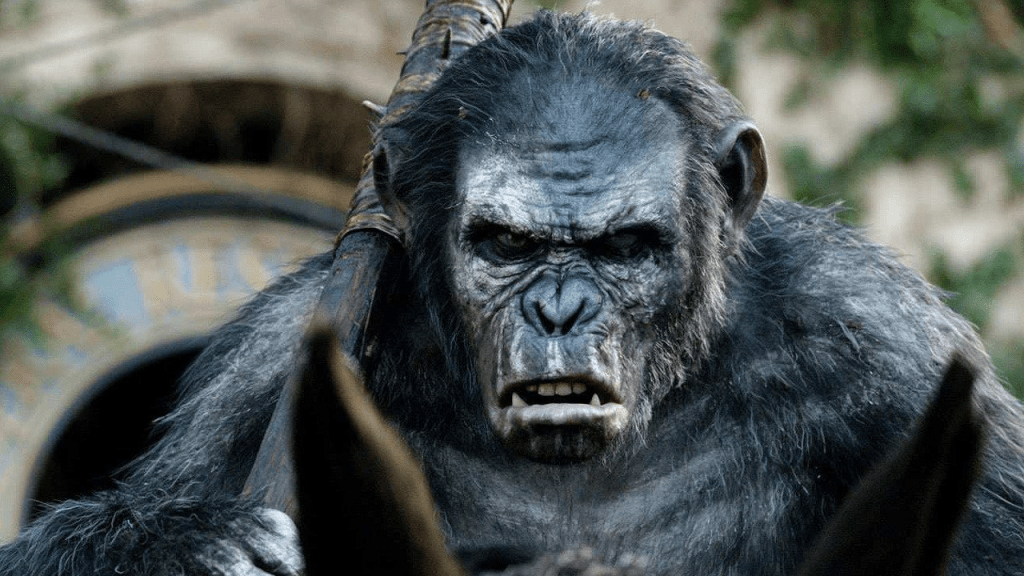
Like the state giving itself the authority to execute who it pleases, Caesar, fittingly named after the one man statesman, unilaterally decides that the only way to unify the fractured ape community, split over the Human Question, is to kill his rival Koba. In doing so, he breaks one of his commandments (“ape shall not kill ape”) by conveniently declaring that Koba is not an ape, for he killed an ape first. By its conclusion, Dawn undoes all the diplomatic undertakings instigated by the Jason Clarke character toward Caesar and the apes. Caesar has the opportunity to try the diplomatic approach ape-to-ape, but it’s never even considered. Caesar doesn’t seem to learn anything and I wish this hypocrisy would’ve been explored more in War, or Kingdom for that matter. I do really enjoy the tortured king who has to do what he must (and Serkis kills it), but this ending severely undercuts what could’ve been a much more bold and groundbreaking characterization in my eyes. It’s nothing new to say that post-apocalyptic stories in their imagining of a world beyond the human end up recreating the same conditions that led to catastrophe, building back the same society with the same inequities in a world where it’s already been proven that all rules are off and new modes of living could now be explored, ones more sustainable and decent for everyone. Yet, it seems that even genetically enhanced apes still have too much human nature in them. Interestingly, Dawn posits digital technologies as perhaps the one tool above all which defines the modern human. When Malcolm’s group gets the dam up and running and power is returned back at the settlement, Dreyfus’s iPad turns on and he finds family photos. This technology serves as an extension of his memory, unlocking that which he has repressed. The same applies to Caesar. Returning to his childhood home from Rise, he returns to his former attic sanctuary, where he finds a video camera that had documented a touching moment between human father and ape son. (Side note: Reeves seems pretty preoccupied with having characters and the audience watch events through the mechanism of video: Batman looking through Catwoman’s eyes via contact lenses, the entire structure of Cloverfield, plus Dreyfus and Caesar here.) So, it would seem that Caesar accepts his humanity, as it were, yet still decides to kill Koba. He urges the apes to forgive Malcolm’s group’s transgressions and calls him a good man worthy of his trust. So, why doesn’t he take that same attitude and try to negotiate with the human-hating Koba, his friend and officer?
War might be my favorite of the trilogy. It’s really fun how this series became these neat genre pieces once Reeves took over: Dawn, a war movie, and War, a prison escape movie. I think that speaks to how strong and open-ended a template Rise is—a reputable first entry that would allow one to take the series in any number of directions. Woody Harrelson is better than I initially remembered and gave him credit for. Steve Zahn puts his heart and soul into playing Bad Ape. I wish actors scrambled to play mocap suit monkeys the way they pledge allegiance to the slowly deteriorating Marvel empire.
5/17: Kingdom of the Planet of the Apes (2024, Wes Ball)
I didn’t want to have to say it, but this one is a dud. Wes Ball just does not have it. The opening sequence is trying to hard to be Avatar 2 (of which I am not a fan), fully immersing you in this sublime computer imagery, but it’s just boring and goes on for way too long. Kingdom has plenty of interesting ideas that it never expands on: it squanders its already lengthy runtime. Proximus trying to break into the fallout bunker, William H. Macy as a (criminally underused) academic or historian that educates Proximus about humanity’s heyday, and the different interpretations of Caesar’s teachings and actions are all good ideas that never go anywhere, and then, the movie ends. That being said, I am interested to see more from this next trilogy and the wonderful Kevin Durand.
5/19: Blood on the Tracks (1975, Bob Dylan)
I’d heard over and over that this is classic Dylan (on top of his game, return to form, etc., etc.) and as the album progressed that assessment became increasingly apparent. “Lily, Rosemary and the Jack of Hearts” still runs through my head.
5/24: The Amazing Spider-Man (2012, Marc Webb)*; Pass the Distance (1971, Simon Finn); Spider-Man (2002, Sam Raimi)*
With his Amazing Spider-Man series, Webb turns a hero that could be anyone into a hero that can only be one. In doing so, the hero’s journey is transformed into one big conspiracy. Peter’s father introduced his blood into the super spiders, making his son the only viably possible candidate for Spider-Man. I don’t know if I like or dislike this change. I’d probably like it more if it was executed better, that is, the idea that Peter never really had as big a choice as Tobey Maguire Spider-Man. His decision to become Spider-Man is less meritorious maybe, but it also further deifies him even more than the myth of the exceptional individual at the basis of all superhero movies. I don’t know it that makes sense. This movie is just kinda bland anyway. Like comic book movies new and old, anyone who tries to expose the corruption and contradictions of civilized society must be a homicidal maniac. Doc Ock, the Lizard, Reeves’s Riddler, Nolan’s Joker, etc. Connors wants to imagine a world where everyone is equal, which gets twisted into he wants everyone to be a lizard. Like Doc Ock in Spider-Man 2, curing ills becomes about achieving perfection, some perverted form of it. (Perhaps, perfection is always perverted?) Either way, it’s a straw man of any vaguely egalitarian perspective.
First introduced to “Jerusalem” years ago, thanks to the Spotify algorithm, I finally took the time to give the entire album a listen. Already having listened to its high point, the rest still has the same frantic and mescaline sound that “Jerusalem” takes to the extreme. Pass the Distance sounds like a nervous breakdown, you can practically hear Finn writhing on the floor as he wails and groans in anguish, passing through every stage of grief before your ears.
5/27: 24 Hour Party People (2002, Michael Winterbottom)
I love that 24 Hour Party People affirms how digital video allows one to insert oneself into history and control its flows, rendering history an open spacetime of play and possibility. Steve Coogan is undeniable as Tony Wilson, and so is Andy Serkis as Martin Hannett. A two-hour experiment in mythmaking that feels even longer, but you don’t want it to end.
5/30: Spider-Man 2.1 (2004, Sam Raimi)*; Spider-Man 3 (2007, Sam Raimi)*
Not sure if 2.1 is the version I’ve seen during any of my several watches, but I’ll still mark it as a rewatch. The last time I watched the Raimi Spider-Mans in high school, the first ended up being my favorite, but the second easily sweeps it this time around. It rises above the rest of its comic book ilk, despite having all the same not-so-unconscious political prescriptions and blockbuster format. Allegorizing the ideological workings of the blockbuster, ever wary of abstraction, Doc Ock tells Peter, “Nothing is as bad as uncertainty.” Additionally, the nuclear mad scientist only wanted to provide clean, cheap electricity for the entire planet, before he goes crazy. (Norman Osborne, on the other hand, was creating expressly military technology before his powers got the best of his psyche.) But even, then he doesn’t simply go from a noble cause to a homicidal one: under the influence of the AI metal arms, he wants to try again, this time on a larger scale. It becomes two exceptional individuals taking it into their own hands whether to pull the plug on a world-changing event. An event, mind you, that could cause the earth to collapse into itself. Spider-Man thwarts Doc Ock’s all-consuming force of nature by revealing his identity and appealing to his humanity; however, the blockbuster’s exploitation of gravity is not so easily dispatched. Doc Ock isn’t lying when he says he can’t stop it. And so, he sinks his miniature sun by dragging it to the bottom of the ocean, gravity succumbs to gravity. Is this a way out or merely fantasy? Working within the blockbuster framework, Raimi delivers a film that questions its very phenomenological foundation, all the while delivering an impeccable story and touching character moments. Yeah, the fixation on personal choice and responsibility is incredibly par for the course in the New Hollywood blockbuster, but it’s a great movie nonetheless. I love the moments between Peter and Aunt May. It’s genuinely heartbreaking when she gives him money for his birthday even after Peter finds out she is behind on her mortgage payments, or when she thanks him for finally telling the truth about not stopping Uncle Ben’s murderer. Not only is his aunt (or very much reminds me of my own grandmother) is support system, but the city itself—literally and socially—as perfectly exemplified in the runaway train sequence.
Unfortunately, I just cannot get behind Spider-Man 3. In a little over ten minutes, we’re introduced to three villains and Peter is so annoying. I was already turned off well before they happened, but none of the big emotional moments (e.g., the Sandman stuff, Peter hitting Mary Jane, Harry dying in his friends’ arms) impacted me. Still, it was cool to see the theater I work at onscreen, Peter standing out from under the marquee as he looks up at the very recognizable apartment building across the street, spying Mary Jane through one of the top windows. However, I do like that it ends like all the others plus a little something extra to tie them all together. The first ends with a shot of Peter alone, the second of Mary Jane, the third, the two of them in an embrace.
Books and TV Shows
Don Quixote (1605, Miguel de Cervantes, trans. J. M. Cohen)—Currently Reading
If I don’t finish this book by the end of June, I’m killing myself.
The Temptation of Saint Anthony (1874, Gustave Flaubert, trans. Lafcadio Hearn)—Paused
I’m getting really tired of having to keep up with these monthly updates. It is keeping me writing, sure, but I’m not channeling the limited free time I have into the essays that could actually be good. Yet, I am getting new ideas. I need to write my thoughts here immediately rather than leaving them strewn about on Post-it notesthat take up space or sitting in my mind. Everything takes up space. I’ll get better about staying on top of things.Let’s get this over with.
Albums and Movies
4/2: Bad Lieutenant(1992, Abel Ferrara)
4/4: MAGDALENE (2019, FKA twigs)
My favorite FKA twigs project so far. “fallen alien” is the standout song and the “cellophane” music video is nothing short of stunning.
4/6: Section.80(2011, Kendrick Lamar)
4/9: Catch Me If You Can(2002, Steven Spielberg)
I do not like Tom Hanks and I cannot explain why.
4/10: Le Samouraï(1967, Jean-Pierre Melville)
The coolest movie of all time is not what I expected. Having seen plenty of those works that it inspired, this film is a lot more formally restrained and meditative than I had imagined.
4/14: Jaws (1975, Steven Spielberg)*; The Circus(1928, Charlie Chaplin)
I hadn’t seen Jaws since being a child who was only half paying attention, and while not, in my mind, one of the best films ever made, it is nonetheless incredibly well-crafted and enjoyable. I have many, many more thoughts that I have already started organizing into an essay. As a piece of film history and a cultural text that reflects the changing socioeconomic makeup of American (and global) society in the precarious transition from New Dealing to Reaganomics, it’s fascinating and rife for interpretation and discussion.
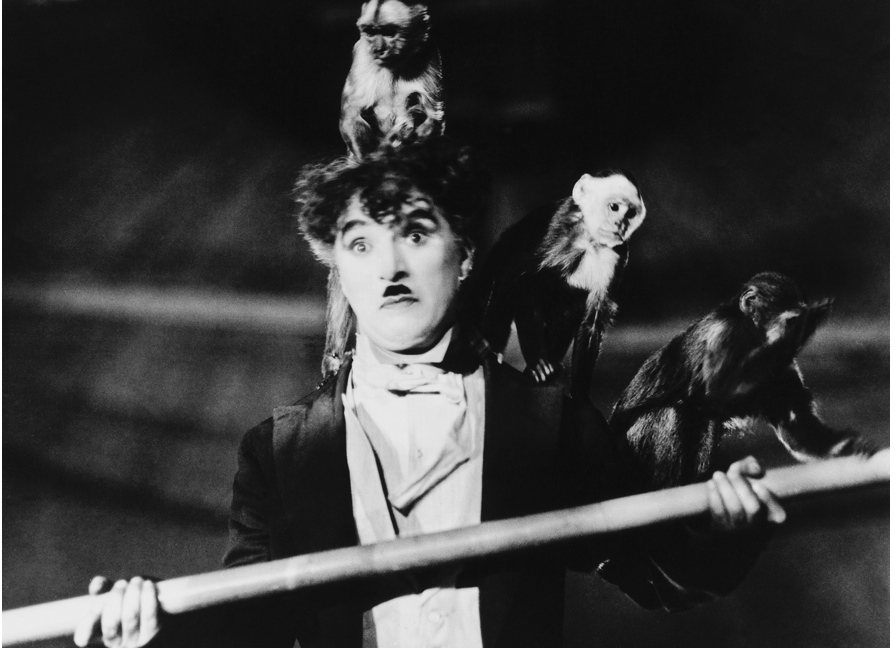
The Circus has one of the most powerful endings ever put to film. The final silent adventure of one of the greatest movie characters, emphasized by a monumental ending score that reverberates with notes of career triumph and bittersweet acceptance. And so, the Tramp willingly steps aside and looks on as the circus caravan leaves him in its dust. In its wake, the circumference of the big top tent remains indexed at his feet. He stands, turning his back to us, walking out of the circle traced in dirt. Heading toward the highway, the iris of the camera tightens around Chaplin’s Tramp, the viewer’s gaze begging the Tramp to stay, ironically closing the world around him until there’s no room for him either. We’re not ready for him to disappear, but he takes his leave anyway. He doesn’t look back. The circus, the cinema goes on without the Tramp, without Chaplin. But this is hardly the last time we’ll be hearing from the greatest clown who ever lived. In fact, the next time will be the first.
4/16: Tommaso (2019, Abel Ferrara); Classe tous risques(1960, Claude Sautet)
I’m so glad there’s someone like Abel Ferrara out there who’s making movies like Tommaso. It’s weird, it’s autobiographical, it’s meandering, he and Willem Dafoe are an unstoppable force that I’ve become enamored by ever since watching New Rose Hotel in Film Noir and the Western. I don’t have particularly strong or rehearsed feelings about Tommaso, but I like that it exists. I like that I don’t know exactly how to feel about it.
I did not expect Classe tous risques to be as big of a drag as it was. I went in for Jean-Paul Belmondo and came away with him as the sole highlight. Toward the beginning of the film, Lino Ventura’s character watches his wife get gunned down by the police in front of him and not once do you believe that was something he, in fact, witnessed. Once Belmondo is introduced, his magnetic charm and lovable boyishness redeem an otherwise middle-of-the-road genre film.
4/17: Nostalghia(1983, Andrei Tarkovsky)
I can only describe watching Nostalghia on a big screen as a religious experience. It’s the type of two-hour film that feels like four and is all the better for it. Tarkovsky envisions nostalgia as an otherworld that entraps all desires, at once a landscape literal and wholly internal. Anytime there will be a Tarkovsky playing in theaters, I will be there.
4/22: Elevator to the Gallows(1958, Louis Malle)
This was a film I was so excited to be able to watch for the first time in a theater—my first time at Metrograph. However, after all the years of waiting to watch it, it was just fine. Nonetheless, the ending scene with Jeanne Moreau in the dark room really saved an otherwise mediocre addition to the canon of film noir. The score by Miles Davis—created by him essentially just riffing over the final cut of the film—is powerful in its tendency toward letting silence be silent. Like Classe tous risques, I can appreciate its impact on cinema and on the specific films it would help usher in that I enjoy watching and discussing much more. Feelings aside, there needs to exist a supercut of scenes in which Jeanne Moreau is wandering and pouting her way through modern European cities. She’s the best to ever do it. I love her. It’s about time I rewatch La Notte.
4/23: Cloverfield(2008, Matt Reeves)
Cloverfield rules. The concept of having the entire movie exist as on a single videotape is my kind of thing. Having the monster attack be recorded on top of previously shot footage of a romantic Coney Island day between two friends-to-lovers is an incredibly inventive way to establish character and introduce “flashbacks” as these accidental, unannounced formal intrusions, plus it’s just a beautiful, succinct way to bookend this movie.
4/27: The Visit(2015, M. Night Shyamalan)
I liked The Visit, but it suffers from the same problems I have with his other movies that I’ve watched over the past couple months. He cannot help himself but to overexplain his symbolism and metaphors. For example, in the climax between the two siblings and the escaped-asylum-inmates-turned-grandparent-imposters, brother and sister and husband and wife are separated. The germaphobe, OCD boy gets a shitty diaper slapped in his face, which is hilarious and shocking and disgusting, but I immediately knew that it would obviously cut back to his sister being terrorized upstairs and have her face her fear of the mirror. It feels clumsy and heavyhanded, but I don’t necessarily not like it, but it did take me out (not that that’s always a bad thing). And I don’t know what it is but the way Shyamalan directs children is extraordinary and light-years beyond any of his contemporaries. They’re funny without being annoying and feel so natural.
4/28: Monkey Man (2024, Dev Patel)
I went into Monkey Man hearing it wasn’t that great and was a bit of an unfocused, bloated mess, but came out blown away by the world it was able to create. The action was awesome, there were several shots that made me think “wow, I’ve never seen this before,” and Dev Patel’s performance is a strong anchor in his directorial debut. I appreciated the transgender representation brought in through Alpha and the hijra warriors—who are very much a part of Indian culture whether ultranationalists want to acknowledge it or not—which never felt belittling or pandering. They’re there and that’s that. They were interesting, they kicked ass, and that whole section in their temple demonstrates that those left behind or cast aside or forgotten by society at large are those who are best equipped to demonstrate a mode of living outside of or subversive to the accepted order, a new way of life organized around collective care for the (in)visible.
Books and TV Shows
Don Quixote (1605, Miguel de Cervantes, trans. J. M. Cohen)—Currently Reading
The Temptation of Saint Anthony (1874, Gustave Flaubert, trans. Lafcadio Hearn)—Paused
4/10: Klara(2010, Klara Lidén)
This was just some book I saw on one of the bargain shelves outside of the Strand that looked interesting because of its all black front cover (except for the title in white typewritten font in the bottom right corner) and the repetition of weird photographs when I flipped through it. It’s an interesting look into a contemporary Swedish artist that I had never heard of. A good chunk of the book feels a bit like nonsense, but it’s an interesting conceptual framework for a book, at least I haven’t encountered anything like it previously.
The bridge that went over no water, Across from the Sweet Tomatoes On the other side of County Road 95. I ask my mother why there’s a sign with flowers on that corner, As we turn in, She says someone was hit by a car here. At some point another sign went up next to it. I’m sorry That’s all I have to say.
3/3: Planet Waves (1974, Bob Dylan); M3GAN (2022, Gerard Johnstone)
I want there to be a Meg and M3GAN crossover, so they can call it The M3G. Other than that, this movie’s critique of AI is weak as hell. Around the time I watched this movie, I read “Will AI Remember the Days of Slavery?” in the latest issue of e-flux Journal, which raises the much more interesting question of what happens to machines of labor . Popular science fiction almost never highlights this class of artifical intelligence, instead opting to project its technological anxieties onto those that have more domestic uses. The productive robots, the ones that make the robots that will wipe your ass in some la-la land Star Trek future, have already been displacing human labor for decades offscreen. M3GAN ends with what is supposed to be a sinister and cautionary handheld long take of its diegetic version of Alexa, but ends up being ridiculous and obvious. We are not told anything new about the further encroachment of AI into human life. To go off of Mudede’s convincingly argued point in his article, supply-side machines turning against mankind in some sort of sci-fi, Y2K singularity event would be leaps and bounds more terrifying and have much more dire consequences far beyond the more commonplace what-if-Roomba-was-evil.
3/4: Heat (1995, Michael Mann)*; The Dark Knight (2008, Christopher Nolan)*; The Batman (2022, Matt Reeves)*
I really spent nine hours watching movies and every single one was a rewatch. Heat is one of the best movies ever. The Dark Knight is too long and is boring and when you’ve outgrown liking Batman, it’s just a movie that’s way too long with insane politics. Not saying anything new there. The Batman just fucking sucks. This is the first time I’ve seen it since its theatrical release: I was lukewarm toward it then, but it’s downright horrible to me now. Firstly, the characters are almost unanimously miscast across the board, aside from maybe Penguin and Catwoman. Robert Pattinson is okay, Andy Serkis is a horrible Alfred, Paul Dano is poorly directed, Jon Turturro is flat and not credible, Jeffery Wright only ever says, “What are you saying?” or “What does that mean?” over and over, and the needle has swung toward “hard pass” on the question of Barry Keoghan Joker. Stylistically, the overuse of shallow/rack focus in this movie and any other still irritates me, but whatever I get it, no one knows what’s going on in the movie, so I guess I’m not allowed to see what the fuck is going on either. Just a really obnoxious bokeh effect going on. Seems like a waste of the Gothic architecture (shooting on location in London was kinda genius). The Batman feels like it crafted a world where you can believe superheroes and supervillains exist, but the characters do not fill the shoes. The ending is still laughably corny and I still firmly believe that Bruce giving up the mantle of Batman to be with Catwoman would have saved the movie for me. That seems like the best thing that could’ve happened after he finds out that he and the Riddler are the same, motivated by vengeance. I don’t care, it’s a stupid movie, it’s not for me, I don’t like cape shit anymore.
3/5: Dune (2021, Denis Villeneuve)*; The Beekeeper (2024, David Ayer)
I want to like Kurt Wimmer, but Equilibrium and The Beekeeper are just bad scripts. Before its release, this movie struck me as a weird QAnon, one-man-army fantasy, but it had Jason Statham, so I had to see it. Nothing much of mention here aside from Josh Hutcherson giving a fun and memorable performance as a slimy loser failson.
3/8: Kung Fu Panda 4(2024, Mike Mitchell)
It seems extremely fitting, bordering on almost self-aware, that the villain of the unnecessary sequel to the Kung Fu Panda trilogy, which resurrects all the series’ past villains, is a chameleon. My problems with this one are the same as with the second: underdeveloped villain played by a legendary actor. But, Ian McShane as Tai Lung still hits so hard.
3/10: This Is Me… Now (2024, Dave Meyers); Hail to the Thief (2003, Radiohead); Crank (2006, Mark Neveldine and Brian Taylor)
Radiohead is still on fool’s notice ever since I listened to Hail to the Thief. Did not enjoy a single song and then was surprised when I heard one I sounded promising to me, but turns out that was the last song right before the album ended. Made me really reflect on how I feel about the band. Kind of annoy me, but Amnesiac is still great. At some point in the near future, I’ll keep the chronological discography deep dive going.
How have I never seen Crank until this point? It has everything I like: Jason Statham, shitty digital video(tape) cinematography, a playful post-end-of-cinema nihilism, and liberal use of slurs. A man who cannot stop or he’ll die surmises the affect of living in the aftermath of the Digital/Neoliberal Revolution. One of the greatest movies in my mind. Will be writing more on it in the future: the ending fall from the helicopter as Hito Steyerl’s vertical perspective.
3/12: Crank: High Voltage (2009, Mark Neveldine and Brian Taylor); Hancock (2008, Peter Berg); Inside Man (2006, Spike Lee)
Inside Man was a fun watch—Clive Owen captivates your attention in every scene and the heist unfolds masterfully—but something about it feels off. The film wraps up almost too neatly. It’s too clever. Can’t put my finger on it. I watched this based on recommendation from Todd McGowan’s discussion with Anna Kornbluh on her new Immediacy book that I need to read still, in which they believe this film to be the point after which Spike Lee’s artistic output began to take a nosedive.
3/18: Ring (1998, Hideo Nakata)
I do not care how beloved or influential it is, this movie is bad. I like it, but it’s just not good. We only find out at the very final scene that if you just double it and give it to the next person, you can save yourself from the videotape’s curse. It’s randomly revealed that the husband is apparently psychic just like the girl from the tape. With an admittedly small sample size to pull from, J-horror films are a mess oftentimes, and sometimes it works and sometimes it doesn’t. They present images and scenarios quite unlike anything you’ve ever seen before but in such a clunky way. An approach to horror that confounds and depresses rather than frightens. There’s something to be said about the videotape freezing its victims within the frame of the film (a thoroughly filmic convention), this movie being shot on film yet meditating heavily on video, and how that relates to film and its relationship to video. I’ll think about it and maybe come back to write down my thoughts. People who engage with video are punished filmically? Yeah, no, I don’t know.
3/20: The Zone of Interest (2023, Jonathan Glazer)
An incredibly powerful ending that wonderfully concludes this one-hundred-minute long conceptual experiment. Höss pauses at the threshold of darkness; workers preserving the artifacts from the greatest human atrocity; he starts down the stairs again, his descent into Hell. I loved the abstract color fields and overtures dispersed throughout. Zone of Interest is just a precisely, masterfully constructed work of art all around. It employs its digital dullness to underscore the already uneasy, nauseating effect that Glazer and sound designer Johnnie Burn worked to create. Really, really great. I’m Jonathan’s glazer.
3/21: Cure (1997, Kiyoshi Kurosawa); Civil War (2024, Alex Garland)
A film I had been dying to see for years—ever since watching Pulse, one of my favorites—but could not find a copy online, was playing at Film Forum. I was so excited to be able to watch it in a theater setting, but I was fighting a losing battle with sleep. And now, I don’t go out to watch movies at night anymore. Can’t really say much about it because I was drifting in and out during the middle section. Goddammit.
Civil War is a laughably terrible movie that makes me question whether Ex Machina is actually that great of a movie. The actors are asleep as they deliver some of the most heinous dialogue in recent memory. And so, unsurprisingly, this movie is incredibly boring and has nothing to say about the ethics of war photography or what it means to make movies in the political climate of 2020s America. Then, Civil War shifts from a plodding, boring piece of shit into a sludgy, washed out video game as the Western Forces somehow overpower the National Guard and storm the White House and successfully kill President Nick Offerman, but not before Kirsten Dunst’s character dies in one of the lamest and funniest ways imaginable. I was able to see this trash before it was officially released in the US because of an early screening held by the owner of the theater I work at, which turned out to be the best way to watch it, crying from laughter alongside my coworkers as Stephen McKinley Henderson dramatically bleeds out in the backseat of a car amidst a swarm of embers or when Wagner Moura silently screams for the camera once his colleague kicks the bucket after arriving at the military encampment. How did people like this? Jesse Plemons is the only shred of anything redeemable or worth salvaging, as his one scene is legitimately unnerving and suspenseful. At least, we can rest easy knowing that Alex Garland won’t be putting his grubby British fingers on a camera anytime soon, or so he says.
3/22: Mike Recine: I’m Normal (2024, Jason Katz)
3/25: Everything Sucks (1996, Descendents); Pure Mania (1977, The Vibrators); Taxi Driver (1976, Martin Scorsese)*
Descendents make punk rock for nice guys, and I love it. In terms of early British punk, the Vibrators do not have the same penchant for memorable hits as the Sex Pistols or the Buzzcocks. “Into the Future…” stays on the rotation though, such a catchy song. Other than that, most of the rest of the album was just alright.
I have never heard anything quite like FKA twigs. It’s erotic, it’s arrhythmic, it’s melancholic, it’s ambient, it’s dance. The music video for “Papi Pacify” is stunning. (Steven Shaviro of all people finally got me to give her music a listen.) “Two Weeks” is my favorite track from these three projects, I think.
3/28:Welcome to New York (2014, Abel Ferrara)
3/29: M3LL155X(2015, FKA twigs)
3/30: Snatch(2000, Guy Ritchie)
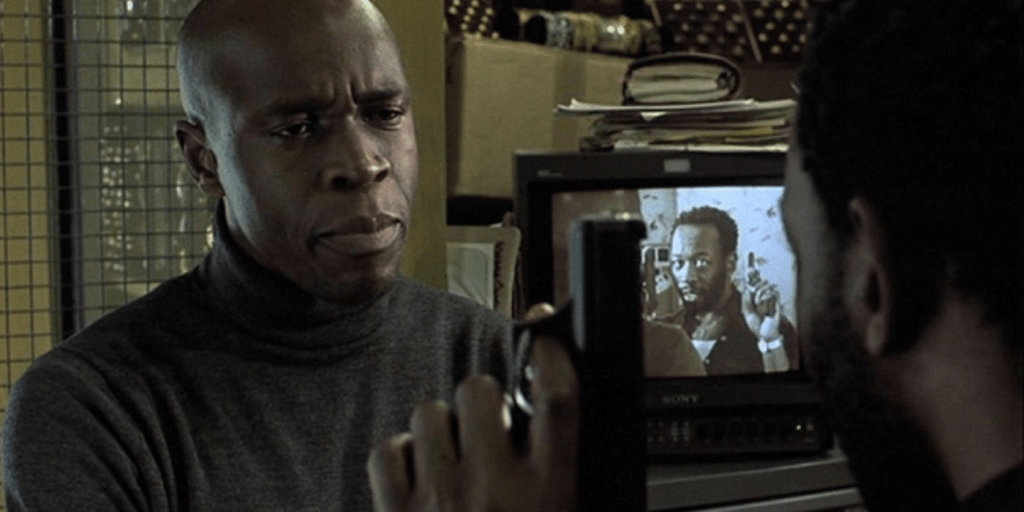
Creating a two shot by framing the second character in closeup on a CCTV monitor placed behind the first character is absolutely genius. The hyperbolized, stylistic, and kinetic editing juxtaposes the relatively slow pacing of the story—moving fast but going nowhere, perhaps? A lot happens but the film doesn’t feel like it goes anywhere, like running in place. It didn’t seem like the film really commented on the “end of cinema” trend going on at the turn of the century. Ritchie jumps between film and video aesthetics without any judgment. Ritchie has the frame doing somersaults and barrel rolls, allowing the viewer to see the frame as nothing but surface, even if it is filmic with a material basis. It can’t stay that way. The film entitles itself with such a gesture. Video is just one more toy to play with in the sandbox of the moving image; however, Ritchie is clearly aware of the implications of the former toward surveillance and how this top-down digitization of the gaze does not affect everyone equally. For example, the heist in the beginning sees the crew pretend to be Hassids, where they shed off these identities as quickly as they adopted them. Ironically, they steal the diamond MacGuffin from real Jews. They are successful in the robbery because to them everything is just an appearance to be shed off. Any criticisms of this film as “style over substance” completely misunderstand or fail to take into account the larger era of cinema and its fraught relationship with video, and what video signaled socially, culturally, cinematically. Ritchie depicts it masterfully. And so, to prove this, Ritchie sees the two Black criminals pulled over and caught with a dead body in their trunk. Surveillance doesn’t so much have blind spots as it has its specific targets. Video brings everything to the surface. That is, until it doesn’t. After managing to get their revenge and getting paid handsomely for it in the final boxing match, the pikeys go into hiding and disappear: to set up camp somewhere else. Ritchie illustrates that there are still avenues by which to subvert the surveillance state. The film, through Turkish, introduces all the players and their motivations and backstories at the outset; the audience is situated like the surveillance apparatus, yet even then, we (like the English characters in the film) do not foresee the scheme laid out by the pikey Irish Travellers until it’s already been pulled off. In the near future, I’m super excited to go back and watch Lock, Stock and Two Smoking Barrels and rewatch Snatch. I think I’m onto something here.
3/31: Animal (Expanded Edition) (2010, Kesha)
It felt so gay to walk down the street at night listening to “Boots and Boys,” but in the best way possible. This album is so good. Maybe the 2010s weren’t all bad.
Books and TV Shows
Don Quixote (1605, Miguel de Cervantes, trans. J. M. Cohen)—Currently Reading
3/23–25: Death of a Salesman (1949, Arthur Miller)
3/26: The Temptation of Saint Anthony (1874, Gustave Flaubert, trans. Lafcadio Hearn)—Started
I’m back on my monk shit.
3/26: The Sayings of the Desert Fathers: The Alphabetical Collection (1975, trans. Benedicta Ward)—”Foreword,” “Translator’s Preface,” “Prologue,” “Anthony the Great”
I repeat: the St. Anthony phase is not over. I don’t know exactly what yet, but I’m researching for something.


 videophage.com