
Albums and Movies
3/1: Dan Soder: On the Road (2024, Mike Lavin)
3/3: Planet Waves (1974, Bob Dylan); M3GAN (2022, Gerard Johnstone)
I want there to be a Meg and M3GAN crossover, so they can call it The M3G. Other than that, this movie’s critique of AI is weak as hell. Around the time I watched this movie, I read “Will AI Remember the Days of Slavery?” in the latest issue of e-flux Journal, which raises the much more interesting question of what happens to machines of labor. Popular science fiction almost never highlights this class of artifical intelligence, instead opting to project its technological anxieties onto those that have more domestic uses. The productive robots, the ones that make the robots that will wipe your ass in some la-la land Star Trek future, have already been displacing human labor for decades offscreen. M3GAN ends with what is supposed to be a sinister and cautionary handheld long take of its diegetic version of Alexa, but ends up being ridiculous and obvious. We are not told anything new about the further encroachment of AI into human life. To go off of Mudede’s convincingly argued point in his article, supply-side machines turning against mankind in some sort of sci-fi, Y2K singularity event would be leaps and bounds more terrifying and have much more dire consequences far beyond the more commonplace what-if-Roomba-was-evil.
3/4: Heat (1995, Michael Mann)*; The Dark Knight (2008, Christopher Nolan)*; The Batman (2022, Matt Reeves)*
I really spent nine hours watching movies and every single one was a rewatch. Heat is one of the best movies ever. The Dark Knight is too long and is boring and when you’ve outgrown liking Batman, it’s just a movie that’s way too long with insane politics. Not saying anything new there. The Batman just fucking sucks. This is the first time I’ve seen it since its theatrical release: I was lukewarm toward it then, but it’s downright horrible to me now. Firstly, the characters are almost unanimously miscast across the board, aside from maybe Penguin and Catwoman. Robert Pattinson is okay, Andy Serkis is a horrible Alfred, Paul Dano is poorly directed, Jon Turturro is flat and not credible, Jeffery Wright only ever says, “What are you saying?” or “What does that mean?” over and over, and the needle has swung toward “hard pass” on the question of Barry Keoghan Joker. Stylistically, the overuse of shallow/rack focus in this movie and any other still irritates me, but whatever I get it, no one knows what’s going on in the movie, so I guess I’m not allowed to see what the fuck is going on either. Just a really obnoxious bokeh effect going on. Seems like a waste of the Gothic architecture (shooting on location in London was kinda genius). The Batman feels like it crafted a world where you can believe superheroes and supervillains exist, but the characters do not fill the shoes. The ending is still laughably corny and I still firmly believe that Bruce giving up the mantle of Batman to be with Catwoman would have saved the movie for me. That seems like the best thing that could’ve happened after he finds out that he and the Riddler are the same, motivated by vengeance. I don’t care, it’s a stupid movie, it’s not for me, I don’t like cape shit anymore.
3/5: Dune (2021, Denis Villeneuve)*; The Beekeeper (2024, David Ayer)
I want to like Kurt Wimmer, but Equilibrium and The Beekeeper are just bad scripts. Before its release, this movie struck me as a weird QAnon, one-man-army fantasy, but it had Jason Statham, so I had to see it. Nothing much of mention here aside from Josh Hutcherson giving a fun and memorable performance as a slimy loser failson.
3/8: Kung Fu Panda 4 (2024, Mike Mitchell)
It seems extremely fitting, bordering on almost self-aware, that the villain of the unnecessary sequel to the Kung Fu Panda trilogy, which resurrects all the series’ past villains, is a chameleon. My problems with this one are the same as with the second: underdeveloped villain played by a legendary actor. But, Ian McShane as Tai Lung still hits so hard.
3/10: This Is Me… Now (2024, Dave Meyers); Hail to the Thief (2003, Radiohead); Crank (2006, Mark Neveldine and Brian Taylor)
Radiohead is still on fool’s notice ever since I listened to Hail to the Thief. Did not enjoy a single song and then was surprised when I heard one I sounded promising to me, but turns out that was the last song right before the album ended. Made me really reflect on how I feel about the band. Kind of annoy me, but Amnesiac is still great. At some point in the near future, I’ll keep the chronological discography deep dive going.
How have I never seen Crank until this point? It has everything I like: Jason Statham, shitty digital video(tape) cinematography, a playful post-end-of-cinema nihilism, and liberal use of slurs. A man who cannot stop or he’ll die surmises the affect of living in the aftermath of the Digital/Neoliberal Revolution. One of the greatest movies in my mind. Will be writing more on it in the future: the ending fall from the helicopter as Hito Steyerl’s vertical perspective.
3/12: Crank: High Voltage (2009, Mark Neveldine and Brian Taylor); Hancock (2008, Peter Berg); Inside Man (2006, Spike Lee)
Inside Man was a fun watch—Clive Owen captivates your attention in every scene and the heist unfolds masterfully—but something about it feels off. The film wraps up almost too neatly. It’s too clever. Can’t put my finger on it. I watched this based on recommendation from Todd McGowan’s discussion with Anna Kornbluh on her new Immediacy book that I need to read still, in which they believe this film to be the point after which Spike Lee’s artistic output began to take a nosedive.
3/18: Ring (1998, Hideo Nakata)
I do not care how beloved or influential it is, this movie is bad. I like it, but it’s just not good. We only find out at the very final scene that if you just double it and give it to the next person, you can save yourself from the videotape’s curse. It’s randomly revealed that the husband is apparently psychic just like the girl from the tape. With an admittedly small sample size to pull from, J-horror films are a mess oftentimes, and sometimes it works and sometimes it doesn’t. They present images and scenarios quite unlike anything you’ve ever seen before but in such a clunky way. An approach to horror that confounds and depresses rather than frightens. There’s something to be said about the videotape freezing its victims within the frame of the film (a thoroughly filmic convention), this movie being shot on film yet meditating heavily on video, and how that relates to film and its relationship to video. I’ll think about it and maybe come back to write down my thoughts. People who engage with video are punished filmically? Yeah, no, I don’t know.
3/20: The Zone of Interest (2023, Jonathan Glazer)
An incredibly powerful ending that wonderfully concludes this one-hundred-minute long conceptual experiment. Höss pauses at the threshold of darkness; workers preserving the artifacts from the greatest human atrocity; he starts down the stairs again, his descent into Hell. I loved the abstract color fields and overtures dispersed throughout. Zone of Interest is just a precisely, masterfully constructed work of art all around. It employs its digital dullness to underscore the already uneasy, nauseating effect that Glazer and sound designer Johnnie Burn worked to create. Really, really great. I’m Jonathan’s glazer.
3/21: Cure (1997, Kiyoshi Kurosawa); Civil War (2024, Alex Garland)
A film I had been dying to see for years—ever since watching Pulse, one of my favorites—but could not find a copy online, was playing at Film Forum. I was so excited to be able to watch it in a theater setting, but I was fighting a losing battle with sleep. And now, I don’t go out to watch movies at night anymore. Can’t really say much about it because I was drifting in and out during the middle section. Goddammit.
Civil War is a laughably terrible movie that makes me question whether Ex Machina is actually that great of a movie. The actors are asleep as they deliver some of the most heinous dialogue in recent memory. And so, unsurprisingly, this movie is incredibly boring and has nothing to say about the ethics of war photography or what it means to make movies in the political climate of 2020s America. Then, Civil War shifts from a plodding, boring piece of shit into a sludgy, washed out video game as the Western Forces somehow overpower the National Guard and storm the White House and successfully kill President Nick Offerman, but not before Kirsten Dunst’s character dies in one of the lamest and funniest ways imaginable. I was able to see this trash before it was officially released in the US because of an early screening held by the owner of the theater I work at, which turned out to be the best way to watch it, crying from laughter alongside my coworkers as Stephen McKinley Henderson dramatically bleeds out in the backseat of a car amidst a swarm of embers or when Wagner Moura silently screams for the camera once his colleague kicks the bucket after arriving at the military encampment. How did people like this? Jesse Plemons is the only shred of anything redeemable or worth salvaging, as his one scene is legitimately unnerving and suspenseful. At least, we can rest easy knowing that Alex Garland won’t be putting his grubby British fingers on a camera anytime soon, or so he says.
3/22: Mike Recine: I’m Normal (2024, Jason Katz)
3/25: Everything Sucks (1996, Descendents); Pure Mania (1977, The Vibrators); Taxi Driver (1976, Martin Scorsese)*
Descendents make punk rock for nice guys, and I love it. In terms of early British punk, the Vibrators do not have the same penchant for memorable hits as the Sex Pistols or the Buzzcocks. “Into the Future…” stays on the rotation though, such a catchy song. Other than that, most of the rest of the album was just alright.
3/26: Training Day (2001, Antoine Fuqua)
3/27: LP1 (2014, FKA twigs); EP1 (2012, FKA twigs); EP2 (2013, FKA twigs)
I have never heard anything quite like FKA twigs. It’s erotic, it’s arrhythmic, it’s melancholic, it’s ambient, it’s dance. The music video for “Papi Pacify” is stunning. (Steven Shaviro of all people finally got me to give her music a listen.) “Two Weeks” is my favorite track from these three projects, I think.
3/28: Welcome to New York (2014, Abel Ferrara)
3/29: M3LL155X (2015, FKA twigs)
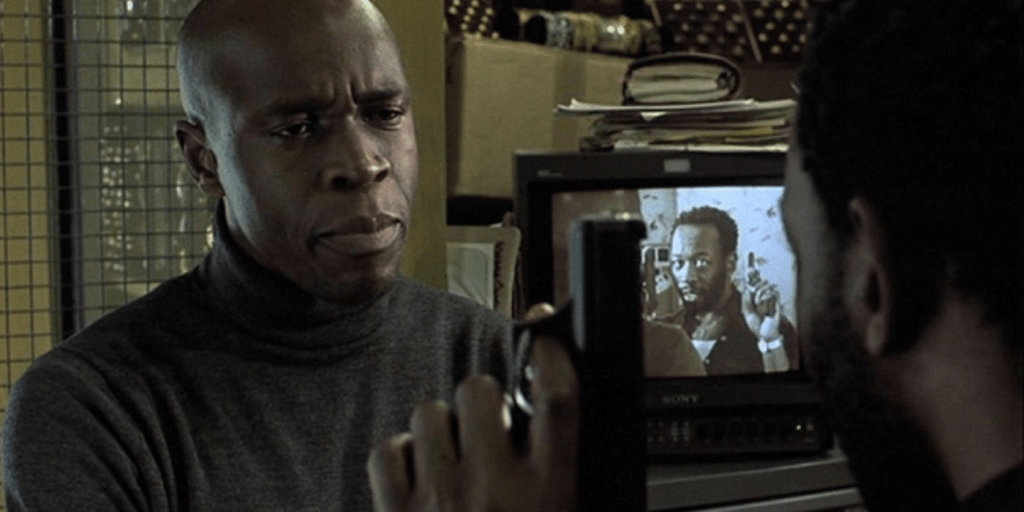
3/30: Snatch (2000, Guy Ritchie)
Creating a two shot by framing the second character in closeup on a CCTV monitor placed behind the first character is absolutely genius. The hyperbolized, stylistic, and kinetic editing juxtaposes the relatively slow pacing of the story—moving fast but going nowhere, perhaps? A lot happens but the film doesn’t feel like it goes anywhere, like running in place. It didn’t seem like the film really commented on the “end of cinema” trend going on at the turn of the century. Ritchie jumps between film and video aesthetics without any judgment. Ritchie has the frame doing somersaults and barrel rolls, allowing the viewer to see the frame as nothing but surface, even if it is filmic with a material basis. It can’t stay that way. The film entitles itself with such a gesture. Video is just one more toy to play with in the sandbox of the moving image; however, Ritchie is clearly aware of the implications of the former toward surveillance and how this top-down digitization of the gaze does not affect everyone equally. For example, the heist in the beginning sees the crew pretend to be Hassids, where they shed off these identities as quickly as they adopted them. Ironically, they steal the diamond MacGuffin from real Jews. They are successful in the robbery because to them everything is just an appearance to be shed off. Any criticisms of this film as “style over substance” completely misunderstand or fail to take into account the larger era of cinema and its fraught relationship with video, and what video signaled socially, culturally, cinematically. Ritchie depicts it masterfully. And so, to prove this, Ritchie sees the two Black criminals pulled over and caught with a dead body in their trunk. Surveillance doesn’t so much have blind spots as it has its specific targets. Video brings everything to the surface. That is, until it doesn’t. After managing to get their revenge and getting paid handsomely for it in the final boxing match, the pikeys go into hiding and disappear: to set up camp somewhere else. Ritchie illustrates that there are still avenues by which to subvert the surveillance state. The film, through Turkish, introduces all the players and their motivations and backstories at the outset; the audience is situated like the surveillance apparatus, yet even then, we (like the English characters in the film) do not foresee the scheme laid out by the pikey Irish Travellers until it’s already been pulled off. In the near future, I’m super excited to go back and watch Lock, Stock and Two Smoking Barrels and rewatch Snatch. I think I’m onto something here.
3/31: Animal (Expanded Edition) (2010, Kesha)
It felt so gay to walk down the street at night listening to “Boots and Boys,” but in the best way possible. This album is so good. Maybe the 2010s weren’t all bad.
Books and TV Shows
Don Quixote (1605, Miguel de Cervantes, trans. J. M. Cohen)—Currently Reading
3/23–25: Death of a Salesman (1949, Arthur Miller)
3/26: The Temptation of Saint Anthony (1874, Gustave Flaubert, trans. Lafcadio Hearn)—Started
I’m back on my monk shit.
3/26: The Sayings of the Desert Fathers: The Alphabetical Collection (1975, trans. Benedicta Ward)—”Foreword,” “Translator’s Preface,” “Prologue,” “Anthony the Great”
I repeat: the St. Anthony phase is not over. I don’t know exactly what yet, but I’m researching for something.
Note: * indicates a rewatch, relisten, or reread


Leave a Reply