
Albums and Movies
5/1: Problemista (2023, Julio Torres)
First time at Williamsburg Cinemas. I don’t know anything about Julio Torres, but thinking back on this debut, he seems pretty annoying. When I was watching it, I could mostly stomach his and Tilda Swinton’s quirky and grating humor, but I cannot see myself ever wanting to rewatch Problemista. Something that I would’ve liked to see more of is the figure of the maze—in the form of a staircase of cubicles. It felt more like an afterthought rather than a fleshed out detail of much importance, only appearing twice. On the other hand, I did like how the movie showcased what it’s like to live in Bushwick and turning to Craigslist, personified as some queer deity, during desperate times. When all is said and done, this movie did get me to ride the Roosevelt Island tram, which was cool.
5/2: Places and Spaces (1975, Donald Byrd)
Recommended by a friend. Yeah, jazz-funk fucking rips. Everyone say, “thank you, black people.”
5/3: El Topo (1970, Alejandro Jodorowsky); The Darktown Revue (1931, Oscar Micheaux); Body and Soul (1925, Oscar Micheaux)
El Topo is an insane film. The lone gunslinger wandering the desert is reborn and accepts his role as a monastic guide for the disenfranchised. Surrealist cinema at its best.
Darktown Revue played before Body and Soul as an accompanying short during Film Forum’s Micheaux retrospective, which sadly was not held over for an extra week, I assume because no one came to watch any of them. His first sound film, Darktown Revue was surprisingly funny, especially given its invocation of minstrelsy, in which a black preacher in blackface delivers a sermon comprised of mostly nonsense. Micheaux always seems to have been a provocateur, criticizing aspects of black culture for breeding complacency amidst poverty, speaking from his perspective as a black homesteader and promoting the upliftment of the individual through hard work and commitment to a craft. While I don’t necessarily agree fully, Micheaux was all about offering alternatives when not many were available.
I could not follow the plot of Body and Soul and even after its “cop-out” ending was still left puzzled. It is revealed that the whole thing was a dream, Paul Robeson’s diabolical reverend character didn’t really kill the dreaming mother’s only daughter, Isabelle. I don’t know if it was established earlier in the film or it’s just one of those Micheaux sudden endings that wraps up everything too neatly right at the very end, but Robeson was playing twin brothers the entire time and Isabelle marries the long-lost sibling, Sylvester. I think? It doesn’t really matter, because I was more invested in Julia Theresa Russell’s performance as Isabelle. She’s beautiful in a demure, waif sort of way. Her eyes seemingly always about to overflow with tears, like a woman burdened by too many secrets, always appearing as if she has just seen a ghost. Every time her face is onscreen, I can’t take my eyes off this woman I’ve never seen before. Herself, a ghost: not much is known about her and she never appeared in another film. There’s something deathly and tragic about her mousy appearance. This must’ve been how Bazin felt about Bogart.
~5/4: Pussy Whipped (1993, Bikini Kill)
Kathleen Hanna’s voice is so attractive.
5/6: Dune: Part Two (2024, Denis Villeneuve); good kid, m.A.A.d city (2012, Kendrick Lamar)
After watching Dune 2, I thought the movie was cool, but it didn’t really make me feel much. Yet, leaving the theater I felt oddly invigorated and confident. So, I’ve come to the conclusion that this movie is crack for average white guys who haven’t achieved anything. I ended up watching it for free at work, after dragging my feet for two months and never going to AMC Lincoln Square to watch it in IMAX 70mm. I just needed to get it over with. I’m tired of seeing Timothée Chalamet and Zendaya everywhere, they just don’t have the sauce that Hollywood is still trying to convince us they have.
I’ve been in a pretty rock heavy phase of music listening for the past year and a half, but this album really brought hip hop back into the fold for me.
5/7: Swing! (1938, Oscar Micheaux); Underworld (1937, Oscar Micheaux); To Pimp a Butterfly (2015, Kendrick Lamar)
Every time a couple of characters would kiss or intimately embrace, Micheaux fades to black before cutting to the next scene. I still don’t know what exactly this could mean in relation to Swing!, but it’s a noteworthy device. No one quite intercuts like Micheaux either, often asking the audience to draw parallels between extensive cabaret numbers and emotionally vulnerable conversations between two characters. Truly the first Black auteur. Really enjoyed this film.
Out of all the Micheaux films I saw at Film Forum during the festival’s week-long run, I would say Underworld might be the most entertaining. Sol Johnson plays the naive pushover who wants to do the right thing expertly, Bee Freeman as the manipulative and conspiring villain steals the show, and ever since I first saw her in Birthright years ago, Ethel Moses has always reminded me of Setsuko Hara. Throw in a gangster plot on top of that with the classic Micheaux last-minute reveal that saves the hero and you got yourself a really fun race film.
I get it now. Kendrick Lamar is a Bob Dylan level talent. His beef with Drake seemed like as good a time as any to finally get around to listening through his albums. “Wesley’s Theory” is the strongest album opener I’ve heard since “Serve the Servants“.
5/8: untitled unmastered. (2016, Kendrick Lamar); DAMN. (2017, Kendrick Lamar); Ten Minutes to Live (1932, Oscar Micheaux)
I liked untitled unmastered. but by the very nature of it, I haven’t gone back to listen to specific tracks, like I have with DAMN. “LUST” is the song I listen to most off the album.
Ten Minutes to Live is definitely a film I need to go back and rewatch, as I feel I would have a lot more thoughts. There’s just so much good stuff going on and my memory is failing me right now.
5/13: The Last of the Mohicans (1992, Michael Mann); The Amazing Spider-Man 2 (2014, Marc Webb)*
First time at Roxy, really liked how moody it was and that it’s only one theater. Saw Last of the Mohicans on 35 with a friend, which was the first time I’ve actually seen a film on film in New York. It was like watching a Romantic painting come to life. We watched the theatrical cut, so this ending did not have Chingachgook’s final monologue, proclaiming that one day there will be no more frontier left and new peoples will come along. While I haven’t seen this scene in full context of the Director’s Definitive Cut, I think it might say too much. I love the tragedy of the last Mohican declaring himself thusly and leaving it at that. In my mind, the rest is unspoken. The breathtaking soundtrack and photography do the rest. My parents were in town visiting me and my dad insisted that I had to accept the invite to go watch The Last of the Mohicans.
Amazing Spider-Man 2 might be my favorite moviegoing experience to date. We flipped a coin, which dictated that we rush to Prospect Park Nitehawk (another first) to miss only the first bit of this movie. Also projected on 35mm (and only finding out after the fact that it was actually shot on that format as well), this film looks incredible. It’s a disaster, but it’s great. I hadn’t seen it since high school probably when I watched it on a laptop or something, back when I knew even less than I did now and watched slop pop-criticism like ScreenJunkies and New Rockstars. The character design of Electro is actually super inventive and his final fight with Spider-Man is insanely creative. And then, on the other hand, Dane DeHaan’s Green Goblin looks repulsive and uninspired and is such a huge miss in a film with such tremendous high points in terms of costume design. I suppose I can applaud trying to do something new across the board. Of course, the scenes with Gwen and Peter have off-the-charts chemistry and you can’t help but smile, as Andrew Garfield and Emma Stone somehow elevate what is mostly trash dialogue. To add, Sally Fields is great as Aunt May and her scenes with Garfield are just as emotional and heartfelt. All around this movie is phenomenonally acted for absolutely no reason. And when you’re not invested in the onscreen tension between love interests, you can laugh alongside everyone else in the theater as a sad Peter Parker puts in earbuds and listens to Philip Philips’s “Gone, Gone, Gone.” This movie is the most comic book movie in every sense, for better and for worse.
5/14: Mr. Morale & the Big Steppers (2022, Kendrick Lamar); Challengers (2024, Luca Guadagnino)
I am not a big Luca Guadagnino fan, but Challengers is the film of his that I’ve enjoyed the most (so far and based on the few I’ve seen). For me, it’s not movie of the year or as awesome as I was promised it to be, but I like it more than I dislike it. However, while not getting me to go out and find a racket and someone to play with, it did inspire me to get a gym membership since every character is insanely in-shape and hot. It actually got me to change something in my life, which is more than I can say for most movies. The acting for the most part was just fine, I’m still not a Zendaya fan and something about Mike Faist’s performance seems off somehow (which maybe I kinda like?), but Josh O’Connor as Patrick was really the highlight of it all.
5/15: Rise of the Planet of the Apes (2011, Rupert Wyatt)*; Dawn of the Planet of the Apes (2014, Matt Reeves)*; War for the Planet of the Apes (2017, Matt Reeves)*
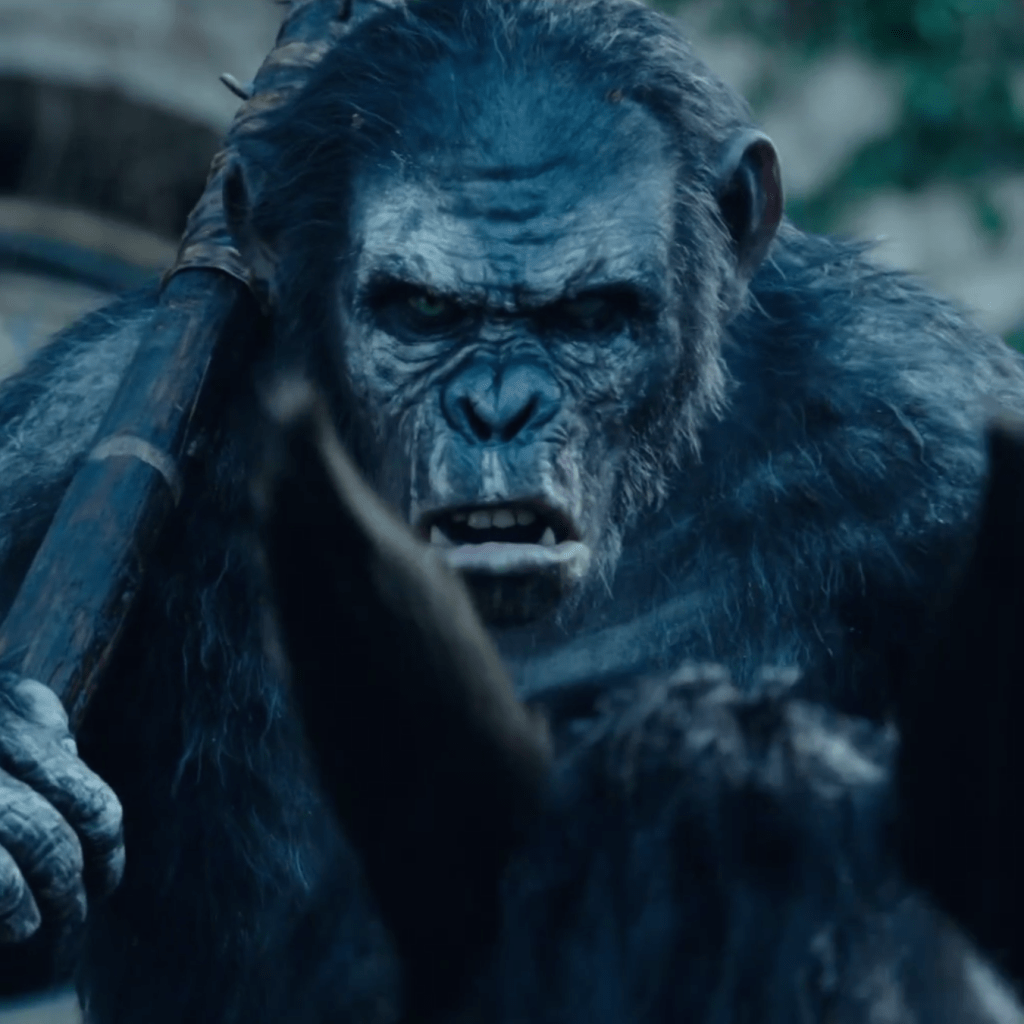
Like the state giving itself the authority to execute who it pleases, Caesar, fittingly named after the one man statesman, unilaterally decides that the only way to unify the fractured ape community, split over the Human Question, is to kill his rival Koba. In doing so, he breaks one of his commandments (“ape shall not kill ape”) by conveniently declaring that Koba is not an ape, for he killed an ape first. By its conclusion, Dawn undoes all the diplomatic undertakings instigated by the Jason Clarke character toward Caesar and the apes. Caesar has the opportunity to try the diplomatic approach ape-to-ape, but it’s never even considered. Caesar doesn’t seem to learn anything and I wish this hypocrisy would’ve been explored more in War, or Kingdom for that matter. I do really enjoy the tortured king who has to do what he must (and Serkis kills it), but this ending severely undercuts what could’ve been a much more bold and groundbreaking characterization in my eyes. It’s nothing new to say that post-apocalyptic stories in their imagining of a world beyond the human end up recreating the same conditions that led to catastrophe, building back the same society with the same inequities in a world where it’s already been proven that all rules are off and new modes of living could now be explored, ones more sustainable and decent for everyone. Yet, it seems that even genetically enhanced apes still have too much human nature in them. Interestingly, Dawn posits digital technologies as perhaps the one tool above all which defines the modern human. When Malcolm’s group gets the dam up and running and power is returned back at the settlement, Dreyfus’s iPad turns on and he finds family photos. This technology serves as an extension of his memory, unlocking that which he has repressed. The same applies to Caesar. Returning to his childhood home from Rise, he returns to his former attic sanctuary, where he finds a video camera that had documented a touching moment between human father and ape son. (Side note: Reeves seems pretty preoccupied with having characters and the audience watch events through the mechanism of video: Batman looking through Catwoman’s eyes via contact lenses, the entire structure of Cloverfield, plus Dreyfus and Caesar here.) So, it would seem that Caesar accepts his humanity, as it were, yet still decides to kill Koba. He urges the apes to forgive Malcolm’s group’s transgressions and calls him a good man worthy of his trust. So, why doesn’t he take that same attitude and try to negotiate with the human-hating Koba, his friend and officer?
War might be my favorite of the trilogy. It’s really fun how this series became these neat genre pieces once Reeves took over: Dawn, a war movie, and War, a prison escape movie. I think that speaks to how strong and open-ended a template Rise is—a reputable first entry that would allow one to take the series in any number of directions. Woody Harrelson is better than I initially remembered and gave him credit for. Steve Zahn puts his heart and soul into playing Bad Ape. I wish actors scrambled to play mocap suit monkeys the way they pledge allegiance to the slowly deteriorating Marvel empire.
5/17: Kingdom of the Planet of the Apes (2024, Wes Ball)
I didn’t want to have to say it, but this one is a dud. Wes Ball just does not have it. The opening sequence is trying to hard to be Avatar 2 (of which I am not a fan), fully immersing you in this sublime computer imagery, but it’s just boring and goes on for way too long. Kingdom has plenty of interesting ideas that it never expands on: it squanders its already lengthy runtime. Proximus trying to break into the fallout bunker, William H. Macy as a (criminally underused) academic or historian that educates Proximus about humanity’s heyday, and the different interpretations of Caesar’s teachings and actions are all good ideas that never go anywhere, and then, the movie ends. That being said, I am interested to see more from this next trilogy and the wonderful Kevin Durand.
5/19: Blood on the Tracks (1975, Bob Dylan)
I’d heard over and over that this is classic Dylan (on top of his game, return to form, etc., etc.) and as the album progressed that assessment became increasingly apparent. “Lily, Rosemary and the Jack of Hearts” still runs through my head.
5/24: The Amazing Spider-Man (2012, Marc Webb)*; Pass the Distance (1971, Simon Finn); Spider-Man (2002, Sam Raimi)*
With his Amazing Spider-Man series, Webb turns a hero that could be anyone into a hero that can only be one. In doing so, the hero’s journey is transformed into one big conspiracy. Peter’s father introduced his blood into the super spiders, making his son the only viably possible candidate for Spider-Man. I don’t know if I like or dislike this change. I’d probably like it more if it was executed better, that is, the idea that Peter never really had as big a choice as Tobey Maguire Spider-Man. His decision to become Spider-Man is less meritorious maybe, but it also further deifies him even more than the myth of the exceptional individual at the basis of all superhero movies. I don’t know it that makes sense. This movie is just kinda bland anyway. Like comic book movies new and old, anyone who tries to expose the corruption and contradictions of civilized society must be a homicidal maniac. Doc Ock, the Lizard, Reeves’s Riddler, Nolan’s Joker, etc. Connors wants to imagine a world where everyone is equal, which gets twisted into he wants everyone to be a lizard. Like Doc Ock in Spider-Man 2, curing ills becomes about achieving perfection, some perverted form of it. (Perhaps, perfection is always perverted?) Either way, it’s a straw man of any vaguely egalitarian perspective.
First introduced to “Jerusalem” years ago, thanks to the Spotify algorithm, I finally took the time to give the entire album a listen. Already having listened to its high point, the rest still has the same frantic and mescaline sound that “Jerusalem” takes to the extreme. Pass the Distance sounds like a nervous breakdown, you can practically hear Finn writhing on the floor as he wails and groans in anguish, passing through every stage of grief before your ears.
5/27: 24 Hour Party People (2002, Michael Winterbottom)
I love that 24 Hour Party People affirms how digital video allows one to insert oneself into history and control its flows, rendering history an open spacetime of play and possibility. Steve Coogan is undeniable as Tony Wilson, and so is Andy Serkis as Martin Hannett. A two-hour experiment in mythmaking that feels even longer, but you don’t want it to end.
5/30: Spider-Man 2.1 (2004, Sam Raimi)*; Spider-Man 3 (2007, Sam Raimi)*
Not sure if 2.1 is the version I’ve seen during any of my several watches, but I’ll still mark it as a rewatch. The last time I watched the Raimi Spider-Mans in high school, the first ended up being my favorite, but the second easily sweeps it this time around. It rises above the rest of its comic book ilk, despite having all the same not-so-unconscious political prescriptions and blockbuster format. Allegorizing the ideological workings of the blockbuster, ever wary of abstraction, Doc Ock tells Peter, “Nothing is as bad as uncertainty.” Additionally, the nuclear mad scientist only wanted to provide clean, cheap electricity for the entire planet, before he goes crazy. (Norman Osborne, on the other hand, was creating expressly military technology before his powers got the best of his psyche.) But even, then he doesn’t simply go from a noble cause to a homicidal one: under the influence of the AI metal arms, he wants to try again, this time on a larger scale. It becomes two exceptional individuals taking it into their own hands whether to pull the plug on a world-changing event. An event, mind you, that could cause the earth to collapse into itself. Spider-Man thwarts Doc Ock’s all-consuming force of nature by revealing his identity and appealing to his humanity; however, the blockbuster’s exploitation of gravity is not so easily dispatched. Doc Ock isn’t lying when he says he can’t stop it. And so, he sinks his miniature sun by dragging it to the bottom of the ocean, gravity succumbs to gravity. Is this a way out or merely fantasy? Working within the blockbuster framework, Raimi delivers a film that questions its very phenomenological foundation, all the while delivering an impeccable story and touching character moments. Yeah, the fixation on personal choice and responsibility is incredibly par for the course in the New Hollywood blockbuster, but it’s a great movie nonetheless. I love the moments between Peter and Aunt May. It’s genuinely heartbreaking when she gives him money for his birthday even after Peter finds out she is behind on her mortgage payments, or when she thanks him for finally telling the truth about not stopping Uncle Ben’s murderer. Not only is his aunt (or very much reminds me of my own grandmother) is support system, but the city itself—literally and socially—as perfectly exemplified in the runaway train sequence.
Unfortunately, I just cannot get behind Spider-Man 3. In a little over ten minutes, we’re introduced to three villains and Peter is so annoying. I was already turned off well before they happened, but none of the big emotional moments (e.g., the Sandman stuff, Peter hitting Mary Jane, Harry dying in his friends’ arms) impacted me. Still, it was cool to see the theater I work at onscreen, Peter standing out from under the marquee as he looks up at the very recognizable apartment building across the street, spying Mary Jane through one of the top windows. However, I do like that it ends like all the others plus a little something extra to tie them all together. The first ends with a shot of Peter alone, the second of Mary Jane, the third, the two of them in an embrace.
Books and TV Shows
Don Quixote (1605, Miguel de Cervantes, trans. J. M. Cohen)—Currently Reading
If I don’t finish this book by the end of June, I’m killing myself.
The Temptation of Saint Anthony (1874, Gustave Flaubert, trans. Lafcadio Hearn)—Paused
Note: * indicates a rewatch, relisten, or reread


Leave a Reply