

I have been thinking it would be fun to go back and look at some of my old essays I submitted for school. The purpose is to fix up some of these texts and/or to expand some into more lengthy, thoughtful projects with better direction and scope, now that I have graduated and can do whatever I want really. Plus, I need to start building some kind of public “portfolio” to prove to some imaginary prospective future employer that I actually do, in fact, write with a relative amount of competency. Also, I felt that this essay could serve as a bit of a companion piece to the video I just finished, and while they don’t necessarily go together, I am picking up on many of the same threads that were on my mind at the time I was writing (December 10, 2022).
The following essay was the last piece of writing I ever submitted in my three-and-a-half years at my undergraduate program within the Film and New Media Studies department. This essay was my final contribution to my time in college and the cherry on top of a one-on-one directed study with a professor of mine who came to be a trusted cinephile-mentor over the years, an advocate for my writing, and a good friend. The semester prior I had completed my “final” project for my Humanities Seminar, a paper almost twice as long as the one I am about to reproduce and horrifyingly bland and academic when I went back to reread it. I can only describe this piece as my reaction against that style of writing.
Although much of the layout/form of the writing/images that I messed around with on the original Word document will be changed due to the alien nature of the blog format, I think the message should not be too harmed; however, I would recommend whoever happens to find themselves reading this here now, that you take the time to at least watch Pulse (2001, Kiyoshi Kurosawa), Ichi the Killer (2001, Takashi Miike), and Demonlover (2002, Olivier Assayas), as they will all be discussed, or perhaps don’t, that in and of itself could offer a fun, alternate reading. So, here is maybe the best thing I have ever written, over a feverish few days.
When cinema “ended” it had already been the end of history. It just had not caught up yet until the digital exposed what was already apparent: film, as the everlasting, pure cinematic medium, was a fantasy no longer tenable. Years after the fact, I have caught up too. It is the end of my last semester. What comes next? As I see it, the end of history and the digital merged aesthetically onto a cinematic formulation that mirrors what Hito Steyerl calls the “groundlessness” of the present (13). The simulations of the postmodern were imbedded into the cinema. Capital, as much as gravity, pulls us back to Earth again. Inertia is a historical process.
Falling,
Falling, ever faster. If there is no end,
can it be disaster?
In her thought experiment, Steyerl characterizes the inability to rally behind progressive metanarratives or offer foundational truth claims as free fall—the feeling of disorienting weightlessness that comes with falling (13). Only there is no ground. One falls ostensibly forever, having forgotten the time before when they were not. As a result of the shattered horizon—shattered in its linear form and shattered, as in, realized to be a manmade fiction—of the present and the digital revolution, aerial perspective has been the dominant way of looking (14).
Postmodern simulation dominated mainstream cinema around the dawn of the new millennium, when the digital revolution, already in progress for decades, was going global. This fin-de-siècle cinema thematized the growing digital neoliberalization of the planet, equally paranoid as enthusiastic. The exciting, untapped relations to new media technologies and processes found its way not only into the diegetic realm but into the films’ form as well. The previously privileged analog truth of film was increasingly overwritten with computer-generated effects, digital nonlinear editing systems, digitized negatives, and of course, the digital video camera (Rodowick 6-8).
In the decade or so surrounding the new millenium era (let us say, 1996-2004), several moving image texts were tapped into the precarity of the digital revolution: that is, what would become of the cinema? The image is changing, digital video patrols the skies unseen. The relation between viewer and viewer as well, that which constructs the view and those who view it. The digital underscored the groundlessness of film as a medium, challenging notions of indexicality and reality in their anxiety about evolving new media technologies.
Linear perspective is spatial relation that makes the image navigable; however, there is also the notion of linear time that it introduces, as its spatial construction allows the “calculation of future risk” (Steyerl 18). Predictable linear time is modernist in its ideation of linear historical progress: “The future might be a ways away, but it is inevitable.” In order for these calculations and narrative constructions to exist, the horizon must be imagined as stable. The index, the human, the medium. Cinema takes its core language from painting, so it would not be a stretch to map linear perspective onto film, as also evidenced by the film strip’s material (linear) composition, in opposition to digital video’s free fall perspective. Linear perspective is built around one eye looking in space, the cyclopic lens of film maintains this linearity. With the digital, a lens may not even need be present.
Vertical perspective, similar to linear perspective’s construction of grounded spectator and stable horizon, creates floating spectator and stable ground. This aerial view reflects the distancing effect of “surveillance technology and screen-based distractions” (Steyerl 24). To be above is no longer to escape. God is not in His heaven—the cinema is—and all is not right with the world. I have spent time wondering what draws me to this period, only ever able to come up with the lackluster post hoc excuse of time travel: to return to birth, where it all began in 2001 with a pulse.
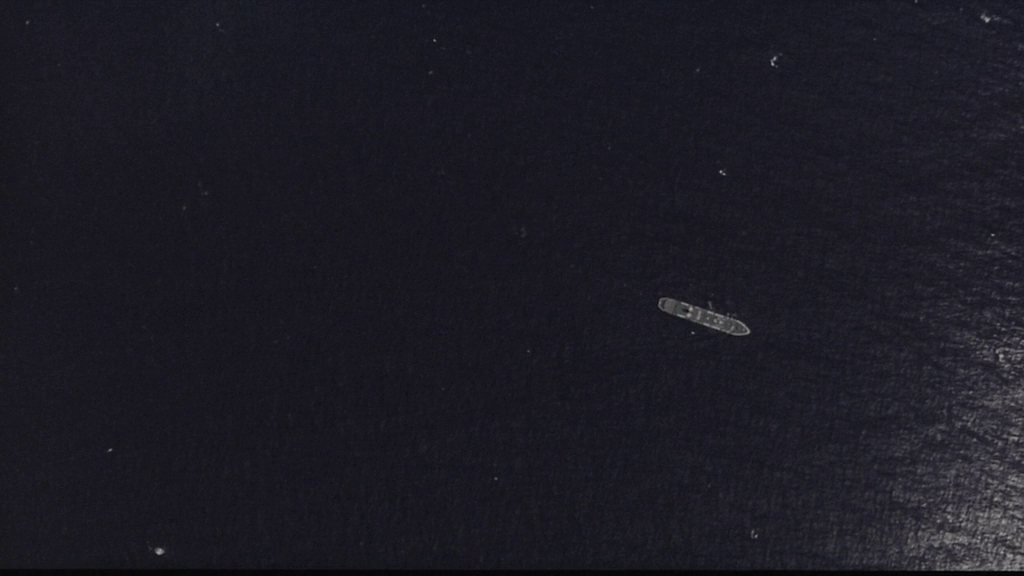
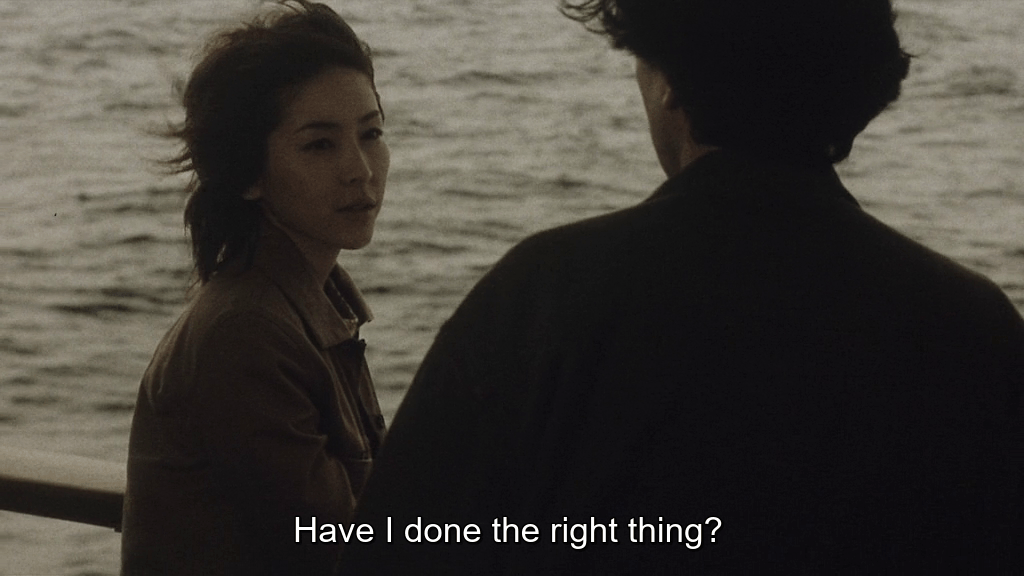
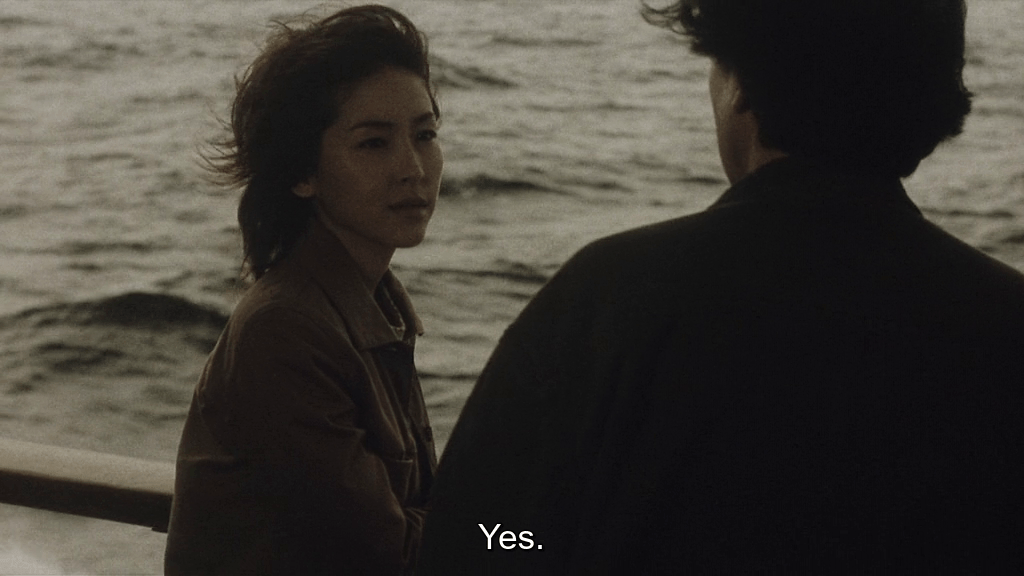
And so, I am just as much concerned with beginnings as I am with endings. In Kiyoshi Kurosawa’s Pulse, vertical perspective spells the end. After two hours of digital ghosts moving between digitality and reality, the gaze itself becomes equally disembodied and haunting, perhaps even more so. The final shot is an aerial shot, no different than one found on Google Earth really, or a video feed from a drone—that is, until we are shut out. Kurosawa turns the TV off, defeated. The last image before the screen goes black is a sad little ship in a deep blue sea. Realizing cinema, which extended the “detached observant gaze” from photography, was, of course, going to become only more elaborate in this respect (Steyerl 24). Even when the world has ended, verticality ensures that it will be rebuilt in exactly the same dysfunctional image. The digital captures “the world as a picture,” as Steyerl points out in How Not to Be Seen. Maybe the apocalypse was the digital, but the digital is the only thing that can survive to witness it. Nuclear winter.
The final shot freezes in time before the camera zooms out (or the image sinks into void), only then does Kurosawa switch it off. The freeze frame is the dying breath of the filmic trying to reassert itself at the dawn of the digital century, but the screen zooms, the freeze frame itself a frame within a frame of the digital before the image is turned off remotely. But as I watch this scene over and over, this photographic gesture is never actually a still image: “its ontological structure is of a constantly shifting or self-refreshing display”—subverted once more, this time by the digitality of my computer monitor (Rodowick 138). The closing song over the credits, “~lay down my arms~,” signals Kurosawa’s admitted defeat before his name fades to black. “Now, alone with my last friend in the world, I have found happiness.” Michi, the woman from the frame narrative, tells us this revelation as Kawashima dissolves into digital particles. Her last friend is no longer there, but she still acknowledges his spectral outline on the wall. A ghost: half-present, half-absent. A new kind of indexicality? This might as well be Kurosawa talking through the screen. Having come to terms with the false fantasy of cinema as a distinct medium with its own essence, Kurosawa embraces the uncertainty, although quite reluctantly and only at the signs of inevitability, admitting that it’s “not coming back,” “there’s nothing left now.” The ghost of Kawashima, the digital particles resist gravitational pull, and in the next shot, he becomes vertical perspective himself.
“Pilots have even reported that free fall can trigger a feeling of confusion between the self and the aircraft” (Steyerl 13). The cybernetic conjunction of man and machine was exacerbated even further by the automatic qualities of video compared to film: instantaneous playback, on-site improvisational synthetization, its grab-and-go consumer appeal. Pulse highlights confusion of person and digital image machines, where the machinic component of the cybernesis has subsumed the human element. The end occurring on a boat is of importance here as well. Boats once relied on the horizon for navigation. Now maritime navigation is subservient to aerial. The camera floats above the imagined stability of the observer on a boat’s deck. This aerial perspective gives no information, makes nothing visible that was already otherwise so. The move upward of the camera extends the walls of the frame, the ship forever trapped in the middle of the sea during the apocalypse, the ship to be seen constantly from above, trapped within the confines of the frame in space and time. It has nowhere to dock. The epitome of linear perspective travel/navigation has been outmoded. It can never dock. Film likewise threatened by video. The linearity of film, its images miniaturized and sequenced in rows, has been compounded by the chameleonic single frame of the digital numerical. Aerial perspective, its tie to video, transports us away from reality, Kurosawa notes. It creates a distancing god’s eye in place of indexical immediacy.
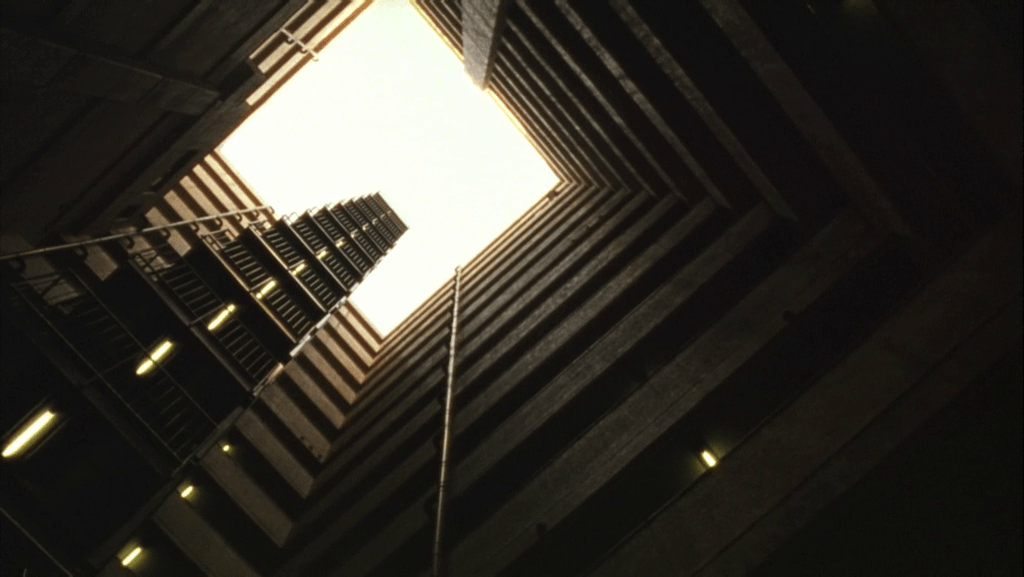
Once more: 2001, Japan: Takashi Miike’s Ichi the Killer diagrams a similar confusion of self and machine. Antagonist Jijii (played by Shinya Tsukamoto) removes his loose-fitting garments to reveal the physique of a bodybuilder. The grotesque bodily transformations of the famous body horror auteur go digital: the filmmaker’s face uncannily superimposed onto an ill-fitting muscular form. Tsukamoto snaps bodyguard Takayama’s neck in bone-crunching POV. The walls of the frame are doubly claustrophobic; free fall channeled by the socioeconomics of the apartment building. The snapped neck looking up implies thwarted desire to fly out of free fall to accelerate upward to break the illusion of relational weightlessness. The snapped neck indexes the highly stratified society of new millennium Japan, “intensified class war from above” as seen from below (Steyerl 26). Rather than looking up to the sun, the nationalist pride of Japan, we are met with a washed-out sky. So then, even if we did climb the floors, what is waiting at the top?
To fall back down again. In slo-mo, Kakihara balances on the railing of the rooftop staircase, having been kicked by Ichi. The moment right before one is condemned to free fall feels as if it would never end. “What do you mean history has ended?” He is expected to catch himself, but he loses control and enjoys the fall. After Tsukamoto discovers the body, Kakihara is pictured in a liminal space washed in blue light, recognizable as the place where Karen, and presumably Boss Anjo, once tortured Kakihara for his own masochistic pleasure. Although he fell to ground to escape the unfulfillment of his digital desires (digital media creates impossible desires: Kakihara deals in pornographic videotapes), he cannot escape the limbo of groundlessness. Even death offers no reprieve. With history killed, where do the dead go? They haunt the present. Like a video image allows one to see one’s image instantaneously, to see oneself outside of oneself, to haunt oneself—Peter Campus’s dilemma, the “displacement of image.”
Let us return to Tsukamoto’s Jijii: even the cyberpunk director cannot escape becoming a cyborg, modified by the digital, incorporated into it, nay, constituted by it! If we follow this logic, the other major characters can be ascribed with a cinematic positionality. Ichi is easily video with his slick black costume, hikikomori relation to TV and videogames, and false, programmed memories inserted by Tsukamoto are coated in digital noise. Tsukamoto’s orchestrative relationship to Ichi as well as his digital chimera body marks him as film with digital modifications, a partly video aesthetic merged to film. He is Miike. Kakihara is the most difficult to characterize, until I read Tom Mes’s assessment of the film, wherein he resolves the trinity quite nicely. Kakihara, in such a libidinally unsatisfying film with despicable and pathetic characters, is the only “identification figure” left for the audience, both him and the viewer participating in violence with a laissez-faire attitude (Mes 235). He is like you and me.
In the end, mastermind Tsukamoto—no motives ever explained—kills himself, like Kakihara. Ichi, although never seen again after the rooftop, survives alongside the child Takeshi who kicks him as revenge for his father’s murder. Kakihara’s blue purgatory is prompted by Tsukamoto looking up the apartment shaft, and before that, when he looks up, montage implies that he intuits Ichi’s helpless state as well. Tsukamoto (film as a medium in its own limbo) realizes his mortality in the pathetic fates of the unstable yet precise ones and zeroes of digital video and the audience. After the masochistic spectatorship is lost to free fall, our new identificatory figure is Takeshi; he registers the camera at the end after a computer-generated crow flies by his head—a new relation between a new audience and a new form of cinema is forged after the digital continues to infiltrate postmodern society (no longer merely onscreen violence but a part of nature itself). Digital cinema requires a new mode of viewing, of interacting with the world. It starts by recognizing the gaze, only then can we deploy digital cinema to examine critically our contemporary institutions.
Like Kakihara’s delight in free fall, the audience loves the fleeting hyper-Newtonian thrills enhanced by digital technologies which leads to the birth of the acritical audience, a viewership that desires spectacle enabled by digital special effects. The death of cinema begets the death of the audience. Although now, it would seem the causality is reversed. However, it was all an illusion. Kakihara was not kicked off the roof; the digital did not thrill the audience. The index of Ichi’s knife boot on Kakihara’s forehead, as a sign that is marked by direct causality, is a hallucination. Video has no index, no relation to the real from the perspective of the filmic semiotic paradigm. Puppet master Tsukamoto’s filmic persona as the one to reveal Kakihara’s unmarked forehead confirms this illusion. It does not matter. It is Tsukamoto’s actions that still lead to the death of Kakihara and the humiliating dissolution of Anjo gang. Ichi—a voyeuristic, isolated, amorphous avatar for Tsukamoto—did not cause Kakihara’s death as Tsukamoto had planned. Tsukamoto looks up at the sight of the aerial perspective framed by the apartment building. He recognizes his own fate—suspended in air, around the neck, from a tree. Takeshi ignores him for the camera, and after humiliating the two biggest sadists in the film, demonstrates a sort of mastery over Ichi the Digital and Tsukamoto the Analog Hybrid.
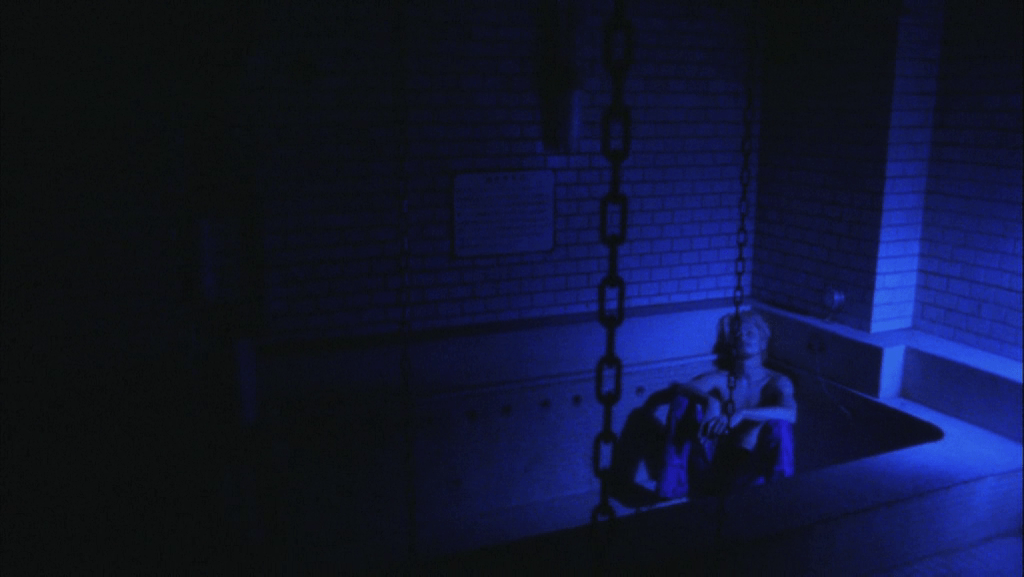
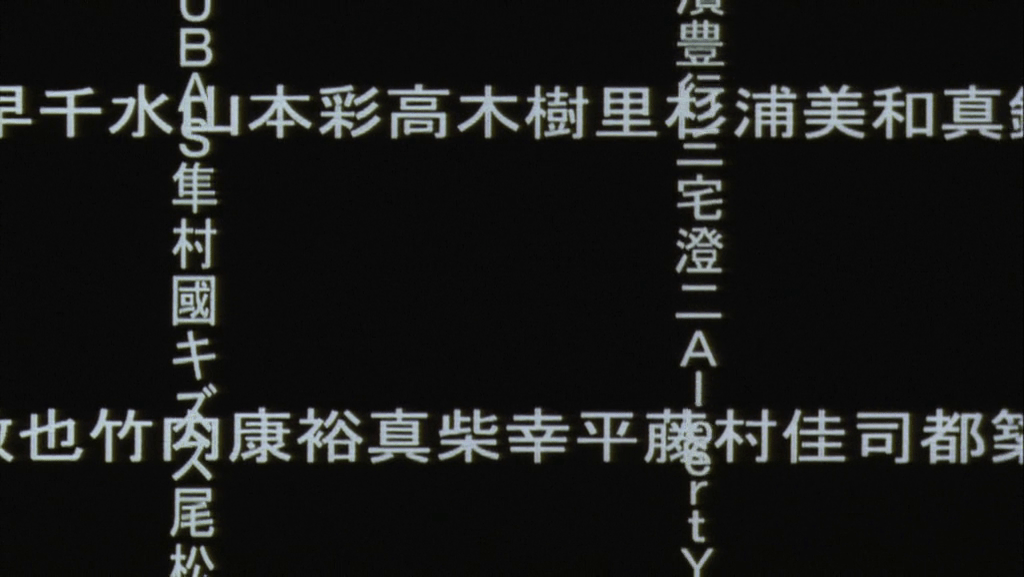
After free fall, the audience is left feeling like Kakihara, trapped in the blues of our empty sadomasochistic chamber, completely unfulfilled in either impulse. The hanging chains in the foreground key us into the shackles of verticality. The camera cuts to close-up: Kakihara looks up at the high-angle lens, his digital extendo mouth falls open, his eyes expressionless. Cornered by the camera on all axes. The horizontal tessellation of the non-place walls overpowered by the free-falling chains. The intermixed horizontal and vertical credits reconfigure this visual contrast metacinematically. The last chain of text is vertical and ends with the year: 2001.
The stability once afforded by linear perspective and its privileging of the horizon has been superseded by “multiple perspectives, overlapping windows, distorted flight lines, and divergent vanishing points” (Steyerl 13).
“Digital practices call for transformation, dissemination, recontextualization, and even transmutation into other kinds of perceptual outputs. Their identity is inherently multiple and open to viruslike mutations into ever-renewable series” (Rodowick 133).
The following year, Olivier Assayas’s Demonlover carries the torch. The ending sees Franky interfacing with an automatically scrolling selection of snuff livestreams spotlighting female torture. Aligned in a row in the center of the frame, the Hellfireclub thumbnails roll from left to right consecutively, resembling a perversely digital film strip. Gravity is inevitable, and thus, so is free fall. As Franky contemplates over a model of DNA, the tortured Diane looks back at the surveillance camera beaming her image to viewers and voyeurs alike, like us and Franky. Here, Assayas claims that this turn of events, the end of cinema, the end of history was always to pass. A digital determinism. Hardwired. Diane’s face strikes the same visual chords as Kakihara’s—both in limbo, both watched and aware of it; his desires shaped by digital mediation, desires of others pasted onto her through the digital. “These hands could’ve moved mountains.” The lyrics of the closing credits indict the filmmakers but also mourn the potentialities of the digital that continues and makes more efficient the exploitation of women under capital and moving image culture. Franky embodies Steyerl’s floating spectator, safely inputting his fantasies from a high-angled distance thanks to daddy’s credit card. Aerial perspective is male, White, and wealthy: it is not afforded to everyone. After the film’s form effectively kills itself and then returns to continuity stasis, after its defeatist conclusion, Demonlover takes the motif of visual entanglement (“tangled in shit”) from Ichi’s purgatory and makes it auditory in the credits. Two simultaneous voices, singing different lyrics, are heard. 2002 (palindrome): the digital and analog, two ongoing threads in not-quite-yet-certain relation. The fear is not the future but that the future will bring nothing new, in fact, only arriving with the same old failures. No new solutions. All films picture some purgatory—whether trapped inside a monitor, a retired space of sexual fantasy, or, as in Demonlover, some present combination of the two.
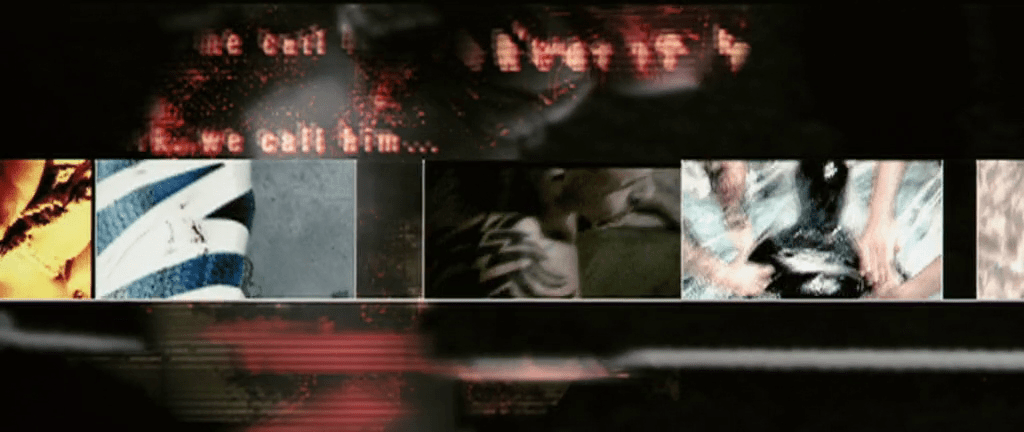
These films by Kiyoshi Kurosawa, Takashi Miike, and Olivier Assayas react to digital disorientation of cinema, the invasion of multi-screen displays and aerial perspectives onto linear filmmaking. In addition, they react to the decentering of the individual subject as a result of this new perspective paradigm. Ichi the Killer seems most willing to embrace the digital with its laughably over-the-top, grotesque computer effects. It is also the most confident in its embrace of the digital absurd, the figure of Takeshi offering some generative possibility under the digital regime. In the years before and those that followed, the digital absorbed cinema and did cinema better. Pulse knows this truth, Ichi and Demonlover too. Cinema’s own genetic makeup and language created its death, as its formal conventions were programmed into the digital. If we are to consider Rodowick’s assumption that the digital image does not “occupy space,” then the digital is spectral—a ghost from the future that haunted cinema even before its new millennium revolution, a harbinger of the death of cinema (134). And so, the linear perspective once coded into digital machines and software has taken on a new gaze that Rodowick fails to address (132). “Photorealism was displacing abstraction as the driving goal of research in digital image simulation” (Rodowick 132). Now, the entire world is digital simulation with surveillance situated atop it, maintaining it.
“Falling is corruption as well as liberation, a condition that turns people into things and vice versa”: Pulse’s phantasmagoric computer virus turns people into images (Steyerl 28). But Kurosawa images this transformation as much epochal as it is apocalyptic. Twenty-one years later, self-objectification might be our only chance to render ourselves invisible, or at least organized under some new solidarity. If the boat were removed from the final shot, the film would end on a much less dour note. The endless sea would be a place of play with its open possibilities: sink or swim.
History has been halted. My future as well. Suspended in air. However, if history ended half a century ago, then it was certainly confirmed last week. Recent advances in artificial intelligence processes [Midjourney and, more recently, OpenAI] spell, once again, the end of the human, and I do not mean this in any alarmist, “end-of-cinema” sense. OpenAI GBT-3.5, for example, an application programming interface in open beta, can write an essay about Hito Steyerl’s concept of the poor image, for example, or answer ethical and philosophical dilemmas faced by the postmodern subject, with oftentimes surprising mindfulness—that is, humanlike, student-like. This software exposes the inhuman manner of writing upheld by humanities scholarship. Academic publishing institutionalizes and protects stale form, never rewarding anyone for challenging it. In few years’ time, AI will surpass academia in this form of writing that it blindly teaches. Of course, it will; it can do it better! “Did you internalize the content?” “Can you swallow information and spit it back out?” In the near future, an undergraduate could receive a degree largely by submitting assignments (partially or mostly) written by AI—undetectable to Turnitin and editors. OpenAI even allows one to edit text according to customizable instructions, allowing overworked and underpaid professors and teaching assistants to grade and add comments faster, if desired. AI will grade AI, simulations of simulations. The sort of education that regurgitates formula should be over. The infinite conversation must come to an end. AI art will continue to produce and then consume itself to produce more AI art, until humans are pathetically pushed out of the loop. The same will happen with online discourse, etc., etc. We are made external to the infinite conversation after believing ourselves to be enlightened for centuries, and the end of that process is to digitally recreate ourselves via feedback loop that no longer needs us. The end of (the end of) history. Thus, I do not think there is no future. While technology and media will devolve into the mindless never-ending discourse we finds ourselves engulfed in today, we will have the ability to walk away and start again, to refuse to watch the forty-seventh installment in the Marvel Cinematic Universe produced entirely by AI, to escape free fall. The freedom to choose, but the choice is always yours.
The digital is one means by which we can turn writing into a living document.
With this, I have relinquished the linearity of my academic track and the style of scholarship it produces for the uncertainty of free fall outside of its bubble. Here, I have taken up the impossible challenge of concluding an entire semester’s worth of theory across all my classes, plus the last three-and-a-half school years of undergraduate knowledge, all while attempting to discover (over just a few days) some alternative form that will satisfy me, that will convert narcissistically (in)coherent thought process to poetic, nonlinear magnum opus. And I have failed, but it is all there somewhere in between.
Works Cited
Mes, Tom. “Ichi the Killer.” Agitator: The Cinema of Takashi Miike, revised edition, FAB Press, 2006, pp. 226–243.
Rodowick, David. The Virtual Life of Film. Harvard U Press, 2007.
Steyerl, Hito. “In Free Fall: A Thought Experiment on Vertical Perspective.” The Wretched of the Screen, e-flux, 2012, pp. 12–30.


Leave a Reply