
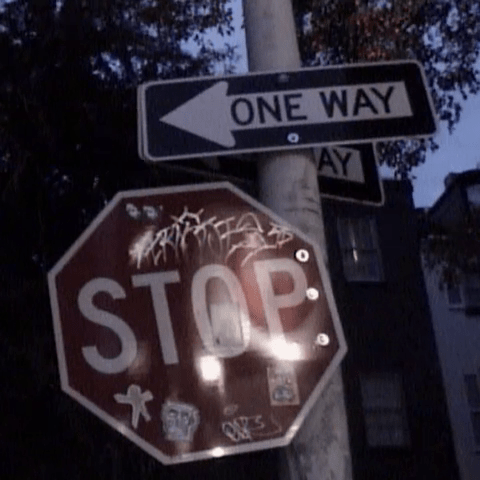
Three tapes, 60 minutes each. That’s all we had going into this trip. I’m sure you can see, as time passes onscreen, how we interacted with and staged time differently as illustrated in the changing relationships between the images from tape to tape. In my mind, I was always going to go back and cut out “bad” takes or repetitive imagery to create a better rhythm—something that would feel more intentional, more elevated or artistic to whoever happened to watch. When I got back home and I ran back all three tapes and converted them from analog to digital, I did not want to cut anything out. (Although not a clear-cut conversion outright, since Digital8 is already itself an odd hybrid of analog 8mm recording mechanisms plus a digital encoding codec in order to write the image-sound signals to guarantee clearer results for both, and therefore, allowing “digital images to be recorded on . . . tape.”) I realized something so obvious when I was marveling at the flow of images and each of our competing and complimenting approaches to moving image form on my first playback through these events I had just lived. Everything we did was intentional. If that red button was pressed, even by accident, it nonetheless created an impression (rather than an index) of our living and goings-on in Tampa, on the train, in Philadelphia, in New York, and then back again.
Surely, I could have crafted a tighter narrative, centered on any number of things, and certainly that was my goal at first: the best candidate for a singular protagonist being Matthew with the most definable arc, or more explicitly paralleling or reframing juxtapositions between all three cities, or adding the guiding voice of god through narration or subtitles, or whatever. From there, I could have whittled down what we had shot, but the in-camera feel would have been lost. Although I was often shooting, and reshooting, with the after-the-fact edit in mind, in which I would pick which of the two shots of the same thing were better, I instead opted to keep in both. It is important that each tape can hold around 60 minutes because that is what we knew from the beginning we had to work with. Digital8 processes only give you, as we found out, a little over an hour of allotted time to record on a 120-minute 8mm videotape. So, although I was thinking of the edit (both cutting out “bad” takes on my computer and the in-camera question of how the previously recorded shot would line up with the one I was looking at through the viewfinder), it was still all up to the camera. I am wholly subservient to it. I surrender to the image cult in my rejection of further endless digital manipulation at the hands of my hands relying on Premiere Pro. The result was only to be revealed to me once I was back home alone.
With her idea of the “possessive spectator,” Laura Mulvey in Death 24x a Second, essentially argues (and I agree, albeit less inclined toward the psychoanalytic), digital cinema and its associated systems of perpetually evolving sign exchange and spectatorship enhance, make more convenient the desire for “cinematic repetition compulsion.” With nonlinear video editing software and chapters on DVD/Blu-ray menus and the easily accessible array of other electronic aids, the digital viewer—often alone, or at least in the shared isolation of their homes—can manipulate the sequencing, speed, or any number of adjustable settings and sliders of varying technical complexities if they only learn how. Now, I do not think this kind of digital spectatorship is a bad thing, I cannot stand (most of) that old-timey scholarly fearmongering over digital cinema with no credit given to its innovation and unique aesthetic capabilities. I stand in stark opposition to that line of thinking. However, her model for a more thoughtful, “pensive” form of spectatorship—one more acutely aware of time and what is past and the stillness of the image that digital technologies now reveal as always beneath the rush of images with the press of a button—would be welcome simply for the fact that it is different and new and it is about time we had something different and new. Or maybe, I actually don’t agree. The possessive is no less new, and better yet, it is already here. Why are we trying to legitimate the digital by means of the index? If digital video is more akin to a “sub-genre of painting,” why are we still clinging to the old rules of legitimation? Be possessive, be fetishistic, join the winning side of objects over subjects, that is, images.
On the one hand, yes, I am lazy and wanted to get this project done and over with minimal effort, so I could focus on others that will require a greater deal of my time and energy, but also the idea of having a project that relied on in-camera editing was recently planted in my head by my old professor; this set of tapes was the perfect candidate. Plus, I think it’s funny to completely eschew the ethos of meticulous planning that often comes with working in-camera, generally a film camera. Ironically, cameras with digital capabilities presented a less costly and mentally exhausting alternative industrial model to filmmakers who were burning money whenever film was rolling, making the once necessitated economics of the in-camera model largely obsolete for penny pinching purposes. We just did it anyway, playing with an outmoded form on an outmoded camera that contributed to outmoding the very style I adopted for our tapes.
Yet, I feel editing in this sense seems too active a verb, which also highlights my concern with the term moviemaker or the more refined, academic alternative, imagemaker. We don’t make images or bring them about, we have no control over them. We can manipulate them to our will, but we live in a world comprised almost entirely of images, and they do not care about us. We did not create the image of the image in our image, but our image in the image of the image. And so, I have felt for some time it is more accurate to describe such a profession or passion as imagefinding, its devotees, imagefinders—like the camera: viewfinder. I have no control over the camera, so I relinquish the imagined power I hold over it in the final cut. Let it be. The digital hailed as democratizing is too much about control. I do not handle a camcorder because of “nostalgic vibes,” but for this reason. It may seem sloppy or amateurish, but I think it is much more beneficial to the viewer to see it as is—to see the readjustment mid-shot after clearly whoever was behind the camera had a lightbulb moment they wanted to test out, or they try a couple times to get a shot, but it doesn’t quite turn out, the camera button might have gotten stuck and the shot lasted too long, the composition that looked good with the naked eye just didn’t translate well, etc.
Instead of curating the frames (by conjuring up an overarching story or removing filler or editing according to any thematic), I made it about the lack, the refusal to trim the excess, precisely because none of it is. We all contributed to its organization and submitted ourselves to the object-apparatus, so why would I get to choose what passes the final say after the fact? When you edit in-camera on the street, whether shooting on Super8 film or 8mm videotape, you know you have this much space to fill over this much time. And that’s it. We filled that space with little room for much else. For seven days, we were only thinking in minutes and seconds.


Leave a Reply