
Political art is dead. And while it is incredibly hacky to declare an entire insitution that no longer holds the cultural gravity that you wish it did as dead—poetry, cinema, music, cultural criticism—nonetheless, my visit this afternoon to the Cristin Tierney Gallery served to strengthen this sort of claim, even if it is a lazy one. Political art today is dog shit. So, let me rephrase: good political art is dead. I am not against political art, but I am becoming even more of an anti-moralist. Donald Trump and his consequences have been a disaster for the art world. (Adam Kotsko’s essay in the Atlantic on the adoption of evangelicism by the mainstream Left summarizes and critiques this problem excellently.) Gone are the days of Eisenstein and the “Dialectic Approach to Film Form”; say hello to the milquetoast headline-driven slop of rampant radical liberalism! At this point, I would take another film as thematically reprehensible and vile as The Birth of a Nation if it meant we got something that managed to be both formally groundbreaking and overwhelmingly popular.
My visit was initially prompted by my research for the Three Transitions essay (that I just finally pushed into the good-enough-to-post stage yesterday), where I learned that this space would begin screening this video by the time that I would be in the city. The chance to see a Peter Campus in person was too good to pass up. The Cristin Tierney Gallery is a sleek space, its up- and downstairs walls entirely white with lots of open space due to the limited works on display. I knew Campus awaited me upstairs, but I walked through the lower level first: mostly paintings, some sculptures, a photograph or two, and a single-channel video—all a part of the ongoing Masculinity in Contemporary Art exhibition. None of it really did anything for me, but I do wish I would have stayed to watch the entire runtime of the video, as its cover image was the most striking and interesting on the gallery website.
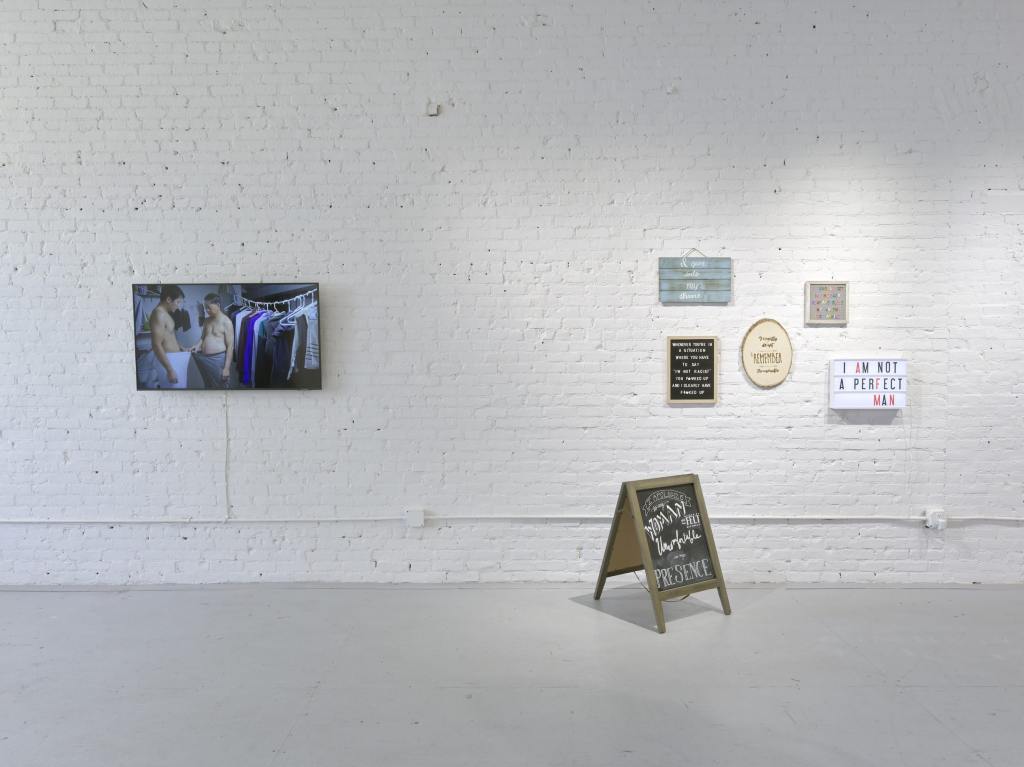
The work that most annoyed me was a series of sculptures (?) by Jennifer Dalton, Mistakes Were Made, in which she just writes out slogans that are vaguely apologetic and clearly orbit around #MeToo. It was only after the fact when I read the exhibition information packet that I learned they were all apologies from famous men. So, sure, you could read these works as reflexively acknowledging the phony, placatory tone of these celebrities through the felt boards and chalkboards and cinema light boxes, but lazy moralizing and pandering became smug condescension when I read their titles (absent from the wall). Really, Matt Damon saying he should take a backseat on women’s issues and Joe Rogan admitting he’s said racist stuff is comparable to Kevin Spacey raping young boys? I know, patriarchy and White supremacy encompass all of these instances and they all contribute to their cultural proliferation, but what does this series hope to accomplish? “Please, clap.”
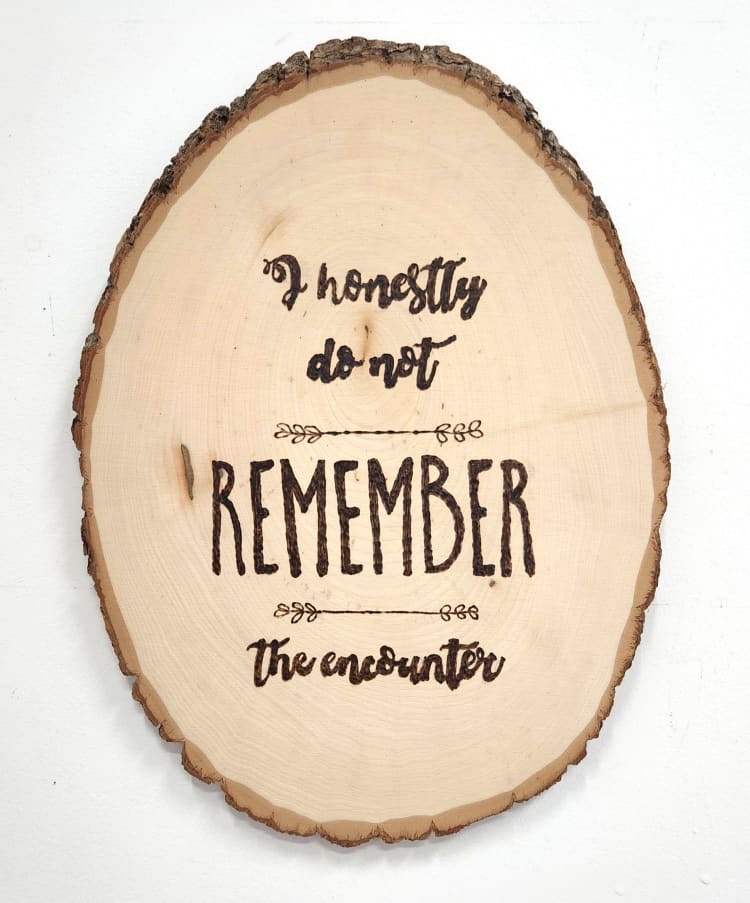
Thinking more and more about it, I could see this piece critiquing that White liberal, virtue signaling, empty slogans in wacky fonts accompanied by flat illustrations, purely aesthetic style of politics (identified by Brad Troemel in his The Left Can’t Meme Report, also coinciding with the phenomenon he identifies as “literalism,” similar to Kotsko’s diagnosis that “we are all evangelicals now”); however, the rest of the gallery does not lead me to offer that charitable a reading. God forbid a work of art run the risk of “misinterpretation,” better tell everyone exactly what I think about a given issue, so I can’t be criticized for having the wrong opinion! The choice of media strikes me as not befitting of the subject matter either, as this bland appropriation of kitsch/camp aesthetics is practically inseperable from overly earnest liberal White women who don’t understand irony and love to drop words like “anti-racist” or “trauma” into every conversation. This style of post-Trump contemporary art practically broadcasts everything about it before you even get the chance to look it over a second time. Needless to say, I did not need to spend much time in this part of the gallery. What screams gentrification more than mediocre art in the middle of the Bowery? Maybe I’m just an asshole.
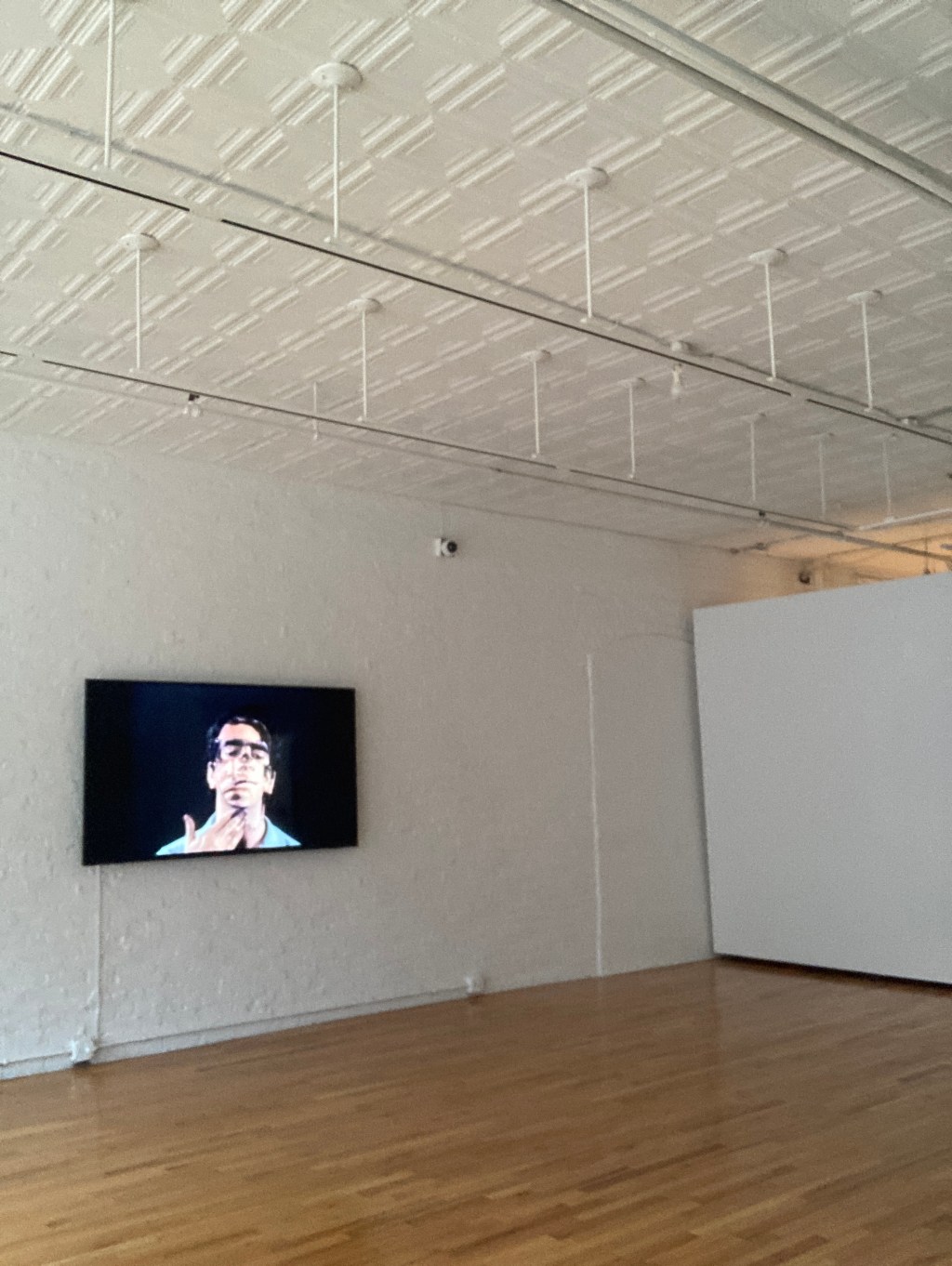
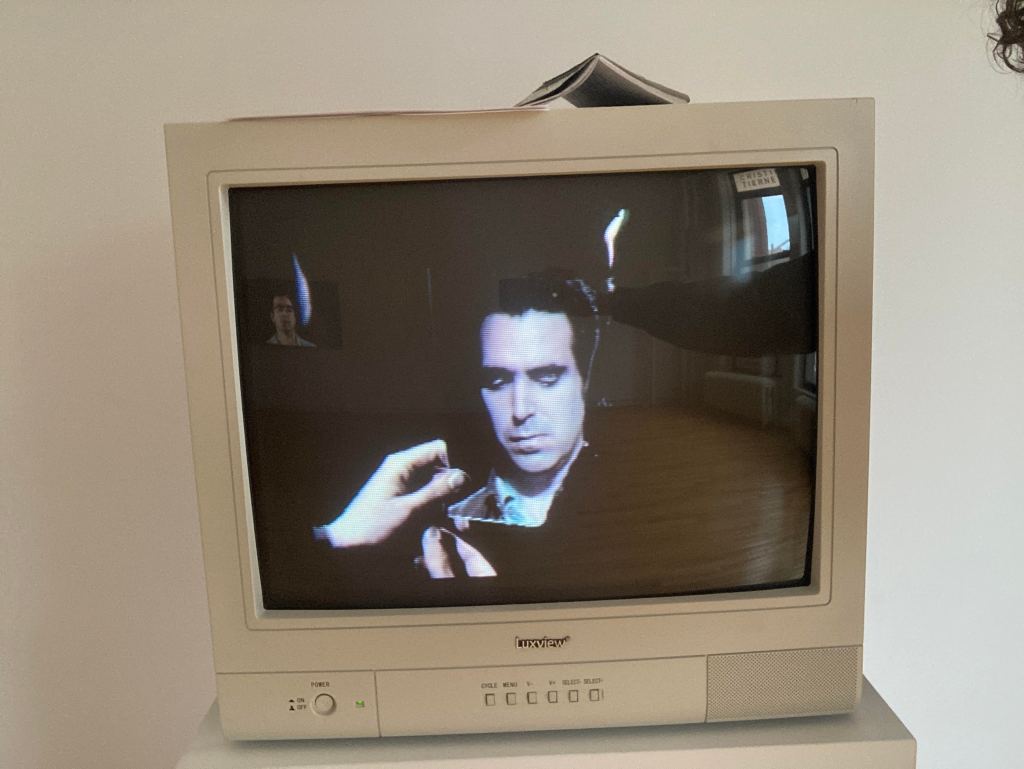
I walked out, went to the next door over and was buzzed in to go up to the main attraction. This space was even more open: only a flatscreen television playing Three Transitions on loop was on the wall as you walked into the large room. Opposite the large screen, a slick looking cathode ray-tube TV with a white chassis sat atop a white pedestal around chest height. And that was it. I did appreciate the choice to have the video playing in two forms, but I did prefer the smaller, low-definition screen for sure. Interestingly, the two videos were not synced—about half a full runtime’s length difference between them, if I had to guess—so, you could hear the rip of the paper barrier over your shoulder as you watched Campus paint his face in front of you. Not a complaint, just an observation.
I probably watched the whole thing a total of four times or so. The man who first greeted me at the top of the stairs came around the corner and approached me again. Based on the staff listing online, I assume he is William Petroni, Managing Director of Cristin Tierney. He asked me what I thought of the video. I told him I’m a fan of Campus’s work and was already well acquainted with this one in particular. I told him I felt the video strikes me as posthuman. “What do you mean by that?” I did my best to explain my reading on the spot as concisely as possible. I mentioned the deconstructionist tendency seen in video art of that period and the importance of the classical art object to Campus’s critique of self-portraiture by way of video. He said that was interesting, spoke to the confused sense of interiority and exteriority while highlighting the intensely psychological underpinnings, and then I left. On my way down the stairs, walking up is a pretty woman, and she makes eye contact with me. She could possibly be the model in these photographs, but I can’t tell.
I think I’d like to visit more museums and galleries and see which ones I like the best. I was performing that experiment with coffee shops, but I think I’ve found my usual spot already—free wi-fi and plenty of outlets, not too crowded either, good Colombian empanadas. I don’t know how these places normally work, but I liked that this gallery was free, plus it was completely empty; a complaint I had about my visit to the Museum of Modern Art last Monday was how crowded it was (and $15 definitely isn’t free), but to be expected. The free postcards with a screengrab from the third transition was a great addition as well and will definitiely be going on my wall at some point. Although I had already read the press release online over a month ago probably, I took a physical copy, and I do like that the artspeak is pretty toned down from some of the more pretentious and egregious examples that are all too common.
So, I did enjoy my time there as a whole. Seeing such a monumental work in person in a similar capacity to how it would’ve been viewed fifty years ago was certainly a worthwhile experience. I’m glad I brought my back pocket notebook because I took some notes on details I hadn’t noticed that I want to add to my essay. It’s still the fiftieth anniversary, so I wanna see if I can get this thing published by someone for that reason alone, or at least get some eyes on it. I’m saying it here so I have to do it, but Peter Campus has his email on his website, so I wanna send it there and see if I get a response. Maybe he’s like Chomsky and replies to all the emails he recieves. I still keep saying I’m gonna email that old gnome before he croaks, but I don’t have anything I really want to ask. Tomorrow, I’ll go to the library for the third time to make my edits to the essay. Nothing crazy, but the details I noted today seem so obvious in hindsight and will work themselves well into the established mold, plus I think they’ll really help make it a stronger commentary.


Leave a Reply