
Part II (of II)
I don’t remember if I said “see you later” or “see you tomorrow.” Either way, the response in return is always “see you around.” An indication of both time and place. I’m always around. I spend so much of my time in that place. All I do is work. I go to one theater for work, others for fun. I attend regularly like any good devotee, indoctrinated into the church before I had any memories. I know I should be doing more. Everything in the world is projecting at me to stop. I keep shattering phones and keep buying new ones. I don’t like anything I write, that is, when I actually sit down to do it. I keep working a job that I’m growing to despise more each day, just because it’s comfortable in a masochistic sort of way. Before, taking the train home from work could be an unexpectedly rewarding time of day, but now, it’s mostly just pathetic. The sight of everyone in their nonslip shoes and work boots and scrubs can be horrifying. The horrible feeling of “I’m sure [we’re] supposed to be doing something else.” I fear I am becoming illiterate, anti-intellectual, and overall less sharp. I’ve become complacent. As Michel tells Charles in The Devil Probably, “you want to be an exceptional guy in an exceptional world.” I don’t think I possess anything that is worth clinging to my individuality for, but I do anyway. I just don’t know what to think anymore.
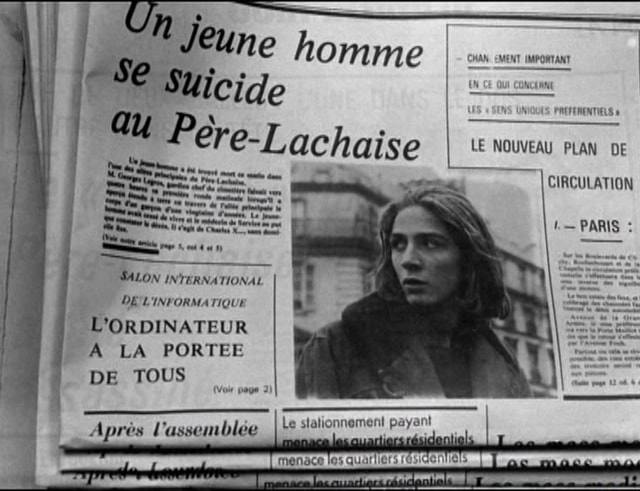
In Bresson’s penultimate film, the work of a weathered cineaste decades ahead of his time, the young protagonist and the veteran filmmaker conclude that modern life—microcosmically figured as France post-May 68—is “unlivable.” In what ends up becoming a last resort before his inevitable death (already recorded and printed for the audience in the second shot of the film), Charles’s friends manage to get him into a psychoanalyst’s office (after activism, religion, university, and hedonism prove ineffectual in raising his spirits). Speaking freely for the first time, the self-deprecatingly imperious nihilist surmises his outlook matter-of-factly: “The rejection of all politics.” The only resignation is death, something even Charles cannot bring himself to do. Even here, the one action that would resign him from an individualistic world that disgusts him falls to him alone. He enlists a companion to pull the trigger. The montage of newspapers in the film’s opening don’t know who to blame either: is it suicide or murder? It is always someone’s fault. To believe in individual choice is to merely hold your hand between your face and overwhelming fatalism. “But Doctor, I’m not ill. My illness is seeing too clearly.” To the individual, seeing is believing. So, in that sense, we are individuals condemned to the freedom of choice, but the choice is always yours.


Leave a Reply