
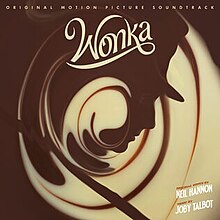
My new job at a quaint Brooklyn movie theater has got me thinking. Now in the fifth week since its U.S. release, Wonka is still going strong, oftentimes filling our larger theaters close to capacity on the weekend, with families curious to see the third film adaptation of the Roald Dahl chocolatier, popularized more than 50 years ago by Gene Wilder’s iconic performance in Willy Wonka & the Chocolate Factory (1971, Mel Stuart). Cleaning the theaters before the next screening means I repeatedly (and only) catch the tail end of the credits, accompanied every time by an undeniably catchy original song for the film, “A World of Your Own,” performed by Wonka star Timothée Chalamet. It begins:
Close your eyes and count to ten
Make a wish, now open them
Here’s a store that’s like no other
If it was, I wouldn’t bother
Chocolate bushes, chocolate trees
Chocolate flowers and chocolate bees
Chocolate memories that a boy once saved
Before they melted away
A world of your own
A place to escape to
A world of your own
Where you can be free
Wherever you go
Wherever life takes you
This is your home
A world of your own
The song is dripping with nostalgia, dreaming of a time when things were better and inviting the viewer to do the same. It proffers Wonka’s chocolate store as one way in which to experience that feeling once more, the feeling of being a child—even after your dreams have long since “melted away.” Here, the verse succeeding the chorus:
Here is the child that you left behind
Here is the kid with the curious smile
Here is the wonder we used to feel
Back when the magic was real
The repetition of “here” in the beginning of each line positions the viewer in both space and time, seated before the conjured image of the film they are watching. What you left behind is right here; here is the kid you used to be. To be back in the theater in that very moment is to return to the “wonder” and “curiosity” of childhood. Wonka claims it can revive the magic lost to the years gone by. Certainly no small feat. Nostalgia is the antidote of (the) age, Wonka affirms. And then, reprising the refrain:
A world of your own
A place to go when you’re
Feeling alone
Feeling unsure
Embrace the unknown
Enjoy the adventure
Wonka founds itself on the assumption that there once existed a world capable of magic: a world of sorcerers and believers alike. Practitioners and adherents turned to disillusioned skeptics and heretics after the mirages, myths, and mirror tricks of the last few centuries were unmasked in the philosophical power vacuum following the atrocities of the Second World War. “To write poetry after Auschwitz is barbaric,” philosopher Theodor Adorno famously declared. The world as it remains is no longer conducive to magic, only simulacra. It likely never was. Wonka tells its audience to “[e]njoy the adventure” by retreating into fantasy, by believing that everything is going to be fine in spite of all indications to the contrary, hoping against all hope. Speaking directly to the viewer, this retreat into fantasy essentially relies on an adherence to individualism: “A world of your own / A place to go when you’re / Feeling alone” (emphasis added). As if widespread loneliness and isolation is best treated on a case-by-case basis, that is, with more isolation. While the film ostensibly offers the triumph of a diverse collective over the monopolistic Chocolate Cartel, the individualistic shortcomings of liberalism, that presuppose the individual rational subject as the basis for its politics, are reinforced. The film’s faux progressive slant is as vapid as its oft-repeated phrase: “The greedy beat the needy.” After a bridge, the song ends with another variation of its chorus, Chalamet now backed by the ensemble cast:
A world of our own (A world of our own)
A place to escape to (A place to escape to)
The world of our own (A world of our own)
Where we can be free (Where we can be free)
Wherever you go (Wherever you go)
Wherever life takes you (Wherever life takes you)
This is our home (Ooh)
A world of our own
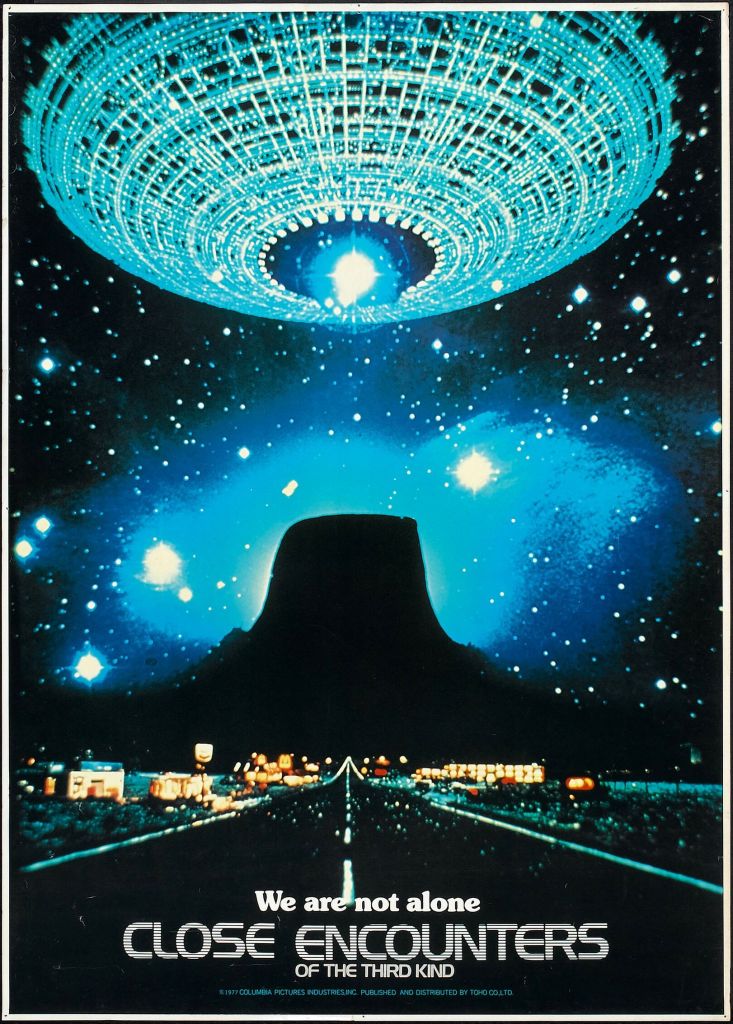
After being subjected to these lyrics over and over, I am eventually reminded of Dr. Ferguson’s lectures on the New Hollywood blockbuster, in which he notes that this form of media like any other reflexively allegorizes its own operations. His primary example is in regards to Spielberg’s Close Encounters of the Third Kind (1977)—the year that formally codified the blockbuster in conjunction with Star Wars (1977, George Lucas). Specifically, Ferguson draws attention to the film’s tagline: “We are not alone.” He goes on to contextualize: in a world still reeling from the post-Nixon military-industrial complex and the consumerist alienation of (primarily White) midcentury suburban life, directors like Spielberg and Lucas reinvented the cinema, imbuing into it a new sense of community. Not only this, but also introducing a “new aesthetic value”: “material contiguity” in the form of hyper-Newtonian aesthetics (“Self-Exculpating Environmentalism”). We are not alone, indeed. This new brand of aesthetics—made possible by a shifted emphasis from image to sound (Dolby, then later, surround sound, foreground bass as a physical force), post-Classical Hollywood aesthetics (shaky cam, fast-paced editing, loosened and fragmented notion of continuity), increased z-axis movement, and the increased value on gravity and physics in order to provide an immersive thrill ride—envelopes the viewer in a purely sublime “thisness,” an enclosed bubble of sensation “grounded” in the here and now (“Self-Exculpating Environmentalism”). Therefore, this thisness (or haecceity), rejecting “causal dependencies between spatially separated beings,” represses and expresses distrust toward the forces of abstraction, themselves predicated on certain degrees of pure imagination, ironically enough (“Introduction”). There is no better future; that is, to say, it does not get better than this. The blockbuster, from Close Encounters to Wonka, tends to exculpate its own contributions to what Steven Shaviro calls the “neoliberal network society,” itself also a project decades in the making that prioritizes and privileges “immediate connection in an age of self-perceived disaggregation” (“New Hollywood Blockbuster”).
In “A World of Your Own” (playing once as its own musical number and then again in the end credits), a parallel is drawn between Wonka the movie and Wonka the chocolate store in the diegesis. Either way, we are “buying in” to that which is “Wonka.” Director Paul King imagines his musical fantasy as a reprieve from the poisonous banality of contemporary life. However, the film falls short of this mark by a long stretch. As indicated by character interactions between Wonka and his sidekick Noodle as well as the lyrics across the entire soundtrack, this movie is expressly intended to make you feel like a little kid again, relying on the physical embrace of blockbuster aesthetics more than anything else to enrapture the audience’s imagination. However, this film could not function as a standalone effort, purposefully reminding the viewer of the “magic” of the original 1971 film, in addition to all its own spectacular bells and whistles. Thus, King immediately underscores the opening of the film with the instrumental composition of “Pure Imagination” from the original film, as if the cinemagoer eager for their dose of nostalgia was not already drooling. Yet, this longing for the past goes even further. Embodying the nostalgia mode (Frederic Jameson’s conception of present-day media’s insistence on the formal reproduction of older forms over the establishment of newer ones), the opening audio track of Wonka directly parallels that of Willy Wonka. In the 1971 film, the opening credits “Main Title” is subtitled “Golden Ticket/Pure Imagination,” with the codetta of the first running into the beginning of the second. In Wonka, the closing notes of “Pure Imagination” transform in a similarly contiguous manner, into the opening whistles of “A Hatful of Dreams.” A polyvalent song that supposes paradise is merely a matter of perception is replaced by an ode to rugged individualism, requiring anyone who dares dream of a better life to pull themselves up by their “one good bootlace.” Wonka admits that the Protestant logic of pulling yourself up by your bootstraps proves even more difficult today, yet for all its professed imagination and magic, offers no substantial or consistent critique, let alone, any alternative. The film is acutely aware of its sappy wistfulness, going as far as to embrace it and wish to be celebrated for it; after all, the director does brand his film “A Paul King Confection.” So, what is the film’s proposed solution to the thousand natural shocks that neoliberal flesh is heir to? To feed oneself on the “chocolate memories” that only the blockbuster can revive and sell back to you, wherein the postmodern condition is repackaged and remarketed as utopia. But, it will never be enough; the appetite only grows. Such films that fall victim to this nostalgic impulse today can be categorized into what Bill Nichols identifies as postmodern films of reaction (as opposed to those of resistance). These films “sanction the status quo” by failing to imagine or present any indication of an alternative to the present order (Nichols 207). In Wonka, the invisible machinations of capital are downplayed as merely the individual greed of the three heads of the Chocolate Cartel, assuring that the socioeconomic order being critiqued is able to be directly confronted and swiftly defeated, simultaneously ensuring its reification offscreen.
However, what is to be made of the chorus of voices behind the last refrain in “A World of Your Own, wherein the lyrics change to “[a] world of our own” (emphasis added)? It would seem, after all, that the film wishes to conclude with some sort of future founded upon collective cooperation; however, its vision of a new world is as inclusive as it is atomizing, unintentionally reflecting the algorithmic logic of life entangled in the network society. Not to mention, the complete lack of credibility that these characters, in any sense, genuinely care for each other, especially since Wonka’s lead is so obviously disinterested. Furthermore, the possessive determiner your becomes our, involving the audience in the ensemble rather than their simply being addressed, conjoining the diegetic and the extradiegetic realms at film’s end. And while the cinemagoing experience can certainly be regarded as a communal act, the phenomenology of the Spielberg-Lucas blockbuster cannot adequately address the socioeconomic framework that it simultaneously meditates upon and props up. Moreover, it was designed (1) as a way for these pop auteurs to pay homage to the B-movie serials that they and the rest of the TV Generation grew up on, and thus, “return” to an idealized world of easily demarcated lines between good and evil, and (2) to cradle the viewer in a comforting caress of hyperbolized gravitational physics, offering what Dr. Ferguson refers to as a reassuring “there, there,” alluding both to hyper-Newtonianism’s consoling phenomenology as well as its preoccupation with physical proximity, wherein gravity is a more secure, distanced form of mediation (“New Hollywood Blockbuster”). In turn, the blockbuster approach to cinema paralleled the rise of Thatcherite/Reaganist economics; on the one hand, imaging neoliberal “desires and possibilities” while, on the other, decrying its “instabilities and anxieties” (“New Hollywood Blockbuster”). And so, the cinema itself becomes a sandbox and a mirror, “[a] world of our own” and “[t]he world of our own,” as the final chorus dually invokes, embodying the central conceit of the Information Age: we are more connected than ever, yet we are more alone than ever.
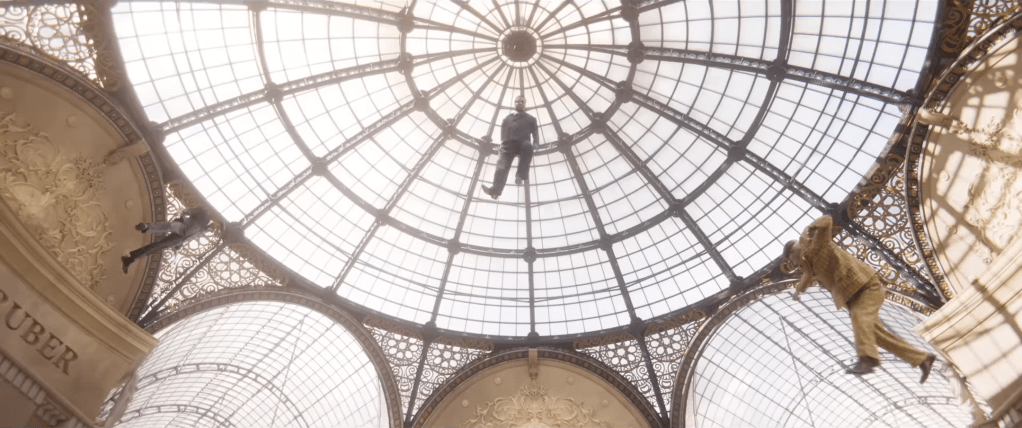
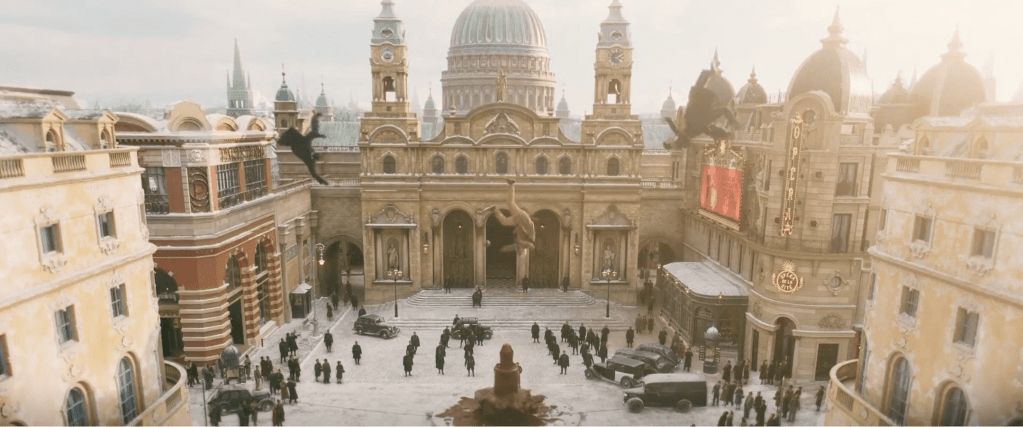
Employing chocolate as a figure, Wonka then reflexively allegorizes the aforementioned underpinnings of the blockbuster—its nostalgic impetus and gravitational tropes. After landing in the city after seven years at sea, the first instance of Wonka’s magical edibles is the Hoverchoc—a chocolate that causes those who ingest it to defy gravity and lift off the ground, mirroring the effects of the Fizzy Lifting Drink in Willy Wonka & the Chocolate Factory. Then, the “World of Your Own” musical number in the middle of the film connects past memories to chocolate, reducing the elusive/illusive and abstract nature of their construction into simplistic and sugarcoated confectioneries. Coming full circle, Wonka and his crew of formerly indentured servants vanquish the evil corporate tyrants by tricking them into consuming the Hoverchocs in the resolution of the film. This move—either naively or disingenuously—asserts that the blockbuster and its gravitational fetishism as a means of critique is effective in challenging and eventually dismantling existing power structures and returning previously monopolized resources back to the public. To consume (and agree with) the vaguely anticapitalist notion of Wonka is to take part in its nominally performative act of “protest.” Yet, no formation of media that represses abstraction in favor of reducing “nearly all cinematic experience to hyperbolic material physics” can itself truly envision a better world beyond the structural limitations of our own—within or without the cinema (“New Hollywood Blockbuster”).
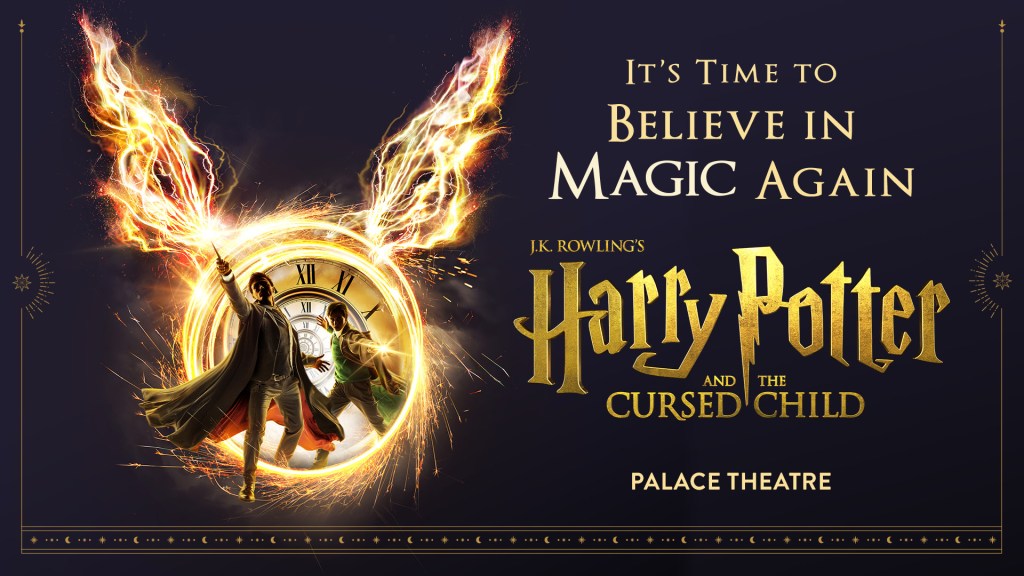
Nonetheless, the film sees itself aligned with the title character and against the corruption of the Chocolate Cartel; however, a reading that situates the film itself in the role of the three chocolate tycoons is much more in line with our reality. Slugworth, Prodnose, and Fickelgruber control the institutions of power—namely, the police and the church, and therefore, the masses—through chocolate (often being described with language typically reserved for and producing effects commonly associated with recreational drug use), not at all unlike the tranquilizing effects of the blockbuster on the aesthetic (and therefore, the audience). “The greedy beat the needy, every time.” That may very well be the case, however, the film is not speaking for the needy, as it claims, but rather for that other, privileged term of the binary opposition. What exemplifies greed more than a halfhearted, uninspiringly safe, nostalgic cash cow, designed to “uplift” the spirits of those in need? The neoliberal blockbuster instructs us to take comfort in the constant flux of cameras and characters falling and flying through space, mirroring the precarity of life in network society, a world where nothing feels grounded, from institutions of finance to institutions of culture (“Declarations”). It is all-encompassing, all-consuming, and presently seems inescapable. Even the stage play for all its abstraction and imagination and comparatively “primitive” suspension of disbelief is subsumed by the same order. “It’s Time to Believe in Magic Again,” announce the billboards for Harry Potter and the Cursed Child seen all over Broadway and Times Square. The film nominally speaks out against socioeconomic disparities (well, as much as one can in a movie “made for children”), cashing in on the wave of progressive politics that have continued to surge into the mainstream since Occupy, but even then does a rather poor job, offering only an inconsistent and contradictory critique of the capitalism boogeyman.
But, any assessment of a Willy Wonka movie is not complete without a look at the man himself. Regarding the 1971 film, it was elevated to cult status largely on the strength of Gene Wilder’s performance. And although the first film is in no way a sacred text in my movie-watching life, Chalamet, on the other hand, for all his promise fails to live up to either of his predecessors. His performance is above all boring and uncaptivating, failing to capture the mysterious and sadistic charm of the Wilder version or the cranked-up-to-11, grating ridiculousness of the Johnny Depp version in Tim Burton’s reimagining of the source material [Charlie and the Chocolate Factory (2005)]. If the Willy Wonka of the first film was an obvious stand-in for God, then God is most certainly dead in this film. Wonka winds up just another bland star vehicle that will coast its way to a respectable box office return something shy of a billion dollars solely on the good graces of its hot, young actor and famous licensed property. It is genuinely baffling how such a dull and uninspiring movie received positive reviews from the likes of anyone fancying themselves a professional “critic.”
Wonka expects you to sit back and enjoy the film for what it is, or at least, what it tries to be: a lighthearted romp, all in good fun; and anyone you mention your distaste to will likely tell you to do the same thing. Yet, the film is particularly lacking in imagination of any sort. You cannot expect to jump-start magic in a world no longer agreeable to it. There is reason, and good reason at that, why even the most humble of moviegoers bemoan the constant remakes, reboots, and sequels. This transparently dubious attempt at producing a guaranteed moneymaker—amidst the hundreds of other produced every year—just so happened to be the one that arrested my attention. Wonka is only one tiny piece of a globalized industrial and aesthetic trend that has spiraled beyond its considerably humble beginnings in the 1970s. More than fifty years ago, Charlie could pass the tests of Old Testament Wonka, uplifting his family out of poverty through his persistent faith, goodhearted nature, and an unwavering attachment to his loved ones. Willy Wonka & the Chocolate Factory demonstrates that, while almost certainly unlikely, one can be lifted out of these conditions if one plays by the rules. However, the possible rewards for adhering to these rules were already diminishing in the same decade, so how about now, more than a half-century later? “You lose,” whether you return the Everlasting Gobstopper to the candyman or not. “You get nothing!” All that being said, it is no wonder Wonka fails to conjure any magic of its own.
Works Cited
Adorno, Theodor W. “Cultural Criticism and Society.” Prisms, translated by Samuel and Shierry Weber, MIT Press, 1983, pp. 17–34. Archive, https://archive.org/details/prisms0000ador/mode/2up.
Ferguson, Scott. “Introduction: Critique after Modern Monetary Theory.” Declarations of Dependence: Money, Aesthetics, and the Politics of Care, U of Nebraska P, 2018, pp. 12–36. PDF file.
Ferguson, Scott. “The New Hollywood Blockbuster: Close Encounters of the Third Kind.” Canvas, University of South Florida, 23 Feb. 2022, usflearn.instructure.com. Video recording.
Ferguson, Scott. “Self-Exculpating Environmentalism in the Digital Blockbuster.” Moving Image Aesthetics: Introduction to Film and New Media Studies, 11 Sep. 2019, University of South Florida, Tampa. Lecture.
Nichols, Bill. “Three Fundamental Styles: Realism, Modernism, Postmodernism.” Engaging Cinema, W. W. Norton & Company, 2010, pp. 175–208. Archive, https://archive.org/details/engagingcinemain0000nich/mode/2up.


Leave a Reply