
I have been terribly lazy and bad about keeping up with any sort of writing, this past month in particular. I’m taking this idea from Steven Soderbergh’s blog, as in my own personal diaries where I have been documenting the movies and music I have been watching and listening to since the start of last year. I have plenty of thoughts on several of the things I watch and listen to, but oftentimes, these go nowhere and just kinda sit around in my mind. Perhaps, this space will give me some space to expand upon them or just to record some basic reflections on what I’ve seen (even if only to help me better remember what I’ve seen/read/listened to) or to just let bad ideas be bad ideas without any sort of expectation.
Albums and Movies
1/2: Boarding Gate (2007, Olivier Assayas)
Assayas is a weird director for me. In theory, I should love his films and how he handles and thematizes post-classical aesthetics. Yet, I just cannot help but feel that there’s just something missing (for me) whenever I finished Irma Vep, Demonlover, and now, Boarding Gate. I love thinking through his films and find that a more enjoyable experience than watching the films themselves. Perhaps, this lack is carefully crafted, not that it matters, but it is always there. Never quite revealing itself, keeping right below the surface of feeling or sensation. Engaging with criticism about the film, namely Steven Shaviro’s Post-Cinematic Affect (my main motivation for watching this film), helps me intellectualize my own response and make sense of my own inability to grapple with Assayas-as-auteur. His films are unsatisfying because their very form embodies the untethered, mobile, and unstable nature of life in the late 20th/early 21st century, maybe?
1/4: Frailty (2023, Jane Remover)
1/5: The Human Centipede (First Sequence) (2009, Tom Six)
This movie is so nauseating to look at, its sterile cinematography and poor color grading probably contributing more to my headache while watching it than any of the body horror depicted onscreen. That being said, I think the film’s ugliness as a result of its low budget works in its favor, producing a nauseating and uneasy e/affect. I cannot stand it when people write off any sort of production or project on the basis of its economic limitations. This-movie-looks-terrible-therefore-it-is-terrible sort of logic is uncritical and lazy and excludes you from engaging with the work as a cultural text. Please, just take one second to think how this one aspect that does not please your senses might still serve the greater whole. This problem persists from the more casual “movie nerd” with their pop culture palette and desire for escapism to the most hardcore analog film bro who still clings to the idea of cinematic truth via film as this contained medium with transcendental potential. As Sergio Leone once said, “When I was young, I believed in three things: Marxism, the redemptive power of cinema, and dynamite. Now I just believe in dynamite.” Anyway, I haven’t yet decided to visit the subsequent entries in this series, and I’m not in any hurry to do so, although I’m sure I will eventually at some point. But above all else, Human Centipede’s greatest accomplishment is the creation of two of the most annoying female characters of all time.
1/6: El Mariachi (1992, Robert Rodriquez)
This movie is great, plain and simple. Charming in its performances, cinematography, editing, music, action setpieces, ADR, love story, etc. The more you learn about its production, the more you enjoy it. I’d love to rewatch it with director’s commentary. I don’t think there’s any person alive who could watch this film and not want to go out and make a movie of their own. This is Rodriquez’s greatest gift.
1/7: Desperado (1995, Robert Rodriquez)
So disappointing. What the fuck happened? I was so excited to watch the followup to El Mariachi, but the casting change from Carlos Gallardo to Antonio Banderas is such a miss. The gentle masculinity and boyish charisma of the neo-Western hero has been “upgraded” to a hypersexually aggressive parody of himself. The character feels completely different. I thoroughly enjoyed the Steve Buscemi cold open, who is great but criminally underused in this film. The sex scene between Banderas and Hayek is laughably horrible: electric guitar solo, liberal use of dissolves, dozens of candles, uncomfortable closeups, gratuitous female nudity. To be fair, this whole movie is gratuitous and ridiculous in comparison to the relative restraint of the first, of which I am stylistically much more fond of and impressed by. But now that I have experienced and can expect the tonal whiplash, I have to go ahead and watch Once upon a Time in Mexico, don’t I?
1/8: New Morning (1970, Bob Dylan)*; Pat Garrett & Billy the Kid (1973, Bob Dylan); Dylan (1973, Bob Dylan); I Love You (2023, Teen Jesus and the Jean Teasers); The Bends (1995, Radiohead)*; Jackass Number Two (2006, Jeff Tremaine)*; Jackass 3D (2010, Jeff Tremaine)
Jackass Number Two easily deserves its newly earned spot as one of my favorite movies. It had been years since I had (re)watched it, but there’s something timeless and universal about the comedy of Jackass, and this entry into the series is easily the best, pound-for-pound, in terms of laughs. A man getting hit in the dick will never not be funny. These guys deserve to be enshrined among the all-time comedy greats right up there next to Charlie Chaplin and the lot. The most elaborate of Number Two’s pranks, like the finale staged kidnapping of a fake terrorist with a beard made out of pubes and ass hair, elicits just as big a laugh from me as a short insert of Bam Margera skateboarding down a ramp into a sheet of plexiglass directly in front of the camera. This movie improved upon the lightning-in-a-bottle of the first that I feel the next two sequels could not hope to top.
1/9: Jackass Forever (2022, Jeff Tremaine)
1/10: mid90s (2018, Jonah Hill); Kids (1995, Larry Clark)
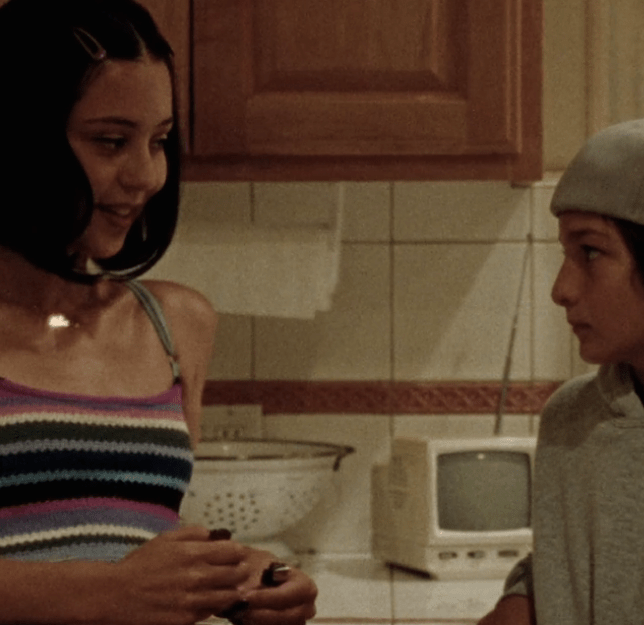
The standout scene of mid90s for me was the scenes between Stevie and Estee during the house party. I was immediately pulled in when I heard Nirvana’s “Where Did You Sleep Last Night?” play softly underneath their conversation in the kitchen, as this older teenage girl flirts with and seduces this 13-year old kid. She knows he’s bullshitting and turns it against him. “I don’t kiss and tell. I’m a gentleman.” “That’s good to know.” She knows she won’t be considered a predator, not even to the child victim who most certainly will spin the tail to impress his cool older friends. The whole scene is heartbreaking and hard to watch. The wailing of the cello off this cut from the Unplugged album as she leads him to the bedroom lends the scene its mundanely sinister and melancholic, haunting air. Cobain belts the first verse for the final time from the other side of the closed door after Estee asks Stevie to undress her, as if desperately trying to warn this misguided little boy that he doesn’t have to go through with anything. “It’s okay, don’t be nervous,” she assures him. “My girl, my girl, don’t lie to me,” Cobain protests over Stevie’s silence. The song fades, Stevie admits he’s not sure about this, but she goes in to kiss him again anyway. Shutting him up under the guise of passion, charity. “He’s gonna worship you for the rest of his fucking life.” It’s a masterfully executed, terrifying scene that I was completely emotionally unprepared for, making my stomach sink into the floor with how acutely it captures the dread of being in what feels like a helpless encounter, one in which you think maybe your only way out is through.
The 90s adolescence double feature concluded with Kids, which I had been meaning to watch for a long time due to its controversial status in the film world. I thought it was great. I appreciated how detached it was; it did not moralize the abhorrent abuses committed by its two lead characters and their friends. Protagonists Telly and Jasper are disgusting and reprehensible teenagers and I felt no sympathy toward them, but all you can do is look in on their lives over the course of one New York City day, in which they smoke, steal, and rape. Of course, the idea of the fly-on-the-wall, D. A. Pennebaker style of documentary that this film is indebted to is ultimately a fiction. We know there is no such thing as a wholly detached observer or a mere window into another world when it comes to cinema. We know that montage shapes how the audience interprets events and characters onscreen. I learned that bell hooks takes issue with this film and dismisses it as reactionary garbage. She states that a Black man getting beaten close to death in the film is emblematic of its problematic racial politics; however, I think I might disagree. Where hooks thinks the film is unaware of its race problem, I found that to be exactly its point when I watched it. These kids are diabolical, racist, misogynistic, and get away with every crime they commit. The filmmakers don’t punish them because the world doesn’t. It is neither endorsement nor condemnation. It’s the horrifying reality. The kids are not alright. I would like to rewatch it with her arguments in mind and see if I lean more toward her view, paying particular attention to montage, but I definitely want to check out Larry Clark’s other work.
1/16: Wonka (2023, Paul King); Willy Wonka & the Chocolate Factory (1971, Mel Stuart)*; Charlie and the Chocolate Factory (2005, Tim Burton)*
I watched all three of these movies after feeling compelled to watch Wonka to see if a hunch I had about it, based on its end credits, was correct. I’ve already compiled most of my thoughts on that movie in my last post. So, I went back and watched the other two Willy Wonka movies afterward, more as a why-not than anything else. I like the Gene Wilder movie, mostly for his performance and the music. For some reason whenever my brother and I would spend time with my grandpa in his room, we would surf channels in search of Willy Wonka & the Chocolate Factory. I don’t know why my grandpa insisted on looking for this movie in particular. Maybe we had stumbled upon it the first time by accident and enjoyed it so much that we wanted to see if we could find it playing again by sheer dumb luck every other time. I remember one time we found Charlie and the Chocolate Factory instead. Rewatching that film, I couldn’t stand it; however, I find myself respecting the film all the more for it. But, my god, was this film grating to sit through. I saw Depp’s Wonka as Burton’s avatar. “Candy has no point. That’s why it’s candy,” sums up the point of this movie for me. In the years right before the industrial shift from film to digital, Wonka/Burton says there’s no point, so he can feel free to insert his retarded ideas into a beloved cult property and combine it with established film history and pop culture imagery as he pleases within his approach to the blockbuster form. Mike Teavee is shrunken down and inserted into a television playing the prehistoric opening of 2001: A Space Odyssey. There’s probably something to unpack there about Burton’s blockbuster and what he’s saying about this dominant form and the effects of mass media on his characters/audience with his choice to include 2001, a sort of proto-blockbuster, a necessary precursor for its existence. Burton is his Wonka. If the ’71 Wonka is God, Burton’s is the Devil.
1/19: Penalty of Leadership (2024, Nicholas Craven and Boldy James)
Books and Series
??/??–~1/6: The Orphanage (2021, Serhiy Zhadan)—Finished
~12/22–~1/6: Post-Cinematic Affect (2010, Steven Shaviro)
Brilliant. Shaviro blends vulgar autuerism and academic rigor in one of the finest pieces of moving image criticism that I have ever read without ever falling into either’s trap of coming across as annoying or pretentious. I cannot praise the imagination of these essays enough.
1/11–~30: Silas Marner (1861, George Eliot)
1/21–22: Fleabag (2016–2019, Phoebe Waller-Bridge)
The mental image of the police banging on the front door in the middle of night because my dad put out a missing persons report to the NYPD because no one’s texts were getting through to my broken phone while I’m just in my room watching Fleabag with headphones on is so fucking funny.
~1/27: It’s Always Sunny in Philadelphia (2005-present, Rob McElhenney)—Started
~1/30: Don Quixote (1605, Miguel de Cervantes, trans. J. M. Cohen)—Started
Note: * indicates a rewatch, relisten, or reread


Leave a Reply