
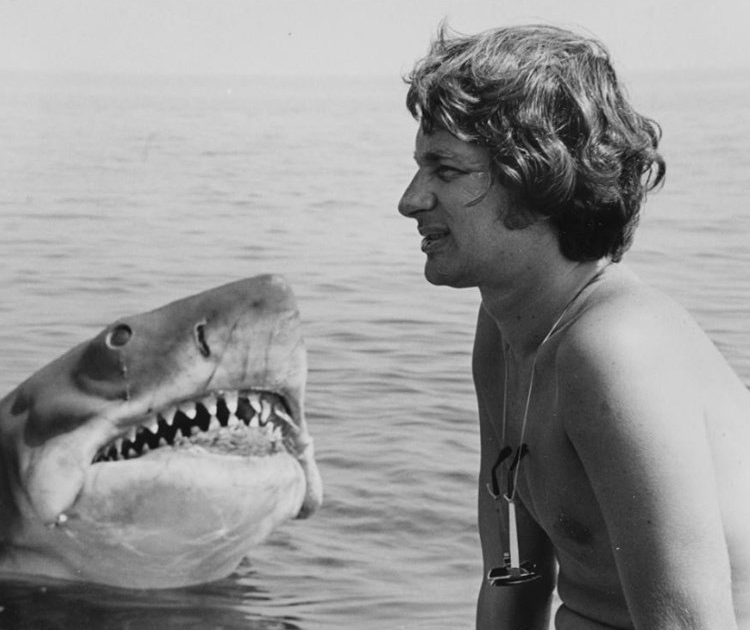
From the beginning, Jaws was always supposed to be the highest grossing film ever made. Widespread rollout into hundreds of theaters simultaneously during summer vacation, extensive television adverts, and a tie-in merchandise line all ensured its blockbusting capabilities before the film was ever screened before a paying audience. So began the industrial model of the blockbuster, an enterprise had it failed, would have meant (in a manner of speaking) the studio being “on welfare the whole winter,” as shark hunter Quint warns the Amity townsfolk. He could get the job done for three, but will accept nothing less than ten thousand. High risk, even higher reward. “This shark will swallow you whole,” that is, if you (the studios) fail to control this colossus never before seen. And so, this fear of being reduced back to working-class toil and all its insecurities and instabilities is the central anxiety at the bleeding heart of this film.
In Jaws, the individual reigns supreme, the deliberative power of the masses are manifested as corrupt, overly bureaucratic, ineffectual, and callous. No doubt a consequence of Nixon’s Watergate blunder the year before. After all, chief of police Martin Brody moved from New York City to the quiet Massachusetts resort town in order to escape the urban tumult and social alienation, to start his middle-class life on his new suburban waterfront property. He was afforded the opportunity of upward class mobility, not entirely uncommon for the time, but one that was increasingly waning well before the outset of the next decade.
Yet perhaps, the greatest element of fantasy in a film with a 25-foot killer shark is surmised by Brody’s insistence that “one man can make a difference.” However, in the world of Jaws, any attempt to come together is thwarted. Initially, Brody unilaterally closes the beach after the first attack, then relinquishes to their reopening at the behest of Mayor Vaughn. Furthermore, the civilian shark hunting parties are demonstrably disorganized and counterproductive, leading to the capture and killing of the wrong animal. Lastly, the final expedition of Brody, Hooper, and Quint goes horribly awry. Brody, with his fear of the ocean, clings to an onshore (stable) notion of collective support and accountability while at sea, attempting to radio for help in killing the great white; however, Quint, the self-made working man born and bred on a individualist diet of mistrust and self sufficiency, smashes the thing to bits. Right as the three men—a cop, a scholar, and the one man specialized for this kind of work—begin to get along, the shark attacks, leading to a damaged hull, a busted engine, and a dead captain.
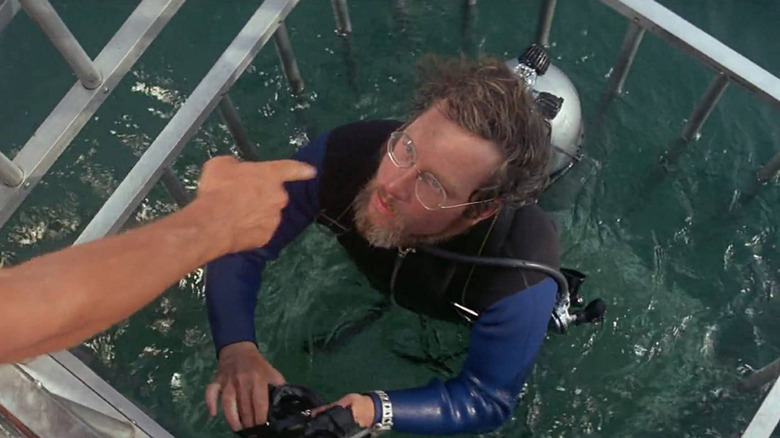

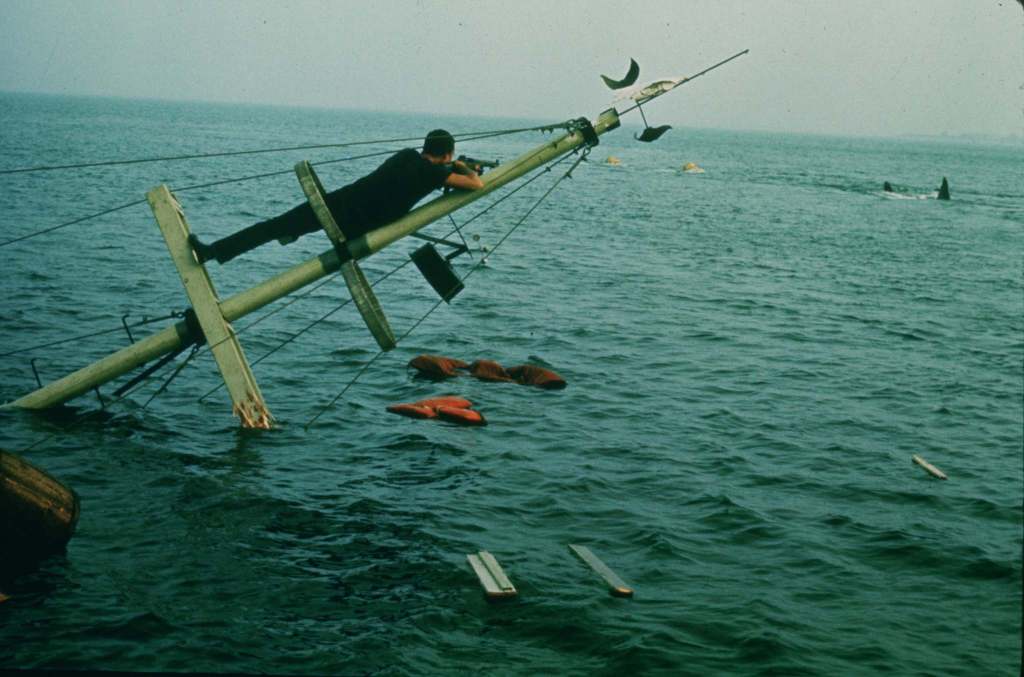
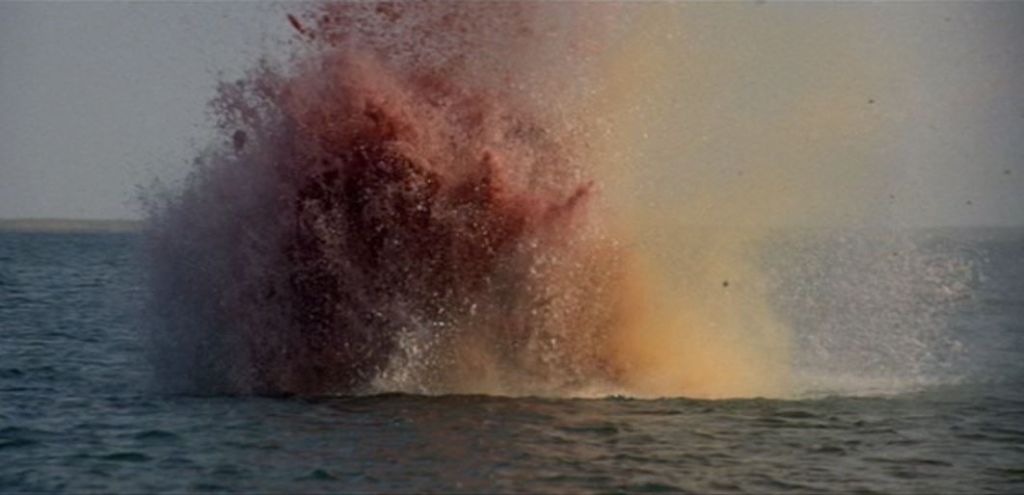
With Quint eaten alive and Hooper stranded underwater, Brody the surrogate of the state employs the former’s mode of safety and vantage with the latter’s tools to explode the relentless consuming machine. The ideal individual for the neoliberal age. Brody fully succumbs to the call of the individual after the death of the “working class hero” (Hooper’s jab at Quint). This middle-class savior now captaining the surviving duo of himself and the old money academic, kicking to shore in tandem, held afloat by flotation barrels. The state-regulated industrial patriarchy of Classical Hollywood gives way to the neoliberal network society. Every man for himself. Quint is not so fortunate. He succumbs to the gravity that the other two manage, as if a necessary sacrifice, sliding down the deck into the jaws that haunt him. The working man is consumed by the spectacle, pulled into the indiscriminate, all-devouring field of the shark.
In the theaters, the similarly stratified audience has become enraptured by the Spielbergian cinema; in addition, a sort of stratification of the audience itself was underway on the basis of class due to the growing suburbanization of theaters. Not to say that the early cinema was utopian and did not succumb to divisions and exclusions, but in just 70 years, gone are the days of the nickelodeon; here are the days of the mall multiplex and the drive-in theater. And then now, streaming and the home theater further continue the social atomization of spectatorship, especially with rising ticket costs turning cinemagoing away from its roots as a shared working-class pastime. However, in its depiction of a fraught relationship between the collective and the individual, Jaws does not simply and entirely willingly accept the cult of the individual. Likewise, outside the text, the pop auteur forges a formal language unique to himself, while appealing to the largest possible audience. Spielberg wishes to have it both ways, and like any good hyper-Newtonian blockbuster, things end up in the air.


Leave a Reply